Showing posts with label Before. Show all posts

Saturday, January 08, 2022

A prophecy being fulfilled before our very eyes

 Time and again, motivated by a spirit of evil, Francis has attacked the universal language of the Church.   

As noted here:


Francis lamented on the feast of Epiphany about those whose religion he said was self-referential and encased in a “suit of armour”, “Have we been stuck all too long, nestled inside a conventional, external and formal religiosity that no longer warms our hearts and changes our lives?”

And, “Do our words and our liturgies ignite in people's hearts a desire to move towards God, or are they a 'dead language' that speaks only of itself and to itself?”

Talking about his self-referential Synod on Synods, he said that the task is “to journey together, to listen to one another, so that the Spirit can suggest to us new ways and paths to bring the Gospel to hearts of those who indifferent, distant, and without hope.”


_______________________________________


Have you ever encountered a priest, Bishop or layman who impugned the Latin Mass? Is such an attitude even Catholic? In a word, no. In his Apostolic Letter Ecclesia Dei, Pope John Paul II said that, "Respect must everywhere be shown for the feelings of all those who are attached to the Latin liturgical tradition...for the use of the Roman Missal according to the 1962 edition."


And, in his book "Salt of the Earth," Joseph Cardinal Ratzinger said, "I am of the opinion, to be sure, that the old rite should be granted much more generously to all those who desire it. It's impossible to see what could be dangerous or unacceptable about that. A community is calling its very being into question when it suddenly declares that what until now was its holiest and highest possession is strictly forbidden and when it makes the longing for it seem downright indecent."


To be sure, Vatican II called for an extended use of the vernacular. But nowhere did Vatican II call for the Latin language to be abolished from the liturgy. And anyone who claims otherwise is either ignorant of the facts or a liar. The Constitution on the Sacred Liturgy (Sacrosanctum Concilium) No. 36 states clearly that, "Particular law remaining in force, the use of the Latin language is to be preserved in the Latin rites."


Number 54 of this same Vatican II document teaches that, "In Masses which are celebrated with the people, a suitable place may be allotted to their mother tongue. This is to apply in the first place to the readings and "the common prayer," but also, as local conditions may warrant, to those parts which pertain to the people, according to the norm laid down in Art. 36 of this Constitution.


Nevertheless steps should be taken so that the faithful may also be able to say or to sing together in Latin those parts of the Ordinary of the Mass which pertain to them."


This is the teaching of Vatican II and the mind of the Church on the use of Latin and the attitude Catholics should have toward those who are attached to the Latin liturgical tradition.


A prophecy given by Pope Pius XII is being fulfilled before our very eyes.  The Reign of Antichrist approaches. 


Thursday, October 14, 2021

The Ecstatic of Tours: "Before the war breaks out again, food will be scarce and expensive.."


As noted here, a Walmart worker warns of massive price increases and merchandise shortages.

Signs are emerging.  The Ecstatic of Tours told us that: "Before the war breaks out again, food will be scarce and expensive. There will be little work for the workers, and fathers will hear their children crying for food. There will be earthquakes and signs in the sun. Toward the end, darkness will cover the earth. When everyone believes that peace is assured, when everyone least expects it, the great happening will begin. Revolution will break out in Italy almost at the same time as in France. For some time the Church will be without a Pope."


Our Lady told Fr. Stephano Gobbi on November 15, 1990, at Malvern Pennsylvania: "I announce to you that the hour of the great trial is on the point of arriving. The great trial has arrived for your country. How many times, as a concerned and sorrowing mother, have I endeavored to urge my children to follow the path of conversion and of return to the Lord. I have not been listened to. You have continued to walk along the way of rejection of God, and of His law of love. Sins of impurity have become ever more widespread, and immorality has spread like a sea which has submerged all things. Homosexuality, a sin of impurity which is against nature, has been justified; recourse to the means of preventing life have become commonplace, while abortions - these killings of innocent children, that cry for vengeance before the face of God - have spread and are performed in every part of your homeland.The moment of divine justice and of great mercy has now arrived.


You will know the hour of weakness and of poverty; the hour of suffering and defeat; the purifying hour of the great chastisement. The great trial has arrived for your Church. How great is your responsibility, O Pastors of the Holy Church of God! You continue along the path of division from the Pope and of the rejection of his Magisterium; indeed, in a hidden way, there is in preparation a true schism which could soon become open and proclaimed...And then, there will remain only a small faithful remnant, over which I will keep watch in the garden of my Immaculate Heart.


The great trial has arrived for all humanity. The chastisement, predicted by me at Fatima and contained in that part of the secret which has not yet been revealed, is about to take place. The great moment of divine justice and of mercy has come upon the world."

We are being prepared for the Reign of Antichrist. The Rev. P. Huchede, in his work entitled "History of Antichrist," explains the religious preparation, both intellectual and moral, for the Reign of Antichrist which will arrive after economic collapse:


"But how shall he deprive the world of Christianity and have himself adored as God? Alas, it is only too true that the minds and hearts of men are admirably disposed for revolution and consequently ready to accept and bear the cruel yoke of such a tyrant. Revolution as the word itself implies means a subversion, but a subversion of all that is true, good, beautiful, and grand in the universe. It is the subversion of religion, representing its dogmas as myths and its moral teachings as tyranical. It is the subversion of authority. Licentiousness under the name of liberty becomes the order of the day; each one is invested with the right to govern himself. It is the subversion of reason: and do we not find leading minds in some of the most enlightened nations denying the principle of contradiction and maintaining the absolute identity of all beings? Revolution is therefore essentially destructive, and it becomes cosmopolitan by the action of secret societies scattered throughout the world. Is it not true to say that the 'mystery of iniquity' is prepared in secret revolutionary dens? But it does not suffice to destroy; it is absolutely necessary to build up again. The world cannot subsist long in a vacuum. It must have a religion; it must have a philosophy; it must have an authority. Revolution will furnish all these. Instead of the reasonable and supernatural religion of Jesus Christ, Revolution will preach Pantheism. The God-humanity will impart the theurgic spirit and thus lead men to adore the demon as the author of universal emancipation...What frightful immorality must follow in the train of this shameless prostitution of religion! Never has the threefold concupiscence made greater ravage among mankind. And this is the religion sought and hoped for as the cherished boon of the aspirations of our modern free thinkers. To our Christian philosophy, the honor of humanity's revolution will substitute a babel of extravagant and absurd ideas. Instead of a mild and efficient authority consecrated alike by Church and state, despotism* and anarchy will rise up and contend for the shreds of religious liberty and human policy...if the state of perversion continue for a while longer, he [Antichrist] will find the world prepared to receive and serve him." (Rev. P. Huchede, History of Antichrist, pp. 13-14, Tan Books).


Is there really any doubt that we are now on the verge of a One World Government which will be eventually led by the Son of Perdition? Men are ready to worship and adore the demon. Those whose names are not written in the Book of Life, that is, who are not consecrated to the Immaculata.  But first we must have economic collapse.


At his Blog, Mark Mallett writes, "world bodies such, as the International Monetary Fund, who are increasingly warning that America’s foundations are beginning to crumble under its enormous debt. I have written before that Revolution is coming. But it will only come when the social order has been sufficiently destabilized, and then, the opportunity for a new political order is possible. That destabilization is coming hard and fast, it seems, as unemployment and poverty in the U.S. rises and the possibility for social chaos, such as we see breaking out in other third world countries, becomes less remote. Far from a speculation, several popes have been warning for decades that such a revolution has been the intention all along of secret societies working parallel to governments...With the collapse of the United States, the door will be open for a new super-power—or super-world government—to assert a mode of governance that does not place the intrinsic freedom and dignity of the human person at its center, but instead profitability, efficiency, ecology, the environment, and technology as its primary goal."


The hearts of men are growing ever colder.  As multi-millionaires and billionaires accumulate more and more wealth, many cities have witnessed tent cities spring up.  Some estimate the number of unemployed at over 30 million.  Many have given up and many more are well on their way to doing so.  It is an evil time.  A time prophesied some 1,600 years ago by Saint Nilus: "After the year 1900, toward the middle of the 20th century, the people of that time will become unrecognizable. When the time for the Advent of the Antichrist approaches, people's minds will grow cloudy from carnal passions, and dishonor and lawlessness will grow stronger. Then the world will become unrecognizable. People's appearances will change, and it will be impossible to distinguish men from women due to their shamelessness in dress and style of hair. These people will be cruel and will be like wild animals because of the temptations of the Antichrist. There will be no respect for parents and elders, love will disappear, and Christian pastors, bishops, and priests will become vain men, completely failing to distinguish the right-hand way from the left. At that time the morals and traditions of Christians and of the Church will change. People will abandon modesty, and dissipation will reign. Falsehood and greed will attain great proportions, and woe to those who pile up treasures. Lust, adultery, homosexuality, secret deeds and murder will rule in society."

Monday, April 15, 2019

The inability to kneel is seen as the very essence of the diabolical..


I've said this many times before, masonic forces seek to subvert the Church from within and to create a 'new church' created in the image and likeness of man. The new humanitarian religion will result from a quiet revolution within the Church. This new religion will be anti-supernatural. And it will embrace the Socialistic New World Order and the Reign of Antichrist. This is the false church Venerable Anne Catherine Emmerich saw in her visions.

In this false church within the True Church, the cancer within the Mystical Body of Christ, there is a loss of the sense of the sacred.  Which is why Fr. Miceli wrote that, "Much of the new liturgy has been drained of the numinous and the sacred.  The new forms are without splendor, flattened, undifferentiated.  Why was kneeling replaced by standing?  Jesus himself fell on his knees and on his face as he prayed to his heavenly Father.  Satan too knows the meaning of worship and man's need for it.  He tried to get Jesus to fall down and worship him.  Why has the liturgical year and the Mass been so unfortunately mutilated against the wishes of the faithful?  In fact, the faithful are now confused about the Mass, the feast of the saints, the holy seasons.  Why was the Gloria, that prayer of total consecration on God's Majesty and Goodness, restricted practically to Sundays alone, and only to those Sundays outside of Lent? Moreover, is the faith really renewed and vivified by by obscuring our sense of community with the Christians of apostolic and ancient times?  The new liturgy no longer draws us into the true experience of reliving the Life of Christ.  We are deprived of this experience through the elimination of the hierarchy of feasts and the at random changing of the dates of famous feasts....

Then too, the new forms are the result of experimentation.  But one experiments with things, with objects that one wants to analyze.  Experimentation is the method of science.  The wretched idolatry and vulgarity of tinkering with sacred realities has, unfortunately, penetrated the Church and produced a mediocrity-ridden liturgy, a show for spectators that distracts from the holy, frustrates intimate communion with God and trivializes, where it does not suppress, sacred actions, symbols, music and words.

In reality, such diminished liturgies have renewed nothing.  Rather these innovations have emptied churches, dried up vocations to the priesthood and sisterhood, driven off converts and opened the doors wide to a flood of renegades.  Even though valid in its essence, such a new liturgy cannot inspire for it is colorless, artificial, banal, without the odor and flavor of sanctity.  A humanized and popularized, man-oriented liturgy will never produce saints.  Only a divinized, God-oriented liturgy can accomplish that miracle.  One suspects that many priests realize the banality of the new liturgy.  That is why they often become, during the Mass and other ceremonies, actors and entertainers.  They put on a show in order to gain the attention of the congregation.  These comedians in chasubles preach a utopian Christianity rather than the true Christianity.  Their treasure is man rather than God; their emphasis this-worldly rather than other-worldly; their goal progress rather than sanctity; their apostolate is immanent rather than transcendent; their means to their goal is the way of revolution rather than the way of the cross; they preach a secular Church instead of the Sacred Church founded by Christ; the essence of their morality is self-assertion rather than self-denial; the Christ they present to the congregation is the Humanist Christ rather than the God-Man crucified Christ...they genuflect before the world and stand before Christ...they are moved by resentment and envy instead of radiating the joy of Christ.."

In his book The Spirit of the Liturgy, Poor Benedict XVI (then Cardinal Ratzinger) wrote: "..there is a story that comes from the sayings of the Desert Fathers, according to which the devil was compelled by God to show himself to a certain Abba Apollo. He looked black and ugly, with frighteningly thin limbs, but most strikingly, he had no knees. The inability to kneel is seen as the very essence of the diabolical.*

But I do not want to go into more detail. I should like to make just one more remark. The expression used by Saint Luke to describe the kneeling of Christians (theis ta gonata) is unknown in classical Greek. We are dealing here with a specifically Christian word. With that remark, our reflections turn full circle to where they began. It may well be that kneeling is alien to modern culture — insofar as it is a culture, for this culture has turned away from the faith and no longer knows the one before whom kneeling is the right, indeed the intrinsically
necessary gesture. The man who learns to believe learns also to kneel, and a faith or a liturgy no longer familiar with kneeling would be sick at the core. Where it has been lost, kneeling must be rediscovered, so that, in our prayer, we remain in fellowship with the apostles and martyrs, in fellowship with the whole cosmos, indeed in union with Jesus Christ Himself."

*  See here

Saturday, June 24, 2017

"They genuflect before the world and stand before Christ..."

Vatican Insider reports:

"Pope Francis met the new leader of the Knights of Malta Friday in a toned-down encounter in which the head of the historic chivalric order seemed to emphasize its loyalty to the pontiff after a period of tension with the Vatican earlier this year.

As Francis greeted Fra’ Giacomo Dalla Torre del Tempio di Sanguinetto in the antechamber to the papal library, the head knight genuflected before the pontiff and kissed his ring."

But while Francis enjoys being genuflected before, he refuses to kneel before Our Eucharistic Lord.  See here.

This should come as no surprise. I've said this many times before, masonic forces seek to subvert the Church from within and to create a 'new church' created in the image and likeness of man. The new humanitarian religion will result from a quiet revolution within the Church. This new religion will be anti-supernatural. And it will embrace the Socialistic New World Order and the Reign of Antichrist. This is the false church Venerable Anne Catherine Emmerich saw in her visions.

In this false church within the True Church, the cancer within the Mystical Body of Christ, there is a loss of the sense of the sacred.  Which is why Fr. Miceli wrote that, "Much of the new liturgy has been drained of the numinous and the sacred.  The new forms are without splendor, flattened, undifferentiated.  Why was kneeling replaced by standing?  Jesus himself fell on his knees and on his face as he prayed to his heavenly Father.  Satan too knows the meaning of worship and man's need for it.  He tried to get Jesus to fall down and worship him.  Why has the liturgical year and the Mass been so unfortunately mutilated against the wishes of the faithful?  In fact, the faithful are now confused about the Mass, the feast of the saints, the holy seasons.  Why was the Gloria, that prayer of total consecration on God's Majesty and Goodness, restricted practically to Sundays alone, and only to those Sundays outside of Lent?  Moreover, is the faith really renewed and vivified by by obscuring our sense of community with the Christians of apostolic and ancient times?  The new liturgy no longer draws us into the true experience of reliving the Life of Christ.  We are deprived of this experience through the elimination of the hierarchy of feasts and the at random changing of the dates of famous feasts....

Then too, the new forms are the result of experimentation.  But one experiments with things, with objects that one wants to analyze.  Experimentation is the method of science.  The wretched idolatry and vulgarity of tinkering with sacred realities has, unfortunately, penetrated the Church and produced a mediocrity-ridden liturgy, a show for spectators that distracts from the holy, frustrates intimate communion with God and trivializes, where it does not suppress, sacred actions, symbols, music and words.

In reality, such diminished liturgies have renewed nothing.  Rather these innovations have emptied churches, dried up vocations to the priesthood and sisterhood, driven off converts and opened the doors wide to a flood of renegades.  Even though valid in its essence, such a new liturgy cannot inspire for it is colorless, artificial, banal, without the odor and flavor of sanctity.  A humanized and popularized, man-oriented liturgy will never produce saints.  Only a divinized, God-oriented liturgy can accomplish that miracle.  One suspects that many priests realize the banality of the new liturgy.  That is why they often become, during the Mass and other ceremonies, actors and entertainers.  They put on a show in order to gain the attention of the congregation.  These comedians in chasubles preach a utopian Christianity rather than the true Christianity.  Their treasure is man rather than God; their emphasis this-worldly rather than other-worldly; their goal progress rather than sanctity; their apostolate is immanent rather than transcendent; their means to their goal is the way of revolution rather than the way of the cross; they preach a secular Church instead of the Sacred Church founded by Christ; the essence of their morality is self-assertion rather than self-denial; the Christ they present to the congregation is the Humanist Christ rather than the God-Man crucified Christ...they genuflect before the world and stand before Christ...they are moved by resentment and envy instead of radiating the joy of Christ.."

Saturday, September 05, 2015

Judge David Bunning: We will not bow down before your false gods

In his Encyclical Letter Annum Sacrum, No. 10, Pope Leo XIII warned that, "In these latter times especially, a policy has been followed which has resulted in a sort of wall being raised between the Church and civil society. In the constitution and administration of States the authority of sacred and divine law is utterly disregarded, with a view to the exclusion of religion from having any constant part in public life. This policy almost tends to the removal of the Christian faith from our midst, and, if that were possible, of the banishment of God Himself from the earth. When men's minds are raised to such a height of insolent pride, what wonder is it that the greater part of the human race should have fallen into such disquiet of mind and be buffeted by waves so rough that no one is suffered to be free from anxiety and peril? When religion is once discarded it follows of necessity that the surest foundations of the public welfare must give way, whilst God, to inflict on His enemies the punishment they so richly deserve, has left them the prey of their own evil desires, so that they give themselves up to their passions and finally wear themselves out by excess of liberty."

This punishment, this chastisement, is in evidence everywhere in the latter times. A judge in Kentucky, drunk with what he perceives as "power," and enamored with himself, holds a Christian woman in "contempt" for not being obedient to an unjust law and for refusing to bow before his ego.

This is, of course, an exercise in complete nonsense and madness. As human beings, we possess only contingent rights, those which have been given to us by God. There can never be a "right" to choose that which is evil. And homosexual acts are evil.

When moral liberty is detached from Natural and Divine Law, it degenerates into license. Pope Leo XIII reminds us in his Encyclical Letter Libertas Humana that, "Liberty, the highest of natural endowments, being the portion only of intellectual or rational natures, confers on man this dignity - that he is 'in the hand of his counsel' and has power over his actions. But the manner in which such dignity is exercised is of the greatest moment, inasmuch as on the use that is made of liberty the highest good and the greatest evil alike depend. Man, indeed, is free to obey his reason, to seek moral good, and to strive unswervingly after his last end. Yet he is free also to turn aside to all other things; and, in pursuing the empty semblance of good, to disturb rightful order and to fall headlong into the destruction which he has voluntarily chosen...

Therefore, the nature of human liberty, however it be considered, whether in individuals or in society, whether in those who command or in those who obey, supposes the necessity of obedience to some supreme and eternal law, which is no other than the authority of God, commanding good and forbidding evil. And, so far from this most just authority of God over men diminishing, or even destroying their liberty, it protects and perfects it, for the real perfection of all creatures is found in the prosecution and attainment of their respective ends, but the supreme end to which human liberty must aspire is God."

Although a great physical chastisement is coming because of man's rebellion and his rejection of God's Law of Love (John 14: 15), we are already experiencing a moral chastisement. Witness how quickly sodomy, which was a crime in many states, has been legitimized by judicial fabrication into a constitutionally protected form of "liberty."

Such moral blindness is a punishment from God as Saint Paul explains, "The wrath of God is indeed being revealed from heaven against every impiety and wickedness of those who suppress the truth by their wickedness...they became vain in their reasoning, and their senseless minds were darkened. While proclaiming to be wise, they became fools and exchanged the glory of the immortal God for the likeness of an image of mortal man...Therefore, God handed them over to impurity through the lusts of their hearts for the mutual degradation of their bodies. They exchanged the truth of God for a lie and revered and worshiped the creature rather than the Creator, who is blessed forever. Amen." (Romans 1: 18, 21-25).

Human laws are incapable of sanctioning anything which is not contained in the eternal law. This is crystal clear Catholic teaching. There is no room for doubt. All other "laws" are unjust and are, therefore, not laws at all. And Catholics are not bound to obey them. In fact, Catholics have a duty to resist them. As I mentioned in a previous post, "Any law supportive of same-sex 'marriage' is no law at all. This because any law which is promulgated must correspond to the divine law. No human authority can declare what is morally evil to be morally good. Laws permitting slavery, abortion, euthanasia, divorce and "marriages" between persons of the same gender are immoral, and therefore unjust (St. Thomas Aquinas, Summa Theologiae, I-II, q. 96, a.5)."

In Kentucky a theater of madness is playing out.  And this sick production is, or will be soon, being reenacted all across this nation.  This because there is no shortage of fools who are willing to expose their stupidity for all the world to see.

These fools of darkness are enraged because a Christian remnant, accompanied by other people of good will, simply refuses to worship at the altar of what Pope Benedict XVI rightly referred to as the Dictatorship of Relativism.

We will not adore their false gods.  And this makes them burn with rage.

Friday, October 24, 2014

Before he became Pope, Francis downplayed the necessity of Holy Mass?


"The Man who would one day be Pope Francis had come to hold a service far from the grandeur of the great cathedral of Buenos Aires. He had travelled – taking the subway train and then the bus – to arrive in one of the shanty-towns, which Argentines call villas miserias – misery villages. He had picked his way down crooked and chaotic alleyways, criss-crossed with water pipes and dangling electricity cables, along which open sewers ran as malodorous streams when the rain came. There, amid ramshackle houses of crudely- cemented terracotta breezeblock, he fell into conversation with the middle-aged mother.

She told him of life in an impoverished slum, terrorised by gangs peddling paco – the cheap chemical waste product left over from processing the cocaine sent to Europe and the United States, or sold to the affluent middle classes of the Argentinian capital. Dealers mix the residue with kerosene, rat poison or even crushed glass and sell it for a dollar a hit to the people of the slums. So addictive is the drug that one day’s free supply is enough to get hooked, creating a short-lived high followed by an intense craving, paranoia and hallucination. The dealers target the children of the poor and adolescents who hang around because there is no work to be had.


The woman looked at the prince of the Church and apologised to him for the fact that her son, amidst all that, had stopped going to Mass. The man, who as Pope was to take the name of Francis – the great saint of the poor – looked into her eyes as though she were the only person in his world. “But is he a good kid?” the priest asked.

“Oh, yes, Father Jorge,” she replied, eschewing the grander titles of the cardinal archbishop. “Well,” pronounced the prelate, “that’s what matters.” See here.

It goes without saying that such is pure nonsense. As Manuel Garrido, O.S.B. explains:

"The moral obligation to participate in the eucharistic sacrifice on Sundays dates from the very beginning of Christianity, although it did not become a definite law of the Church until the fourth century. The meaning, the scope and the application of this law have been the subject of much research and study, not to mention considerable controversy, in the years following the Second Vatican Council. The matter can be studied from the vertical point of view, in that there exists the obligation to worship God, and also from the horizontal viewpoint, which involves all the anthropological aspects of every shade and hue. Both of these approaches are legitimate and easily lead to a solution, so long as they are integrated, and the conclusions drawn from each are given their proper place in the scale of values. But trouble begins when the proponents of one approach refuse to recognize the validity of the other. And here, as in so many other manifestations of the Church's discipline, the strength of our faith is all-important, and so is the regulating of all our acts by a truly religious conscience. Something similar happens in hospitals and schools, or in any institution with a set of rules that must be followed. Typical is a fixed schedule for meals, which people with a good appetite find no difficulty in obeying, while those with poor appetites regard it as an imposition to be avoided.
The obligation to attend Sunday Mass exists. It is a commandment of the Church which binds under the penalty of grave sin. It exists for a specific reason and should be known and loved, so that the soul feels a need to fulfill it. The fact that it is a law helps to create a religious consciousness of this need, which, in turn, makes it easier to fulfill the obligation.

Although they refer to another subject, the following words of Msgr. Escriva de Belaguer sum up admirably what I am trying to say: "In direct opposition to the faith which we find a mistaken interpretation of freedom, a freedom with no end in sight, with no objective standards, without law, without responsibility; in a word licentiousness. This unfortunately, is what some people propose, and it is nothing but an excuse to attack the faith." ("Friends of God", no. 32) Like any other society, the Church has her own laws, which should be followed in the light of her proper aims, especially when it is a matter with some bearing on the third Commandment. In order to appreciate a law and fulfill it conscientiously and enthusiastically, it is first necessary to know it properly.

The Day Of The Lord

The Second Vatican Council reminds us that "apostolic tradition of the Church is, from the very day of the resurrection of Christ, to celebrate the Pasch every eight days, on the day which is called the day of the Lord" ("Sacrosanctum Concilium", 106). Modern scientific investigation also proves that this custom is from the time of the apostles.

The first mention of this is to be found in Sacred Scripture is in St. Paul's first Epistle to the Corinthians, written in the year 57. The Apostle refers "to the first day of the week" (16, 1-2) as the most appropriate for the collection for the poorer communities. About two years later the Acts of the Apostles tell of the celebration of the eucharist in Troas: "on the first day of the week" (20, 7-8). Here we are given to understand that the celebration takes place in the evening or the night of the day before. This custom was observed in the Church until the last century and has been restored since the Council. From the foregoing it is clear that in Greece, Galatia, Bithynia, and consequently in Palestine and Syria, during the first half of the first century, the celebration of the eucharist on the first day of the week was a common establishment among Christian communities.

We first hear of this day being referred to as the Lord's day in the Apocalypse of St. John, 1, 9-10: "I was in the spirit on the Lord's Day". In Latin it is called "Dominica" or "Dies Dominicus", a name which is retained in the Latin languages: "domingo, domenica, dimanche, domineca", etc.; while in the Germanic languages the pagan name is retained "dies solis" (sonntag, Sunday), in Russia it is called "voskresenie," after the resurrection of the Lord; the Armenians call it "haruthjan" and "deruni," which means "the Lord's Day."

In Didache, 14, I the Sunday celebration seems obligatory: "On Sundays, get together and break the bread and give thanks, confessing your sins in order that your sacrifice may be pure." This testimony pertains to the second half of the first century. In the second century, St. Justin, writing to a pagan, gives us a striking description of Holy Mass being celebrated every Sunday, referred to by him as "dies solis"; and he goes on to explain that those who live in towns and villages attend this sacred assembly ("Apologia" I, 67). During the same period we have Dionisius of Corinth speaking of the first day of the week as a "holy day" ("PG", 20, 388). From here on we can find numerous descriptions of the Sunday eucharistic celebration and also of the Christians' obligation of participating in the same."

In Luke 18:19, Jesus responds to a young man who calls Him "Good Master,":

"Why dost thou call me good? None is good but God alone."

Apparently these words are lost on Francis.  As are these words from Jesus related in John 6:53:


“Amen, amen, I say to you, unless you eat the flesh of the Son of Man and drink his blood, you do not have life within you."

And some insist that orthodox Catholics have nothing to worry about? Really?

Who's kidding who?

Tuesday, April 08, 2014

Saint Vincent de Paul Parish in Baldwinville and silence before Mass

Those who are bent on making their own unauthorized changes to the liturgy or who otherwise promote or tolerate various liturgical abuses often fail to appreciate how such an endeavor can constitute grave sin.  I know this because some have accused me of making a mountain out of a molehill for my opposition to various liturgical abuses.  Dr. Germain Grisez explains: "There are many reasons why it is wrong for priests intentionally to make unauthorized liturgical changes.  Two are especially important.  First, such changes sometimes embody or imply deviations from Catholic faith; even when they do not, they often omit (see here for example) or obscure something of the liturgy's expression of faith.  Thus, the Church teaches: 'The law of prayer is the law of faith: the Church believes as she prays.  Liturgy is a constitutive element of the holy and living Tradition' (cf. DV 8).  For this reason no sacramental rite may be modified or manipulated at the will of the minister or the communityEven the supreme authority in the Church may not change the liturgy arbitrarily, but only in the obedience of faith and with religious respect for the mystery of the liturgy.' (CCC, 1124-1125).

Dr. Grisez continues, "..in the Eucharist, a priest acts in the person of Christ, who joins humankind to the Father; but in making unauthorized changes, a priest obscures Jesus' action, focuses attention on himself, and becomes an obstacle to the relationship between God and His People that priests are ordained to serve...Priests are agents ordained to deliver God's gifts to His People.  If they deliver some substitute for what Jesus has entrusted to them, they interpose themselves between - and defraud - both God and His People...

There are five additional reasons why unauthorized changes should not be made in the liturgy.  First, the liturgy is the worship of the Church as a body, and those who are ordained act as Church officials in performing liturgical roles.  So, insofar as a priest makes unauthorized changes, he misrepresents as the Church's what is in fact only his or some limited group's.  Even if this misrepresentation deceives no one and is intended for some good end, it is at odds with the reverence necessary for true worship.  Second, this essential irreverence and the obvious arbitrariness of intentional unauthorized changes strongly suggest that the Eucharist is not sacred, and this suggestion tends to undermine not only faith in Jesus' bodily presence in the consecrated elements, but faith that the Eucharist is Jesus' sacrifice made present for the faithful to share in.  Third, a priest who makes intentional, unauthorized changes acts with deplorable clericalism by imposing his personal preferences on the laity and violating the rights of those who quite reasonably wish only to participate in the Church's worship.  Fourth, intentionally making unauthorized changes sets a bad example of serious disobedience to the Church's norms, and this bad example is likely to encourage some people to think and do as they please not only in liturgical and canonical matters, but in matters of faith and morals.  Fifth...unauthorized liturgical changes often become a needless, divisive issue for the faithful, thus impeding the charity that the Eucharist should express and foster."

Still think that liturgical abuse is a small matter of little significance?  If so, this reflects on your own immaturity and not the objective truth that liturgical abuse constitutes grave matter.  How grave?  Again, Dr. Grisez:

"The reasons why priests should not make unauthorized liturgical changes also make it clear..that a priest's intentionally doing so is of itself matter of grave sin.  Of course, many changes are in themselves very minor, and a few perhaps even are real improvements.  But though this kind of sin admits  parvity, such small changes also are scandalous, not only because they give the faithful a bad example of disobedience but because they contribute to a clerical culture in which liturgical abuse is widely tolerated and sometimes even expected, so that some are encouraged to engage in far graver abuses.  Now, even a sin venial in itself becomes grave scandal when one foresees that it is likely to lead others to commit grave sin; thus, the element of scandal makes grave matter of even minor liturgical abuses likely to encourage more serious abuses by other priestsDue to widespread confusion and negligence of some bishops, many priests undoubtedly lack sufficient reflection regarding this sin."


This past Sunday and the previous Sunday at Saint Vincent de Paul Parish in Baldwinville, Massachusetts, devout Catholics attempting to prepare for Holy Mass through prayer (including myself - I was attempting to pray my Rosary) were subjected to loud conversation and riotous laughter from a group of women who were taking part in some sort of support group.  The group sat in church - in front of the tabernacle no less - and engaged in inappropriate socializing without any regard for Jesus truly present in the Eucharist within the tabernacle Body, Blood, Soul and Divinity.

And this with the blessing of the "pastor" Father Francis Roberge.  At every Vigil Mass on Saturday afternoons, the choir and band will rehearse without any regard for the faithful who are trying to prepare for Mass.

As Father Peter M.J. Stravinskas, Ph.D., S.T.L., says in his book The Catholic Answer, Book 2: "Socializing is inappropriate in the body of the Church; that is for the vestibule and parish hall." (p. 195).  Monsignor Peter J. Elliott, in his book entitled Ceremonies of the Modern Roman Rite, has this to say: "The Church should be open well before the liturgy for those who wish to pray privately.  Silence is the best preparation for the celebration of the liturgy.  Apart from suitable music, no intrusion on the people's right to tranquility before the Eucharist should be tolerated, for example, musical or choral rehearsals, announcements which could be given later, or distractions in the sanctuary or elsewhere.  People may meet and talk before Mass, but in an area set well apart from the place where the liturgy is about to be celebrated." (Ceremonies of the Modern Roman Rite, No. 233, p. 87).

The General Instruction of the Roman Missal has this to say: "Sacred silence also, as part of the celebration, is to be observed at the designated times....Its purpose, however, depends on the time it occurs in each part of the celebration. Thus within the Act of Penitence and again after the invitation to pray, all recollect themselves; but at the conclusion of a reading or the homily, all meditate briefly on what they have heard; then after Communion, they praise and pray to God in their hearts. Even before the celebration itself, it is commendable that silence be observed in the church, in the sacristy, in the vesting room, and in adjacent areas, so that all may dispose themselves to carry out the sacred action in a devout and fitting manner."  (GIRM, No. 45).  

Silence should also be observed after Mass until one is outside the Church building, both for respect toward the Blessed Sacrament, and toward those members of the faithful who wish to prolong their thanksgiving after Mass.

When I politely informed the women who were engaging in inappropriate and loud conversation and laughter of this and that perhaps they could meet downstairs in the parish hall, I was told there was no room there.  I was also subjected to hate-filled glares and angry commentary from a small group of unhappy souls who obviously have a problem with the Church's teaching and liturgical rubrics.

As Father Vincent Miceli, S.J., reminded us some years back, "Rampant immorality is [an] obstacle opposing the work of evangelization.  Since conduct follows from convictions, once Catholics cancel their creed from their lives, their conduct inevitably becomes depraved....The decay on all sides of Christian morals makes it not only difficult to bring in those outside the Church, but even to stay in themselves and hold their fellow Catholics within the Church." (Essay entitled The Evangelization of the United States).

Small wonder parishes are not thriving.  Indeed many are in crisis as the pews continue to empty.  Conduct flows from convictions.  What then shall we make of the conduct of Catholics who disrespect Jesus' Presence in the Most Blessed Sacrament while keeping other Catholics from their prayer?  What shall we make of a "pastor" who permits such a situation?

At no time have I witnessed either the "pastor" of St. Vincent de Paul Parish or its deacon preparing for Mass through prayer.  I have witnessed both of them engaging in conversation and running to and fro in the church.  But I have not witnessed a spirit of prayer.

 
What a shame!


Because I tell the truth about the dissent and liturgical abuse which has been part and parcel of the Worcester Diocese, I will, no doubt, continue to be ostracized.  But I will be in good company:  See here: http://protectthepope.com/?p=10315

Tuesday, December 03, 2013

"Before I come as a just Judge....."


Like so many others today, Reverend Frank Schaefer has lost his faith in Christ Jesus and expects the Lord to conform to men rather than the other way around.  See here: http://www.huffingtonpost.com/2013/11/24/frank-schaefer-sirius-xm_n_4331938.html

Just this morning, while at Eucharistic Adoration, a woman approached me and assured me that I was wrong to accept the Church's teaching that women may not be ordained to the priesthood and that dissent from teachings which are definitive places one outside of communion with the Church.  This woman was arguing for a right to dissent from the mind of Christ IN AN ADORATION CHAPEL!

Sad times!  This woman also had high praise for Father Andre Dargis*

Those who, like Rev. Schaefer, promote "gay marriage" and other societal evils always like to remind us of God's Mercy.  And indeed His Mercy is like an ocean.  But these deluded souls have forgotten that God's Justice must be infinite too, and that sooner or later [I believe very soon based upon Our Lady's messages and Our Lord's warning] it must be exercised to preserve His honor and integrity, to save the innocent, to confirm the good and to justify the martyrs.

Sin brings destruction and death, and a terrible eternal death for the unrepentant, those who flaunt their pride and their resistance in the face of a Loving and Merciful God, those who are a continuous scandal to others.  The souls who have been slain for the Word of God are heard crying out from under the altar: "How long, O Lord, dost Thou not judge and revenge our blood on them that dwell on the earth.  And it was said to them that they should rest for a little time till their fellow servants and their brethren, who are to be slain even as they, should be filled up." (Revelation 6: 10, 11).

Mankind is facing so many problems today. Sin has been enshrined as a good. As Father Albert Hebert, S.M., once said, even the "great pagan juridical systems admitted the fact of wrong-doing and their legal systems prescribed punishment for it. It is only in our day that there is such a widespread denial of the existence of sin and moral laws. This makes God appear as the Creator of evil, and God hates this blasphemy, pride and hypocrisy on the part of His creature man....Today, persons great and lowly commit sin, deny it and even blasphemously call it virtue. For example, active homosexuals and lesbians call their practices 'love' and demand the legal status of normal married man and wife.."


It is because sin has been enshrined as a good, because so many people have turned away from the Merciful Heart of Jesus, that there is no peace today. Many will argue that I'm being "too simplistic," or that there are other reasons for the breakdown of peace we are experiencing across our culture and throughout the world.

But when Faustina Kowalska's confessor told her to ask Jesus the meaning of the two rays in the image which she had previously been shown, Jesus spoke to her while she was in prayer:

"The two rays denote Blood and Water. The pale ray stands for the Water which makes souls righteous. The red ray stands for the Blood which is the life of souls...These two rays issued forth from the very depths of My tender mercy when My agonized Heart was opened by a lance on the Cross. These rays shield souls from the wrath of My Father. Happy is the one who will dwell in their shelter, for the just hand of God shall not lay hold of him. I desire that the first Sunday after Easter be the Feast of Mercy...

Mankind will not have peace until it turns with trust to My mercy..." (Divine Mercy in My Soul, Notebook I, 299, 300).

If we want peace, we will only obtain it through Our Jesus of Mercy. We must confess our sins regularly and dwell in the shelter of the two rays which emanate from His Merciful Heart. There is no peace in attempting to legitimize sin. There is no peace apart from Our Jesus of Mercy.

The choice is ours. But not for much longer. "...before I come as a just Judge, I first open wide the door of My mercy. He who refuses to pass through the door of My mercy must pass through the door of My justice.." (Notebook III, 1146); "My daughter, Speak to the world about My mercy; let all mankind recognize My unfathomable mercy. It is a sign for the end times; after it will come the day of justice. While there is still time, let them have recourse to the fount of My mercy; let them profit from the Blood and Water which gushed forth for them." (Notebook II, 848).

We have two ways before us: Love and mercy which produce peace and tranquility or hatred, sin and unforgiveness which lead to despair, violence and war. The choice, as always, is ours to make. A way of life and a way of death as the Didache teaches.

Choose wisely  

Sunday, March 06, 2011

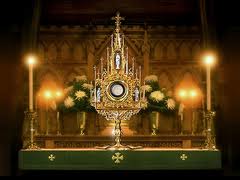
"The time I have spent before the tabernacle is the best spent time of my life."

"Jesus is in our tabernacles, and this fact we call the Real Presence. The same Jesus Who was sheltered by Mary Immaculate within Her virginal body, is in the little body of a white Host. The same Jesus Who was whipped, crowned with thorns, and crucified as a Victim for the sins of the world, remains in the ciborium in the Host as a Victim sacrificed for our salvation. The same Jesus Who rose from the dead and ascended into Heaven, where He now is gloriously reigning at the right hand of the Father, resides on our altars, surrounded by a multitude of countless adoring Angels — a sight that Blessed Angela of Foligno beheld in a vision.


Thus Jesus is truly with us. 'Jesus is there!' — The holy Curé of Ars could not finish repeating these three words without shedding tears. And St. Peter Julian Eymard exclaimed with joyful fervor, 'There Jesus is! Therefore all of us should go visit Him!' And when St. Teresa of Jesus heard someone say, 'If only I had lived at the time of Jesus ... If only I had seen Jesus ... If only I had talked with Jesus ...,' she responded in her spirited way, 'But do we not have in the Eucharist the living, true and real Jesus present before us? Why look for more?'

The Saints certainly did not seek for more. They knew where Jesus was, and they desired no more than the privilege of keeping inseparable company with Him, both in their affections, and by bodily presence. Being ever with our beloved — is this not one of the primary things true love calls for? Indeed it is; and, therefore, we know that visits to the Blessed Sacrament and the Eucharistic Benediction were the secret yet evident loves of the Saints. The time of paying a visit to Jesus is wholly the time of love — a love we will resume practicing in Paradise, since love alone 'does not come to an end' (1 Cor. 13:8). St. Catherine of Genoa made no blunder in saying, 'The time I have spent before the tabernacle is the best spent time of my life.'" (From Jesus Our Eucharistic Love, by Father Stefano Manelli, O.F.M., Conv., S.T.D.).

Are we cold toward Jesus in the Blessed Sacrament?  Do we only visit Jesus when we need something or when we feel obliged?  Or do we visit Him for the best reason: because we want to be near Him? 

When we neglect Jesus in the Blessed Sacrament, we hurt ourselves.  This because it is only through frequent visits to Jesus in the Eucharist that we are able to grow in that union with God which Jesus desires to bestow upon us in our daily lives.  Jesus is interested in our thoughts, our desires, our needs and hopes, our ambitions and our work.  Put simply: our daily lives are of the utmost importance to Him.  He is there for love of us.  And we should be there for love of Him.

Who else is always there for you?  Fickle men who praise you one day and denounce you the next?  Who else is as interested in you as the Lord Jesus in the Blessed Sacrament.

He waits for you.  He waits for me.  Our sad world cannot hear Him as He says, "Could you not watch with Me for one hour"?

Are we indifferent?  Do we seek out the Eucharistic Jesus or do we prefer the noise of this dying world?


Site Meter