Mary Daly, a radical feminist theologian, asserted in 1974 (in what is a now-famous slogan used by her disciples) that "Since God is male, the male is God." As with most slogans, this one was crafted to elicit an emotional response from women in the Church who believed themselves to be an "oppressed" class simply because Christ has not called them to the priesthood. And, like most slogans, it was long on emotional appeal while being short on substance.
References to God as Father may be traced well back into the Old Testament. For example, in Deuteronomy 32:6, Moses uses a rhetorical question to teach that God is Father to the Children of Israel: "Is not he your Father who created you, who made you and established you?" And in Isaiah 63:16, the prophet directly addresses and professes God in just those terms: "For you are our Father....You, O Lord, are our Father."
But, within the biblical framework, such passages cannot be taken to mean that God is to be considered male, or biologically masculine, or that He is to be identified in any way biologically. We see the proof of this in Sacred Scripture, in numerous passages which must have escaped Mary Daly as she penned her emotional, but theologically unastute slogan. For example, in Numbers 23:19, we read that: "God is not a man" and again in 1 Samuel 15:29, we read that: "the glory of Israel...is not a man." Furthermore, in Hosea 11:9, God speaks directly to the prophet saying that: "I am God, and not man." And one of the most dramatic repudiations of any identification of God as a male (or as a female for that matter) may be found in Moses's "last address" to the Children of Israel, where he reiterates the prohibition of every form of idolatry, including the perverse religious conceptions of God as either male or female: "Since you saw no form when the Lord spoke to you at Horeb out of the fire, take care and watch yourselves closely, so that you do not act corruptly by making an idol for yourselves, in the form of any figure - the likeness of male or female...." (Deuteronomy 4:15-16).
Radical feminists reject God's revelation in Sacred Scripture as "sexist" and "patriarchal" because their understanding of God's Word has been distorted by their own ideology. The Catechism of the Catholic Church, which Pope John Paul II has referred to as a "sure norm" in his Apostolic Constitution Fidei Depositum, teaches quite clearly that: "In no way is God in man's image. He is neither man nor woman. God is pure spirit in which there is no place for the differences between the sexes. But the respective 'perfections' of men and women reflect something of the infinite perfection of God: those of a mother and those of a father and husband" (CCC, 370).
However, that being said, God has revealed Himself as "Father" and this too is the teaching of the Catechism of the Catholic Church: "Many religions invoke God as 'Father.' The deity is often considered the 'father of gods and of men.' In Israel, God is called 'Father' inasmuch as he is Creator of the world. Even more, God is Father because of the covenant and the gift of the law to Israel, 'his firstborn son.' God is also called Father of the king of Israel. Most especially he is 'the Father of the poor,' of the orphaned and the widowed, who are under his loving protection."
And again, "By calling God 'Father,' the language of faith indicates two main things: that God is the first origin of everything and transcendent authority; and that he is at the same time goodness and loving care for all his children....We ought....to recall that God transcends the human distinction between the sexes. He is neither man nor woman: he is God." (CCC, 239).
And yet again: "Jesus revealed that God is Father in an unheard of sense: he is Father not only in being Creator; he is eternally Father in relation to his only Son, who is eternally Son only in relation to his Father." (CCC, 240).
Many religious sisters, and most especially those agitating for the ordination of women to the ministerial priesthood, accuse both the Church and Sacred Scripture of being "sexist" and "patriarchal" without any having any real basis for such ridiculous claims. Such malcontents have already left the Church in heart and mind. But what is the spirit which stirs this radical feminist animus against Holy Mother Church? Hasn't the Holy Spirit already provided us with an answer? We read that, "If you have bitter jealousy and selfish ambition in your hearts, do not boast and be false to the truth. This wisdom is not such as comes down from above, but is earthy, unspiritual, devilish...But the wisdom from above is first pure, then peaceable, gentle, open to reason." (James 3:14-17).
When radical feminists (and their male cooperators) argue that God is addressed in the Old Testament as "Father" rather than "Mother" because of a merely "patriarchal" projection onto the ultimate reality, they are really asserting that the Old Testament is pagan. Faithful Catholics know better. And they know as well that while God has been revealed as Father, he also has many attributes of a mother.
Is there sexism in our society? Of course. Are there individuals within the Church who are sexist? Of course. Is the Church or Sacred Scripture sexist or patriarchal? I have just demonstrated that such is not the case.
Ironically, many radical feminists are sexist themselves. They fail to see that by attempting to impose a "Mother" deity, they are guilty of the very thing which they accuse the Church and Sacred Scripture of.
God love you,
Paul Anthony Melanson
Tuesday, March 08, 2005


Why women cannot symbolically represent Christ the Bridegroom
An individual who posts at the Holy Cross College Cardinal Newman Society website has asked me a series of questions and I shall endeavour to answer these four questions here in the order in which they were asked.
The first question is: "Why is it that a woman cannot symbolically represent Christ the Bridegroom?"
The reason is that "God became man" and took on human nature in the masculine mode. The Word reveals itself in the flesh of Christ Jesus as the "only Son of the Father" (John 1:14, 18, 41, 49), who by virtue of giving His flesh for the life of the world (John 6:51) is the Bridegroom of the Bride (John 3:29), namely, the Church.
In John's Gospel, the line of communication is clearly set up as follows: Jesus Christ (1:18), being the incarnate Word (1:1, 14) is the only-begotten Son of the Father (1:14) and the Bridegroom of the Church (3:29; Rev. 19:7; 21:2; - see also: Mt. 9:15; 2 Cor. 11:2; Eph. 5:21-32).
The masculinity of Jesus is part of the Logos' self-expression in the flesh and forms the basis for the original relation of Christ to the Church and for His sacramental union with her as His Body and His Bride.
Through the natural symbolism of the sexes, God communicates the reality of His free, historical, and corporeal presence in the world. By assuming humanity in the mode of masculinity, the Logos communicates Himself in His dealings with the new People of God in that fundamental personal relationship that has its foundation in masculinity. Thus, the Dogmatic Constitution the Church of Vatican II can say: "Christ loves the Church as his bride, having been established as the model of a man loving his wife as his own body (Eph. 5:25-28); the Church, in her turn, is subject to her head (Eph. 5: 23-24), 'Because in him dwells all the fullness of the Godhead bodily' (Col. 3:29)." (Lumen Gentium, No. 7).
Now, the priest takes the part of Christ, lending Him his voice and gestures. St. Thomas Aquinas, Doctor of the Church, expresses this concept with precision: "The priest enacts the image of Christ, in whose person and by whose power he pronounces the words of consecration" (Summa Theologica, III, q. 83, a.1, ad 3-um).
Therefore, the priest is truly a "sign" in the sacramental sense of the word. This is why St. Bonaventure says: "The person ordained is a sign of Christ the mediator" - "persona quae ordinatur significat Christum mediatorem." It is a principle of sacramental theology that "sacramental signs represent what they signify by a natural resemblance" (In IV Sent., Dist. 25, q. 2, a.2, q.1, ad 4-um: signa sacramentalia ex naturali similitudine repraesentent.).
In other words, there is a need for that "natural resemblance" between Christ and the person who is His sign. In the words of St. Thomas Aquinas, "Since a sacrament is a sign, what is done in the sacrament requires not only the reality but also a sign of the reality" (Ibid. In corp. quaestiunculae: Quia cum sacramentum sit signum, in eis quae in sacramento aguntur requiritur non solum res, sed significatio rei.).
And as the Sacred Congregation for the Doctrine of the Faith states quite clearly in its document "On the Question of the Admission of Women to the Ministerial Priesthood": "It would not accord with 'natural resemblance,' with that obvious 'meaningfulness,' if the memorial of the Supper were to be carried out by a woman; for it is not just the recitation involving the gestures and words of Christ, but an action, and the sign is efficacious because Christ is present in the minister who consecrates the Eucharist, as is taught by the Second Vatican Council, following the Encyclical Mediator Dei."
Because of a secularized understanding of reality, not to mention a reductive and functionalist view of man, there are some who still think that it is their job to demand the application of societal standards and values within the Church such as democratic procedures, equal opportunities for advancement in all capacities and offices etc. For such people, the Sacrament of Holy Orders, which has been instituted by Christ Jesus Himself - Who is incapable of error or of deceiving or being deceived - is little more than a Baroque, or antiquarian form of appointment to a position of leadership, like that of a bank president, party chief or television station manager. These people view the priesthood in terms of self-fulfillment and "power" rather than from the sacramental point of view.
The second question posed: "Wouldn't you regard a class of people with no access to authority as second-class citizens?"
Archbishop Oscar Romero answered this line of thinking before he was killed by an assasins bullet: "Authority in the Church is not command, but service." This is the Church's authentic understanding of authority within the Church. Jesus Himself tells us that He came not to e served, but to serve and to give His life as a ransom for many. Besides, many women exercise prominent positions within the Church and have been entrusted with much authority. And they are doing a remarkable job. But Christ has not called them to the priesthood just as He has not called most men to the priesthood. The priesthood, for reasons stated above, may never be viewed as a "right." Strictly speaking, we possess only contingent rights (those afforded us by God) and not intrinsic rights. Only God possesses intrinsic rights. Therefore, we are bound to avoid anything which opposes His Holy Will.
The third question posed: "How would you differentiate between a dissenter and someone who is not convinced of the inerrancy of a particular Church teaching?"
My opinion in this matter (and anything else touching on faith or morals) is not really relevant. However, the Church teaches, in its 1990 Instruction on the Ecclesial Vocation of the Theologian, that the nature of "religious submission of soul" or of "will and mind" that the Fathers of Vatican II said is to be given by the faithful, including theologians, to authoritative but noninfallibly proposed magisterial teachings (see Lumen Gentium, No. 25) is clear.
This Instruction clearly distinguishes between questions that theologians may raise about such teachings (nn. 24-31) and dissent from such teachings (nn. 32-41). It judges that questioning can be compatible with the "religious submission" required, but it firmly and unequivocally repudiates dissent from these teachings as incompatible with this "religious submission" and irreconcilable with the vocation of the theologian. Dissent from infallibly proposed magisterial teachings is a fortiori excluded.
The fourth and last question: "..do you see a problem with putting one's faith blindly in an institution ? And if so, how would one avoid doing this?"
I will answer this question with a question of my own: Is the Church merely an "institution" for you dear friend or is it something more? For those of us who are Catholic, the Church is the Mystical Body of Christ (see Pope Pius XII's Encyclical Mystici Corporis). We believe that Jesus is the Second Person of the Blessed Trinity and that, being the very essence of truth and integrity (in fact, Jesus IS Truth: John 14:6), that He is incapable of error and "can neither deceive nor be deceived."
We also believe, as told in Sacred Scripture, that after His Ascension into Heaven, He solemnly promised that He would send His Church "another Paraclete...the spirit of truth," to dwell with it forever (John 14: 16-17). And that He inspired the Apostle Paul (for whom I was named) to describe His Church as "the pillar and ground of the truth" (1 Timothy 3:15).
My dear friend, now that I have patiently answered all your questions I have a few of my own. Firstly, what is your argument - from the standpoint of sacramental theology - for believing that women should be ordained to the ministerial priesthood or that they are unjustly discriminated against because Christ has not called them to the same? Secondly, How is it possible for the Second Person of the Blessed Trinity to be guilty of error?
God love you, I wait with much anticipation for your response.
Paul Anthony Melanson
The first question is: "Why is it that a woman cannot symbolically represent Christ the Bridegroom?"
The reason is that "God became man" and took on human nature in the masculine mode. The Word reveals itself in the flesh of Christ Jesus as the "only Son of the Father" (John 1:14, 18, 41, 49), who by virtue of giving His flesh for the life of the world (John 6:51) is the Bridegroom of the Bride (John 3:29), namely, the Church.
In John's Gospel, the line of communication is clearly set up as follows: Jesus Christ (1:18), being the incarnate Word (1:1, 14) is the only-begotten Son of the Father (1:14) and the Bridegroom of the Church (3:29; Rev. 19:7; 21:2; - see also: Mt. 9:15; 2 Cor. 11:2; Eph. 5:21-32).
The masculinity of Jesus is part of the Logos' self-expression in the flesh and forms the basis for the original relation of Christ to the Church and for His sacramental union with her as His Body and His Bride.
Through the natural symbolism of the sexes, God communicates the reality of His free, historical, and corporeal presence in the world. By assuming humanity in the mode of masculinity, the Logos communicates Himself in His dealings with the new People of God in that fundamental personal relationship that has its foundation in masculinity. Thus, the Dogmatic Constitution the Church of Vatican II can say: "Christ loves the Church as his bride, having been established as the model of a man loving his wife as his own body (Eph. 5:25-28); the Church, in her turn, is subject to her head (Eph. 5: 23-24), 'Because in him dwells all the fullness of the Godhead bodily' (Col. 3:29)." (Lumen Gentium, No. 7).
Now, the priest takes the part of Christ, lending Him his voice and gestures. St. Thomas Aquinas, Doctor of the Church, expresses this concept with precision: "The priest enacts the image of Christ, in whose person and by whose power he pronounces the words of consecration" (Summa Theologica, III, q. 83, a.1, ad 3-um).
Therefore, the priest is truly a "sign" in the sacramental sense of the word. This is why St. Bonaventure says: "The person ordained is a sign of Christ the mediator" - "persona quae ordinatur significat Christum mediatorem." It is a principle of sacramental theology that "sacramental signs represent what they signify by a natural resemblance" (In IV Sent., Dist. 25, q. 2, a.2, q.1, ad 4-um: signa sacramentalia ex naturali similitudine repraesentent.).
In other words, there is a need for that "natural resemblance" between Christ and the person who is His sign. In the words of St. Thomas Aquinas, "Since a sacrament is a sign, what is done in the sacrament requires not only the reality but also a sign of the reality" (Ibid. In corp. quaestiunculae: Quia cum sacramentum sit signum, in eis quae in sacramento aguntur requiritur non solum res, sed significatio rei.).
And as the Sacred Congregation for the Doctrine of the Faith states quite clearly in its document "On the Question of the Admission of Women to the Ministerial Priesthood": "It would not accord with 'natural resemblance,' with that obvious 'meaningfulness,' if the memorial of the Supper were to be carried out by a woman; for it is not just the recitation involving the gestures and words of Christ, but an action, and the sign is efficacious because Christ is present in the minister who consecrates the Eucharist, as is taught by the Second Vatican Council, following the Encyclical Mediator Dei."
Because of a secularized understanding of reality, not to mention a reductive and functionalist view of man, there are some who still think that it is their job to demand the application of societal standards and values within the Church such as democratic procedures, equal opportunities for advancement in all capacities and offices etc. For such people, the Sacrament of Holy Orders, which has been instituted by Christ Jesus Himself - Who is incapable of error or of deceiving or being deceived - is little more than a Baroque, or antiquarian form of appointment to a position of leadership, like that of a bank president, party chief or television station manager. These people view the priesthood in terms of self-fulfillment and "power" rather than from the sacramental point of view.
The second question posed: "Wouldn't you regard a class of people with no access to authority as second-class citizens?"
Archbishop Oscar Romero answered this line of thinking before he was killed by an assasins bullet: "Authority in the Church is not command, but service." This is the Church's authentic understanding of authority within the Church. Jesus Himself tells us that He came not to e served, but to serve and to give His life as a ransom for many. Besides, many women exercise prominent positions within the Church and have been entrusted with much authority. And they are doing a remarkable job. But Christ has not called them to the priesthood just as He has not called most men to the priesthood. The priesthood, for reasons stated above, may never be viewed as a "right." Strictly speaking, we possess only contingent rights (those afforded us by God) and not intrinsic rights. Only God possesses intrinsic rights. Therefore, we are bound to avoid anything which opposes His Holy Will.
The third question posed: "How would you differentiate between a dissenter and someone who is not convinced of the inerrancy of a particular Church teaching?"
My opinion in this matter (and anything else touching on faith or morals) is not really relevant. However, the Church teaches, in its 1990 Instruction on the Ecclesial Vocation of the Theologian, that the nature of "religious submission of soul" or of "will and mind" that the Fathers of Vatican II said is to be given by the faithful, including theologians, to authoritative but noninfallibly proposed magisterial teachings (see Lumen Gentium, No. 25) is clear.
This Instruction clearly distinguishes between questions that theologians may raise about such teachings (nn. 24-31) and dissent from such teachings (nn. 32-41). It judges that questioning can be compatible with the "religious submission" required, but it firmly and unequivocally repudiates dissent from these teachings as incompatible with this "religious submission" and irreconcilable with the vocation of the theologian. Dissent from infallibly proposed magisterial teachings is a fortiori excluded.
The fourth and last question: "..do you see a problem with putting one's faith blindly in an institution ? And if so, how would one avoid doing this?"
I will answer this question with a question of my own: Is the Church merely an "institution" for you dear friend or is it something more? For those of us who are Catholic, the Church is the Mystical Body of Christ (see Pope Pius XII's Encyclical Mystici Corporis). We believe that Jesus is the Second Person of the Blessed Trinity and that, being the very essence of truth and integrity (in fact, Jesus IS Truth: John 14:6), that He is incapable of error and "can neither deceive nor be deceived."
We also believe, as told in Sacred Scripture, that after His Ascension into Heaven, He solemnly promised that He would send His Church "another Paraclete...the spirit of truth," to dwell with it forever (John 14: 16-17). And that He inspired the Apostle Paul (for whom I was named) to describe His Church as "the pillar and ground of the truth" (1 Timothy 3:15).
My dear friend, now that I have patiently answered all your questions I have a few of my own. Firstly, what is your argument - from the standpoint of sacramental theology - for believing that women should be ordained to the ministerial priesthood or that they are unjustly discriminated against because Christ has not called them to the same? Secondly, How is it possible for the Second Person of the Blessed Trinity to be guilty of error?
God love you, I wait with much anticipation for your response.
Paul Anthony Melanson
Friday, March 04, 2005
Gossip and slander
Dr. Germain Grisez, one of the most respected moral theologians in the United States, explains that: "It is a normal and valuable exercise of community for members of a group to exchange information about the personal doings and concerns of other members just insofar as doing so arises from love and contributes to cooperation and help for those in need. When it does not arise from love and merely serves curiosity, however, it is gossip: idle talk which treats those discussed as objects of astonishment, amusement, and so forth. Gossip is sinful, for it is idle talk, not directed toward building up community."
And with regards to slander, or calumny, he has this to say: "Detraction (also called 'defamation') is any act of communication that wrongfully sullies an individual's or group's reputation. It takes two forms: lying and communicating truths which should not be communicated. The former is called 'calumny'; the latter is simply called 'detraction.' Because of the good at stake and the violation of justice and love involved, all detraction, even that involving no lie, is of itself grave matter, although it admits of parvity of matter."
Do we engage in calumny or detraction? Do we listen to it willingly? If so, we should have recourse to the Sacrament of Reconciliation.
God love you,
Paul Anthony Melanson
And with regards to slander, or calumny, he has this to say: "Detraction (also called 'defamation') is any act of communication that wrongfully sullies an individual's or group's reputation. It takes two forms: lying and communicating truths which should not be communicated. The former is called 'calumny'; the latter is simply called 'detraction.' Because of the good at stake and the violation of justice and love involved, all detraction, even that involving no lie, is of itself grave matter, although it admits of parvity of matter."
Do we engage in calumny or detraction? Do we listen to it willingly? If so, we should have recourse to the Sacrament of Reconciliation.
God love you,
Paul Anthony Melanson
Tuesday, February 22, 2005
Homosexuality and Catholic doctrine
While it is certainly true that homosexual persons "must be accepted with respect, compassion and sensitivity" and that "every sign of unjust discrimination in their regard should be avoided" (CCC, 2358), still, the premise that homosexuality is a God-given orientation which must be accepted and affirmed by society is erroneous.
Dr. Richard Fitzgibbons, a Philadelphia area psychiatrist whose specialty is reparative therapy for those who suffer from same-sex attractions, has said that "..homosexuality is an attraction and not an orientation. In some ways homosexuality represents a false identity - a failure to develop that proper masculinity or femininity which God desires. Homosexuality is therefore considered to be an objective disorder."
And this is precisely the teaching of the Catholic Church: "The number of men and women who have deep-seated homosexual tendencies is not negligible. This inclination, which is objectively disordered, constitutes for most of them a trial." (CCC, 2358).
Homosexuality and lesbianism are both on the increase. This fact is highly significant. Dr. Abram Kardiner, distinguished physician, psychoanalyst and anthropologist, states that homosexuality reaches pestilential and plague proportions in morally rotting societies during the final stages of total collapse.
According to Catholic doctrine, any disorderly tendency, above all to a vice contrary to nature, cannot have a right to citizenship in a person's thoughts. If someone in his mind makes a concession to this tendency, he sins. This is why in the Confiteor one asks forgiveness for thoughts, words and deeds.
As for the act of sodomy, it constitutes a sin that cries out to Heaven and clamors to God for vengeance (See Gn 18:20; Gn 19:12-13; Lv 18:22; Lv 18"24-28; Lv 20:13; 1 Cor 6: 9-10; Rm 1: 24-27; 2 Pt 2:4-9; Jd 7:8).
It is an ominous fact that the "gay" movement is having its way of life (more accurately its way of death) redefined as a simple variant of normal sexuality and woven into the fabric of society. The movement to legitimize homosexuality runs contrary to the constant teaching of the Church. In fact, Saint Thomas Aquinas, writing about sins against nature, explains: "..they are called passions of ignominy because they are not worthy of being named, according to that passage in Ephesians (5:12): 'For the things that are done by them in secret, it is a shame even to speak of.' For if the sins of the flesh are commonly censurable because they lead man to that which is bestial in him, much more so is the sin against nature, by which man debases himself lower than even his animal nature." (St. Thomas Aquinas, Super Epistulas Sancti Pauli Ad Romanum, I, 26, pp. 27f).
Saint Catherine of Sienna, a religious mystic of the 14th century, relays words of Our Lord Jesus Christ about the vice against nature, which contaminated part of the clergy in her time. Referring to sacre ministers, He says: "They not only fail from resisting this frailty (of fallen human nature)...but do even worse as they commit the cursed sin against nature. Like the blind and stupid, having dimmed the light of their understanding, they do not recognize the disease and misery in which they find themselves. For this not only causes Me nausea, but displeases even the demons themselves, whom these miserable creatures have chosen as their lords. For Me, this sin against nature is so abominable that, for it alone, five cities were submersed, by virtue of the judgment of My divine justice, which could no longer bear them...It is disagreeable to the demons, not because evil displeases them and they find pleasure in good, but because their nature is angelic and thus is repulsed upon seeing such an enormous sin being committed. It is true that it is the demon who hits the sinner with the poisoned arrow of lust, but when a man carries out such a sinful act, the demon leaves." (St. Catherine of Sienna, El dialogo, in Obras de Santa Catarina de Siena, Madrid: BAC, 1991, p. 292).
Tertullian, the great apologist of the Church in the second century, writes: 'We condemn all those who give themselves over to the excesses of luxury contrary to natural law...and expel them from the bosom of the Church, for such acts are greater monstrosities than sins." (Tertullian, De pudicitia, IV, in J. McNeill, La Iglesia ante la homosexualidad, p. 134).
Saint Augustine is just as frank in his condemnation of sodomy and similar vices: "Sins against nature, therefore, like the sin of Sodom, are abominable and deserve punishment whenever and wherever they are committed...for our Maker did not prescribe that we should use each other in this way. In fact, the relationship that we ought to have with God is itself violated when our nature, of which He is Author, is desecrated by perverted lust." (St. Augustine, Confessions, New York: Penguin, 1967; Book III. Chap 8, p.65).
If the events of September 11th are a warning, and I believe that they are, then the clergy sex scandal is a judgment. For years, members of the Church's hierarchy have been ignoring the warnings of Our Lady that toleration (and even promotion of) false teaching would lead to a time of crisis.
Many so-called "scripture scholars" and "moral theologians" have destroyed the faith and morality of millions. Many priests and religious "educators" in turn, influenced by these "scholars" and "theologians" have sown doubt about the scriptures and morality, thereby destroying the faith and morality of countless lay persons.
Their Destroyer is awake and waiting for them.
Until next time,
God love you
Paul
Dr. Richard Fitzgibbons, a Philadelphia area psychiatrist whose specialty is reparative therapy for those who suffer from same-sex attractions, has said that "..homosexuality is an attraction and not an orientation. In some ways homosexuality represents a false identity - a failure to develop that proper masculinity or femininity which God desires. Homosexuality is therefore considered to be an objective disorder."
And this is precisely the teaching of the Catholic Church: "The number of men and women who have deep-seated homosexual tendencies is not negligible. This inclination, which is objectively disordered, constitutes for most of them a trial." (CCC, 2358).
Homosexuality and lesbianism are both on the increase. This fact is highly significant. Dr. Abram Kardiner, distinguished physician, psychoanalyst and anthropologist, states that homosexuality reaches pestilential and plague proportions in morally rotting societies during the final stages of total collapse.
According to Catholic doctrine, any disorderly tendency, above all to a vice contrary to nature, cannot have a right to citizenship in a person's thoughts. If someone in his mind makes a concession to this tendency, he sins. This is why in the Confiteor one asks forgiveness for thoughts, words and deeds.
As for the act of sodomy, it constitutes a sin that cries out to Heaven and clamors to God for vengeance (See Gn 18:20; Gn 19:12-13; Lv 18:22; Lv 18"24-28; Lv 20:13; 1 Cor 6: 9-10; Rm 1: 24-27; 2 Pt 2:4-9; Jd 7:8).
It is an ominous fact that the "gay" movement is having its way of life (more accurately its way of death) redefined as a simple variant of normal sexuality and woven into the fabric of society. The movement to legitimize homosexuality runs contrary to the constant teaching of the Church. In fact, Saint Thomas Aquinas, writing about sins against nature, explains: "..they are called passions of ignominy because they are not worthy of being named, according to that passage in Ephesians (5:12): 'For the things that are done by them in secret, it is a shame even to speak of.' For if the sins of the flesh are commonly censurable because they lead man to that which is bestial in him, much more so is the sin against nature, by which man debases himself lower than even his animal nature." (St. Thomas Aquinas, Super Epistulas Sancti Pauli Ad Romanum, I, 26, pp. 27f).
Saint Catherine of Sienna, a religious mystic of the 14th century, relays words of Our Lord Jesus Christ about the vice against nature, which contaminated part of the clergy in her time. Referring to sacre ministers, He says: "They not only fail from resisting this frailty (of fallen human nature)...but do even worse as they commit the cursed sin against nature. Like the blind and stupid, having dimmed the light of their understanding, they do not recognize the disease and misery in which they find themselves. For this not only causes Me nausea, but displeases even the demons themselves, whom these miserable creatures have chosen as their lords. For Me, this sin against nature is so abominable that, for it alone, five cities were submersed, by virtue of the judgment of My divine justice, which could no longer bear them...It is disagreeable to the demons, not because evil displeases them and they find pleasure in good, but because their nature is angelic and thus is repulsed upon seeing such an enormous sin being committed. It is true that it is the demon who hits the sinner with the poisoned arrow of lust, but when a man carries out such a sinful act, the demon leaves." (St. Catherine of Sienna, El dialogo, in Obras de Santa Catarina de Siena, Madrid: BAC, 1991, p. 292).
Tertullian, the great apologist of the Church in the second century, writes: 'We condemn all those who give themselves over to the excesses of luxury contrary to natural law...and expel them from the bosom of the Church, for such acts are greater monstrosities than sins." (Tertullian, De pudicitia, IV, in J. McNeill, La Iglesia ante la homosexualidad, p. 134).
Saint Augustine is just as frank in his condemnation of sodomy and similar vices: "Sins against nature, therefore, like the sin of Sodom, are abominable and deserve punishment whenever and wherever they are committed...for our Maker did not prescribe that we should use each other in this way. In fact, the relationship that we ought to have with God is itself violated when our nature, of which He is Author, is desecrated by perverted lust." (St. Augustine, Confessions, New York: Penguin, 1967; Book III. Chap 8, p.65).
If the events of September 11th are a warning, and I believe that they are, then the clergy sex scandal is a judgment. For years, members of the Church's hierarchy have been ignoring the warnings of Our Lady that toleration (and even promotion of) false teaching would lead to a time of crisis.
Many so-called "scripture scholars" and "moral theologians" have destroyed the faith and morality of millions. Many priests and religious "educators" in turn, influenced by these "scholars" and "theologians" have sown doubt about the scriptures and morality, thereby destroying the faith and morality of countless lay persons.
Their Destroyer is awake and waiting for them.
Until next time,
God love you
Paul
Monday, February 14, 2005
Sister Lucy dies
Sister Lucy of Fatima has died. We ask her to pray for us and intercede for all of our needs.
Paul
Paul
Monday, February 07, 2005
Pope John Paul II and salvation for non-Catholics
In his eigth encyclical entitled Redemptoris Missio signed on December 7, 1990, Pope John Paul II reminded the Church that salvation in Christ is offered to all. He wrote, "The universality of salvation means that it is granted not only to those who explicitly believe in Christ and have entered the Church. Since salvation is offered to all, it must be made concretely available to all. But it is clear that today, as in the past, many people do not have an opportunity to come to know or accept the Gospel revelation or to enter the Church. The social and cultural conditions in which they live do not permit this, and frequently they have been brought up in other religious traditions. For such people salvation in Christ is accessible by virtue of a grace which, while having a mysterious relationship to the Church, does not make them formally part of the Church but enlightens them in a way which is accomodated to their spiritual and material situation. This grace comes from Christ; it is the result of his Sacrifice and is communicated by the Holy Spirit. It enables each person to attain salvation through his or her free cooperation." (Redemptoris Missio, No. 10).
Paul
Paul
Saturday, February 05, 2005
Catechism of the Catholic Church on salvation
Outside the Church there is no salvation
"How are we to understand this affirmation, often repeated by the Church Fathers? Re-formulated positively, it means that all salvation comes from Christ the Head through the Church which is his Body: 'Basing itself on Scripture and Tradition, the Council teaches that the Church, a pilgrim now on earth, is necessary for salvation: the one Christ is the mediator and the way of salvation; he is present to us in his body which is the Church. He himself explicitly asserted the necessity of faith and Baptism, and thereby affirmed at the same time the necessity of the Church which men enter through Baptism as through a door. Hence they could not be saved who, knowing that the Catholic Church was founded as necessary by God through Christ, would refuse either to enter it or to remain in it." (CCC, 846).
"This affirmation is not aimed at those who, through no fault of their own, do not know Christ and His Church: Those who, through no fault of their own, do not know the Gospel of Christ or his Church, but who nevertheless seek God with a sincere heart, and, moved by grace, try in their actions to do his will as they know it through the dictates of their conscience - those too may achieve eternal salvation." (CCC, 847).
This is the authentic teaching of the Church as expressed in the Catechism of the Catholic Church and at Vatican II. When examining the Athanasian Creed, we should remember this teaching so that our understanding of that Creed won't be flawed.
God love you,
Paul Anthony Melanson
"How are we to understand this affirmation, often repeated by the Church Fathers? Re-formulated positively, it means that all salvation comes from Christ the Head through the Church which is his Body: 'Basing itself on Scripture and Tradition, the Council teaches that the Church, a pilgrim now on earth, is necessary for salvation: the one Christ is the mediator and the way of salvation; he is present to us in his body which is the Church. He himself explicitly asserted the necessity of faith and Baptism, and thereby affirmed at the same time the necessity of the Church which men enter through Baptism as through a door. Hence they could not be saved who, knowing that the Catholic Church was founded as necessary by God through Christ, would refuse either to enter it or to remain in it." (CCC, 846).
"This affirmation is not aimed at those who, through no fault of their own, do not know Christ and His Church: Those who, through no fault of their own, do not know the Gospel of Christ or his Church, but who nevertheless seek God with a sincere heart, and, moved by grace, try in their actions to do his will as they know it through the dictates of their conscience - those too may achieve eternal salvation." (CCC, 847).
This is the authentic teaching of the Church as expressed in the Catechism of the Catholic Church and at Vatican II. When examining the Athanasian Creed, we should remember this teaching so that our understanding of that Creed won't be flawed.
God love you,
Paul Anthony Melanson
Wednesday, February 02, 2005
A Prayer for Love of Neighbor
Lord Jesus,
you teach me that the greatest of all virtues is love.
I earnestly ask for an increase
of true love for my neighbor.
Give me a love that is long-suffering,
kind not envious,
not self-seeking, and not irritable.
Let my love take no note of injury,
and refuse to rejoice when injustice triumphs
but rather be joyful when truth prevails.
Make it a love that is ready to make allowance,
that always trusts and hopes,
and is ever patient.
May my love be kind, merciful, and forgiving
in imitation of your Father's love for me.
Amen.
you teach me that the greatest of all virtues is love.
I earnestly ask for an increase
of true love for my neighbor.
Give me a love that is long-suffering,
kind not envious,
not self-seeking, and not irritable.
Let my love take no note of injury,
and refuse to rejoice when injustice triumphs
but rather be joyful when truth prevails.
Make it a love that is ready to make allowance,
that always trusts and hopes,
and is ever patient.
May my love be kind, merciful, and forgiving
in imitation of your Father's love for me.
Amen.
Pope Pius XII
"He who makes a distinction between Jews and other men is unfaithful to God and is in conflict with God's commands." - Pope Pius XII, Broadcast of Vatican Radio to the people of France, June 1943.
Dominus Iesus
I would invite readers to visit: http://www.faithfulvoice.com for an excellent treatment of the declaration "Dominus Iesus: On The Unicity And Salvific Universality Of Jesus Christ And The Church" issued by the Congregation for the Doctrine of the Faith.
This instruction is very important since it warns that, "The Church's constant missionary proclamation is endangered today by relativistic theories which seek to justify religious pluralism, not only de facto but de iure (or in principle). As a consequence, it is held that certain truths have been superseded; for example, the definitive and complete character of the revelation of Jesus Christ, the nature of Christian faith as compared with that of belief in other religions, the inspired nature of the books of Sacred Scripture, the personal unity between the Eternal Word and Jesus of Nazareth, the unity of the economy of the Incarnate Word and the Holy Spirit, the unicity and salvific universality of the mystery of Jesus Christ, the universal salvific mediation of the Church, the inseparability - while recognizing the distinction - of the kingdom of God, the kingdom of Christ, and the Church, and the subsistence of the one Church of Christ in the Catholic Church." (No. 4).
Christ founded a Church and made it necessary for salvation. And we must avoid any form of religious indifferentism or "pluralistic" theories which suggest that there are many "paths" to salvation, all of which are equally valid. At the same time, as the Church also teaches, "..those who have not yet received the Gospel are related in various ways to the People of God. In the first place we must recall the people to whom the testament and the promises were given (the Jews) and from whom Christ was born according to the flesh (cf. Rom 9:4-5). On account of their fathers this people remains most dear to God, for God does not repent of the gifts he makes nor of the calls he issues (cf. Rom 11:28-29). But the plan of salvation also includes those who acknowledge the Creator." (Lumen Gentium, No. 16).
As Catholics, we should not only avoid religious indifferentism and false "pluralistic" theories, but we should also refrain from judging anyone's internal guilt. As Gaudium et Spes, No. 28 teaches, "God alone is the judge and searcher of hearts; for that reason he forbids us to make judgments about the internal guilt of ANYONE."
This is the teaching of Sacred Scripture: " There is one lawgiver and judge who is able to save or to destroy. Who then are you to judge your neighbor?" (James 4:12).
So here's an idea. Let's all admit that there is one God and that we are not Him. And leave the judging to God. When we adopt any other attitude, we are engaging in pride and fostering an "us verses them" attitude. And we've seen the tragic results of such an attitude. My father, a devoted Catholic and career soldier, witnessed firsthand the ovens at Auschwitz and several other concentration camps where innocent men, women and children were burned into ashes simply because they were born Jewish. That was their only "crime."
This is why I have been exposing the radical anti-semitism which may be found at the Saint Benedict Center in Richmond. Standing with my Jewish friends I say along with them: Never again!
Never again.
Paul Anthony Melanson
This instruction is very important since it warns that, "The Church's constant missionary proclamation is endangered today by relativistic theories which seek to justify religious pluralism, not only de facto but de iure (or in principle). As a consequence, it is held that certain truths have been superseded; for example, the definitive and complete character of the revelation of Jesus Christ, the nature of Christian faith as compared with that of belief in other religions, the inspired nature of the books of Sacred Scripture, the personal unity between the Eternal Word and Jesus of Nazareth, the unity of the economy of the Incarnate Word and the Holy Spirit, the unicity and salvific universality of the mystery of Jesus Christ, the universal salvific mediation of the Church, the inseparability - while recognizing the distinction - of the kingdom of God, the kingdom of Christ, and the Church, and the subsistence of the one Church of Christ in the Catholic Church." (No. 4).
Christ founded a Church and made it necessary for salvation. And we must avoid any form of religious indifferentism or "pluralistic" theories which suggest that there are many "paths" to salvation, all of which are equally valid. At the same time, as the Church also teaches, "..those who have not yet received the Gospel are related in various ways to the People of God. In the first place we must recall the people to whom the testament and the promises were given (the Jews) and from whom Christ was born according to the flesh (cf. Rom 9:4-5). On account of their fathers this people remains most dear to God, for God does not repent of the gifts he makes nor of the calls he issues (cf. Rom 11:28-29). But the plan of salvation also includes those who acknowledge the Creator." (Lumen Gentium, No. 16).
As Catholics, we should not only avoid religious indifferentism and false "pluralistic" theories, but we should also refrain from judging anyone's internal guilt. As Gaudium et Spes, No. 28 teaches, "God alone is the judge and searcher of hearts; for that reason he forbids us to make judgments about the internal guilt of ANYONE."
This is the teaching of Sacred Scripture: " There is one lawgiver and judge who is able to save or to destroy. Who then are you to judge your neighbor?" (James 4:12).
So here's an idea. Let's all admit that there is one God and that we are not Him. And leave the judging to God. When we adopt any other attitude, we are engaging in pride and fostering an "us verses them" attitude. And we've seen the tragic results of such an attitude. My father, a devoted Catholic and career soldier, witnessed firsthand the ovens at Auschwitz and several other concentration camps where innocent men, women and children were burned into ashes simply because they were born Jewish. That was their only "crime."
This is why I have been exposing the radical anti-semitism which may be found at the Saint Benedict Center in Richmond. Standing with my Jewish friends I say along with them: Never again!
Never again.
Paul Anthony Melanson
Tuesday, February 01, 2005
Romans 11
In the eleventh chapter of his letter to the Romans, St. Paul writes that: "But if some of the branches were broken off, and you, a wild olive shoot, were grafted in their place to share the richness of the olive tree, do not boast over the branches. If you do boast, remember it is not you that support the root, but the root that supports you. You will say, 'Branches were broken off so that I might be grafted in.' That is true. They were broken off because of their unbelief, but you stand fast only through faith. So do not become proud, but stand in awe. For if God did not spare the natural branches, neither will he spare you. Note then the kindness and the severity of God: severity toward those who have fallen, but God's kindness to you, provided you continue in his kindness; OTHERWISE YOU TOO WILL BE CUT OFF. And even the others, if they do not persist in their unbelief, will be grafted in, for God has the power to graft them in again. For if you have been cut from what is by nature a wild olive tree, and grafted, contrary to nature, into a cultivated olive tree, HOW MUCH MORE WILL THESE NATURAL BRANCHES BE GRAFTED BACK INTO THEIR OWN OLIVE TREE. Lest you be wise in your own conceits, I want you to understand this MYSTERY, brethren: a hardening has come upon part of Israel, until the full number of the Gentiles come in, AND SO ALL ISRAEL WILL BE SAVED; as it is written, 'The Deliverer will come from Zion, he will banish ungodliness from Jacob'; 'and this will be my covenant with them when I take away their sins.' As regards the gospel they are enemies of God, FOR YOUR SAKE; but as regards election THEY ARE BELOVED for the sake of their forefathers. For the gifts and the call of God ARE IRREVOCABLE." (Rom. 11:17-29).
This is, as the Holy Spirit tells us through St. Paul, a "mystery." Almighty God has His plan. As Catholics, we should avoid any semblance of boasting over the fact that we have been grafted onto the olive tree. We are reminded that if the natural branches have been cut off, that this could all the more easily happen with those of us who are mere grafts.
Paul
This is, as the Holy Spirit tells us through St. Paul, a "mystery." Almighty God has His plan. As Catholics, we should avoid any semblance of boasting over the fact that we have been grafted onto the olive tree. We are reminded that if the natural branches have been cut off, that this could all the more easily happen with those of us who are mere grafts.
Paul
Excellent definition of what constitutes a "cult."
An excellent definition of what constitutes a cult may be found at: http://www.spiritdaily.com/cults.htm
Also, for an in-depth analysis on where Father Leonard Feeney went wrong, please read the following article which is located at: http://www.ewtn.com/library/SCRIPTUR/FEENEY.txt
Paul
Also, for an in-depth analysis on where Father Leonard Feeney went wrong, please read the following article which is located at: http://www.ewtn.com/library/SCRIPTUR/FEENEY.txt
Paul
Veiled threat?
A layman who is a member of the Saint Benedict Center in Richmond, New Hampshire, recently wrote me an e-mail in which he says that if I am the Saint Benedict Center's "enemy" I am also his "enemy."
I wonder if this is a veiled threat? This is the same layman who informed me that he had "many guns" and that, "I'd like to see them take my guns." Whoever "they" are. Perhaps this was a reference to the government?
At any rate, this man also informed me that he and others study Tae Kwon Do at the Center. Guns and martial arts. Not what one expects to find at a "monastery."
Paul Anthony Melanson
Is there a Feeneyite-Neo-Nazi/White-Supremacist Connection?
In his e-letter of January 13, 2004, Mr. Karl Keating (the founder of Catholic Answers, a Catholic apologetics apostolate), expressed his concern over the fact that the Saint Benedict Center in Richmond, New Hampshire has not renounced the hard-core anti-semitism which may be found at www.fatherfeeney.org. He wrote, "Have the folks at the Saint Benedict Center - including old-timers who used to join Feeney in Boston Common - renounced the anti-semitism that used to come from the mouths of Feeneyite speakers? Have they renounced the anti-semitism that was the chief note of 'The Point' and therefore of the Saint Benedict Center in the 1950's? Have they renounced the anti-semitism that appears at the website of the other Feeneyite offshoot? Not that I can determine. They have sidestepped such questions. They still run articles from 'The Point,' and that suggests they are not overly embarassed about what appeared in that publication..."
It is indeed very strange that the Saint Benedict Center in Richmond has not renounced the website of the Feeneyite offshoot which maintains a website which is very antagonistic toward the Jewish People. And all the more disturbing since this website has a link to a website which serves as a sort of hub or clearinghouse for various anti-semitic hate-groups such as Aryan Nation and the KKK. If one visits this link: http://www.fatherfeeney.org/point/56-mar.htm one cannot help but notice a banner ad which reads "heretical." This banner ad is actually a link to the website which serves as a hub for hate-groups.
At the top of this website's opening page, there is a quote from Adolf Hitler's book Mein Kampf (My Story) which reads, "If a government uses the instruments of power in its hands for the purpose of leading a people to ruin, then rebellion is not only the right but also the duty of every individual citizen." This website also has a little statement which asserts that the website has to move often, sometimes every week, to avoid government authorities who would seek to "censor" their "point of view." As well as this little poem: "If we're to survive, let alone thrive, We've got to get rid of the yid."
One may find many articles at the "Heretical Press" website which demean Jewish People, African-Americans, women, and various other groups which are deemed "subhuman." Also, there are a multitude of links to websites owned and operated by various other hate-groups. For example, the following websites (and many more) are listed:
"Ohrdruff," a website dedicated to anti-semitism which includes a picture of two hanged men and the caption: "These hebe criminals were caught dealing in the black market and were turned into windchimes as a result."
"Stormfront," which is billed as the "..most popular Nationalist website worldwide."
"NSDAP/AO," which is billed as "not a neo-nazi organization but the real thing."
"Knights of the KKK," which needs no introduction.
"Historical Review Press," which claims to be operated by a "long established British publisher" responsible for a work entitled "Did six million really die."
"Focal Point Publications," which discusses "the concerted antics of Jews in suppressing free speech."
"Final Conflict," a website which is supposedly "British-Internationalist" and which is clearly Neo-Nazi.
"Comedy Porn," billed as "Wacky and perverse: the mother of all porn sites."
And various other websites, such as Aryan Nation and one called "Air Photo Evidence" which purports to have "aerial photographs of German WWII concentration camps" which prove that "there is no evidence of the extermination of millions of people."
Why would the website which serves as a clearinghouse for anti-semitic and other hate groups be advertised at a Feeneyite website? Is the community in Richmond supportive of www.fatherfeeney.org? If not, why haven't they renounced the anti-semitism which may be found there as Mr. Karl Keating has noted in his e-letter? And why has the founder of the Saint Benedict Center in Richmond, Mr. Douglas Bersaw, denied the Holocaust?
These are disturbing questions. And, as Mr. Keating has said, they have been side-stepped by the Saint Benedict Center in Richmond.
Until next time,
God love you
Paul Anthony Melanson
It is indeed very strange that the Saint Benedict Center in Richmond has not renounced the website of the Feeneyite offshoot which maintains a website which is very antagonistic toward the Jewish People. And all the more disturbing since this website has a link to a website which serves as a sort of hub or clearinghouse for various anti-semitic hate-groups such as Aryan Nation and the KKK. If one visits this link: http://www.fatherfeeney.org/point/56-mar.htm one cannot help but notice a banner ad which reads "heretical." This banner ad is actually a link to the website which serves as a hub for hate-groups.
At the top of this website's opening page, there is a quote from Adolf Hitler's book Mein Kampf (My Story) which reads, "If a government uses the instruments of power in its hands for the purpose of leading a people to ruin, then rebellion is not only the right but also the duty of every individual citizen." This website also has a little statement which asserts that the website has to move often, sometimes every week, to avoid government authorities who would seek to "censor" their "point of view." As well as this little poem: "If we're to survive, let alone thrive, We've got to get rid of the yid."
One may find many articles at the "Heretical Press" website which demean Jewish People, African-Americans, women, and various other groups which are deemed "subhuman." Also, there are a multitude of links to websites owned and operated by various other hate-groups. For example, the following websites (and many more) are listed:
"Ohrdruff," a website dedicated to anti-semitism which includes a picture of two hanged men and the caption: "These hebe criminals were caught dealing in the black market and were turned into windchimes as a result."
"Stormfront," which is billed as the "..most popular Nationalist website worldwide."
"NSDAP/AO," which is billed as "not a neo-nazi organization but the real thing."
"Knights of the KKK," which needs no introduction.
"Historical Review Press," which claims to be operated by a "long established British publisher" responsible for a work entitled "Did six million really die."
"Focal Point Publications," which discusses "the concerted antics of Jews in suppressing free speech."
"Final Conflict," a website which is supposedly "British-Internationalist" and which is clearly Neo-Nazi.
"Comedy Porn," billed as "Wacky and perverse: the mother of all porn sites."
And various other websites, such as Aryan Nation and one called "Air Photo Evidence" which purports to have "aerial photographs of German WWII concentration camps" which prove that "there is no evidence of the extermination of millions of people."
Why would the website which serves as a clearinghouse for anti-semitic and other hate groups be advertised at a Feeneyite website? Is the community in Richmond supportive of www.fatherfeeney.org? If not, why haven't they renounced the anti-semitism which may be found there as Mr. Karl Keating has noted in his e-letter? And why has the founder of the Saint Benedict Center in Richmond, Mr. Douglas Bersaw, denied the Holocaust?
These are disturbing questions. And, as Mr. Keating has said, they have been side-stepped by the Saint Benedict Center in Richmond.
Until next time,
God love you
Paul Anthony Melanson
The horror of Ohrdruf Concentration Camp
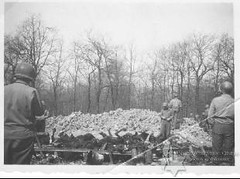
Burned corpses next to a pit with a mound of dirt in the background. This photograph was taken by Paul Wentink, an American soldier, following the liberation of Ohrdruf Concentration Camp. Ohrdruf was a sub-camp of Buchenwald Concentration Camp. A forced labor camp, Ohrdruf prisoners worked building huge underground mountain tunnels that housed V-weapons factories.
Monday, January 31, 2005
Quotation with brief comment
"Christ, the Master of humility, manifests His Truth only to the humble and hides Himself from the proud." - St. Vincent Ferrer (1350-1419).
In other words, when a small band of cultists in the backwoods of Richmond, New Hampshire (or dissidents found anywhere else for that matter) believe themselves to be wiser than the Holy Father and all the Bishops throughout the world, you know humility isn't exactly their strong suit.
Paul
In other words, when a small band of cultists in the backwoods of Richmond, New Hampshire (or dissidents found anywhere else for that matter) believe themselves to be wiser than the Holy Father and all the Bishops throughout the world, you know humility isn't exactly their strong suit.
Paul
Saint Benedict Center rejects the Catechism and Vatican II
Please visit this link to read an article which is to be found at the Saint Benedict Center's website: http://www.catholicism.org/pages/crusdr19.htm
Seems that members of this cult reject Vatican II (insisting that the Holy Spirit was not at work during this Council and that therefore its not infallible) and that the teaching of the Catechism of the Catholic Church (which Pope John Paul II has referred to as "a sure norm") is flawed.
Paul
Seems that members of this cult reject Vatican II (insisting that the Holy Spirit was not at work during this Council and that therefore its not infallible) and that the teaching of the Catechism of the Catholic Church (which Pope John Paul II has referred to as "a sure norm") is flawed.
Paul
Friday, January 28, 2005
Interesting e-letter from Karl Keating, well-known apologist
Dear friends,
Kindly take the time to visit this link: http://www.catholic.com/newsletters/kke_040113.asp
This very interesting e-letter from Karl Keating is definitely worth reading.
Paul
Kindly take the time to visit this link: http://www.catholic.com/newsletters/kke_040113.asp
This very interesting e-letter from Karl Keating is definitely worth reading.
Paul
Subscribe to:
Posts (Atom)