Lifesite News reports:
"America magazine has sent out a mass mailing containing a prayer composed by its “editor-at large,” LGBT activist Fr. James Martin, which captures so well the narcissistic pseudo-spirituality that sadly is plaguing so many among Catholic clergy today.
The prayer, taken from Martin’s homosexualist book “Building a Bridge,” reads like one that could have been composed by the Saturday Night Live Character, “Stuart Smalley,” who famously stared at a mirror and said to himself, “I’m good enough, I’m smart enough, and doggone it, people like me.”
The title of Martin’s “Stuart Smalley prayer” is “A Prayer for When I Feel Rejected,” which feeds Martin’s narrative about the Catholic Church “rejecting” practicing homosexuals, rather than “welcoming them,” when it condemns the sin of sodomy. Martin claims that homosexual orientation is given to people by God, says that the Church’s condemnation of homosexual behavior isn’t “authoritative,” and advocates eliminating expressions of Catholic doctrine on the intrinsically disordered nature of homosexual attraction."
___________________
In the Congregation for the Doctrine of the Faith's Letter to Bishops of the Catholic Church on the Pastoral Care of Homosexual Persons, Cardinal Ratzinger summarized the biblical teaching on homosexuality and explained why the Church's teaching on this subject follows necessarily from her teaching on the nature and purpose of sexuality:
"The Church, obedient to the Lord who founded her and gave to her the sacramental life, celebrates the divine plan of the loving and life-giving union of men and women in the Sacrament of Marriage. It is only in the marital relationship that the use of the sexual faculty can be morally good. A person engaging in homosexual behavior therefore acts immorally. To choose someone of the same sex for one's sexual activity is to annul the rich symbolism and meaning, not to mention the goals, of the Creator's sexual design. Homosexual activity is not a complementary union, able to transmit life; and so it thwarts the call to a life of that form of self-giving which the Gospel says is the essence of Christian living. This does not mean that homosexual persons are not often generous and giving of themselves; but when they engage in homosexual activity they confirm within themselves a disordered sexual inclination which is essentially self-indulgent. As in every moral disorder, homosexual activity prevents one's own fulfillment and happiness by acting contrary to the creative wisdom of God. The Church, in rejecting erroneous opinions regarding homosexuality, does not limit but rather defends personal freedom and dignity realistically and authentically understood."
Homosexual activity is both self-indulgent and narcissistic. Gianfrancesco Zuanazzi, Professor of Psychology and Psychopathology for the John Paul II Institute for Studies at the Pontifical Lateran University, explains that, "The homosexual condition is difficult, sometimes tragic, and not only because of the obstacles it can still encounter in society and the injustices of which it can be the victim, but also because of its narcissistic quality. This quality is expressed in the continual attempts at 'self-recovery' and in searching for the 'better self' or the 'missing self' in another person. The homosexual approach is really one of identification and possession. According to Miller, it is easier for two homosexuals to regard each other as narcissistic extensions of themselves than to be involved in a mutual exchange. Socarides says without hesitation that in a homosexual relationship each partner plays his role, ignoring the complementarity of a sexual union, as if the act were consummated in "splendid isolation" from the other individual, simply as a stratagem for portraying a one-sided emotional conflict. Every homosexual encounter is primarily concerned with disarming the partner by means of seduction, prayer, power, prestige, effeminacy or masculinity, in order to derive satisfaction then from the loser.
Homosexual, like heterosexual, relationships exhibit forms of uplifting tenderness or mere genital expression, but whatever the approach, it always seems that the subjects use each other to fulfil themselves and, at the same time, to defend themselves from one another in a reciprocal way. Even if at the present time, dominated by the fear of AIDS, a couple's relations are not exceptional, as a rule they are unstable, unfaithful, strewn with jealousy and bitterness, marked by possessive love and demands that will never be satisfied. Very often homosexual relationships do not bind the two parties, but reveal that typical self-isolation which is an expression of complete autoerotism. The absence of complementarity, which stems from the radical difference between masculine and feminine identification, prevents the genuine dynamic of a couple. 'There is always something false", Marcel Eck notes, "and deeply painful in these loves which cannot experience reciprocity'. The problem of being, the title of a work by Jean Cocteau, who wrote from direct experience, is precisely the problem of being together.
Hans Giese rightly stresses that the 'foreground' of the homosexual syndrome comes from 'clinging to the self'. The move towards the other is not completed, while the move towards one's own sex is shorter, less costly, simpler; but, since one fears the risk of failure, to take this step involves a new risk, that of egotism. Bergler also maintains that the dominant note is always emotional detachment from the other and the focusing of interest on mere sexual gratification. Kardiner notes that the majority of these experiences are due to casual encounters and are 'one-night stands', i.e., the essential element is the value the experience has for the imagination and not the lasting human relationship. This easily leads to the desire for arousal for its own sake, to repetition and finally to anonymity, the discovery of the other not being worth the effort. Then the body is truly reduced to something corporeal: Pier Paolo Pasolini's posthumous work Petrolio exemplifies this eventuality as amply as it does monotonously. In short, for the homosexual there is the proximate danger of failing into such anonymous, repetitive and ever more demanding sexual behaviour that it becomes a kind of addiction. But this promiscuity or 'tricking', which is so frequent in the gay world, is sometimes praised by those involved as the best of relationships."
And Francis has made Martin an adviser to the Vatican. But then, narcissism has crept into the Vatican under Francis.
Showing posts with label Magazine. Show all posts
Showing posts with label Magazine. Show all posts
Saturday, November 03, 2018


Monday, March 20, 2017
A demon-infested generation embraces satanic gender-confusion
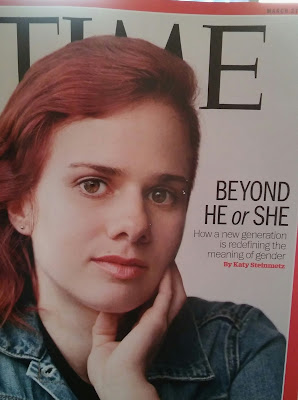
Time magazine, in its cover story for the March 27, 2017 edition:
"This week’s TIME cover story, with exclusive data from GLAAD, explores a change taking hold in American culture. The piece explores how you-do-you young people are questioning the conventions that when it comes to gender and sexuality, there are only two options for each: male or female, gay or straight.

Those aspects of identity — how one sees themselves as a man or woman, for instance, and who they are drawn to physically and romantically — are distinct but undergoing similar sea changes, as teenagers and 20-somethings reject notions of what society has told them about who they are supposed to be.
In a new survey from LGBTQ advocacy organization GLAAD, conducted by Harris Poll, those open minds are reflected in the numbers: 20% of millennials say they are something other that strictly straight and cisgender, compared to 7% of boomers. The people in that group may be be a little sexually curious about people of their own gender or may reject the notion that they have a gender in the first place."
A demon-infested generation, ignorant of God's Holy Word thanks to a lack of sound catechesis and influenced by the poor example of a significant portion of the clergy who have succumbed to darkness and sin, have not been shaped by Our Lord's Teaching: "“Have you not read that from the beginning the Creator ‘made them male and female" (Matthew 19:4).
No doubt radical homosexual activists are rejoicing over this lost generation and its embrace of the demonic. For the desire to mix male and female into a new androgynous gender lies at the very heart of homosexual ideology.
Harry Hay, the founder of the homosexual movement, began his manifesto for the Mattachine Society with these words: "We, the androgynes of the world.."
Homosexual writer and activist Paul Varnell explains how Hay gave androgyny vital importance in the homosexual movement: "Hay's 'idealism' had three components: a) gays are qualitatively different from heterosexuals, mentally, psychologically, spiritually, not just in 'what they do in bed;' b) the core difference lies in the natural androgyny of homosexuals, that they embody both male and female elements; and c) in order to help promote their acceptance gays need to explain the contribution this difference makes to society." (Paul Varnell, "Harry Hay: One Big Idea).
Pope Benedict XVI, in a Christmas Address given in 2008, denounced the contemporary notion that gender is a malleable definition and said, "The Church speaks of the human being as man and woman, and asks that this order is respected." But our sin-sick culture, in its hatred for God and His Commandments, has another agenda. God's order is rejected. And this is most significant. Because, as Father Vincent Miceli, S.J., has noted, "It has been a special scar on the worst pagan cultures and the worst idolatrous religions that they openly attacked the gender identities of the sexes. They celebrated sexual indulgence, sexual experimentation, sexual symbols, fertility rites, temple prostitution, seasonal sex orgies, sexual abuse and enslavement of young women, girls and boys....But sex is not an accidental characteristic of man and woman. A human person without sex is a monstrous abstraction. Sex entails the very identity of each person; sex plunges to the deepest mystery of each person. Hence the sexes and the vocations pertaining thereto are not interchangeable. Each person is called to serve God and his fellowman, accepting gladly the sex with which one is endowed and the vocation attached to that sex." (The Antichrist, P. 231).
In the comments section of a previous post, one reader
 noted how, "Homosexuals, lesbians and transsexuals are often afflicted by evil spirits. Gender confusion is often a sign of demonic possession. Fr. Malachi Martin recounts the story of a possessed transsexual in his bestselling book 'Hostage to the Devil.' In the chapter titled 'The Virgin and the Girl-Fixer,' he writes, 'At one moment, Father Gerald, the exorcist, was bending over the possessed, Richard/Rita, who had sunk his teeth into his own instep. In the next instant, the glaze in Richard/Rita's eyes broke, melting into a lurid gleam of mockery. Greenish. The teeth loosened their grip on the instep. The mouth opened, baring gums and throat, the tongue protruded, quivering on a stream of gray foam bubbles. The whole face was furrowed in irregular lines, as Richard/Rita broke into peals of laughter. Great buffeting gusts of mocking, jeering, Schadenfreude laughter. Laugter pouring from a belly of amused scorn and contemptuous hate.'"
How quickly we forget this. Gender confusion represents something more than a cultural revolution. It is often the result of demonic possession. The more a culture rejects the Living God and His Commandments, the more it sinks into an abyss of depravity. Gender is not a human construct. Sacred Scripture - God's Holy Word - tells us that, "God created man in his image; in the divine image he created him; male and female he created them." (Genesis 1:27).

"This week’s TIME cover story, with exclusive data from GLAAD, explores a change taking hold in American culture. The piece explores how you-do-you young people are questioning the conventions that when it comes to gender and sexuality, there are only two options for each: male or female, gay or straight.

Those aspects of identity — how one sees themselves as a man or woman, for instance, and who they are drawn to physically and romantically — are distinct but undergoing similar sea changes, as teenagers and 20-somethings reject notions of what society has told them about who they are supposed to be.
In a new survey from LGBTQ advocacy organization GLAAD, conducted by Harris Poll, those open minds are reflected in the numbers: 20% of millennials say they are something other that strictly straight and cisgender, compared to 7% of boomers. The people in that group may be be a little sexually curious about people of their own gender or may reject the notion that they have a gender in the first place."
A demon-infested generation, ignorant of God's Holy Word thanks to a lack of sound catechesis and influenced by the poor example of a significant portion of the clergy who have succumbed to darkness and sin, have not been shaped by Our Lord's Teaching: "“Have you not read that from the beginning the Creator ‘made them male and female" (Matthew 19:4).
No doubt radical homosexual activists are rejoicing over this lost generation and its embrace of the demonic. For the desire to mix male and female into a new androgynous gender lies at the very heart of homosexual ideology.
Harry Hay, the founder of the homosexual movement, began his manifesto for the Mattachine Society with these words: "We, the androgynes of the world.."
Homosexual writer and activist Paul Varnell explains how Hay gave androgyny vital importance in the homosexual movement: "Hay's 'idealism' had three components: a) gays are qualitatively different from heterosexuals, mentally, psychologically, spiritually, not just in 'what they do in bed;' b) the core difference lies in the natural androgyny of homosexuals, that they embody both male and female elements; and c) in order to help promote their acceptance gays need to explain the contribution this difference makes to society." (Paul Varnell, "Harry Hay: One Big Idea).
Pope Benedict XVI, in a Christmas Address given in 2008, denounced the contemporary notion that gender is a malleable definition and said, "The Church speaks of the human being as man and woman, and asks that this order is respected." But our sin-sick culture, in its hatred for God and His Commandments, has another agenda. God's order is rejected. And this is most significant. Because, as Father Vincent Miceli, S.J., has noted, "It has been a special scar on the worst pagan cultures and the worst idolatrous religions that they openly attacked the gender identities of the sexes. They celebrated sexual indulgence, sexual experimentation, sexual symbols, fertility rites, temple prostitution, seasonal sex orgies, sexual abuse and enslavement of young women, girls and boys....But sex is not an accidental characteristic of man and woman. A human person without sex is a monstrous abstraction. Sex entails the very identity of each person; sex plunges to the deepest mystery of each person. Hence the sexes and the vocations pertaining thereto are not interchangeable. Each person is called to serve God and his fellowman, accepting gladly the sex with which one is endowed and the vocation attached to that sex." (The Antichrist, P. 231).
In the comments section of a previous post, one reader

How quickly we forget this. Gender confusion represents something more than a cultural revolution. It is often the result of demonic possession. The more a culture rejects the Living God and His Commandments, the more it sinks into an abyss of depravity. Gender is not a human construct. Sacred Scripture - God's Holy Word - tells us that, "God created man in his image; in the divine image he created him; male and female he created them." (Genesis 1:27).

Wednesday, March 16, 2011
"For the Lord disciplines him who he loves, and chastises every son whom he receives..."

An article entitled "My Redeemer Lives: Tragedy, Disaster, and the Justice of God," which appeared in an edition of The Word Among Us magazine back in 2006, presented this argument. The author of this article, after referring to the multiple disasters in New Orleans and the earthquake and the tsunami which followed it in the Indian Ocean, wrote: "..how should we think about these things? Does Scripture really teach that God punishes us with earthquakes and floods and hurricanes? Does the Church teach that God sits back impassively while we suffer at the cruel hands of Mother Nature? Of course, the answer to both questions is a resounding 'No.'"
And of course, when you pose those questions, the answer is definitely a "resounding no." But perhaps those are the wrong questions? What does Sacred Scripture really teach us about chastisement? Does chastisement really represent merely a "punishment"? Or is it something else entirely? We can best examine this issue through the analogy of parents who actually love their children and who wish what is best for them. Such parents will employ both the carrot and the stick to encourage their children to do the right thing. When the carrot isn't working, parents will very often turn to the stick because of their love for their children. Does not Sacred Scripture teach us that, "He that spareth his rod hateth his son: but he that loveth him chasteneth him betimes (diligently)" (Proverbs 13: 24).
And in Hebrews 12: 6-12, we read: "For the Lord disciplines him who he loves, and chastises every son whom he receives. It is for discipline that you have to endure. God is treating you as sons; for what son is there whom his father does not discipline? If you are left without discipline, in which all have participated, then you are illegitimate children and not sons. Besides this, we have had earthly fathers to discipline us and we respected them. Shall we not much more be subject to the Father of spirits and live? For they disciplined us for a short time at their pleasure, but he disciplines us for our good, that we may share his holiness. For the moment all discipline seems painful rather than pleasant; later it yields the peaceful fruit of righteousness to those who have been trained by it. Therefore lift your drooping hands and strengthen your weak knees, and make straight paths for your feet, so that what is lame may not be put out of joint but rather be healed."
We see how earthly parents discipline and chastise us for our own good, what makes us believe that things would be any different in God's relationship with all of His children? Are we prepared to accept what God's Holy Word has to say on this matter or do we believe ourselves to be "wiser" than that inspired Word?
A chastisement is coming. Why? Father Albert Hebert, S.M., explains: "Sin and evil is the one enemy of mankind. It spearheads the columns of all the other evils it brings with it. It brings destruction and death, and a terrible eternal death for the unrepentant, those who flaunt their pride and their resistance in the face of a Loving and Merciful God, those who are a continuous scandal to others. They forget that God's Justice must be infinite too, and that sooner or later it must be exercised to preserve His honor and integrity, to save the innocent, to confirm the good and to justify the martyrs." See here.
Thursday, July 15, 2010
Quod scripsi scripsit or "I'm inflexible and refuse to consider evidence"
After writing his insightful analysis of Charles Pierce’s sophomoric article entitled “What I Believe” which appeared in the Boston Sunday Globe Magazine, Joe Sacerdo invited Mr. Pierce to his Blog to comment and to clarify his views. Mr. Pierce responded by writing, “Thank you for giving the piece such a careful reading. I’ll pass, I think….I’ll let the piece speak for itself. Quod scripsi scripsit, as someone once said.” (See here).
That someone was Pontius Pilate. The same bright light who quipped, “What is truth?” and walked away without waiting for answer (John 18: 38). This is the attitude of the ideologue, the person who refuses to reconsider his opinions and who prefers to live without self-criticism. In his allegory of the cave (Republic 8.514-17), Plato compares this desire to believe what is convenient and to act on false opinions with living in a cave, a world of shadows and illusions rather than the world of daylight, of reality.
It was Socrates who said that “an unexamined life is not worth living.” Which is why Dignitatis Humanae of the Second Vatican Council tells us that, “It is in accordance with their dignity as persons – that is, beings endowed with reason and free will and therefore privileged to bear personal responsibility – that all men should be at once impelled by nature and also bound by a moral obligation to seek the truth, especially religious truth. They are also bound to adhere to the truth, once it is known, and to order their whole lives in accord with the demands of truth.” (Dignitatis Humanae, No. 2).
The ideologue rejects this notion. Crippled in personality, he stubbornly refuses to change his mind even when presented with objective truth. He is inflexible rather than certain. Dr. Montague Brown explains the difference between certainty and inflexibility thusly: “Certainty pertains to knowledge: it is knowing without doubt that something is so. Certainty is a result of having considered the matter thoroughly and having found sufficient evidence to justify our position. Although certainty is something that I have within me, it is outward looking. That is, I appeal to objective criteria to substantiate my position. If I refuse to change my mind, it is because no objective evidence has been given, nor can I conceive of any, that would shake my certainty. Certainty is not a consequence of being proud or overbearing; rather, it is the result of being humble before the truth….
Inflexibility pertains to will: it is a decision not to consider that we might be wrong. It is a refusal to be convinced by any amount of evidence against our position, no matter how overwhelming it may be. Unlike certainty, which is outward looking, inflexibility is a turning inward. That is, my understanding of objective truth does not cause my inflexibility; it is caused by a subjective attitude: my desire to be right. The reason I do not change is that I do not want to change. Since my inflexibility is not based on evidence, even if new evidence surfaces that proves me to be mistaken, I still will not change.” (The One-Minute Philosopher, pp. 6-7).
This is a teaching moment for Catholics in and around Boston and beyond. Joe Sacerdo has examined Mr. Pierce’s article with fairness and objectivity. Even Mr. Pierce acknowledged this when he wrote, “Thank you for giving the piece such a careful reading.” But Mr. Pierce refuses to examine evidence which might prove him wrong. Therefore he writes, “Quod scripsi scripsit” – What I have written I have written.
Some people prefer to live in Plato’s cave.
Related reading: Making an accusation and failing to support that accusation with sufficient evidence.
That someone was Pontius Pilate. The same bright light who quipped, “What is truth?” and walked away without waiting for answer (John 18: 38). This is the attitude of the ideologue, the person who refuses to reconsider his opinions and who prefers to live without self-criticism. In his allegory of the cave (Republic 8.514-17), Plato compares this desire to believe what is convenient and to act on false opinions with living in a cave, a world of shadows and illusions rather than the world of daylight, of reality.
It was Socrates who said that “an unexamined life is not worth living.” Which is why Dignitatis Humanae of the Second Vatican Council tells us that, “It is in accordance with their dignity as persons – that is, beings endowed with reason and free will and therefore privileged to bear personal responsibility – that all men should be at once impelled by nature and also bound by a moral obligation to seek the truth, especially religious truth. They are also bound to adhere to the truth, once it is known, and to order their whole lives in accord with the demands of truth.” (Dignitatis Humanae, No. 2).
The ideologue rejects this notion. Crippled in personality, he stubbornly refuses to change his mind even when presented with objective truth. He is inflexible rather than certain. Dr. Montague Brown explains the difference between certainty and inflexibility thusly: “Certainty pertains to knowledge: it is knowing without doubt that something is so. Certainty is a result of having considered the matter thoroughly and having found sufficient evidence to justify our position. Although certainty is something that I have within me, it is outward looking. That is, I appeal to objective criteria to substantiate my position. If I refuse to change my mind, it is because no objective evidence has been given, nor can I conceive of any, that would shake my certainty. Certainty is not a consequence of being proud or overbearing; rather, it is the result of being humble before the truth….
Inflexibility pertains to will: it is a decision not to consider that we might be wrong. It is a refusal to be convinced by any amount of evidence against our position, no matter how overwhelming it may be. Unlike certainty, which is outward looking, inflexibility is a turning inward. That is, my understanding of objective truth does not cause my inflexibility; it is caused by a subjective attitude: my desire to be right. The reason I do not change is that I do not want to change. Since my inflexibility is not based on evidence, even if new evidence surfaces that proves me to be mistaken, I still will not change.” (The One-Minute Philosopher, pp. 6-7).
This is a teaching moment for Catholics in and around Boston and beyond. Joe Sacerdo has examined Mr. Pierce’s article with fairness and objectivity. Even Mr. Pierce acknowledged this when he wrote, “Thank you for giving the piece such a careful reading.” But Mr. Pierce refuses to examine evidence which might prove him wrong. Therefore he writes, “Quod scripsi scripsit” – What I have written I have written.
Some people prefer to live in Plato’s cave.
Related reading: Making an accusation and failing to support that accusation with sufficient evidence.
Subscribe to:
Posts (Atom)
