Friday, October 09, 2015
Reconciliation: Its meaning and value...
Most of us are aware that sin destroys our relationship with God and that it also undermines our relationships with family members, friends and others with whom we come into contact. Reconciliation refers to that precise effect of Christ's redemption of the human race by His sacrificial death on the Cross which restores our relationship with God and breaks down the barriers of sin which prevent us from engaging in authentic relationships with others.
In the words of the Catechism of the Catholic Church, "Conversion is accomplished in daily life by gestures of reconciliation, concern for the poor, the exercise and defense of justice and right, by the admission of faults to one's brethren, fraternal correction, revision of life, examination of conscience, spiritual direction, acceptance of suffering, endurance of persecution for the sake of righteousness. Taking up one's cross each day and following Jesus is the surest way of penance." (1435).
In other words, our transformation in Christ, our daily conversion, is made manifest by such gestures of reconciliation by which we demonstrate our commitment toward the theological virtue of charity "by which we love God above all things for his own sake, and our neighbor as ourselves for the love of God" (CCC, 1822). We are told in Sacred Scripture that a faith without works is dead (James 2:14-19). An authentic reconciliation, therefore, will show itself in a charity which embraces both God and neighbor. As Jean Jaouen so eloquently puts it, "..Christian compassion cannot be a cerebral, fleshless reality. It is completely impossible for one who loves people coldly to dissociate eternal salvation from the temporal well-being of a human person. A person is a whole. Time is eternity already begun yet still not completely visible. The conflict will be resolved if Christian apostles learn to live with their people while remaining present to the Lady who, with her Son, weeps over both the death of souls and the death of little children. 'Lady of heaven, empress of earth.' Through the Virgin Mediator and Queen, apostles will find a balance between the demands of heaven and those of earth." (Jean Jaouen, m.s., "A Grace Called La Salette: a story for the world," pp. 327-328, grassroots publishing international, Enfield, New Hampshire, English edition 1991).


Tuesday, October 06, 2015
The Flight from God: Building a godless world
In his powerful classic entitled, "The Flight from God," the eminent Swiss philosopher Max Picard writes: "In every age man has been in flight from God. What distinguishes the Flight to-day from every other flight is this: once Faith was the universal, and prior to the individual; there was an objective world of Faith, while the Flight was only accomplished subjectively, within the individual man. It came into being through the individual man's separating himself from the world of Faith by an act of decision. A man who wanted to flee had first to make his own flight. The opposite is true to-day. The objective and external world of Faith is no more; it is Faith which has to be remade moment by moment through the individual's act of decision, that is to say, through the individual's cutting himself off from the world of the Flight. For to-day it is no longer Faith which exists as an objective world, but rather the Flight; for every situation into which man comes is from the beginning, without his making it so, plainly a situation of flight, since everything in this world exists only in the form of the Flight." (The Flight from God, Gateway Editions, 1951, pp.1-2).
Picard goes on to explain in this critically important work that, "The man of the Flight cannot bear the feeling that there is one thing and one thing only: the Flight. He needs something wholly other, something, now threatening, now friendly, which is above him, like a heaven beneath which he can make his journey...This is Art...The very existence of Art in a sphere of its own already means that it is 'wholly other,' and from the beginning it is other than reality itself. The strange thing about Art is that a work of art is indeed made by man, but that once it is made it stands there independently of man. This gives it a semblance of otherness." (The Flight from God, pp. 138-139).
This is of the utmost importance for "modern man" as he flees from his God Who is Wholly Other. Nature abhors a vacuum after all. And so, in his flight from the Divine Other, man in the flight substitutes "Art" for the Divine Being as the Wholly Other." Picard explains that the cinema "..is the perfect Flight" and that here is where "men may learn how best to flee." For this reason, "..cinemas are everywhere erected, examples of the Flight. The figures on the screen are fashioned only for the Flight, they are disembodied. Like one in a hurry who drops his luggage, the figures have laid down their bodily substance somewhere in the background, while they themselves make off in the foreground of the screen, outlines only of their bodies. Sometimes they are still for a moment, looking backwards fearfully, as if there was one who pursued them. Alas, it is only a game, they do but pretend to be afraid. No one can reach them, these things without being. And now, as if they want to fool the one who pursues them, they move more slowly, they even translate a movement which ought o be fast into a slow one; they demonstrate slowness in the Flight, so sure are they that nothing can reach them, these things without being. Here in the cinema it is as if there were no more men, as if the real men were somewhere in safety, had for long been in safety, and as if these shadows had been left behind simply to flee in place of the real men. They only pretend to be in flight and even the men who sit in front of the screen in order to gaze at the shadows there seem nothing but dummies, arranged to complete the illusion,while the real men have long since departed." (pp. 8-9).
Dr. Von Hildebrand was right when he said that, "Modern man has lost that consciousness of being a creature which even the pagan possessed, and he lives in the illusion that by his own powers he can transform the world into a terrestrial paradise." (The New Tower of Babel, Sophia Institute Press, 1994, p. 21).
Having decided against God, "modern man" has embraced the Flight. This flight from the Divine Other has led to the decline of man's confidence in the powers of human reason to attain reality and truth. Man in the Flight has concluded today that all truth is relative. In the same way that Pilate asked Our Lord, "What is truth?" and hastened in his flight to the judgment-hall without waiting for an answer (John 18:38), so "modern man," in his embrace of relativism, joins the flight without any thought of inquiring for the truth. Instead, he settles for illusion, rejecting the permanent authority of truth as founded by the Divine Other in reality, reason and revelation while setting himself up as the autonomous source of all truth:"Before Christ's second coming the Church must pass through a final trial that will shake the faith of many believers. The persecution that accompanies her pilgrimage on earth will unveil the 'mystery of iniquity' in the form of a religious deception offering men an apparent solution to their problems at the price of apostasy from the truth. The supreme religious deception is that of the Antichrist, a pseudo-messianism by which man glorifies himself in place of God and of his Messiah come in the flesh." (Catechism of the Catholic Church, 675).
The Antichrist is behind the Flight, urging "modern man" to hasten in his Flight and not to look back. How will this Flight end? In the words of Romano Guardini:"One day the Antichrist will come: a human being who introduces an order of things in which rebellion against God will attain its ultimate power. He will be filled with enlightenment and strength. The ultimate aim of all aims will be to prove that existence without Christ is possible - nay rather, that Christ is the enemy of existence, which can be fully realized only when all Christian values have been destroyed. His arguments will be so impressive, supported by means of such tremendous power - violent and diplomatic, material and intellectual - that to reject them will result in almost insurmountable scandal, and everyone whose eyes are not opened by grace will be lost. Then it will be clear what the Christian essence really is: that which stems not from the world, but from the heart of God; victory of grace over the world; redemption of the world, for her true essence is not to be found in herself, but in God, from whom she has received it. When God becomes all in all, the world will finally burst into flower." (The Lord, p. 513).
Are we not approaching the Reign of Antichrist? "Modern man" strives to build a godless world where he is subject to no one but himself. Having eliminated God from this world, "modern man" deifies and absolutizes himself. Having rejected his place as a creature dependent upon God, "modern man" is moving, "..not toward divinity, but toward dehumanizing, toward the destruction of being itself through through the destruction of truth. The Jacobin variant of the idea of liberation...is a rebellion against being human in itself, rebellion against truth, and that is why it leads people - as Sartre percipiently observed - into a self-contradictory existence that we call hell." (Joseph Cardinal Ratzinger, Truth and Tolerance, p. 248).

Picard goes on to explain in this critically important work that, "The man of the Flight cannot bear the feeling that there is one thing and one thing only: the Flight. He needs something wholly other, something, now threatening, now friendly, which is above him, like a heaven beneath which he can make his journey...This is Art...The very existence of Art in a sphere of its own already means that it is 'wholly other,' and from the beginning it is other than reality itself. The strange thing about Art is that a work of art is indeed made by man, but that once it is made it stands there independently of man. This gives it a semblance of otherness." (The Flight from God, pp. 138-139).
This is of the utmost importance for "modern man" as he flees from his God Who is Wholly Other. Nature abhors a vacuum after all. And so, in his flight from the Divine Other, man in the flight substitutes "Art" for the Divine Being as the Wholly Other." Picard explains that the cinema "..is the perfect Flight" and that here is where "men may learn how best to flee." For this reason, "..cinemas are everywhere erected, examples of the Flight. The figures on the screen are fashioned only for the Flight, they are disembodied. Like one in a hurry who drops his luggage, the figures have laid down their bodily substance somewhere in the background, while they themselves make off in the foreground of the screen, outlines only of their bodies. Sometimes they are still for a moment, looking backwards fearfully, as if there was one who pursued them. Alas, it is only a game, they do but pretend to be afraid. No one can reach them, these things without being. And now, as if they want to fool the one who pursues them, they move more slowly, they even translate a movement which ought o be fast into a slow one; they demonstrate slowness in the Flight, so sure are they that nothing can reach them, these things without being. Here in the cinema it is as if there were no more men, as if the real men were somewhere in safety, had for long been in safety, and as if these shadows had been left behind simply to flee in place of the real men. They only pretend to be in flight and even the men who sit in front of the screen in order to gaze at the shadows there seem nothing but dummies, arranged to complete the illusion,while the real men have long since departed." (pp. 8-9).
Dr. Von Hildebrand was right when he said that, "Modern man has lost that consciousness of being a creature which even the pagan possessed, and he lives in the illusion that by his own powers he can transform the world into a terrestrial paradise." (The New Tower of Babel, Sophia Institute Press, 1994, p. 21).
Having decided against God, "modern man" has embraced the Flight. This flight from the Divine Other has led to the decline of man's confidence in the powers of human reason to attain reality and truth. Man in the Flight has concluded today that all truth is relative. In the same way that Pilate asked Our Lord, "What is truth?" and hastened in his flight to the judgment-hall without waiting for an answer (John 18:38), so "modern man," in his embrace of relativism, joins the flight without any thought of inquiring for the truth. Instead, he settles for illusion, rejecting the permanent authority of truth as founded by the Divine Other in reality, reason and revelation while setting himself up as the autonomous source of all truth:"Before Christ's second coming the Church must pass through a final trial that will shake the faith of many believers. The persecution that accompanies her pilgrimage on earth will unveil the 'mystery of iniquity' in the form of a religious deception offering men an apparent solution to their problems at the price of apostasy from the truth. The supreme religious deception is that of the Antichrist, a pseudo-messianism by which man glorifies himself in place of God and of his Messiah come in the flesh." (Catechism of the Catholic Church, 675).
The Antichrist is behind the Flight, urging "modern man" to hasten in his Flight and not to look back. How will this Flight end? In the words of Romano Guardini:"One day the Antichrist will come: a human being who introduces an order of things in which rebellion against God will attain its ultimate power. He will be filled with enlightenment and strength. The ultimate aim of all aims will be to prove that existence without Christ is possible - nay rather, that Christ is the enemy of existence, which can be fully realized only when all Christian values have been destroyed. His arguments will be so impressive, supported by means of such tremendous power - violent and diplomatic, material and intellectual - that to reject them will result in almost insurmountable scandal, and everyone whose eyes are not opened by grace will be lost. Then it will be clear what the Christian essence really is: that which stems not from the world, but from the heart of God; victory of grace over the world; redemption of the world, for her true essence is not to be found in herself, but in God, from whom she has received it. When God becomes all in all, the world will finally burst into flower." (The Lord, p. 513).
Are we not approaching the Reign of Antichrist? "Modern man" strives to build a godless world where he is subject to no one but himself. Having eliminated God from this world, "modern man" deifies and absolutizes himself. Having rejected his place as a creature dependent upon God, "modern man" is moving, "..not toward divinity, but toward dehumanizing, toward the destruction of being itself through through the destruction of truth. The Jacobin variant of the idea of liberation...is a rebellion against being human in itself, rebellion against truth, and that is why it leads people - as Sartre percipiently observed - into a self-contradictory existence that we call hell." (Joseph Cardinal Ratzinger, Truth and Tolerance, p. 248).

Saturday, October 03, 2015
Parish priest where I attended Mass tonight: Yes many, even in the Church, are promoting sodomite "marriage," but every family is dysfunctional
Matthew Pearson, writing for Church Militant, notes how "A Polish priest working at the Congregration for the Doctrine of the Faith (CDF) has admitted his homosexuality and issued a manifesto demanding changes to Church teaching.
The priest, Msgr. Krzysztof Charamsa, is a professor at the Pontifical Gregorian University and has been on the Vatican's International Theological Commission since 2009.
In a video released yesterday by the Polish LGBT activist group Artykuł osiemnasty, Msgr. Charamsa declares his homosexuality and admits to having a boyfriend.
Also released along with the video was a 10-point manifesto of demands.
1. Disposal of homophobia and anti-gay discrimination
We demand that the Catholic Church divest itself of activities, the mentality and language of homophobia, hate speech, humiliation and depreciating, marginalization, stigmatization and rejection of LGBT people. We demand the cessation of the Church of discrimination and soft persecution of these people so within it as well as beyond its borders.
2. Condemnation of punishment for homosexuality
We demand that the Church unequivocally speak out against punishment for sexual orientation and against the death penalty or imprisonment, against any acts of cruelty against any discrimination against people based on sexual orientation, as well as against attempts to undergo "reorganizational therapies" of persons belonging to sexual minorities.
3. Cessation of the Church's interference in guaranteeing human rights by democratic states
We demand that the Church revise its past behavior to states and nations which, through the democratic development of civilizations, seek to guarantee human rights, including the right of persons belonging to sexual minoritiesto love and to civil marriage. Civilized countries should respect their autonomy for the sake of the common good of all, not just Catholics.
4. Canceling incompetent and prejudicial documents
We demand the Pope revise the Catechism and repeal all the cruel documents that are incompetent to deal with the issue of homosexual persons, who are the object both of the Church's compassion and stigmatization — in particular, the documents of the Congregation for the Doctrine of the Faith, the heir to the Holy Inquisition. Unacceptable documents include:
a) the declaration Persona Humana from 1975, discussing among other things the "pathological constitution" of homosexual persons, which by their nature supposedly "have difficulty adjusting socially" and carry an "disorder" that "without the necessary and significant adjustment" is considered a "depravity";
b) Letter on the Pastoral Care of Homosexual Persons of 1986, which calls for "compassion" for homosexuals, who "suffer" from same-sex attraction, and which accepts the existence of "fair discrimination" against homosexuals and rejects only "unjust discrimination" against them;
c) the outrageous Considerations Concerning the Response to Legislative Proposals on the Non-Discrimination of Homosexual Persons in 1992;
d) Considerations Regarding Proposals to Legalize Unions Between Homosexual Persons from 2003, according to which homosexuality is "devoid of any genuine affective maturity," and homosexual relationships are devoid of any "human and ordered form of sexual relations";
e) the Catechism of the Church Catholic, sections 2357–2359, teaches that not only same-sex acts but also homosexual orientation are "objectively disordered." It also emphasizes that by nature, homosexuals have no emotional complementarity with other human persons they love. And it adds that for most of us orientation is a difficult experience requiring compassion toward our neighbor, but not without avoiding just discrimination. How does the Church know what is our suffering and difficulty? Well, it is not sexual orientation, but homophobia from the Church. Learning via the Catechism is offensive, apart from the fact that the very definition of homosexuality is deficient, if not quite false. The analysis of the situation of homosexual persons is also deficient.
5. Immediate cancellation of discriminatory instructions about denying the priesthood to homosexual persons
We demand that the Pope immediately abolish regrettable instructions about refusing the ordination of homosexuals, endorsed by Pope Benedict XVI in 2005.
6. Initiate a serious interdisciplinary scientific reflection over the morality of human sexuality
We demand that the Church initiate a serious and objective scientific reflection on sexual morality, taking note of the development — which so far the Church has only viewed ideologically — of science and reproductive health services, medical, psychological, psychiatric, biological, sociological, anthropological, Gender studies, etc.
7. Revision of the interpretation of biblical texts on homosexuality
We demand that the Church treat seriously the question of its own interpretation of the Bible, freeing itself of fundamentalism, noting verses that talk about homosexual people, never condemning them, and contextualizing biblical texts that address homogenital acts.
8. Adoption of ecumenical dialogue with our Lutheran and Anglican brothers about homosexuality
We demand that the Church take seriously ecumenical dialogue on the issue of homosexuality with Christians, Protestants and Anglicans who, in an open and transparent process of maturation, have developed their own beliefs on this subject, which may help the Catholic Church understand the reality of it.
9. The need to ask for forgiveness toward homosexuals
We demand that the Church stop persecution and crimes against homosexuals and to cease committing similar acts from now on.
10. Respect for and belief in homosexuals and change in the distorted position of the Church on what a homosexual Christian life should look like
We demand that the Church finally open itself up to believing in homosexuals, who are baptized persons belonging to sexual minorities who still do not have the right to dispose themselves in total love and resignation to a healthy sex life, which expresses their nature in accordance with their sexual orientation."
Now, given the first reading and the Gospel for Sunday, October 4th, I was hoping that the priest who celebrated Holy Mass which I attended (a Vigil Mass) would speak on the Church's teaching regarding what constitutes authentic marriage.
The readings:
Reading 1 GN 2:18-24
The LORD God said: "It is not good for the man to be alone.
I will make a suitable partner for him."
So the LORD God formed out of the ground
various wild animals and various birds of the air,
and he brought them to the man to see what he would call them;
whatever the man called each of them would be its name.
The man gave names to all the cattle,
all the birds of the air, and all wild animals;
but none proved to be the suitable partner for the man.
So the LORD God cast a deep sleep on the man,
and while he was asleep,
he took out one of his ribs and closed up its place with flesh.
The LORD God then built up into a woman the rib
that he had taken from the man.
When he brought her to the man, the man said:
"This one, at last, is bone of my bones
and flesh of my flesh;
this one shall be called 'woman, '
for out of 'her man’ this one has been taken."
That is why a man leaves his father and mother
and clings to his wife,
and the two of them become one flesh.
And the Gospel
MK 10:2-16
The Pharisees approached Jesus and asked,
"Is it lawful for a husband to divorce his wife?"
They were testing him.
He said to them in reply, "What did Moses command you?"
They replied,
"Moses permitted a husband to write a bill of divorce
and dismiss her."
But Jesus told them,
"Because of the hardness of your hearts
he wrote you this commandment.
But from the beginning of creation, God made them male and female.
For this reason a man shall leave his father and mother
and be joined to his wife,
and the two shall become one flesh.
So they are no longer two but one flesh.
Therefore what God has joined together,
no human being must separate."
In the house the disciples again questioned Jesus about this.
He said to them,
"Whoever divorces his wife and marries another
commits adultery against her;
and if she divorces her husband and marries another,
she commits adultery."
And people were bringing children to him that he might touch them,
but the disciples rebuked them.
When Jesus saw this he became indignant and said to them,
"Let the children come to me;
do not prevent them, for the kingdom of God belongs to
such as these.
Amen, I say to you,
whoever does not accept the kingdom of God like a child
will not enter it."
Then he embraced them and blessed them,
placing his hands on them."
Rather than addressing the growing darkness and the rampant confusion of our sad time, the priest who celebrated Mass said that everyone suffers from dysfunction and EVERY FAMILY IS DYSFUNCTIONAL.
Then he offered a prayer for family healing.
It would seem that some of us suffer more than others from dysfunction.
But do you see what this troubled priest was implying? - That no one can really speak out against the sin which cries to Heaven for vengeance because we are all sinners and EVERY FAMILY has its problems.
Some are more dysfunctional than others

The priest, Msgr. Krzysztof Charamsa, is a professor at the Pontifical Gregorian University and has been on the Vatican's International Theological Commission since 2009.
In a video released yesterday by the Polish LGBT activist group Artykuł osiemnasty, Msgr. Charamsa declares his homosexuality and admits to having a boyfriend.
Also released along with the video was a 10-point manifesto of demands.
1. Disposal of homophobia and anti-gay discrimination
We demand that the Catholic Church divest itself of activities, the mentality and language of homophobia, hate speech, humiliation and depreciating, marginalization, stigmatization and rejection of LGBT people. We demand the cessation of the Church of discrimination and soft persecution of these people so within it as well as beyond its borders.
2. Condemnation of punishment for homosexuality
We demand that the Church unequivocally speak out against punishment for sexual orientation and against the death penalty or imprisonment, against any acts of cruelty against any discrimination against people based on sexual orientation, as well as against attempts to undergo "reorganizational therapies" of persons belonging to sexual minorities.
3. Cessation of the Church's interference in guaranteeing human rights by democratic states
We demand that the Church revise its past behavior to states and nations which, through the democratic development of civilizations, seek to guarantee human rights, including the right of persons belonging to sexual minoritiesto love and to civil marriage. Civilized countries should respect their autonomy for the sake of the common good of all, not just Catholics.
4. Canceling incompetent and prejudicial documents
We demand the Pope revise the Catechism and repeal all the cruel documents that are incompetent to deal with the issue of homosexual persons, who are the object both of the Church's compassion and stigmatization — in particular, the documents of the Congregation for the Doctrine of the Faith, the heir to the Holy Inquisition. Unacceptable documents include:
a) the declaration Persona Humana from 1975, discussing among other things the "pathological constitution" of homosexual persons, which by their nature supposedly "have difficulty adjusting socially" and carry an "disorder" that "without the necessary and significant adjustment" is considered a "depravity";
b) Letter on the Pastoral Care of Homosexual Persons of 1986, which calls for "compassion" for homosexuals, who "suffer" from same-sex attraction, and which accepts the existence of "fair discrimination" against homosexuals and rejects only "unjust discrimination" against them;
c) the outrageous Considerations Concerning the Response to Legislative Proposals on the Non-Discrimination of Homosexual Persons in 1992;
d) Considerations Regarding Proposals to Legalize Unions Between Homosexual Persons from 2003, according to which homosexuality is "devoid of any genuine affective maturity," and homosexual relationships are devoid of any "human and ordered form of sexual relations";
e) the Catechism of the Church Catholic, sections 2357–2359, teaches that not only same-sex acts but also homosexual orientation are "objectively disordered." It also emphasizes that by nature, homosexuals have no emotional complementarity with other human persons they love. And it adds that for most of us orientation is a difficult experience requiring compassion toward our neighbor, but not without avoiding just discrimination. How does the Church know what is our suffering and difficulty? Well, it is not sexual orientation, but homophobia from the Church. Learning via the Catechism is offensive, apart from the fact that the very definition of homosexuality is deficient, if not quite false. The analysis of the situation of homosexual persons is also deficient.
5. Immediate cancellation of discriminatory instructions about denying the priesthood to homosexual persons
We demand that the Pope immediately abolish regrettable instructions about refusing the ordination of homosexuals, endorsed by Pope Benedict XVI in 2005.
6. Initiate a serious interdisciplinary scientific reflection over the morality of human sexuality
We demand that the Church initiate a serious and objective scientific reflection on sexual morality, taking note of the development — which so far the Church has only viewed ideologically — of science and reproductive health services, medical, psychological, psychiatric, biological, sociological, anthropological, Gender studies, etc.
7. Revision of the interpretation of biblical texts on homosexuality
We demand that the Church treat seriously the question of its own interpretation of the Bible, freeing itself of fundamentalism, noting verses that talk about homosexual people, never condemning them, and contextualizing biblical texts that address homogenital acts.
8. Adoption of ecumenical dialogue with our Lutheran and Anglican brothers about homosexuality
We demand that the Church take seriously ecumenical dialogue on the issue of homosexuality with Christians, Protestants and Anglicans who, in an open and transparent process of maturation, have developed their own beliefs on this subject, which may help the Catholic Church understand the reality of it.
9. The need to ask for forgiveness toward homosexuals
We demand that the Church stop persecution and crimes against homosexuals and to cease committing similar acts from now on.
10. Respect for and belief in homosexuals and change in the distorted position of the Church on what a homosexual Christian life should look like
We demand that the Church finally open itself up to believing in homosexuals, who are baptized persons belonging to sexual minorities who still do not have the right to dispose themselves in total love and resignation to a healthy sex life, which expresses their nature in accordance with their sexual orientation."
Now, given the first reading and the Gospel for Sunday, October 4th, I was hoping that the priest who celebrated Holy Mass which I attended (a Vigil Mass) would speak on the Church's teaching regarding what constitutes authentic marriage.
The readings:
Reading 1 GN 2:18-24
The LORD God said: "It is not good for the man to be alone.
I will make a suitable partner for him."
So the LORD God formed out of the ground
various wild animals and various birds of the air,
and he brought them to the man to see what he would call them;
whatever the man called each of them would be its name.
The man gave names to all the cattle,
all the birds of the air, and all wild animals;
but none proved to be the suitable partner for the man.
So the LORD God cast a deep sleep on the man,
and while he was asleep,
he took out one of his ribs and closed up its place with flesh.
The LORD God then built up into a woman the rib
that he had taken from the man.
When he brought her to the man, the man said:
"This one, at last, is bone of my bones
and flesh of my flesh;
this one shall be called 'woman, '
for out of 'her man’ this one has been taken."
That is why a man leaves his father and mother
and clings to his wife,
and the two of them become one flesh.
And the Gospel
MK 10:2-16
The Pharisees approached Jesus and asked,
"Is it lawful for a husband to divorce his wife?"
They were testing him.
He said to them in reply, "What did Moses command you?"
They replied,
"Moses permitted a husband to write a bill of divorce
and dismiss her."
But Jesus told them,
"Because of the hardness of your hearts
he wrote you this commandment.
But from the beginning of creation, God made them male and female.
For this reason a man shall leave his father and mother
and be joined to his wife,
and the two shall become one flesh.
So they are no longer two but one flesh.
Therefore what God has joined together,
no human being must separate."
In the house the disciples again questioned Jesus about this.
He said to them,
"Whoever divorces his wife and marries another
commits adultery against her;
and if she divorces her husband and marries another,
she commits adultery."
And people were bringing children to him that he might touch them,
but the disciples rebuked them.
When Jesus saw this he became indignant and said to them,
"Let the children come to me;
do not prevent them, for the kingdom of God belongs to
such as these.
Amen, I say to you,
whoever does not accept the kingdom of God like a child
will not enter it."
Then he embraced them and blessed them,
placing his hands on them."
Rather than addressing the growing darkness and the rampant confusion of our sad time, the priest who celebrated Mass said that everyone suffers from dysfunction and EVERY FAMILY IS DYSFUNCTIONAL.
Then he offered a prayer for family healing.
It would seem that some of us suffer more than others from dysfunction.
But do you see what this troubled priest was implying? - That no one can really speak out against the sin which cries to Heaven for vengeance because we are all sinners and EVERY FAMILY has its problems.
It is this sort of sick "logic," usually advanced by people living the homosexual "lifestyle" or who have a friend or family member who does, which is used as a device to try to guilt others from opposing the sodomite agenda.
This priest, incardinated in the Diocese of Springfield, failed to deliver a homily based upon the Gospel because he is a coward. Rather than using his homily to dispel darkness, this priest provided aid and comfort to those who would distort the Church's authentic teaching on marriage and failed his parishioners in the process.
Some are more dysfunctional than others

Friday, October 02, 2015
Why no similar statement from the Vatican after Pope Francis' meeting with a sodomite?
Writing for The New York Times, Jim Yardley notes that the Vatican issued a statement indicating that Pope Francis’ Meeting with Kim Davis wasn’t an endorsement of her views.
One has to wonder why no such statement was issued by the Vatican after Francis met with radical homosexual activist Simon Cazal who agitated for the Church to change her teaching relative to the sin that cries to Heaven for vengeance.

One has to wonder why no such statement was issued by the Vatican after Francis met with radical homosexual activist Simon Cazal who agitated for the Church to change her teaching relative to the sin that cries to Heaven for vengeance.

Thursday, October 01, 2015
Pope Francis: Preparing the world for a one world religion?
Michael Snyder writes:
"Remarks made by Pope Francis at St. Patrick’s Cathedral in Manhattan have sparked a firestorm of criticism from those that do not believe that Christians and Muslims worship the same God. Many have taken the Pope’s remarks as a major step in the direction of a one world religion, and the truth is that the Pope has made other such statements in the past. In recent years, the theory that Christianity and Islam are just two distinct paths to God among many others has rapidly gained traction all over the planet. Some religious leaders have even gone so far as to try to merge Islamic and Christian practices, and the term “Chrislam” is now often used to describe this ecumenical movement. If all this sounds incredibly strange to you, just keep reading, because this is just the tip of the iceberg..."
Back in September of 2014, Cardinal Theodore McCarrick offered Islamic prayers while insisting that Islam shares foundational rules with Christianity.
“In the name of God, the Merciful and Compassionate,” McCarrick prayed as he introduced himself to the audience at a meeting arranged by the Muslim Public Affairs Council. His praise of the Islamic "deity" is an important formula in Islam and is found more than 100 times in the Koran.
Cardinal McCarrick also made the claim that, “Catholic social teaching is based on the dignity of the human person… [and] as you study the holy Koran, as you study Islam, basically, this is what Muhammad the prophet, peace be upon him, has been teaching.”
The Cardinal made no mention of Islam's long history of torturing and killing millions of Christians.
There is a concerted effort within the Church to promote a false irenicism and some even wish to merge Christianity and Islam, which rejects the divinity of Christ. It is therefore necessary for those who engage in this false irenicism to pretend that "authentic Islam" is opposed to violence. But even the most unenlightened can read the Qu'ran (Koran) for themselves:
Violence and the Quran
by Dave Miller, Ph.D.
One would expect an uninspired book to contradict itself or speak ambiguously on various subjects, at times appearing both to endorse and condemn a practice. So it is with physical violence in the Quran. Yet, despite the occasional puzzling remark that may seem to imply the reverse, the Quran is replete with explicit and implicit sanction and promotion of armed conflict, violence, and bloodshed by Muslims. For example, within months of the Hijrah, Muhammad claimed to receive a revelation that clarified the issue:
Now when ye meet in battle those who disbelieve, then it is smiting of the necks until, when ye have routed them, then making fast of bonds; and afterward either grace or ransom till the war lay down its burdens. That (is the ordinance). And if Allah willed He could have punished them (without you) but (thus it is ordained) that He may try some of you by means of others. And those who are slain in the way of Allah, He rendereth not their actions vain (Surah 47:4, emp. added).
Fight in the way of Allah against those who fight against you, but begin not hostilities. Lo! Allah loveth not aggressors. And slay them wherever ye find them, and drive them out of the places whence they drove you out, for persecution is worse than slaughter. And fight not with them at the Inviolable Place of Worship until they first attack you there, but if they attack you (there) then slay them. Such is the reward of disbelievers. But if they desist, then lo! Allah is Forgiving, Merciful. And fight them until persecution is no more, and religion is for Allah. But if they desist, then let there be no hostility except against wrongdoers. The forbidden month for the forbidden month, and forbidden things in retaliation. And one who attacketh you, attack him in like manner as he attacked you. Observe your duty to Allah, and know that Allah is with those who ward off (evil) (Surah 2:190-194, emp. added).
Warfare is ordained for you, though it is hateful unto you; but it may happen that ye hate a thing which is good for you, and it may happen that ye love a thing which is bad for you. Allah knoweth, ye know not. They question thee (O Muhammad) with regard to warfare in the sacred month. Say: Warfare therein is a great (transgression), but to turn (men) from the way of Allah, and to disbelieve in Him and in the Inviolable Place of Worship, and to expel his people thence, is a greater with Allah; for persecution is worse than killing. And they will not cease from fighting against you till they have made you renegades from your religion, if they can (Surah 2:216-217, emp. added).
Muhammad was informed that warfare was prescribed for him! Though he may have hated warfare, it was actually good for him, and what he loved, i.e., non-warfare, was actually bad for him! And though under normal circumstances, fighting is not appropriate during sacred months, killing was warranted against those who sought to prevent Muslims from practicing their religion. Killing is better than being persecuted! A similar injunction states: “Sanction is given unto those who fight because they have been wronged; and Allah is indeed Able to give them victory” (Surah 22:39, emp. added). In fact, “Allah loveth those who battle for His cause in ranks, as if they were a solid structure” (Surah 61:4, emp. added).
In a surah titled “Repentance” that issues stern measures to be taken against idolaters, the requirement to engage in carnal warfare is apparent:
Freedom from obligation (is proclaimed) from Allah and His messenger toward those of the idolaters with whom ye made a treaty: Travel freely in the land four months, and know that ye cannot escape Allah and that Allah will confound the disbelievers (in His guidance). And a proclamation from Allah and His messenger to all men on the day of the Greater Pilgrimage that Allah is free from obligation to the idolaters, and (so is) His messenger. So, if ye repent, it will be better for you; but if ye are averse, then know that ye cannot escape Allah. Give tidings (O Muhammad) of a painful doom to those who disbelieve. Excepting those of the idolaters with whom ye (Muslims) have a treaty, and who have since abated nothing of your right nor have supported anyone against you. (As for these), fulfill their treaty to them till their term. Lo! Allah loveth those who keep their duty (unto Him). Then, when the sacred months have passed, slay the idolaters wherever ye find them, and take them (captive), and besiege them, and prepare for them each ambush. But if they repent and establish worship and pay the poor-due, then leave their way free. Lo! Allah is Forgiving, Merciful (Surah 9:1-5, emp. added).
The ancient Muslim histories elaborate on the occasion of these admonitions: “[T]he idolaters were given four months’ respite to come and go as they pleased in safety, but after that God and His Messenger would be free from any obligation towards them. War was declared upon them, and they were to be slain or taken captive wherever they were found” (Lings, 1983, p. 323).
Later in the same surah, “Fight against such of those who have been given the Scripture as believe not in Allah nor the Last Day, and forbid not that which Allah hath forbidden by His messenger, and follow not the religion of truth, until they pay the tribute readily, being brought low” (Surah 9:29, emp. added). “Those who have been given the Scripture” is a reference to Jews and Christians. The surah advocates coercion against Jews and Christians in order to physically force them to pay the jizyah—a special religious tax imposed on religious minorities (see Nasr, 2002, p. 166). Muslim translator Mohammed Pickthall explains the historical setting of this quranic utterance: “It signified the end of idolatry in Arabia. The Christian Byzantine Empire had begun to move against the growing Muslim power, and this Surah contains mention of a greater war to come, and instructions with regard to it” (p. 145). Indeed, the final verse of Surah 2 calls upon Allah to give Muslims “victory over the disbelieving folk” (vs. 286), rendered by Rodwell: “give us victory therefore over the infidel nations.” That this stance by the Quran was to be expected is evident from the formulation of the Second Pledge of Aqabah, in which the men pledged their loyalty and their commitment to protecting Muhammad from all opponents. This pledge included duties of war, and was taken only by the males. Consequently, the First Aqabah pact, which contained no mention of war, became known as the “pledge of the women” (Lings, p. 112).
Additional allusions to warfare in the Quran are seen in the surah, “The Spoils,” dated in the second year of the Hijrah (A.D. 623), within a month after the Battle of Badr:
And fight them until persecution is no more, and religion is all for Allah.... If thou comest on them in the war, deal with them so as to strike fear in those who are behind them.... And let not those who disbelieve suppose that they can outstrip (Allah’s purpose). Lo! they cannot escape. Make ready for them all thou canst of (armed) force and of horses tethered, that thereby ye may dismay the enemy of Allah and your enemy, and others beside them whom ye know not.... O Prophet! Exhort the believers to fight. If there be of you twenty stedfast they shall overcome two hundred, and if there be of you a hundred stedfast they shall overcome a thousand of those who disbelieve, because they (the disbelievers) are a folk without intelligence.... It is not for any Prophet to have captives until he hath made slaughter in the land. Ye desire the lure of this world and Allah desireth (for you) the Hereafter, and Allah is Mighty, Wise. Had it not been for an ordinance of Allah which had gone before, an awful doom had come upon you on account of what ye took. Now enjoy what ye have won, as lawful and good, and keep your duty to Allah. Lo! Allah is Forgiving, Merciful (Surah 8:39,57,59-60,65,67-69, emp. added; cf. 33:26).
Muslim scholar Pickthall readily concedes the context of these verses:
vv. 67-69 were revealed when the Prophet had decided to spare the lives of the prisoners taken at Badr and hold them to ransom, against the wish of Omar, who would have executed them for their past crimes. The Prophet took the verses as a reproof, and they are generally understood to mean that no quarter ought to have been given in that first battle (p. 144, emp. added).
So the Quran indicates that at the Battle of Badr, no captives should have been taken. The enemy should have been completely slaughtered, with no quarter given. This very fate awaited the Jewish Bani Qurayzah, when some 700 men were beheaded by the Muslims with Muhammad’s approval (Lings, p. 232). Likewise, members of a clan of the Bani Nadir were executed in Khaybar for concealing their treasure rather than forfeiting it to the Muslims (Lings, p. 267).
Another surah describes how allowances respecting the daily prayers were to be made for Muhammad’s Muslim warriors when engaged in military action:
And when ye go forth in the land, it is no sin for you to curtail (your) worship if ye fear that those who disbelieve may attack you. In truth the disbelievers are an open enemy to you. And when thou (O Muhammad) art among them and arrangest (their) worship for them, let only a party of them stand with thee (to worship) and let them take their arms. Then when they have performed their prostrations let them fall to the rear and let another party come that hath not worshipped and let them worship with thee, and let them take their precaution and their arms. Those who disbelieve long for you to neglect your arms and your baggage that they may attack you once for all. It is no sin for you to lay aside your arms, if rain impedeth you or ye are sick. But take your precaution. Lo! Allah prepareth for the disbelievers shameful punishment. When ye have performed the act of worship, remember Allah, standing, sitting and reclining. And when ye are in safety, observe proper worship. Worship at fixed hours hath been enjoined on the believers. Relent not in pursuit of the enemy (Surah 4:101-104, emp. added; cf. 73:20).
These verses show that the Quran implicitly endorses armed conflict and war to advance Islam.
Muslim historical sources themselves report the background details of those armed conflicts that have characterized Islam from its inception—including Muhammad’s own warring tendencies involving personal participation in and endorsement of military campaigns (cf. Lings, pp. 86,111). Muslim scholar Pickthall’s own summary of Muhammad’s war record is an eye-opener: “The number of the campaigns which he led in person during the last ten years of his life is twenty-seven, in nine of which there was hard fighting. The number of the expeditions which he planned and sent out under other leaders is thirty-eight” (n.d., p. xxvi).
What a contrast with Jesus—Who never once took up the sword or encouraged anyone else to do so! The one time that one of His close followers took it upon himself to do so, the disciple was soundly reprimanded and ordered to put the sword away, with the added warning: “all who take the sword will perish by the sword” (Matthew 26:52). Indeed, when Pilate quizzed Jesus regarding His intentions, He responded: “My kingdom is not of this world. If My kingdom were of this world, My servants would fight, so that I should not be delivered to the Jews; but now My kingdom is not from here” (John 18:36)—the very opposite of the Aqabah pact. And whereas the Quran boldly declares, “And one who attacks you, attack him in like manner as he attacked you” (Surah 2:194; cf. 22:60), Jesus counters, “But whoever slaps you on your right cheek, turn the other to him also” and “love your enemies” (Matthew 5:39,44). The New Testament record presents a far higher, more noble and godly ethic on the matter of violence and armed conflict. In fact, the following verses demonstrate how irrevocably deep the chasm is between the Quran and the New Testament on this point:
[L]ove your enemies, bless those who curse you, do good to those who hate you, and pray for those who spitefully use you and persecute you, that you may be sons of your Father in heaven; for He makes His sun rise on the evil and on the good, and sends rain on the just and on the unjust. For if you love those who love you, what reward have you? (Matthew 5:44-46).
But I say to you who hear: Love your enemies, do good to those who hate you, bless those who curse you, and pray for those who spitefully use you. To him who strikes you on the one cheek, offer the other also. And from him who takes away your cloak, do not withhold your tunic either. Give to everyone who asks of you. And from him who takes away your goods do not ask them back. And just as you want men to do to you, you also do to them likewise. But if you love those who love you, what credit is that to you? For even sinners love those who love them. And if you do good to those who do good to you, what credit is that to you? For even sinners do the same. And if you lend to those from whom you hope to receive back, what credit is that to you? For even sinners lend to sinners to receive as much back. But love your enemies, do good, and lend, hoping for nothing in return; and your reward will be great, and you will be sons of the Most High. For He is kind to the unthankful and evil. Therefore be merciful, just as your Father also is merciful (Luke 6:27-36).
What an amazing contrast! The New Testament says to love, bless, do good to, and pray for those who persecute you. The Quran says that “persecution is worse than killing” (Surah 2:217)—i.e., it is better to kill your persecutors than to endure their persecutions!
The standard Muslim attempt to justify the Quran’s endorsement of violence is that such violence was undertaken in self-defense (e.g., Surah 42:41). Consider the following Muslim explanation:
At the time when this surah (Surah 2—DM) was revealed at Al-Madinah, the Prophet’s own tribe, the pagan Qureysh at Mecca, were preparing to attack the Muslims in their place of refuge. Cruel persecution was the lot of Muslims who had stayed in Meccan territory or who journeyed thither, and Muslims were being prevented from performing the pilgrimage. The possible necessity of fighting had been foreseen in the terms of the oath, taken at Al-Aqabah by the Muslims of Yathrib before the Flight, to defend the Prophet as they would their own wives and children, and the first commandment to fight was revealed to the Prophet before his flight from Mecca; but there was no actual fighting by the Muslims until the battle of Badr. Many of them were reluctant, having before been subject to a rule of strict non-violence. It was with difficulty that they could accept the idea of fighting even in self-defence [sic].... (Pickthall, p. 33, emp. added).
Apart from the fact that the claim that Muhammad’s advocacy of fighting was justifiable on the ground of self-defense is contrary to the historical facts (since the wars waged by Muhammad and the territorial expansion of Islam achieved by his subsequent followers cannot all be dismissed as defensive), this explanation fails to come to grips with the propriety of shedding of blood and inflicting violence—regardless of the reason. Muslim scholar Seyyed Nasr seems unconscious of the inherent self-contradiction apparent in his own remark:
The spread of Islam occurred in waves. In less than a century after the establishment of the first Islamic society in Medina by the Prophet, Arab armies had conquered a land stretching from the Indus River to France and brought with them Islam, which, contrary to popular Western conceptions, was not, however, forced on the people by the sword (2003, p. 17, emp. added).
In other words, Muslim armies physically conquered—by military force and bloodshed—various nations, forcing the population to submit to Muslim rule, but did not require them to become Muslims! One suspects that, at the time, the distinction escaped the citizens of those conquered countries, even as it surely does the reader.
The Quran appears to have been somewhat influenced by the Law of Moses in this regard. For example, the Quran states: “If ye punish, then punish with the like of that wherewith ye were afflicted” (Surah 16:126). Similarly, “O ye who believe! Retaliation is prescribed for you in the matter of the murdered; the freeman for the freeman, and the slave for the slave, and the female for the female.... And there is life for you in retaliation, O men of understanding, that ye may ward off (evil)” (Surah 2:178-179). One is reminded of the lex talionis [literally “law as (or of) retaliation”] of the Law of Moses. However, whereas the Quran appears to enjoin retaliation, the lex talionis were not intended to promote retaliation. Enjoining retaliation would be in direct conflict with the nature of God. God is never vindictive. The New Testament law does not differ with the Old Testament in the areas of proper values, ethics, mercy, and justice. The “eye for an eye” injunctions of the Old Testament were designed to be prohibitive in their thrust, i.e., they humanely limited and restricted legal punishment to a degree in keeping with the crime. That is, they prevented dispensers of justice from punishing too harshly or too much. They were intended to inculcate into Israelite society the principle of confining retribution to appropriate parameters.
The fact that the author of the Quran failed to grasp this feature of God’s laws is evident in various quranic injunctions: “As for the thief, both male and female, cut off their hands. It is the reward of their own deeds, an exemplary punishment from Allah. Allah is Mighty, Wise” (Surah 5:38, emp. added).
The adulterer and the adulteress, scourge ye each one of them (with) a hundred stripes. And let not pity for the twain withhold you from obedience to Allah, if ye believe in Allah and the Last Day. And let a party of believers witness their punishment.... And those who accuse honourable women but bring not four witnesses, scourge them (with) eighty stripes and never (afterward) accept their testimony—They indeed are evildoers (Surah 24:2,4, emp. added).
These latter verses conflict with Mosaic injunction on two significant points. First, on the one hand, it doubles the more reasonable and appropriate forty stripes (Deuteronomy 25:3)—a number that the Jews were so concerned not to exceed that they counted thirty-nine and stopped to allow for accidental miscount (2 Corinthians 11:24). On the other hand, this eighty increases to one hundred for adultery. Second, the requirement of four witnesses is an unreasonable number. The two or three witnesses of the Bible (Deuteronomy 17:6; 19:15; Matthew 18:16; 2 Corinthians 13:1; 1 Timothy 5:19) strikes a logical medium between the precariousness of only a single witness on the one hand, and the excessive and unlikely availability of the four witnesses required by the Quran.
It is true that the God of the Bible enjoined violent, armed conflict for the Israelites in the Old Testament. He did so in order to eliminate the morally corrupt Canaanite civilizations that inhabited Palestine prior to the Israelite occupation of the land (Deuteronomy 9:4; 18:9-12; Leviticus 18:24-25,27-28). There simply was no viable solution to their condition except extermination. Their moral depravity was “full” (Genesis 15:16). They had slumped to such an immoral, depraved state, with no hope of recovery, that their existence on this Earth had to be ended—just like in Noah’s day when God waited while Noah preached for years but was unable to turn the world’s population from its wickedness (Genesis 6:3,5-7; 1 Peter 3:20; 2 Peter 3:5-9).
Additionally, since the nation of Israel was also a civil entity in its own right, the government was also charged with implementing civil retribution upon lawbreakers. However, with the arrival of New Testament Christianity—an international religion intended for all persons without regard to ethnicity or nationality—God has assigned to civil government (not the church or the individual) the responsibility of regulating secular behavior. God’s people who live posterior to the cross of Christ (i.e., Christians) are not charged by God with the responsibility of inflicting physical punishment on the evildoer. Rather, civil government is charged with the responsibility of maintaining order and punishing lawbreakers (Romans 13:1-7; Titus 3:1; 1 Peter 2:13-14). Observe Paul’s explanation of this dichotomy:
Let every soul be subject to the governing authorities. For there is no authority except from God, and the authorities that exist are appointed by God. Therefore whoever resists the authority resists the ordinance of God, and those who resist will bring judgment on themselves. For rulers are not a terror to good works, but to evil. Do you want to be unafraid of the authority? Do what is good, and you will have praise from the same. For he is God’s minister to you for good. But if you do evil, be afraid; for he does not bear the sword in vain; for he is God’s minister, an avenger to execute wrath on him who practices evil. Therefore you must be subject, not only because of wrath but also for conscience’ sake. For because of this you also pay taxes, for they are God’s ministers attending continually to this very thing. Render therefore to all their due: taxes to whom taxes are due, customs to whom customs, fear to whom fear, honor to whom honor (Romans 13:1-7, NKJV, emp. added).
One translation (NIV) renders the boldface type in the above quote “an agent of wrath to bring punishment.” But this assignment of judicial and penal retribution to the government is a contrast in Paul’s discussion with what he wrote in the three verses prior to this quotation:
Beloved, do not avenge yourselves, but rather give place to wrath; for it is written, “Vengeance is Mine, I will repay,” says the Lord. Therefore “If your enemy is hungry, feed him; If he is thirsty, give him a drink; For in so doing you will heap coals of fire on his head.” Do not be overcome by evil, but overcome evil with good (Romans 12:19-21, NKJV, emp. added).
Notice that the very responsibility that is enjoined on the government, i.e., “an avenger to execute wrath” by use of the sword in 13:4, is strictly forbidden to the individual Christian in 12:19, i.e., “do not avenge yourselves, but rather give place to wrath.” To “give place to wrath” means to allow God’s wrath to show itself in His own appointed way that, according to the next few verses, is by means of the civil government.
True Christianity (i.e., that which is based strictly on the New Testament) dictates peace and non-retaliatory promotion of itself. The “absolute imperative” (Rahman, 1979, p. 22) of Islam is the submission/conversion of the whole world. In stark contrast, the absolute imperative of New Testament Christianity is the evangelism of the whole world, i.e., the dissemination of the message of salvation—whether people embrace it or not (Matthew 28:18-20; Mark 16:15-16; Luke 24:46-47). Absolutely no coercion is admissible from the Christian (i.e., New Testament) viewpoint. The Crusades, the Spanish Inquisition, and all other violent activities undertaken in the name of Christ and Christianity have been in complete conflict with the teaching of the New Testament. The perpetrators acted without the authority and sanction of Christ.
Islam seeks to bring the entire world into submission to Allah and the Quran—even using jihad, coercion, and force; Christianity seeks to go into all the world and to announce the “good news” that God loves every individual, that Jesus Christ died for the sins of everyone, and that He offers salvation, forgiveness, and reconciliation. But, each person has free choice to accept or reject without any retaliation by Christians against those who choose to reject. Jesus taught His disciples, when faced with opposition and resistance, simply to walk away: “And whoever will not receive you nor hear your words, when you depart from that house or city, shake off the dust from your feet” (Matthew 10:14). In fact, on one occasion when a Samaritan village was particularly nonreceptive, some of Jesus’ disciples wished to command fire to come down from heaven to consume them! But Jesus rebuked them and said, “ ‘You do not know what manner of spirit you are of. For the Son of Man did not come to destroy men’s lives but to save them.’ And they went to another village” (Luke 9:55). Muhammad and the Quran stand in diametrical opposition to Jesus and the New Testament.
If the majority of Muslims were violent, that would not prove that Islam is a religion of violence. The vast majority of those who claim to be “Christian” are practicing a corrupted form of the Christian faith. So the validity of any religion is determined ultimately not by the imperfect, inaccurate practice of the religion by even a majority of its adherents, but by the official authority or standard upon which it is based, i.e., its Scriptures. The present discussion in the world regarding whether or not jihad includes physical force in the advancement of Islam is ultimately irrelevant (cf. Nasr, 2002, pp. 256-266). The Quran unquestionably endorses violence, war, and armed conflict. No wonder a substantial number of Muslims manifest a maniacal, reckless abandon in their willingness to die by sacrificing their lives in order to kill as many “infidels” (especially Israelis and Americans) as possible. They have read the following:
Now when ye meet in battle those who disbelieve, then it is smiting of the necks.... And those who are slain in the way of Allah, He rendereth not their actions vain. He will guide them and improve their state, and bring them in unto the Garden [Paradise—DM] which He hath made known to them (Surah 47:4-6, emp. added).
O ye who believe! Be not as those who disbelieved and said of their brethren who went abroad in the land or were fighting in the field: If they had been (here) with us they would not have died or been killed.... And what though ye be slain in Allah’s way or die therein? Surely pardon from Allah and mercy are better than all that they amass. What though ye be slain or die, when unto Allah ye are gathered?.... So those who...fought and were slain, verily I shall remit their evil deeds from them and verily I shall bring them into Gardens underneath which rivers flow—a reward from Allah (Surah 3:156-158,195, emp. added).
Even if the vast majority of Muslims in the world reject violence and refrain from terrorist activity (which would appear to be the case), it is still a fact that the Quran (as well as the example of Muhammad himself) endorses the advancement of Islam through physical force. While Muslim apologist Seyyed Hossein Nasr insists that “the traditional norms based on peace and openness to others” characterize true Islam and the majority of Muslims, in contradistinction, he freely admits that at times Islam “has been forced to take recourse to physical action in the form of defense” (Nasr, 2002, pp. 112,110). This concession cannot be successfully denied in view of the Quran’s own declarations. Hence, the Muslim is forced to maintain the self-contradictory position that, yes, there have been times that Islam has been properly violent and, yes, the Quran does endorse violence, but, no, most Muslims are not violent, and then only in self-defense. As reprehensible and cowardly as Islamic terrorists have shown themselves to be in recent years, an honest reading of the Quran leads one to believe that they, at least, are more consistent with, and true to, their own Scriptures—as revolting an idea as that may be.
REFERENCES
Lings, Martin (1983), Muhammad (Rochester, VT: Inner Traditions International).
Nasr, Seyyed Hossein (2002), The Heart of Islam (New York: HarperCollins).
Nasr, Seyyed Hossein (2003), Islam (New York: HarperCollins).
Pickthall, Mohammed M. (no date), The Meaning of the Glorious Koran (New York: Mentor).
Rahman, Fazlur (1979), Islam (Chicago, IL: University of Chicago Press), second edition.
Rodwell, J.M., trans. (1950 reprint), The Koran (London: J.M. Dent and Sons).
Islam is a manifestation of Antichrist. See here.

"Remarks made by Pope Francis at St. Patrick’s Cathedral in Manhattan have sparked a firestorm of criticism from those that do not believe that Christians and Muslims worship the same God. Many have taken the Pope’s remarks as a major step in the direction of a one world religion, and the truth is that the Pope has made other such statements in the past. In recent years, the theory that Christianity and Islam are just two distinct paths to God among many others has rapidly gained traction all over the planet. Some religious leaders have even gone so far as to try to merge Islamic and Christian practices, and the term “Chrislam” is now often used to describe this ecumenical movement. If all this sounds incredibly strange to you, just keep reading, because this is just the tip of the iceberg..."
Back in September of 2014, Cardinal Theodore McCarrick offered Islamic prayers while insisting that Islam shares foundational rules with Christianity.
“In the name of God, the Merciful and Compassionate,” McCarrick prayed as he introduced himself to the audience at a meeting arranged by the Muslim Public Affairs Council. His praise of the Islamic "deity" is an important formula in Islam and is found more than 100 times in the Koran.
Cardinal McCarrick also made the claim that, “Catholic social teaching is based on the dignity of the human person… [and] as you study the holy Koran, as you study Islam, basically, this is what Muhammad the prophet, peace be upon him, has been teaching.”
The Cardinal made no mention of Islam's long history of torturing and killing millions of Christians.
There is a concerted effort within the Church to promote a false irenicism and some even wish to merge Christianity and Islam, which rejects the divinity of Christ. It is therefore necessary for those who engage in this false irenicism to pretend that "authentic Islam" is opposed to violence. But even the most unenlightened can read the Qu'ran (Koran) for themselves:
Violence and the Quran
by Dave Miller, Ph.D.
One would expect an uninspired book to contradict itself or speak ambiguously on various subjects, at times appearing both to endorse and condemn a practice. So it is with physical violence in the Quran. Yet, despite the occasional puzzling remark that may seem to imply the reverse, the Quran is replete with explicit and implicit sanction and promotion of armed conflict, violence, and bloodshed by Muslims. For example, within months of the Hijrah, Muhammad claimed to receive a revelation that clarified the issue:
Now when ye meet in battle those who disbelieve, then it is smiting of the necks until, when ye have routed them, then making fast of bonds; and afterward either grace or ransom till the war lay down its burdens. That (is the ordinance). And if Allah willed He could have punished them (without you) but (thus it is ordained) that He may try some of you by means of others. And those who are slain in the way of Allah, He rendereth not their actions vain (Surah 47:4, emp. added).
Fight in the way of Allah against those who fight against you, but begin not hostilities. Lo! Allah loveth not aggressors. And slay them wherever ye find them, and drive them out of the places whence they drove you out, for persecution is worse than slaughter. And fight not with them at the Inviolable Place of Worship until they first attack you there, but if they attack you (there) then slay them. Such is the reward of disbelievers. But if they desist, then lo! Allah is Forgiving, Merciful. And fight them until persecution is no more, and religion is for Allah. But if they desist, then let there be no hostility except against wrongdoers. The forbidden month for the forbidden month, and forbidden things in retaliation. And one who attacketh you, attack him in like manner as he attacked you. Observe your duty to Allah, and know that Allah is with those who ward off (evil) (Surah 2:190-194, emp. added).
Warfare is ordained for you, though it is hateful unto you; but it may happen that ye hate a thing which is good for you, and it may happen that ye love a thing which is bad for you. Allah knoweth, ye know not. They question thee (O Muhammad) with regard to warfare in the sacred month. Say: Warfare therein is a great (transgression), but to turn (men) from the way of Allah, and to disbelieve in Him and in the Inviolable Place of Worship, and to expel his people thence, is a greater with Allah; for persecution is worse than killing. And they will not cease from fighting against you till they have made you renegades from your religion, if they can (Surah 2:216-217, emp. added).
Muhammad was informed that warfare was prescribed for him! Though he may have hated warfare, it was actually good for him, and what he loved, i.e., non-warfare, was actually bad for him! And though under normal circumstances, fighting is not appropriate during sacred months, killing was warranted against those who sought to prevent Muslims from practicing their religion. Killing is better than being persecuted! A similar injunction states: “Sanction is given unto those who fight because they have been wronged; and Allah is indeed Able to give them victory” (Surah 22:39, emp. added). In fact, “Allah loveth those who battle for His cause in ranks, as if they were a solid structure” (Surah 61:4, emp. added).
In a surah titled “Repentance” that issues stern measures to be taken against idolaters, the requirement to engage in carnal warfare is apparent:
Freedom from obligation (is proclaimed) from Allah and His messenger toward those of the idolaters with whom ye made a treaty: Travel freely in the land four months, and know that ye cannot escape Allah and that Allah will confound the disbelievers (in His guidance). And a proclamation from Allah and His messenger to all men on the day of the Greater Pilgrimage that Allah is free from obligation to the idolaters, and (so is) His messenger. So, if ye repent, it will be better for you; but if ye are averse, then know that ye cannot escape Allah. Give tidings (O Muhammad) of a painful doom to those who disbelieve. Excepting those of the idolaters with whom ye (Muslims) have a treaty, and who have since abated nothing of your right nor have supported anyone against you. (As for these), fulfill their treaty to them till their term. Lo! Allah loveth those who keep their duty (unto Him). Then, when the sacred months have passed, slay the idolaters wherever ye find them, and take them (captive), and besiege them, and prepare for them each ambush. But if they repent and establish worship and pay the poor-due, then leave their way free. Lo! Allah is Forgiving, Merciful (Surah 9:1-5, emp. added).
The ancient Muslim histories elaborate on the occasion of these admonitions: “[T]he idolaters were given four months’ respite to come and go as they pleased in safety, but after that God and His Messenger would be free from any obligation towards them. War was declared upon them, and they were to be slain or taken captive wherever they were found” (Lings, 1983, p. 323).
Later in the same surah, “Fight against such of those who have been given the Scripture as believe not in Allah nor the Last Day, and forbid not that which Allah hath forbidden by His messenger, and follow not the religion of truth, until they pay the tribute readily, being brought low” (Surah 9:29, emp. added). “Those who have been given the Scripture” is a reference to Jews and Christians. The surah advocates coercion against Jews and Christians in order to physically force them to pay the jizyah—a special religious tax imposed on religious minorities (see Nasr, 2002, p. 166). Muslim translator Mohammed Pickthall explains the historical setting of this quranic utterance: “It signified the end of idolatry in Arabia. The Christian Byzantine Empire had begun to move against the growing Muslim power, and this Surah contains mention of a greater war to come, and instructions with regard to it” (p. 145). Indeed, the final verse of Surah 2 calls upon Allah to give Muslims “victory over the disbelieving folk” (vs. 286), rendered by Rodwell: “give us victory therefore over the infidel nations.” That this stance by the Quran was to be expected is evident from the formulation of the Second Pledge of Aqabah, in which the men pledged their loyalty and their commitment to protecting Muhammad from all opponents. This pledge included duties of war, and was taken only by the males. Consequently, the First Aqabah pact, which contained no mention of war, became known as the “pledge of the women” (Lings, p. 112).
Additional allusions to warfare in the Quran are seen in the surah, “The Spoils,” dated in the second year of the Hijrah (A.D. 623), within a month after the Battle of Badr:
And fight them until persecution is no more, and religion is all for Allah.... If thou comest on them in the war, deal with them so as to strike fear in those who are behind them.... And let not those who disbelieve suppose that they can outstrip (Allah’s purpose). Lo! they cannot escape. Make ready for them all thou canst of (armed) force and of horses tethered, that thereby ye may dismay the enemy of Allah and your enemy, and others beside them whom ye know not.... O Prophet! Exhort the believers to fight. If there be of you twenty stedfast they shall overcome two hundred, and if there be of you a hundred stedfast they shall overcome a thousand of those who disbelieve, because they (the disbelievers) are a folk without intelligence.... It is not for any Prophet to have captives until he hath made slaughter in the land. Ye desire the lure of this world and Allah desireth (for you) the Hereafter, and Allah is Mighty, Wise. Had it not been for an ordinance of Allah which had gone before, an awful doom had come upon you on account of what ye took. Now enjoy what ye have won, as lawful and good, and keep your duty to Allah. Lo! Allah is Forgiving, Merciful (Surah 8:39,57,59-60,65,67-69, emp. added; cf. 33:26).
Muslim scholar Pickthall readily concedes the context of these verses:
vv. 67-69 were revealed when the Prophet had decided to spare the lives of the prisoners taken at Badr and hold them to ransom, against the wish of Omar, who would have executed them for their past crimes. The Prophet took the verses as a reproof, and they are generally understood to mean that no quarter ought to have been given in that first battle (p. 144, emp. added).
So the Quran indicates that at the Battle of Badr, no captives should have been taken. The enemy should have been completely slaughtered, with no quarter given. This very fate awaited the Jewish Bani Qurayzah, when some 700 men were beheaded by the Muslims with Muhammad’s approval (Lings, p. 232). Likewise, members of a clan of the Bani Nadir were executed in Khaybar for concealing their treasure rather than forfeiting it to the Muslims (Lings, p. 267).
Another surah describes how allowances respecting the daily prayers were to be made for Muhammad’s Muslim warriors when engaged in military action:
And when ye go forth in the land, it is no sin for you to curtail (your) worship if ye fear that those who disbelieve may attack you. In truth the disbelievers are an open enemy to you. And when thou (O Muhammad) art among them and arrangest (their) worship for them, let only a party of them stand with thee (to worship) and let them take their arms. Then when they have performed their prostrations let them fall to the rear and let another party come that hath not worshipped and let them worship with thee, and let them take their precaution and their arms. Those who disbelieve long for you to neglect your arms and your baggage that they may attack you once for all. It is no sin for you to lay aside your arms, if rain impedeth you or ye are sick. But take your precaution. Lo! Allah prepareth for the disbelievers shameful punishment. When ye have performed the act of worship, remember Allah, standing, sitting and reclining. And when ye are in safety, observe proper worship. Worship at fixed hours hath been enjoined on the believers. Relent not in pursuit of the enemy (Surah 4:101-104, emp. added; cf. 73:20).
These verses show that the Quran implicitly endorses armed conflict and war to advance Islam.
Muslim historical sources themselves report the background details of those armed conflicts that have characterized Islam from its inception—including Muhammad’s own warring tendencies involving personal participation in and endorsement of military campaigns (cf. Lings, pp. 86,111). Muslim scholar Pickthall’s own summary of Muhammad’s war record is an eye-opener: “The number of the campaigns which he led in person during the last ten years of his life is twenty-seven, in nine of which there was hard fighting. The number of the expeditions which he planned and sent out under other leaders is thirty-eight” (n.d., p. xxvi).
What a contrast with Jesus—Who never once took up the sword or encouraged anyone else to do so! The one time that one of His close followers took it upon himself to do so, the disciple was soundly reprimanded and ordered to put the sword away, with the added warning: “all who take the sword will perish by the sword” (Matthew 26:52). Indeed, when Pilate quizzed Jesus regarding His intentions, He responded: “My kingdom is not of this world. If My kingdom were of this world, My servants would fight, so that I should not be delivered to the Jews; but now My kingdom is not from here” (John 18:36)—the very opposite of the Aqabah pact. And whereas the Quran boldly declares, “And one who attacks you, attack him in like manner as he attacked you” (Surah 2:194; cf. 22:60), Jesus counters, “But whoever slaps you on your right cheek, turn the other to him also” and “love your enemies” (Matthew 5:39,44). The New Testament record presents a far higher, more noble and godly ethic on the matter of violence and armed conflict. In fact, the following verses demonstrate how irrevocably deep the chasm is between the Quran and the New Testament on this point:
[L]ove your enemies, bless those who curse you, do good to those who hate you, and pray for those who spitefully use you and persecute you, that you may be sons of your Father in heaven; for He makes His sun rise on the evil and on the good, and sends rain on the just and on the unjust. For if you love those who love you, what reward have you? (Matthew 5:44-46).
But I say to you who hear: Love your enemies, do good to those who hate you, bless those who curse you, and pray for those who spitefully use you. To him who strikes you on the one cheek, offer the other also. And from him who takes away your cloak, do not withhold your tunic either. Give to everyone who asks of you. And from him who takes away your goods do not ask them back. And just as you want men to do to you, you also do to them likewise. But if you love those who love you, what credit is that to you? For even sinners love those who love them. And if you do good to those who do good to you, what credit is that to you? For even sinners do the same. And if you lend to those from whom you hope to receive back, what credit is that to you? For even sinners lend to sinners to receive as much back. But love your enemies, do good, and lend, hoping for nothing in return; and your reward will be great, and you will be sons of the Most High. For He is kind to the unthankful and evil. Therefore be merciful, just as your Father also is merciful (Luke 6:27-36).
What an amazing contrast! The New Testament says to love, bless, do good to, and pray for those who persecute you. The Quran says that “persecution is worse than killing” (Surah 2:217)—i.e., it is better to kill your persecutors than to endure their persecutions!
The standard Muslim attempt to justify the Quran’s endorsement of violence is that such violence was undertaken in self-defense (e.g., Surah 42:41). Consider the following Muslim explanation:
At the time when this surah (Surah 2—DM) was revealed at Al-Madinah, the Prophet’s own tribe, the pagan Qureysh at Mecca, were preparing to attack the Muslims in their place of refuge. Cruel persecution was the lot of Muslims who had stayed in Meccan territory or who journeyed thither, and Muslims were being prevented from performing the pilgrimage. The possible necessity of fighting had been foreseen in the terms of the oath, taken at Al-Aqabah by the Muslims of Yathrib before the Flight, to defend the Prophet as they would their own wives and children, and the first commandment to fight was revealed to the Prophet before his flight from Mecca; but there was no actual fighting by the Muslims until the battle of Badr. Many of them were reluctant, having before been subject to a rule of strict non-violence. It was with difficulty that they could accept the idea of fighting even in self-defence [sic].... (Pickthall, p. 33, emp. added).
Apart from the fact that the claim that Muhammad’s advocacy of fighting was justifiable on the ground of self-defense is contrary to the historical facts (since the wars waged by Muhammad and the territorial expansion of Islam achieved by his subsequent followers cannot all be dismissed as defensive), this explanation fails to come to grips with the propriety of shedding of blood and inflicting violence—regardless of the reason. Muslim scholar Seyyed Nasr seems unconscious of the inherent self-contradiction apparent in his own remark:
The spread of Islam occurred in waves. In less than a century after the establishment of the first Islamic society in Medina by the Prophet, Arab armies had conquered a land stretching from the Indus River to France and brought with them Islam, which, contrary to popular Western conceptions, was not, however, forced on the people by the sword (2003, p. 17, emp. added).
In other words, Muslim armies physically conquered—by military force and bloodshed—various nations, forcing the population to submit to Muslim rule, but did not require them to become Muslims! One suspects that, at the time, the distinction escaped the citizens of those conquered countries, even as it surely does the reader.
The Quran appears to have been somewhat influenced by the Law of Moses in this regard. For example, the Quran states: “If ye punish, then punish with the like of that wherewith ye were afflicted” (Surah 16:126). Similarly, “O ye who believe! Retaliation is prescribed for you in the matter of the murdered; the freeman for the freeman, and the slave for the slave, and the female for the female.... And there is life for you in retaliation, O men of understanding, that ye may ward off (evil)” (Surah 2:178-179). One is reminded of the lex talionis [literally “law as (or of) retaliation”] of the Law of Moses. However, whereas the Quran appears to enjoin retaliation, the lex talionis were not intended to promote retaliation. Enjoining retaliation would be in direct conflict with the nature of God. God is never vindictive. The New Testament law does not differ with the Old Testament in the areas of proper values, ethics, mercy, and justice. The “eye for an eye” injunctions of the Old Testament were designed to be prohibitive in their thrust, i.e., they humanely limited and restricted legal punishment to a degree in keeping with the crime. That is, they prevented dispensers of justice from punishing too harshly or too much. They were intended to inculcate into Israelite society the principle of confining retribution to appropriate parameters.
The fact that the author of the Quran failed to grasp this feature of God’s laws is evident in various quranic injunctions: “As for the thief, both male and female, cut off their hands. It is the reward of their own deeds, an exemplary punishment from Allah. Allah is Mighty, Wise” (Surah 5:38, emp. added).
The adulterer and the adulteress, scourge ye each one of them (with) a hundred stripes. And let not pity for the twain withhold you from obedience to Allah, if ye believe in Allah and the Last Day. And let a party of believers witness their punishment.... And those who accuse honourable women but bring not four witnesses, scourge them (with) eighty stripes and never (afterward) accept their testimony—They indeed are evildoers (Surah 24:2,4, emp. added).
These latter verses conflict with Mosaic injunction on two significant points. First, on the one hand, it doubles the more reasonable and appropriate forty stripes (Deuteronomy 25:3)—a number that the Jews were so concerned not to exceed that they counted thirty-nine and stopped to allow for accidental miscount (2 Corinthians 11:24). On the other hand, this eighty increases to one hundred for adultery. Second, the requirement of four witnesses is an unreasonable number. The two or three witnesses of the Bible (Deuteronomy 17:6; 19:15; Matthew 18:16; 2 Corinthians 13:1; 1 Timothy 5:19) strikes a logical medium between the precariousness of only a single witness on the one hand, and the excessive and unlikely availability of the four witnesses required by the Quran.
It is true that the God of the Bible enjoined violent, armed conflict for the Israelites in the Old Testament. He did so in order to eliminate the morally corrupt Canaanite civilizations that inhabited Palestine prior to the Israelite occupation of the land (Deuteronomy 9:4; 18:9-12; Leviticus 18:24-25,27-28). There simply was no viable solution to their condition except extermination. Their moral depravity was “full” (Genesis 15:16). They had slumped to such an immoral, depraved state, with no hope of recovery, that their existence on this Earth had to be ended—just like in Noah’s day when God waited while Noah preached for years but was unable to turn the world’s population from its wickedness (Genesis 6:3,5-7; 1 Peter 3:20; 2 Peter 3:5-9).
Additionally, since the nation of Israel was also a civil entity in its own right, the government was also charged with implementing civil retribution upon lawbreakers. However, with the arrival of New Testament Christianity—an international religion intended for all persons without regard to ethnicity or nationality—God has assigned to civil government (not the church or the individual) the responsibility of regulating secular behavior. God’s people who live posterior to the cross of Christ (i.e., Christians) are not charged by God with the responsibility of inflicting physical punishment on the evildoer. Rather, civil government is charged with the responsibility of maintaining order and punishing lawbreakers (Romans 13:1-7; Titus 3:1; 1 Peter 2:13-14). Observe Paul’s explanation of this dichotomy:
Let every soul be subject to the governing authorities. For there is no authority except from God, and the authorities that exist are appointed by God. Therefore whoever resists the authority resists the ordinance of God, and those who resist will bring judgment on themselves. For rulers are not a terror to good works, but to evil. Do you want to be unafraid of the authority? Do what is good, and you will have praise from the same. For he is God’s minister to you for good. But if you do evil, be afraid; for he does not bear the sword in vain; for he is God’s minister, an avenger to execute wrath on him who practices evil. Therefore you must be subject, not only because of wrath but also for conscience’ sake. For because of this you also pay taxes, for they are God’s ministers attending continually to this very thing. Render therefore to all their due: taxes to whom taxes are due, customs to whom customs, fear to whom fear, honor to whom honor (Romans 13:1-7, NKJV, emp. added).
One translation (NIV) renders the boldface type in the above quote “an agent of wrath to bring punishment.” But this assignment of judicial and penal retribution to the government is a contrast in Paul’s discussion with what he wrote in the three verses prior to this quotation:
Beloved, do not avenge yourselves, but rather give place to wrath; for it is written, “Vengeance is Mine, I will repay,” says the Lord. Therefore “If your enemy is hungry, feed him; If he is thirsty, give him a drink; For in so doing you will heap coals of fire on his head.” Do not be overcome by evil, but overcome evil with good (Romans 12:19-21, NKJV, emp. added).
Notice that the very responsibility that is enjoined on the government, i.e., “an avenger to execute wrath” by use of the sword in 13:4, is strictly forbidden to the individual Christian in 12:19, i.e., “do not avenge yourselves, but rather give place to wrath.” To “give place to wrath” means to allow God’s wrath to show itself in His own appointed way that, according to the next few verses, is by means of the civil government.
True Christianity (i.e., that which is based strictly on the New Testament) dictates peace and non-retaliatory promotion of itself. The “absolute imperative” (Rahman, 1979, p. 22) of Islam is the submission/conversion of the whole world. In stark contrast, the absolute imperative of New Testament Christianity is the evangelism of the whole world, i.e., the dissemination of the message of salvation—whether people embrace it or not (Matthew 28:18-20; Mark 16:15-16; Luke 24:46-47). Absolutely no coercion is admissible from the Christian (i.e., New Testament) viewpoint. The Crusades, the Spanish Inquisition, and all other violent activities undertaken in the name of Christ and Christianity have been in complete conflict with the teaching of the New Testament. The perpetrators acted without the authority and sanction of Christ.
Islam seeks to bring the entire world into submission to Allah and the Quran—even using jihad, coercion, and force; Christianity seeks to go into all the world and to announce the “good news” that God loves every individual, that Jesus Christ died for the sins of everyone, and that He offers salvation, forgiveness, and reconciliation. But, each person has free choice to accept or reject without any retaliation by Christians against those who choose to reject. Jesus taught His disciples, when faced with opposition and resistance, simply to walk away: “And whoever will not receive you nor hear your words, when you depart from that house or city, shake off the dust from your feet” (Matthew 10:14). In fact, on one occasion when a Samaritan village was particularly nonreceptive, some of Jesus’ disciples wished to command fire to come down from heaven to consume them! But Jesus rebuked them and said, “ ‘You do not know what manner of spirit you are of. For the Son of Man did not come to destroy men’s lives but to save them.’ And they went to another village” (Luke 9:55). Muhammad and the Quran stand in diametrical opposition to Jesus and the New Testament.
If the majority of Muslims were violent, that would not prove that Islam is a religion of violence. The vast majority of those who claim to be “Christian” are practicing a corrupted form of the Christian faith. So the validity of any religion is determined ultimately not by the imperfect, inaccurate practice of the religion by even a majority of its adherents, but by the official authority or standard upon which it is based, i.e., its Scriptures. The present discussion in the world regarding whether or not jihad includes physical force in the advancement of Islam is ultimately irrelevant (cf. Nasr, 2002, pp. 256-266). The Quran unquestionably endorses violence, war, and armed conflict. No wonder a substantial number of Muslims manifest a maniacal, reckless abandon in their willingness to die by sacrificing their lives in order to kill as many “infidels” (especially Israelis and Americans) as possible. They have read the following:
Now when ye meet in battle those who disbelieve, then it is smiting of the necks.... And those who are slain in the way of Allah, He rendereth not their actions vain. He will guide them and improve their state, and bring them in unto the Garden [Paradise—DM] which He hath made known to them (Surah 47:4-6, emp. added).
O ye who believe! Be not as those who disbelieved and said of their brethren who went abroad in the land or were fighting in the field: If they had been (here) with us they would not have died or been killed.... And what though ye be slain in Allah’s way or die therein? Surely pardon from Allah and mercy are better than all that they amass. What though ye be slain or die, when unto Allah ye are gathered?.... So those who...fought and were slain, verily I shall remit their evil deeds from them and verily I shall bring them into Gardens underneath which rivers flow—a reward from Allah (Surah 3:156-158,195, emp. added).
Even if the vast majority of Muslims in the world reject violence and refrain from terrorist activity (which would appear to be the case), it is still a fact that the Quran (as well as the example of Muhammad himself) endorses the advancement of Islam through physical force. While Muslim apologist Seyyed Hossein Nasr insists that “the traditional norms based on peace and openness to others” characterize true Islam and the majority of Muslims, in contradistinction, he freely admits that at times Islam “has been forced to take recourse to physical action in the form of defense” (Nasr, 2002, pp. 112,110). This concession cannot be successfully denied in view of the Quran’s own declarations. Hence, the Muslim is forced to maintain the self-contradictory position that, yes, there have been times that Islam has been properly violent and, yes, the Quran does endorse violence, but, no, most Muslims are not violent, and then only in self-defense. As reprehensible and cowardly as Islamic terrorists have shown themselves to be in recent years, an honest reading of the Quran leads one to believe that they, at least, are more consistent with, and true to, their own Scriptures—as revolting an idea as that may be.
REFERENCES
Lings, Martin (1983), Muhammad (Rochester, VT: Inner Traditions International).
Nasr, Seyyed Hossein (2002), The Heart of Islam (New York: HarperCollins).
Nasr, Seyyed Hossein (2003), Islam (New York: HarperCollins).
Pickthall, Mohammed M. (no date), The Meaning of the Glorious Koran (New York: Mentor).
Rahman, Fazlur (1979), Islam (Chicago, IL: University of Chicago Press), second edition.
Rodwell, J.M., trans. (1950 reprint), The Koran (London: J.M. Dent and Sons).
Islam is a manifestation of Antichrist. See here.

Monday, September 28, 2015
Si palam res est, repetitio injuria non est....
When a woman asked a Bishop why Pope Francis, during his trip to the United States, failed to mention that marriage is between a man and a woman, the Bishop responded that the Holy Father wanted to avoid a "negative polemic."
Dr. Dietrich von Hildebrand refutes this intellectual sophistry. He writes, "Some might be tempted to believe that the rejection of error and falsehood [ and here, again, we are speaking of ideas not persons] is something "negative" and even cult-like....Perhaps never before has there been as much intellectual fraud as there is today. In the mass media - and even in discussions on university campuses - this intellectual fraud appears chiefly as the manipulation of slogans designed to bluff the hearer or reader, and prevent him from thinking clearly. For a typical example, let us consider how the terms positive and negative are now most often used to discredit the refutation of pernicious errors and to give credit to the most shallow speculations. The intellectual swindlers who play such an important role in public discussions will often denominate as 'positive' propositions and attitudes they favor. They thereby seek to forestall questions of truth and value by enveloping their prejudices in a vague suggestion of 'creativity,' 'originality,' 'openness,' 'unaggressiveness.' This is the device of the cuttlefish. The moment one tries to grasp it, it emits a murky substance to confuse and deceive.
In reality, the popular slogan usages of positive and negative is a distortion of the genuine meanings of the terms. In proper usage they can refer to existence and nonexistence or to value and disvalue. They can refer to desirability and undesirability, or to answers to questions and demands, or to results of tests and inquiries. But when these terms are applied to attitudes of mind or to theses - by way of suggesting an evaluation - an intellectual fraud is committed; for they are then being used to evoke vague associations that distract from the question that alone matters - namely: Is this attitude objectively called for? Or: Is this thesis true?...It is the nature of truth to exclude every contradiction of itself. Thus, the rejection of errors and falsehoods can never be separated from the affirmation of truth. The one implies the other...
To give the impression that affirmations are 'positive' and denials 'negative' is to misrepresent completely the nature of judgments and propositions. This abuse of the language transforms the terms positive and negative into deceptive slogans and thus amounts to an intellectual swindle..." (The Charitable Anathema, pp. 45-47).
Si palam res est, repetitio injuria non est: "To say what everybody knows is no injury."
In one of his last homilies, Archbishop Oscar Romero, the martyred Archbishop of San Salvador [whom Francis claims to admire], said: "A preaching that does not point out sin is not the preaching of the gospel. A preaching that makes sinners feel good so that they become entrenched in their sinful state, betrays the gospel's call. A preaching that does not discomfit sinners but lulls them in their sin leaves Zebulun and Naphtali in the shadow of death. A preaching that awakens, a preaching that enlightens -- as when a light turned on awakens and of course annoys a sleeper -- that is the preaching of Christ, calling, "wake up! Be converted!" this is the church's authentic preaching. Naturally, such preaching must meet conflict, must spoil what is miscalled prestige, must disturb, must be persecuted. It cannot get along with the powers of darkness and sin."
Francis has to decide whether he wants to please men or serve Christ (Galatians 1: 10). I believe he has already decided.

Dr. Dietrich von Hildebrand refutes this intellectual sophistry. He writes, "Some might be tempted to believe that the rejection of error and falsehood [ and here, again, we are speaking of ideas not persons] is something "negative" and even cult-like....Perhaps never before has there been as much intellectual fraud as there is today. In the mass media - and even in discussions on university campuses - this intellectual fraud appears chiefly as the manipulation of slogans designed to bluff the hearer or reader, and prevent him from thinking clearly. For a typical example, let us consider how the terms positive and negative are now most often used to discredit the refutation of pernicious errors and to give credit to the most shallow speculations. The intellectual swindlers who play such an important role in public discussions will often denominate as 'positive' propositions and attitudes they favor. They thereby seek to forestall questions of truth and value by enveloping their prejudices in a vague suggestion of 'creativity,' 'originality,' 'openness,' 'unaggressiveness.' This is the device of the cuttlefish. The moment one tries to grasp it, it emits a murky substance to confuse and deceive.
In reality, the popular slogan usages of positive and negative is a distortion of the genuine meanings of the terms. In proper usage they can refer to existence and nonexistence or to value and disvalue. They can refer to desirability and undesirability, or to answers to questions and demands, or to results of tests and inquiries. But when these terms are applied to attitudes of mind or to theses - by way of suggesting an evaluation - an intellectual fraud is committed; for they are then being used to evoke vague associations that distract from the question that alone matters - namely: Is this attitude objectively called for? Or: Is this thesis true?...It is the nature of truth to exclude every contradiction of itself. Thus, the rejection of errors and falsehoods can never be separated from the affirmation of truth. The one implies the other...
To give the impression that affirmations are 'positive' and denials 'negative' is to misrepresent completely the nature of judgments and propositions. This abuse of the language transforms the terms positive and negative into deceptive slogans and thus amounts to an intellectual swindle..." (The Charitable Anathema, pp. 45-47).
Si palam res est, repetitio injuria non est: "To say what everybody knows is no injury."
In one of his last homilies, Archbishop Oscar Romero, the martyred Archbishop of San Salvador [whom Francis claims to admire], said: "A preaching that does not point out sin is not the preaching of the gospel. A preaching that makes sinners feel good so that they become entrenched in their sinful state, betrays the gospel's call. A preaching that does not discomfit sinners but lulls them in their sin leaves Zebulun and Naphtali in the shadow of death. A preaching that awakens, a preaching that enlightens -- as when a light turned on awakens and of course annoys a sleeper -- that is the preaching of Christ, calling, "wake up! Be converted!" this is the church's authentic preaching. Naturally, such preaching must meet conflict, must spoil what is miscalled prestige, must disturb, must be persecuted. It cannot get along with the powers of darkness and sin."
Francis has to decide whether he wants to please men or serve Christ (Galatians 1: 10). I believe he has already decided.

Sunday, September 27, 2015
All men are beginning to fall into the ranks of accepting either the man-god or the God-Man
"As soon as men have, all of them, denied God, man will be lifted up with a spirit of divine Titanic pride and the man-God will appear." - Ivan Karamazov in Fyodor Dostoyevsky's "The Brothers Karamazov."
"It does not take a gift of prophecy to see that humanity is presently polarizing and that all men are beginning to fall into the ranks of accepting either the man-god or the God-Man...Dostoyevsky...knew that atheism had to be associated with the destruction of the old society. There was some suggestion that an overplanned or socialistic society had to be the prelude of an atheistic society...
For the man-god to grow in age and wisdom, two conditions must be fulfilled. The heavens must be emptied, and man must be secularized. Both will be achieved by turning freedom into license. Men will be asked to give up God because His Commandments 'enslave' and because our will often runs counter to His. When finally everyone has his own will and does whatever he pleases, then there will be a chaos due to the conflict of egotisms. It will then be necessary for Big Brother, or the state, to organize this chaos into a closed socialist society and the formulas given by the character, Shigalev, the theorist of the Communism to come: 'Having set out from unlimited freedom, I have ended up with unlimited despotism.'" (Archbishop Fulton John Sheen).


"It does not take a gift of prophecy to see that humanity is presently polarizing and that all men are beginning to fall into the ranks of accepting either the man-god or the God-Man...Dostoyevsky...knew that atheism had to be associated with the destruction of the old society. There was some suggestion that an overplanned or socialistic society had to be the prelude of an atheistic society...
For the man-god to grow in age and wisdom, two conditions must be fulfilled. The heavens must be emptied, and man must be secularized. Both will be achieved by turning freedom into license. Men will be asked to give up God because His Commandments 'enslave' and because our will often runs counter to His. When finally everyone has his own will and does whatever he pleases, then there will be a chaos due to the conflict of egotisms. It will then be necessary for Big Brother, or the state, to organize this chaos into a closed socialist society and the formulas given by the character, Shigalev, the theorist of the Communism to come: 'Having set out from unlimited freedom, I have ended up with unlimited despotism.'" (Archbishop Fulton John Sheen).


Saturday, September 26, 2015
The conspiracy to get rid of Pope Benedict XVI: Proximate preparation for Antichrist
From Robert Spencer on the conspiracy to remove Pope Benedict XVI in order to make the Church more modern - See here.
Antichrist will have an attending Pontiff:
Prophecy of Premol (496)
"..... And here it is that the King of Zion (Pope) along with his cross, with his sceptre and his triple crown, shaking off, on the ruins, the dust of his shoes, hastens to flee towards other shores. And is it not so, 0 Lord, that Your Church is rent asunder by her own children?
The sons of Zion are divided into two camps; one faithful to the fugitive Pontiff, and the other inclined or disposed to the government of Zion respecting the Sceptre, but breaking in pieces the triple crown.
"But my spirit wanders and my eyes become obscured at the sight of this terrible cataclysm. But the Spirit said to me, that the man who hopes in God does penance, because the all powerful and merciful God will draw the world out of confusion and a new world will commence. Then the Spirit said to me: 'Here is the beginning of the end of Time which begins!' And I awoke terrified."
The Old Italian prophecy speaks of, "the White Pope and the Black Pope" who shall die during the same night.
Frederick William Faber (died 1863): Antichrist…Many believe in a demonical incarnation—this will not be so—but he will be utterly possessed…His doctrine as apparent contradiction of no religion, yet a new religion…He has an attending pontiff, so separating regal and prophetic office (Edward. Prophecy for Today. Imprimatur + A.J. Willinger, Bishop of Monterey-Fresno; Reprint: Tan Books and Publishers, Rockford (IL), 1984, p. 87).
Anna-Katarina Emmerick(19th century): The Church is in great danger…The Protestant doctrine and that of the schismatic Greeks are to spread everywhere. I now see that in this place (Rome) the (Catholic) Church is being so cleverly undermined, that there hardly remain a hundred or so priests who have not been deceived. They all work for the destruction, even the clergy. A great destruction is now at hand…I saw that many pastors allowed themselves to be taken up with ideas that were dangerous to the Church. They were building a great, strange, and extravagant Church. Everyone was admitted in it in order to be united and to have equal rights: Evangelicals, Catholics, sects of every description. Such was to be the new Church…I saw again a new and odd-looking Church which they were trying to build. There was nothing holy about it… (Dupont Y. Catholic Prophecy: The Coming Chastisement. TAN Books, Rockford (IL), 1973, pp. 66, 71, 116)
Yves Dupont {writer interpreting A. Emmerick}: They wanted to make a new Church, a Church of human manufacture, but God had other designs…An anti-pope shall be set up in Rome (Dupont, p. 116).
Oba Prophecy: It will come when the Church authorities issue directives to support a new cult, when priests are forbidden to celebrate in any other, when the highest positions in the Church are given to perjurers and hypocrites, when only the renegades are admitted to occupy those positions. (Dupont, p. 115)
Ted and Maureen Flynn (20th century): Catholic prophecy warns us of severe problems facing the papacy in these end times…chaos will be within our midst. An Antipope will seize papal authority…It will be those who hold fast to the truths of the faith who will be labeled as the perpetrators of this horrible schism, according to some visionaries. (Flynn Ted and Maureen. The Thunder of Justice. MaxKol Communications, Inc. Sterling (VA), 1993, p. 255)
Jeanne le Royer (d. 1798): I see that when the Second Coming of Christ approaches a bad priest will do much harm to the Church (Culligan E. The Last World War and the End of Time. The book was blessed by Pope Paul VI, 1966. TAN Books, Rockford (IL), p. 128).
Bl. Anna-Maria Taigi (19th century): At the end, he will have the gift of miracles (Birch DA. Trial, Tribulation & Triumph: Before During and After Antichrist. Queenship Publishing Company, Goleta (CA), 1996, pp. 362-363).
Saint Zenobius (died 285): Antichrist will work a thousand prodigies on earth. (Connor, p. 73)
Priest O’Connor (20th century?): This final false prophet will be a bishop of the church and will lead all religions into becoming one. (The False Prophet. Living in the Final Generation. http://www.geocities.com/rebornempowered/ApparitionsofMary.htm 10/12/07)
Priest Paul Kramer (21st century): The errors of Orthodoxy and of Protestantism will be embraced by that false church, it will be an ecumenical church because the Anti-Pope will be recognized by the world—not by the faithful, but by the world—by the secular world and the secular governments. (Kramer P. The Imminent Chastisement for Not Fulfilling Our Lady’s Request. An edited transcript of a speech given at the Ambassadors of Jesus and Mary Seminar in Glendale, California.
Blessed Joachim (died 1202): Towards the end of the world Antichrist will overthrow the Pope and usurp his See (Connor, p. 76).
St. Francis of Assisi (d. 1226): There will be an uncanonically elected pope who will cause a great Schism, there will be divers thoughts preached which will cause many, even those in the different orders, to doubt, yea even agree with those heretics which will cause My order to divide, then will there be such universal dissentions and persecutions that if these days were not shortened even the elect would be lost (Culleton, p. 130).
Gregory the Great, Pope (d. 604): In those days, near the end…an army of priests and two-thirds of the Christians will join the Schism. (Culleton, R. Gerald. The Reign of Antichrist, p. 122)
Yves Dupont {reader and collector of Catholic prophecies}: “prophecies are quite explicit about the election of an anti-pope…Many prophecies predict an anti-pope and a schism” (Dupont, pp. 34,60-61)
G. Rossi (1873): We must observe that St. Malachy does not mention the last Pope as a distinct person from the preceding one, whom he styles Glory of the Olive. He merely says, “During the last persecution of the Church, Peter II, a Roman, shall reign. He shall feed the flock in many tribulations, at the end of which the City of the Seven Hills (Rome) will be destroyed, and the awful Judge shall judge his people.” According to St. Malachy, then, only ten, or at most eleven, popes remain to be in future more or less legitimately elected. We say more or less legitimately elected, because out of those future popes it is to be feared that one or two will be unlawfully elected as anti-popes. (Rossi, p. 139)
Priest E. Sylvester Berry (20th century) As indicated by the resemblance to a lamb, the prophet will probably set himself up in Rome as a sort of antipope during the vacancy of the papal throne . . .(Berry E.S. The Apocalypse of St. John. First published 1921. http://journals.aol.com/langosh5/Father_E_Sylvester_Berry/ 10/12/07)
Priest Herman Kramer (20th century): In accord with the text this is unmistakably a PAPAL ELECTION . . . But at this time the great powers may take a menacing attitude to hinder the election of the logical and expected candidate by threats of a general apostasy, assassination or imprisonment of this candidate if elected. This would suppose an extremely hostile mind in the governments of Europe towards the Church, because an extended interregnum in the papacy is always disastrous and more so in a time of universal persecution. If Satan would contrive to hinder a papal election, the Church would suffer great travail … one…destined for the papacy at the time will institute the needed reforms. A general council may decree the reforms…The lax clergy at the time will extol the conditions then existing…The dragon is a symbolic term for the evil world powers…They will try to make the Church a “state church” everywhere. This is only possible if they can subject the pope to their wills and compel him to teach and rule as they direct. That would be literally devouring the papacy. (Kramer H.B. L. The Book of Destiny, pp. 278,285).
Bishop Malachy (12th century): During the persecution of the Holy Roman Church, there will sit upon the throne, Peter the Roman…the City of Seven Hills (Rome) will be utterly destroyed (Culleton, R. Gerald. The Prophets and Our Times. Nihil Obstat: L. Arvin. Imprimatur: Philip G. Scher, Bishop of Monterey-Fresno, November 15, 1941. Reprint 1974, TAN Books, Rockford (IL), p. 138).
We are witnessing the gradual emergence of a new humanitarian religion which proposes man, instead of God, as the object of worship. This "religion for progress," as Teilhard de Chardin referred to it, is anti-supernatural. Robert Hugh Benson describes it in his classic "The Lord of the World" thusly:
"Humanitarianism...is becoming the an actual religion itself, though anti-supernatural. It is a Pantheism. Pantheism deifies all nature, God is the world, but naturally, man above all is God since he is the highest expression of nature. It is a religion devoid of the 'super' natural, because since God is nature itself, there is no longer a distinction between Creator and creature. The creature is God and hence arbitrator of his own destiny and establishes the moral law for himself. Nature, and man is its highest expression, has all the divine attributes. Humanitarianism is a religion devoid of the supernatural. It is developing a ritual under Freemasonry; it has a creed, 'God is man'; and the rest. It has, therefore, a real food of a sort to offer religious cravings: it idealizes, and yet makes no demands upon the spiritual faculties. Then, they have the use of all the churches except ours, and of all the Cathedrals; and they are beginning at last to encourage sentiment. Then they may display their symbols and we may not..."
Marxism was an expression of the humanitarian religion. It worshipped society and the state symbols of the party: Lenin, Stalin and Mao. National Socialism deified the state and its Fuhrer Adolph Hitler. Today the United States is moving toward Socialism and that "..supreme religious deception..that of the Antichrist, a pseudo-messianism by which man glorifies himself in place of God and of his Messiah come in the flesh." (Catechism of the Catholic Church, 675).
Albert Drexel, in Ein Neuer Prophet? (Stein am Rhein: Christiana, 1971) explains that: "The modernism or neo-modernism within Christianity, and especially within the Roman Catholic Church after the Second Vatican Council, is above all characterized by a turning away from the supernatural and an exclusive predilection for this world, the Aggiornamento of Pope John XXIII interpreted one-sidedly and hence misapplied. Teilhard's ideology was was a definitive precondition for this. Inasmuch as he turned his back to the past, fused God and the supernatural with the process of a universal evolutionism, and proclaimed religion to be an active participation in a progressive development ending in Point Omega, the basis was given for a humanist cult of the secular." (p. 115).
In the New World Order, man will no longer believe in a God whom he cannot control. Man will worship himself and his new leader who will, like Hitler, be deified: the man spoken of by Saint Paul as the Man of Sin, the Son of Perdition. This world ruler will not tolerate anyone who adores any god other than himself. As Romano Guardini has noted, "The ultimate aim of all aims will be to prove that existence without Christ is possible - nay rather, that Christ is the enemy of existence, which can be fully realized only when all Christian values have been destroyed.." (The Lord, p. 513).
Pray to the Immaculata. The Man of Sin will soon reveal himself. And his False Prophet will be there to welcome him with open arms as will the United Nations.

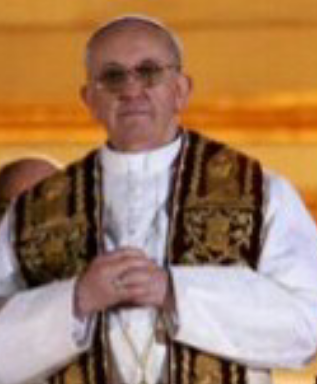
Antichrist will have an attending Pontiff:
Prophecy of Premol (496)
"..... And here it is that the King of Zion (Pope) along with his cross, with his sceptre and his triple crown, shaking off, on the ruins, the dust of his shoes, hastens to flee towards other shores. And is it not so, 0 Lord, that Your Church is rent asunder by her own children?
The sons of Zion are divided into two camps; one faithful to the fugitive Pontiff, and the other inclined or disposed to the government of Zion respecting the Sceptre, but breaking in pieces the triple crown.
"But my spirit wanders and my eyes become obscured at the sight of this terrible cataclysm. But the Spirit said to me, that the man who hopes in God does penance, because the all powerful and merciful God will draw the world out of confusion and a new world will commence. Then the Spirit said to me: 'Here is the beginning of the end of Time which begins!' And I awoke terrified."
The Old Italian prophecy speaks of, "the White Pope and the Black Pope" who shall die during the same night.
Frederick William Faber (died 1863): Antichrist…Many believe in a demonical incarnation—this will not be so—but he will be utterly possessed…His doctrine as apparent contradiction of no religion, yet a new religion…He has an attending pontiff, so separating regal and prophetic office (Edward. Prophecy for Today. Imprimatur + A.J. Willinger, Bishop of Monterey-Fresno; Reprint: Tan Books and Publishers, Rockford (IL), 1984, p. 87).
Anna-Katarina Emmerick(19th century): The Church is in great danger…The Protestant doctrine and that of the schismatic Greeks are to spread everywhere. I now see that in this place (Rome) the (Catholic) Church is being so cleverly undermined, that there hardly remain a hundred or so priests who have not been deceived. They all work for the destruction, even the clergy. A great destruction is now at hand…I saw that many pastors allowed themselves to be taken up with ideas that were dangerous to the Church. They were building a great, strange, and extravagant Church. Everyone was admitted in it in order to be united and to have equal rights: Evangelicals, Catholics, sects of every description. Such was to be the new Church…I saw again a new and odd-looking Church which they were trying to build. There was nothing holy about it… (Dupont Y. Catholic Prophecy: The Coming Chastisement. TAN Books, Rockford (IL), 1973, pp. 66, 71, 116)
Yves Dupont {writer interpreting A. Emmerick}: They wanted to make a new Church, a Church of human manufacture, but God had other designs…An anti-pope shall be set up in Rome (Dupont, p. 116).
Oba Prophecy: It will come when the Church authorities issue directives to support a new cult, when priests are forbidden to celebrate in any other, when the highest positions in the Church are given to perjurers and hypocrites, when only the renegades are admitted to occupy those positions. (Dupont, p. 115)
Ted and Maureen Flynn (20th century): Catholic prophecy warns us of severe problems facing the papacy in these end times…chaos will be within our midst. An Antipope will seize papal authority…It will be those who hold fast to the truths of the faith who will be labeled as the perpetrators of this horrible schism, according to some visionaries. (Flynn Ted and Maureen. The Thunder of Justice. MaxKol Communications, Inc. Sterling (VA), 1993, p. 255)
Jeanne le Royer (d. 1798): I see that when the Second Coming of Christ approaches a bad priest will do much harm to the Church (Culligan E. The Last World War and the End of Time. The book was blessed by Pope Paul VI, 1966. TAN Books, Rockford (IL), p. 128).
Bl. Anna-Maria Taigi (19th century): At the end, he will have the gift of miracles (Birch DA. Trial, Tribulation & Triumph: Before During and After Antichrist. Queenship Publishing Company, Goleta (CA), 1996, pp. 362-363).
Saint Zenobius (died 285): Antichrist will work a thousand prodigies on earth. (Connor, p. 73)
Priest O’Connor (20th century?): This final false prophet will be a bishop of the church and will lead all religions into becoming one. (The False Prophet. Living in the Final Generation. http://www.geocities.com/rebornempowered/ApparitionsofMary.htm 10/12/07)
Priest Paul Kramer (21st century): The errors of Orthodoxy and of Protestantism will be embraced by that false church, it will be an ecumenical church because the Anti-Pope will be recognized by the world—not by the faithful, but by the world—by the secular world and the secular governments. (Kramer P. The Imminent Chastisement for Not Fulfilling Our Lady’s Request. An edited transcript of a speech given at the Ambassadors of Jesus and Mary Seminar in Glendale, California.
Blessed Joachim (died 1202): Towards the end of the world Antichrist will overthrow the Pope and usurp his See (Connor, p. 76).
St. Francis of Assisi (d. 1226): There will be an uncanonically elected pope who will cause a great Schism, there will be divers thoughts preached which will cause many, even those in the different orders, to doubt, yea even agree with those heretics which will cause My order to divide, then will there be such universal dissentions and persecutions that if these days were not shortened even the elect would be lost (Culleton, p. 130).
Gregory the Great, Pope (d. 604): In those days, near the end…an army of priests and two-thirds of the Christians will join the Schism. (Culleton, R. Gerald. The Reign of Antichrist, p. 122)
Yves Dupont {reader and collector of Catholic prophecies}: “prophecies are quite explicit about the election of an anti-pope…Many prophecies predict an anti-pope and a schism” (Dupont, pp. 34,60-61)
G. Rossi (1873): We must observe that St. Malachy does not mention the last Pope as a distinct person from the preceding one, whom he styles Glory of the Olive. He merely says, “During the last persecution of the Church, Peter II, a Roman, shall reign. He shall feed the flock in many tribulations, at the end of which the City of the Seven Hills (Rome) will be destroyed, and the awful Judge shall judge his people.” According to St. Malachy, then, only ten, or at most eleven, popes remain to be in future more or less legitimately elected. We say more or less legitimately elected, because out of those future popes it is to be feared that one or two will be unlawfully elected as anti-popes. (Rossi, p. 139)
Priest E. Sylvester Berry (20th century) As indicated by the resemblance to a lamb, the prophet will probably set himself up in Rome as a sort of antipope during the vacancy of the papal throne . . .(Berry E.S. The Apocalypse of St. John. First published 1921. http://journals.aol.com/langosh5/Father_E_Sylvester_Berry/ 10/12/07)
Priest Herman Kramer (20th century): In accord with the text this is unmistakably a PAPAL ELECTION . . . But at this time the great powers may take a menacing attitude to hinder the election of the logical and expected candidate by threats of a general apostasy, assassination or imprisonment of this candidate if elected. This would suppose an extremely hostile mind in the governments of Europe towards the Church, because an extended interregnum in the papacy is always disastrous and more so in a time of universal persecution. If Satan would contrive to hinder a papal election, the Church would suffer great travail … one…destined for the papacy at the time will institute the needed reforms. A general council may decree the reforms…The lax clergy at the time will extol the conditions then existing…The dragon is a symbolic term for the evil world powers…They will try to make the Church a “state church” everywhere. This is only possible if they can subject the pope to their wills and compel him to teach and rule as they direct. That would be literally devouring the papacy. (Kramer H.B. L. The Book of Destiny, pp. 278,285).
Bishop Malachy (12th century): During the persecution of the Holy Roman Church, there will sit upon the throne, Peter the Roman…the City of Seven Hills (Rome) will be utterly destroyed (Culleton, R. Gerald. The Prophets and Our Times. Nihil Obstat: L. Arvin. Imprimatur: Philip G. Scher, Bishop of Monterey-Fresno, November 15, 1941. Reprint 1974, TAN Books, Rockford (IL), p. 138).
We are witnessing the gradual emergence of a new humanitarian religion which proposes man, instead of God, as the object of worship. This "religion for progress," as Teilhard de Chardin referred to it, is anti-supernatural. Robert Hugh Benson describes it in his classic "The Lord of the World" thusly:
"Humanitarianism...is becoming the an actual religion itself, though anti-supernatural. It is a Pantheism. Pantheism deifies all nature, God is the world, but naturally, man above all is God since he is the highest expression of nature. It is a religion devoid of the 'super' natural, because since God is nature itself, there is no longer a distinction between Creator and creature. The creature is God and hence arbitrator of his own destiny and establishes the moral law for himself. Nature, and man is its highest expression, has all the divine attributes. Humanitarianism is a religion devoid of the supernatural. It is developing a ritual under Freemasonry; it has a creed, 'God is man'; and the rest. It has, therefore, a real food of a sort to offer religious cravings: it idealizes, and yet makes no demands upon the spiritual faculties. Then, they have the use of all the churches except ours, and of all the Cathedrals; and they are beginning at last to encourage sentiment. Then they may display their symbols and we may not..."
Marxism was an expression of the humanitarian religion. It worshipped society and the state symbols of the party: Lenin, Stalin and Mao. National Socialism deified the state and its Fuhrer Adolph Hitler. Today the United States is moving toward Socialism and that "..supreme religious deception..that of the Antichrist, a pseudo-messianism by which man glorifies himself in place of God and of his Messiah come in the flesh." (Catechism of the Catholic Church, 675).
Albert Drexel, in Ein Neuer Prophet? (Stein am Rhein: Christiana, 1971) explains that: "The modernism or neo-modernism within Christianity, and especially within the Roman Catholic Church after the Second Vatican Council, is above all characterized by a turning away from the supernatural and an exclusive predilection for this world, the Aggiornamento of Pope John XXIII interpreted one-sidedly and hence misapplied. Teilhard's ideology was was a definitive precondition for this. Inasmuch as he turned his back to the past, fused God and the supernatural with the process of a universal evolutionism, and proclaimed religion to be an active participation in a progressive development ending in Point Omega, the basis was given for a humanist cult of the secular." (p. 115).
In the New World Order, man will no longer believe in a God whom he cannot control. Man will worship himself and his new leader who will, like Hitler, be deified: the man spoken of by Saint Paul as the Man of Sin, the Son of Perdition. This world ruler will not tolerate anyone who adores any god other than himself. As Romano Guardini has noted, "The ultimate aim of all aims will be to prove that existence without Christ is possible - nay rather, that Christ is the enemy of existence, which can be fully realized only when all Christian values have been destroyed.." (The Lord, p. 513).
Pray to the Immaculata. The Man of Sin will soon reveal himself. And his False Prophet will be there to welcome him with open arms as will the United Nations.


Thursday, September 24, 2015
Pope Francis: Avoid polarization and be on fire for this world
On fire to build man's world.
Malachi Martin, in his book “The Jesuits: The Society of Jesus and the Betrayal of the Roman Catholic Church,” says that, “Those who..know the history of Liberation Theology..may point out that Gutierrez’s work [Father Gustavo Gutierrez, author of A Theology of Liberation] was inspired by a 1968 Conference of Latin American bishops at Medellin, near Bogota, in Colombia, where the delegates highlighted the plight of the poor, and the needy to remedy their awful conditions…
Essentially, Liberation Theology is the answer to that summons to the Church codified so many years before by Maritain – to identify itself with the revolutionary hopes of the masses. The difference, perhaps, insofar as there is one, is that while Maritain adopted a theology of history built on a misapprehension of Marxist philosophy, Liberation Theologians adopted a theology of politics built on Soviet tactics. In essence, the propagators of Liberation Theology took the current of theological thought developed in Europe and applied it to the very concrete situations in Latin America. Suddenly, theological and philosophical theory became the pragmatic proposals and actual programs for changing the face of all social and political institutions in Latin America….
Liberation Theology turned its back on the entire scope of Scholastic Theology, including what was sound in Maritain. It did not base its reasoning on papal teaching, or on the ancient theological tradition of the Church, or on the Decrees of the Church’s Ecumenical Councils. In fact, Liberation Theology refused to start where Councils and Popes had always started: with God as Supreme Being, as Creator, as Redeemer, as Founder of the Church, as the One Who had placed among men a Vicar who was called the Pope, as Ultimate Rewarder of the Good and Punisher of the Evil. Rather, Liberation Theology’s basic presumption was ‘the people,’ sometimes indeed ‘the people of God.’ ‘The people’ were the source of spiritual revelation and religious authority. What mattered in theology was how ‘the people’ fared here and now, in the social, political, and economic realities of the evolving material world. The ‘experience of the people was the womb of theology,’ was the consecrated phrase.
At one stroke, therefore, Liberation Theology unburdened prepared and restless minds from an entire panoply of ancient concepts, dogmas, and mental processes governed by the fixed rules of Thomistic reasoning, and from the directives of the authoritative voice of Rome…Liberation Theology was no theology in the Roman Catholic sense of the word. It was not primarily about God, about God’s law, about God’s redemption, about God’s promises. Liberation Theology was interested in God as revealed today through the oppressed people. In God for himself, practically speaking, no genuine Liberation Theology was interested.
The second promise of Liberation Theology was even more exciting than freedom from Rome’s theology..” (The Jesuits: The Society of Jesus and the Betrayal of the Roman Catholic Church, pp. 308-309).
Under the banner of “liberation,” many in the Church’s hierarchy began to enlist the Church’s resources to advance the Marxist plan of revolution. Having abandoned the Church’s supernatural mission – building the Kingdom of God, these confused clerics began to turn exclusively toward a new goal: that of building a new world centered on man, a City of Man.
Fr. Martin explains how the Jesuits succumbed to this apostasy: “Classical Jesuitism, based on the spiritual teaching of Ignatius, saw the Jesuit mission in very clear outline. There was a perpetual state of war on earth between Christ and Lucifer. Those who fought on Christ’s side, the truly choice fighters, served the Roman Pontiff diligently, were at his complete disposal, were ‘Pope’s Men.’ The ‘Kingdom’ being fought over was the Heaven of God’s glory. The enemy, the archenemy, the only enemy, was Lucifer. The weapons Jesuits used were supernatural: the Sacraments, preaching, writing, suffering. The objective was spiritual, supernatural, and otherworldly. It was simply this: that as many individuals as possible would die in a state of supernatural grace and friendship with their Savior so that they would spend eternity with God, their Creator…
The renewed Jesuit mission debased this Ignatian ideal of the Jesuits. The ‘Kingdom’ being fought over was the ‘Kingdom’ everyone fights over and always has: material well-being. The enemy was now economic, political, and social: the secular system called democratic and economic capitalism. The objective was material: to uproot poverty and injustice, which were caused by capitalism, and the betterment of the millions who suffered want and injustice from that capitalism. The weapons to be used now were those of social agitation, labor relations, sociopolitical movements, government offices…” (The Jesuits, p. 478).
In this light, we can better understand Pope Francis' speech before Congress. The Pope called on Americans to open themselves to the world and not to see things in terms of good and evil, the righteous and unrighteous. This, of course, is unscriptural. (See 2 Corinthians 6: 14, 15 and Ephesians 5: 11 for example).
As Fr. Vincent Miceli, S.J., explained in his essay on Call to Action entitled “Detroit: A Call to Revolution in the Church”: “The following are some of the demands the Church simply cannot fulfill for such is not her mission: 1. Wipe out poverty, ignorance, prejudice and war. 2. Democratize the whole world. 3. Stop the sale of arms everywhere. 4. Back the E.R.A. as a constitutional amendment. Like her Saviour, the Church will not turn stones into bread, thereby becoming the Mother of Socialism or a millennium of this world..’
"..the 'theologies of liberation', which reserve credit for restoring to a place of honor the great texts of the prophets and of the Gospel in defense of the poor, go on to a disastrous confusion between the 'poor' of the Scripture and the 'proletariat' of Marx. In this way they pervert the Christian meaning of the poor, and they transform the fight for the rights of the poor into a class fight within the ideological perspective of the class struggle. For them the 'Church of the poor' signifies the Church of the class which has become aware of the requirements of the revolutionary struggle as a step toward liberation and which celebrates this liberation in its liturgy." (Congregation for the Doctrine of the Faith, "Instruction on Certain Aspects of the 'Theology of Liberation,'" No. 10).
The supernatural faith of Catholicism is being watered down for the sake of a new humanitarian religion. Dialogue is key for this new religion which has abandoned the notion that we must, "Let love be without dissimulation. Hating that which is evil, cleaving to that which is good." (Romans 12: 29).

Wednesday, September 23, 2015
Pope Francis: Do you want to pray the Creed?
Dorothy Sayers, in her classic work Creed or Chaos, reminds us that, "The Christian faith is the most exciting drama that ever staggered the imagination of man — and the dogma is the drama.
That drama is summarised quite clearly in the creeds of the Church, and if we think it dull it is because we either have never really read those amazing documents, or have recited them so often and so mechanically as to have lost all sense of their meaning. The plot pivots upon a single character, and the whole action is the answer to a single central problem: What think ye of Christ?
The Church's answer is categorical and uncompromising, and it is this: That Jesus Bar-Joseph, the carpenter of Nazareth, was in fact and in truth, and in the most exact and literal sense of the words, the God "by Whom all things were made." His body and brain were those of a common man; His personality was the personality of God, so far as that personality could be expressed in human terms. He was not a kind of dæmon or fairy pretending to be human; He was in every respect a genuine living man. He was not merely a man so good as to be "like God" — He was God…This is the dogma we find so dull — this terrifying drama of which God is the victim and hero.
If this is dull, then what, in Heaven's name, is worthy to be called exciting? The people who hanged Christ never, to do them justice, accused Him of being a bore — on the contrary; they thought Him too dynamic to be safe. It has been left for later generations to muffle up that shattering personality and surround Him with an atmosphere of tedium. We have very efficiently pared the claws of the Lion of Judah, certified Him "meek and mild," and recommended Him as a fitting household pet for pale curates and pious old ladies. To those who knew Him, however, He in no way suggested a milk-and-water person; they objected to Him as a dangerous firebrand."
For authentic Christians then, the Creeds are essential. They are our response to the question, "What think ye of Christ?"
But for Pope Francis, the Creed seems to be of little importance. As related here, when challenged on some of his views (which many consider far to the left), Francis responded, "..if they want me to recite the Creed, I can!"
It was Archbishop Fulton Sheen who cautioned, "The modern man must decide for himself whether he is going to have a religion with thought or a religion without it. He already knows that thoughtless policies lead to the ruin of society, and he may begin to suspect that thoughtless religion ends in confusion worse confounded.
The problem is simple. The modern man has two maps before him: one the map of sentimental religion, the other the map of dogmatic religion. The first is very simple. It has been constructed only in the last few years by a topographer who has just gone into the business of map making and is extremely adverse to explicit directions. He believes that each man should find his own way and not have his liberty taken away by dogmatic directions. The other map is much more complicated and full of dogmatic detail. It has been made by topographers who have been over every inch of the road for centuries and know each detour and each pitfall. It has explicit directions and dogmas such as, 'Do not take this road - it is swampy,' or 'Follow this road; although rough and rocky at first, it leads to a smooth road on a mountaintop.'
The simple map is very easy to read, but those who are guided by it are generally lost in a swamp of mushy sentimentalism. The other map takes a little more scrutiny, but it is simpler in the end, for it takes you up through the rocky road of the world's scorn to the everlasting hills where is seated the original Map Maker, the only One who ever has associated rest with learning: 'Learn of Me...and you shall find rest for your souls.'
Every new coherent doctrine and dogma add to the pabulum for thought; it is an extra bit of garden upon which we can intellectually browse; it is new food into which we can put our teeth and thence absorb nourishment; it is the discovery of a new intellectual planet that adds fullness and spaciousness to our mental world. And simply because it is solid and weighty, because it is dogmatic and not gaseous and foggy like a sentiment, it is intellectually invigorating, for it is with weights that the best drill is done, and not with feathers.
It is the very nature of a man to generate children of his brain in the shape of thoughts, and as he piles up thought on thought, truth on truth, doctrine on doctrine, conviction on conviction, and dogma on dogma, a very coherent and orderly fashion, so as to produce a system complex as a body and yet one and harmonious, the more and more human he becomes. When, however, in response to false cries for progress, he lops off dogmas, breaks with the memory of his forefathers, denies intellectual parentage, pleads for a religion without dogmas, substitutes mistiness for mystery, mistakes sentiment for sediment, he is sinking back slowly, surely, and inevitably into the senselessness of stones and into the irresponsible unconsciousness of weeds. Grass is broad-minded. Cabbages have heads - but no dogmas."
A religion with thought or a religion without it. Which do you think Francis advances?
Related reading here.

That drama is summarised quite clearly in the creeds of the Church, and if we think it dull it is because we either have never really read those amazing documents, or have recited them so often and so mechanically as to have lost all sense of their meaning. The plot pivots upon a single character, and the whole action is the answer to a single central problem: What think ye of Christ?
The Church's answer is categorical and uncompromising, and it is this: That Jesus Bar-Joseph, the carpenter of Nazareth, was in fact and in truth, and in the most exact and literal sense of the words, the God "by Whom all things were made." His body and brain were those of a common man; His personality was the personality of God, so far as that personality could be expressed in human terms. He was not a kind of dæmon or fairy pretending to be human; He was in every respect a genuine living man. He was not merely a man so good as to be "like God" — He was God…This is the dogma we find so dull — this terrifying drama of which God is the victim and hero.
If this is dull, then what, in Heaven's name, is worthy to be called exciting? The people who hanged Christ never, to do them justice, accused Him of being a bore — on the contrary; they thought Him too dynamic to be safe. It has been left for later generations to muffle up that shattering personality and surround Him with an atmosphere of tedium. We have very efficiently pared the claws of the Lion of Judah, certified Him "meek and mild," and recommended Him as a fitting household pet for pale curates and pious old ladies. To those who knew Him, however, He in no way suggested a milk-and-water person; they objected to Him as a dangerous firebrand."
For authentic Christians then, the Creeds are essential. They are our response to the question, "What think ye of Christ?"
But for Pope Francis, the Creed seems to be of little importance. As related here, when challenged on some of his views (which many consider far to the left), Francis responded, "..if they want me to recite the Creed, I can!"
First of all, the Creed is a prayer. It should be prayed and not simply recited. Secondly, we should possess the desire to pray the Creed, and not simply recite it as some sort of formula to convince others that we really believe.
It was Archbishop Fulton Sheen who cautioned, "The modern man must decide for himself whether he is going to have a religion with thought or a religion without it. He already knows that thoughtless policies lead to the ruin of society, and he may begin to suspect that thoughtless religion ends in confusion worse confounded.
The problem is simple. The modern man has two maps before him: one the map of sentimental religion, the other the map of dogmatic religion. The first is very simple. It has been constructed only in the last few years by a topographer who has just gone into the business of map making and is extremely adverse to explicit directions. He believes that each man should find his own way and not have his liberty taken away by dogmatic directions. The other map is much more complicated and full of dogmatic detail. It has been made by topographers who have been over every inch of the road for centuries and know each detour and each pitfall. It has explicit directions and dogmas such as, 'Do not take this road - it is swampy,' or 'Follow this road; although rough and rocky at first, it leads to a smooth road on a mountaintop.'
The simple map is very easy to read, but those who are guided by it are generally lost in a swamp of mushy sentimentalism. The other map takes a little more scrutiny, but it is simpler in the end, for it takes you up through the rocky road of the world's scorn to the everlasting hills where is seated the original Map Maker, the only One who ever has associated rest with learning: 'Learn of Me...and you shall find rest for your souls.'
Every new coherent doctrine and dogma add to the pabulum for thought; it is an extra bit of garden upon which we can intellectually browse; it is new food into which we can put our teeth and thence absorb nourishment; it is the discovery of a new intellectual planet that adds fullness and spaciousness to our mental world. And simply because it is solid and weighty, because it is dogmatic and not gaseous and foggy like a sentiment, it is intellectually invigorating, for it is with weights that the best drill is done, and not with feathers.
It is the very nature of a man to generate children of his brain in the shape of thoughts, and as he piles up thought on thought, truth on truth, doctrine on doctrine, conviction on conviction, and dogma on dogma, a very coherent and orderly fashion, so as to produce a system complex as a body and yet one and harmonious, the more and more human he becomes. When, however, in response to false cries for progress, he lops off dogmas, breaks with the memory of his forefathers, denies intellectual parentage, pleads for a religion without dogmas, substitutes mistiness for mystery, mistakes sentiment for sediment, he is sinking back slowly, surely, and inevitably into the senselessness of stones and into the irresponsible unconsciousness of weeds. Grass is broad-minded. Cabbages have heads - but no dogmas."
A religion with thought or a religion without it. Which do you think Francis advances?
Related reading here.

Tuesday, September 22, 2015
Cardinal Sean O'Malley: It was a privilege and a joy to celebrate Mass under the picture of a devil
Cardinal Sean O'Malley on celebrating Mass under the picture of mass murderer and Socialist terrorist Che Guevara:
"Today we had the privilege and the joy to attend Pope Francis' Mass in Havana in the Plaza de la Revolución under the picture of his fellow Argentine Che Guevara. Hundreds of thousands of people from Cuba, and from beyond, gathered with the Holy Father for this great event."
Privilege and joy to celebrate Holy Mass under the picture of a Socialist terrorist and mass murderer?
Michael Totten explains the bizarre worship of the lunatic Guevara, "Che Guevara has the most effective public relations department on earth. The Argentine guerrilla and modern Cuba’s co-founding father has been fashioned into a hipster icon, a counter-cultural hero, an anti-establishment rebel, and a champion of the poor. As James Callaghan once put it, “A lie can be halfway round the world before the truth has got its boots on.”
The truth about Che now has its boots on. He helped free Cubans from the repressive Batista regime, only to enslave them in a totalitarian police state worst than the last. He was Fidel Castro’s chief executioner, a mass-murderer who in theory could have commanded any number of Latin American death squads, from Peru’s Shining Path on the political left to Guatemala’s White Hand on the right.
“Just as Jacobin Paris had Louis Antoine de Saint-Just,” wrote French historian Pascal Fontaine, “revolutionary Havana had Che Guevara, a Latin American version of Nechaev, the nineteenth century nihilist terrorist who inspired Dostoevsky’s The Devils. As Guevara wrote to a friend in 1957, ‘My ideological training means that I am one of those people who believe that the solution to the world’s problems is to be found behind the Iron Curtain.’…He was a great admirer of the Cultural Revolution [in China]. According to Regis Debray, ‘It was he and not Fidel who in 1960 invented Cuba’s first corrective work camp,’ or what the Americans would call a slave labor camp and the Russians called the gulag.”
This is the devil whose image Cardinal Sean O'Malley found to be a joy and a privilege to worship under.
The cult of demons. This is preparation for Antichrist. Father Pascal Huchede writes, "...how shall he [Antichrist] deprive the world of Christianity and have himself adored as God? Alas, it is only too true that the minds and hearts of men are admirably disposed for revolution and consequently ready to accept and bear the cruel yoke of such a tyrant..." And then, after noting that men will abandon the reasonable and supernatural religion of Jesus Christ to worship the demon, Fr. Huchede adds, "What frightful immorality (see here) must follow in the train of this shameless prostitution of religion! Never has the threefold concupiscence made greater ravage among mankind. And this is the religion sought and hoped for as the cherished boon of the aspirations of our modern free thinkers." (History of Antichrist, pp. 13-14).


"Today we had the privilege and the joy to attend Pope Francis' Mass in Havana in the Plaza de la Revolución under the picture of his fellow Argentine Che Guevara. Hundreds of thousands of people from Cuba, and from beyond, gathered with the Holy Father for this great event."
Privilege and joy to celebrate Holy Mass under the picture of a Socialist terrorist and mass murderer?
Michael Totten explains the bizarre worship of the lunatic Guevara, "Che Guevara has the most effective public relations department on earth. The Argentine guerrilla and modern Cuba’s co-founding father has been fashioned into a hipster icon, a counter-cultural hero, an anti-establishment rebel, and a champion of the poor. As James Callaghan once put it, “A lie can be halfway round the world before the truth has got its boots on.”
The truth about Che now has its boots on. He helped free Cubans from the repressive Batista regime, only to enslave them in a totalitarian police state worst than the last. He was Fidel Castro’s chief executioner, a mass-murderer who in theory could have commanded any number of Latin American death squads, from Peru’s Shining Path on the political left to Guatemala’s White Hand on the right.
“Just as Jacobin Paris had Louis Antoine de Saint-Just,” wrote French historian Pascal Fontaine, “revolutionary Havana had Che Guevara, a Latin American version of Nechaev, the nineteenth century nihilist terrorist who inspired Dostoevsky’s The Devils. As Guevara wrote to a friend in 1957, ‘My ideological training means that I am one of those people who believe that the solution to the world’s problems is to be found behind the Iron Curtain.’…He was a great admirer of the Cultural Revolution [in China]. According to Regis Debray, ‘It was he and not Fidel who in 1960 invented Cuba’s first corrective work camp,’ or what the Americans would call a slave labor camp and the Russians called the gulag.”
This is the devil whose image Cardinal Sean O'Malley found to be a joy and a privilege to worship under.
The cult of demons. This is preparation for Antichrist. Father Pascal Huchede writes, "...how shall he [Antichrist] deprive the world of Christianity and have himself adored as God? Alas, it is only too true that the minds and hearts of men are admirably disposed for revolution and consequently ready to accept and bear the cruel yoke of such a tyrant..." And then, after noting that men will abandon the reasonable and supernatural religion of Jesus Christ to worship the demon, Fr. Huchede adds, "What frightful immorality (see here) must follow in the train of this shameless prostitution of religion! Never has the threefold concupiscence made greater ravage among mankind. And this is the religion sought and hoped for as the cherished boon of the aspirations of our modern free thinkers." (History of Antichrist, pp. 13-14).


Saturday, September 19, 2015
Remembering Joe Melanson and his thoughts regarding the Church in eclipse
Fifteen years ago today, my father celebrated his true birthday and went to be with the Lord. My father believed, as I do, that the Church had entered a time of eclipse and that a great Chastisement was on the way (see here).
My father was a very happy, upbeat man. As am I. But he didn't go through life with blinders on [I inherited that quality from him], refusing to see what so many others DO refuse to see: That so many are losing the faith and abandoning the Faith of our Fathers while pretending nothing has changed.
These are perilous times. Even in Rome, the Faith is in crisis, see here and here for example. There is need for much prayer and divine intervention. And so I recommend the Rosary of Our Lady of Tears:
The Rosary of Our Lady of Tears
Our Lady of Tears to Sr. Amalia: "Through this rosary the devil will be conquered and the power of hell will be destroyed."
Our Lady spoke to Sister Amalia: "Do you know why I wear a blue mantle? To remind you of heaven, when you are feeling weary from your labors, and carrying the cross of your tribulations. My mantle reminds you of heaven, to give you indescribable joy and eternal happiness , and this will give courage to your soul and peace to your heart, to continue the struggle until the end!" Do you understand the significance of my purple-violet tunic? I will tell you that you should remember, as you stand before the image of Tears, of the colors I wear, purple signifies pain. The pain the Jesus felt when they beat him, barbarically, on his body. My mother's heart and my soul were also lacerated by pain, on seeing Jesus.""My child, I will explain to you why I wear this white veil , around my breast and covering my head. White signifies purity, and being the white flower of the Holy Trinity, I could appear without this whiteness. The sweet smile you see traced on my lips is for the immense happiness to be able to give mankind such a precious treasure!"
"I will explain to you the reason I appear with my eyes inclined downward. Inspired painters have recorded my eyes looking upward to sing the glory of my immaculate conception. Then why are my eyes inclined downward in this apparition, into which you entrust yourself to my blessed tears? It signifies my compassion toward humanity, because I have come from heaven to alleviate your suffering. My eyes will always be directed to your sorrows and afflictions, whenever you ask my Son through the tears I shed. And as you are near my image, see that I gaze at you with eyes of compassion and tenderness."
"My child, I will tell you about the rosary in my hands. I have named it the Crown (chaplet) of Tears . When you are near me, seeing this chaplet in my hands, remember that it signifies mercy, love, and pain... this chaplet of my blessed tears signifies that your Mother loves you. Use all its privileges, resort to it with confidence and love."
(Source: Catholic Devotions)
Pray this often as a powerful spiritual weapon against the devil.
How to Pray the Rosary of Our Lady of Tears
The rosary transmitted to Sister Amalia by the Mother of God consists of forty-nine white beads, which is divided into seven parts by seven larger beads of the same color -- similar to the rosary of the seven sorrows of Mary. At the end, there are attached three more small beads and a medal of our dear Lady of Tears. Through these instructions we are directed to honor Mary our Mother on account of her sorrows, for which she shed many tears. The medal of our Lady of Tears is an essential part of the rosary, but it must be the way it was revealed to Sister Amalia by the Mother of God on April 30, 1930. In Germany, this medal is made with the specified inscription in all the European languages.
On the Medal to Jesus
(flipside of Medal of Our Lady's Tears)O crucified Jesus, we fall at Your feet and offer You the tears of the one, who with deep compassionate love accompanied You on Your sorrowful way of the Cross. O good Master, grant that we take to heart the lessons which the tears of Your most holy Mother teach us, so that we may fulfill Your holy will on earth, that we may be worthy to praise and exalt You in Heaven for all eternity. Amen+
In Place of the Our Father: (and on the final three beads) V. O Jesus, look upon the tears of the one who loved You most on earth,R. And loves You most ardently in heaven.
In Place of the Hail Mary: V. O Jesus, listen to our prayers,R. For the sake of the tears of your most Holy Mother.
On the Medal to Mary: O Mary, Mother of Love, Sorrow and mercy, we beseech you to unite your prayers with ours so that Jesus, your Divine Son, to whom we turn, may hear our petititons in the name of your maternal tears, and grant us, not only the favors we now ask, but the crown of everlasting life. Amen+
Promises
1. Jesus to Sr. Amalia: ""If you want to receive favors, ask me for the sake of My Mother's tears."
2. "My daughter, whatever people will beg Me for the sake of the tears of My Mother, I shall lovingly grant them. "
3. Later, My Mother will hand over this treasure to our beloved Institute as a Magnet of mercy." This took place on November 8, 1929
4. Mary to Sr. Amalia: "My Son wants to honor me in a special way through these invocations, and so, He will grant all graces that are begged for the sake of my tears."
5. "This rosary will provide for the conversion of many sinners, especially those possessed by the devil."
6. "Through this rosary the devil will be conquered and the power of hell will be destroyed. Get ready for this great battle."
(Source, Pamphlet Our Dear Lady of Tears.ImprimaturBuchweiser, Gen. - Bit.Munchen, 22. Marz 1935)

My father was a very happy, upbeat man. As am I. But he didn't go through life with blinders on [I inherited that quality from him], refusing to see what so many others DO refuse to see: That so many are losing the faith and abandoning the Faith of our Fathers while pretending nothing has changed.
These are perilous times. Even in Rome, the Faith is in crisis, see here and here for example. There is need for much prayer and divine intervention. And so I recommend the Rosary of Our Lady of Tears:
The Rosary of Our Lady of Tears
Our Lady of Tears to Sr. Amalia: "Through this rosary the devil will be conquered and the power of hell will be destroyed."
Our Lady spoke to Sister Amalia: "Do you know why I wear a blue mantle? To remind you of heaven, when you are feeling weary from your labors, and carrying the cross of your tribulations. My mantle reminds you of heaven, to give you indescribable joy and eternal happiness , and this will give courage to your soul and peace to your heart, to continue the struggle until the end!" Do you understand the significance of my purple-violet tunic? I will tell you that you should remember, as you stand before the image of Tears, of the colors I wear, purple signifies pain. The pain the Jesus felt when they beat him, barbarically, on his body. My mother's heart and my soul were also lacerated by pain, on seeing Jesus.""My child, I will explain to you why I wear this white veil , around my breast and covering my head. White signifies purity, and being the white flower of the Holy Trinity, I could appear without this whiteness. The sweet smile you see traced on my lips is for the immense happiness to be able to give mankind such a precious treasure!"
"I will explain to you the reason I appear with my eyes inclined downward. Inspired painters have recorded my eyes looking upward to sing the glory of my immaculate conception. Then why are my eyes inclined downward in this apparition, into which you entrust yourself to my blessed tears? It signifies my compassion toward humanity, because I have come from heaven to alleviate your suffering. My eyes will always be directed to your sorrows and afflictions, whenever you ask my Son through the tears I shed. And as you are near my image, see that I gaze at you with eyes of compassion and tenderness."
"My child, I will tell you about the rosary in my hands. I have named it the Crown (chaplet) of Tears . When you are near me, seeing this chaplet in my hands, remember that it signifies mercy, love, and pain... this chaplet of my blessed tears signifies that your Mother loves you. Use all its privileges, resort to it with confidence and love."
(Source: Catholic Devotions)
Pray this often as a powerful spiritual weapon against the devil.
How to Pray the Rosary of Our Lady of Tears
The rosary transmitted to Sister Amalia by the Mother of God consists of forty-nine white beads, which is divided into seven parts by seven larger beads of the same color -- similar to the rosary of the seven sorrows of Mary. At the end, there are attached three more small beads and a medal of our dear Lady of Tears. Through these instructions we are directed to honor Mary our Mother on account of her sorrows, for which she shed many tears. The medal of our Lady of Tears is an essential part of the rosary, but it must be the way it was revealed to Sister Amalia by the Mother of God on April 30, 1930. In Germany, this medal is made with the specified inscription in all the European languages.
On the Medal to Jesus
(flipside of Medal of Our Lady's Tears)O crucified Jesus, we fall at Your feet and offer You the tears of the one, who with deep compassionate love accompanied You on Your sorrowful way of the Cross. O good Master, grant that we take to heart the lessons which the tears of Your most holy Mother teach us, so that we may fulfill Your holy will on earth, that we may be worthy to praise and exalt You in Heaven for all eternity. Amen+
In Place of the Our Father: (and on the final three beads) V. O Jesus, look upon the tears of the one who loved You most on earth,R. And loves You most ardently in heaven.
In Place of the Hail Mary: V. O Jesus, listen to our prayers,R. For the sake of the tears of your most Holy Mother.
On the Medal to Mary: O Mary, Mother of Love, Sorrow and mercy, we beseech you to unite your prayers with ours so that Jesus, your Divine Son, to whom we turn, may hear our petititons in the name of your maternal tears, and grant us, not only the favors we now ask, but the crown of everlasting life. Amen+
Promises
1. Jesus to Sr. Amalia: ""If you want to receive favors, ask me for the sake of My Mother's tears."
2. "My daughter, whatever people will beg Me for the sake of the tears of My Mother, I shall lovingly grant them. "
3. Later, My Mother will hand over this treasure to our beloved Institute as a Magnet of mercy." This took place on November 8, 1929
4. Mary to Sr. Amalia: "My Son wants to honor me in a special way through these invocations, and so, He will grant all graces that are begged for the sake of my tears."
5. "This rosary will provide for the conversion of many sinners, especially those possessed by the devil."
6. "Through this rosary the devil will be conquered and the power of hell will be destroyed. Get ready for this great battle."
(Source, Pamphlet Our Dear Lady of Tears.ImprimaturBuchweiser, Gen. - Bit.Munchen, 22. Marz 1935)

Subscribe to:
Posts (Atom)
