The dissent group calling itself "Voice of the Faithful" (VOTF) is now well-known for issuing statements which are highly ambiguous and more often than not nonsensical. This is not a criticism directed at the people who belong to VOTF. It is simply an observation.
By way of example, VOTF has the following posted at their website: "In July of 2002, the VOTF Representative Council created a working group to define what VOTF means by its Goal 3 [referring to structural change]." - Source: http://www.voiceofthefaithful.org/Structural_Change/structural.html
This SCWG, which stands for "Structural Change Working Group" (it's important to use acronymns when you want to impress others that you mean business, sounds more authoritative), held meetings. And after much deliberation, this SCWG came to the conclusion that: "The problems which have come to light in the present crisis are more truly cultural than structural ones." (Same link cited above).
You see folks, even when an individual or a group of persons is engaging in dishonesty, the truth has a way of coming out. The truth has a power of its own. It will not be suppressed. VOTF's "Structural Change Working Group," formed to define exactly what the organization means by "structural change," wound up declaring that the sexual abuse crisis is largely due to cultural factors and not the structural make-up of the Church. Ironic isn't it?
For those of you who haven't read my last article at Faithfulvoice.com regarding structural change and VOTF, it may be found here: http://www.faithfulvoice.com/humble.htm
Paul
Tuesday, July 25, 2006


Monday, July 24, 2006
From Mr. Michael Brown at Spirit Daily
Small wonder that Our Lady of La Salette was seen to be weeping. Our loving Mother is heartbroken over the fact that so many of her children rebel (dissent from) her Son's Church and engage in the spirit of contention which Mr. Brown speaks of in his article.
Let us all strive to imitate St. Rita of Cascia, who is also known as the peacemaker. For those of you who are not familiar with her story: http://www.saintritachildren.com
The Church's authentic peace, as Pope John XXIII reminded us, is always at war with every kind of sin and error. But we must never be at war with one another! Remember the words of St. Augustine: interficere errorem, diligere errantem: kill the error, love the one who errs. This is the road to a sure peace. Our war is with the principalities and powers who incite hatred, jealousy and every kind of strife among men.
Being a peacemaker isn't for the faint of heart. It requires courage. Glorious courage. And it is always committed to the truth while respecting the person who may be in error. There is no contradiction here. Jesus shows us the way. While He never backed down in fear when it came time to defend the truth, He never returned an insult when He was insulted.
If only we had Our Lord's patience. The patience He displayed when others laughed at Him, mocked Him, spat on Him, beat and scourged Him and crucified Him. Wonderful patience Lord. Teach me Your patience. Help me to die to self so that it is only You Who lives in me Lord Jesus. So that I may always respond to every action and word of hatred and violence directed at me with love only.
Amen.
Paul
Let us all strive to imitate St. Rita of Cascia, who is also known as the peacemaker. For those of you who are not familiar with her story: http://www.saintritachildren.com
The Church's authentic peace, as Pope John XXIII reminded us, is always at war with every kind of sin and error. But we must never be at war with one another! Remember the words of St. Augustine: interficere errorem, diligere errantem: kill the error, love the one who errs. This is the road to a sure peace. Our war is with the principalities and powers who incite hatred, jealousy and every kind of strife among men.
Being a peacemaker isn't for the faint of heart. It requires courage. Glorious courage. And it is always committed to the truth while respecting the person who may be in error. There is no contradiction here. Jesus shows us the way. While He never backed down in fear when it came time to defend the truth, He never returned an insult when He was insulted.
If only we had Our Lord's patience. The patience He displayed when others laughed at Him, mocked Him, spat on Him, beat and scourged Him and crucified Him. Wonderful patience Lord. Teach me Your patience. Help me to die to self so that it is only You Who lives in me Lord Jesus. So that I may always respond to every action and word of hatred and violence directed at me with love only.
Amen.
Paul
Sunday, July 23, 2006
Saturday, July 22, 2006
DAILY PRAYER TO THE SACRED HEART OF JESUS
Sacred Heart of Jesus
today I wish to live in You,
in Your grace,
in which I desire at all costs to persevere.
Keep me from sin
and strengthen my will by helping me to keep watch over my senses,
my imagination, and my heart.
Help me to correct my faults which are the source of sin.
I beg You to do this,
O Jesus, through Mary,
Your Immaculate Mother.
(Indulgence, 5 years; plenary, under usual conditions, for month's recitation).
Sacred Heart of Jesus
today I wish to live in You,
in Your grace,
in which I desire at all costs to persevere.
Keep me from sin
and strengthen my will by helping me to keep watch over my senses,
my imagination, and my heart.
Help me to correct my faults which are the source of sin.
I beg You to do this,
O Jesus, through Mary,
Your Immaculate Mother.
(Indulgence, 5 years; plenary, under usual conditions, for month's recitation).
Prayer for our Bishop
Heavenly Father,
in these trying times when the spirit of the age threatens Christian values,
give our bishop holiness of life and wisdom to direct and guide our diocesan family
so that we may grow in your love.
We ask this through Christ our Lord.
Amen.
in these trying times when the spirit of the age threatens Christian values,
give our bishop holiness of life and wisdom to direct and guide our diocesan family
so that we may grow in your love.
We ask this through Christ our Lord.
Amen.
Diocese of Manchester: More Parishes to Close
"We're in a crisis..." - Rev. Nicholas Rogers as quoted in the Union Leader.
While the Diocese of Manchester is experiencing a dire shortage of priests and religious vocations in general, those dioceses which have remained faithful to Magisterial teaching are thriving. Case in point: the Diocese of Lincoln, Nebraska.
Although the Diocese of Lincoln covers a rather large area geographically speaking, the Catholic population there is relatively small at approximately 82,000. However, unlike the Diocese of Manchester which serves a Catholic population of approximately 310,000 - see http://www.catholicchurchnh.org/docs/doc308.pdf - the Diocese of Lincoln is not suffering from a vocations crisis. This simply because the diocese is doing what every Catholic diocese should be doing: teaching and defending the Magisterial teaching of the Church.
According to Father T.I. Thorburn, the Chancellor of the Lincoln Diocese, in the last five years or so 19 young men have been ordained priests and there are currently 46 young men in seminary studies for the diocese. There are 114 diocesan priests in active ministry and 71 of these were ordained after 1967. Also, there have been no defections from the priesthood since 1976.
Father Thorburn also notes that, "Three diocesan communities of women religious serve in the Diocese of Lincoln. In 1993, six young women made First Profession of Vows, and three made Final Profession. These Sisters wear a traditional religious habit and are primarily involved in the teaching apostolate. They enjoy growth each year...In the area of Catholic education, the Diocese of Lincoln operates six central Catholic high schools, 23 parochial elementary schools, and one school for the mentally handicapped. Instead of following the national trend of closing Catholic schools, the Catholic school system in the Diocese of Lincoln has grown in number of schools in operation and total enrolment...Great care has been taken to preserve the integrity of Catholic doctrine and formation in the Catholic school and parish CCD programs in the Diocese....The Diocese of Lincoln propagates the Church's teaching concerning marriage and sexuality, as taught by Pope Paul VI in his encyclical Humanae Vitae. In support of this doctrine, the Diocese sponsors teachers to be trained as natural family planning instructors, maintains 11 training centres at convenient locations, includes this doctrine in its marriage preparation policy, and even instructs high school students about the message of Humanae Vitae through its religious education program." (Source: http://www.ad2000.com.au/articles/1993/sep1993p4_808.html ).
And you can be sure that, unlike the Diocese of Manchester NH, the Diocese of Lincoln Nebraska does not tolerate dissent groups such as VOTF. And it certainly wouldn't tolerate such a group conducting its meetings on Church property.
This is why, as the above mentioned article notes, a Cardinal from the Roman Curia commented that, "The Diocese of Lincoln is a very strong church." No Cardinal from the Roman Curia has made such a comment about the Diocese of Manchester, a diocese which continues to permit VOTF (which several Bishops have labelled "anti-Catholic") to meet on diocesan property and which has suffered from numerous sex abuse scandals over the past several years. According to an article in the Manchester Union Leader, "The Diocese of Manchester has told the West Side to expect only three priests by 2012."
I have said it many times in the past and I will repeat it until someone actually hears: The Lord Jesus doesn't bless infidelity. The solution to the many problems within the Diocese of Manchester will be found in a return to fidelity and prayer. All the task forces in the world won't solve our present difficulties. Nor will countless meetings. We can do NOTHING without the Lord Jesus....He has said so! However, "I can do all things in Him who strengthens me" (Phil 4:13).
Sacred Heart of Jesus, have mercy on us. Immaculate Heart of Mary, pray for us.
God love you,
Paul Anthony Melanson
While the Diocese of Manchester is experiencing a dire shortage of priests and religious vocations in general, those dioceses which have remained faithful to Magisterial teaching are thriving. Case in point: the Diocese of Lincoln, Nebraska.
Although the Diocese of Lincoln covers a rather large area geographically speaking, the Catholic population there is relatively small at approximately 82,000. However, unlike the Diocese of Manchester which serves a Catholic population of approximately 310,000 - see http://www.catholicchurchnh.org/docs/doc308.pdf - the Diocese of Lincoln is not suffering from a vocations crisis. This simply because the diocese is doing what every Catholic diocese should be doing: teaching and defending the Magisterial teaching of the Church.
According to Father T.I. Thorburn, the Chancellor of the Lincoln Diocese, in the last five years or so 19 young men have been ordained priests and there are currently 46 young men in seminary studies for the diocese. There are 114 diocesan priests in active ministry and 71 of these were ordained after 1967. Also, there have been no defections from the priesthood since 1976.
Father Thorburn also notes that, "Three diocesan communities of women religious serve in the Diocese of Lincoln. In 1993, six young women made First Profession of Vows, and three made Final Profession. These Sisters wear a traditional religious habit and are primarily involved in the teaching apostolate. They enjoy growth each year...In the area of Catholic education, the Diocese of Lincoln operates six central Catholic high schools, 23 parochial elementary schools, and one school for the mentally handicapped. Instead of following the national trend of closing Catholic schools, the Catholic school system in the Diocese of Lincoln has grown in number of schools in operation and total enrolment...Great care has been taken to preserve the integrity of Catholic doctrine and formation in the Catholic school and parish CCD programs in the Diocese....The Diocese of Lincoln propagates the Church's teaching concerning marriage and sexuality, as taught by Pope Paul VI in his encyclical Humanae Vitae. In support of this doctrine, the Diocese sponsors teachers to be trained as natural family planning instructors, maintains 11 training centres at convenient locations, includes this doctrine in its marriage preparation policy, and even instructs high school students about the message of Humanae Vitae through its religious education program." (Source: http://www.ad2000.com.au/articles/1993/sep1993p4_808.html ).
And you can be sure that, unlike the Diocese of Manchester NH, the Diocese of Lincoln Nebraska does not tolerate dissent groups such as VOTF. And it certainly wouldn't tolerate such a group conducting its meetings on Church property.
This is why, as the above mentioned article notes, a Cardinal from the Roman Curia commented that, "The Diocese of Lincoln is a very strong church." No Cardinal from the Roman Curia has made such a comment about the Diocese of Manchester, a diocese which continues to permit VOTF (which several Bishops have labelled "anti-Catholic") to meet on diocesan property and which has suffered from numerous sex abuse scandals over the past several years. According to an article in the Manchester Union Leader, "The Diocese of Manchester has told the West Side to expect only three priests by 2012."
I have said it many times in the past and I will repeat it until someone actually hears: The Lord Jesus doesn't bless infidelity. The solution to the many problems within the Diocese of Manchester will be found in a return to fidelity and prayer. All the task forces in the world won't solve our present difficulties. Nor will countless meetings. We can do NOTHING without the Lord Jesus....He has said so! However, "I can do all things in Him who strengthens me" (Phil 4:13).
Sacred Heart of Jesus, have mercy on us. Immaculate Heart of Mary, pray for us.
God love you,
Paul Anthony Melanson
Friday, July 21, 2006
Wednesday, July 19, 2006
A thought for the day
"If you believe what you like in the gospels, and reject what you don't like, it is not the gospel you believe, but yourself."-- St. Augustine
Tuesday, July 18, 2006
Devotion to the Sacred Heart
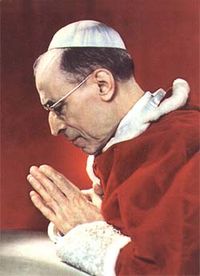
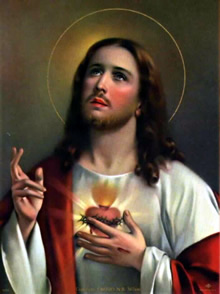
"...it is clear that the faithful must seek from Scripture, tradition and the sacred liturgy as from a deep untainted source, the devotion to the Sacred Heart of Jesus if they desire to penetrate its inner nature and by piously meditating on it, receive the nourishment for the fostering and development of their religious fervor. If this devotion is constantly practiced with this knowledge and understanding, the souls of the faithful cannot but attain to the sweet knowledge of the love of Christ which is the perfection of Christian life as the Apostle, who knew this from personal experience, teaches: "For this cause I bow my knees to the Father of our Lord Jesus Christ. . . that He may grant you, according to the riches of His glory, to be strengthened by His Spirit with might unto the inward man; that Christ may dwell by faith in your hearts; that, being rooted and founded in charity. . .you may be able to know also the charity of Christ which surpasseth all knowledge, that you may be filled unto all the fullness of God." The clearest image of this all-embracing fullness of God is the Heart of Christ Jesus Itself. We mean the fullness of mercy which is proper to the New Testament, in which "the goodness and kindness of God our Savior appeared," for "God sent not His Son into the world to judge the world, but that the world might be saved by Him."
- Pope Pius XII, Encyclical Letter Haurietis Aquas (On Devotion to the Sacred Heart), No. 100, May 15, 1956.
Monday, July 17, 2006
I shall always treasure the genius of Dietrich von Hildebrand and that of his wife Alice. Several years ago, I had a lovely conversation with this brilliant and incredibly articulate woman which I will never forget. At that time, she told me I should study German so that I might better appreciate the many nuances of Dietrich's writings in their original language. This I hope to accomplish in the near future.
I have read Dietrich's classic work entitled Transformation in Christ many times over. And I have always thought it a modern-day version of Thomas A. Kempis' Imitation of Christ. I treasure my copy even more now that Alice has autographed it. Below is an excellent article by Alice von Hildebrand on Christianity and the mystery of suffering. Astute readers will detect the influence of Gabriel Marcel (who shaped my own philosophy) on her thought. Of particular interest to me is what Dr. Hildebrand has to say about gratitude. Not only because this has been a core of my own philosophy, but because I believe gratitude (like reverence) to be a forgotten virtue these days.
This is all the more tragic because we all stand on the shoulders of giants. We all owe a debt of gratitude to those who have shaped us, whether in the intellectual or moral sphere. And, of course, our gratitude to God must be total. In Him we live and move and have our being. Our every breath is a gift from Him. Let us love the Cross. The Cross is our true school. Our gratitude toward God is shown by our embrace of the Cross.
Christianity and the Mystery of SufferingBy Alice Von Hildebrand
In his great novel The Brothers Karamazov, Dostoyevsky states that the earth is soaked from its crust to its centre with the tears of humanity. This fearful statement reflects a fact that only shallow optimism can deny. This earth is a vale of tears. At every hour of the day, all over the world, there are people who are suffering: be it hunger, be it sickness, be it bereavement, be it injustice, be it brutality, and be it lonesomeness, lack of love, be it despair. And suffering humanity raises the question: Why?
Man is made for happiness, that he longs for it with every fiber of his being, and that he keeps striving for it and hoping for it cannot be denied. This longing for happiness is deeply embedded in the human soul. It commands many of man's motivations and actions, yet happiness seems so elusive that the most fortunate human beings can only speak of moments of deep happiness. Who are they who can claim that their whole life is nothing but a continuous flow of overwhelming joy?
The greatest thinkers all raise the question: Why must man suffer? There is not one thinking being who is not tortured by a reality that, much as he tries, he can neither elude nor eliminate. Those who believe that happiness can be universally guaranteed by adhering to some new system of thought have usually been the instruments of greater unhappiness and of more formidable torments.
Often, men raise their fists and accuse God, their Creator, as the one responsible for the tears that water this earth. The reality of suffering seems to pose one of the most serious obstacles to the belief in God's existence. I know people who deny it for reasons that are so shallow that they do not deserve a refutation. Down-to-earth materialists are likely to reject his existence because they have never seen God under a microscope or through a powerful telescope. Such intellectual shallowness does not merit any notice.
However, when a person, confronting the intensity of real suffering, raises the question in despair: How can a God who is both infinitely good and infinitely powerful permit such tortures?, we face an insoluble mystery. Faith, however, can shed light upon it.
Our concern is not to address this challenge. We leave this to those whose spirituality and well-grounded theological knowledge equip them to do so. But one thing is certain: it is man's duty to search for the meaning of suffering, for every meaningless suffering, is it only the prick of a needle is unbearable.
The modest purpose of this lecture is to reflect on the meaning of suffering. Any ray of light shed on this mystery is bound to be a blessing for suffering humanity. However, the conviction that suffering is meaningless is bound to throw men into a state of revolt and despair.
One thing is certain: suffering is something terrible, something we all dread, something that does violence to our nature. Many people spend their lives trying to calculate how best they can escape from suffering. How many mean, wicked, or even criminal actions have been committed for the sake of evading possible sufferings! There are people who commit suicide because they can no longer face the intensity of their sufferings. Reading about the lives of people who have been locked up in prisons and concentration camps shows us that the temptation to take one's life is a "classic" temptation when suffering reaches a certain degree of intensity, with no end in sight. In his masterpiece Le Mie Prigioni, the pious Silvio Pellico relates that this temptation arose more than once during the ten years of his incarceration in various jails.
Our reflections here will be placed in a Christian framework. The Bible makes it plain that suffering came into the world as a punishment for the sin committed by our first parents. Prior to this dreadful moment, Adam and Eve had been placed in an earthly paradise from which they were banished forever as a punishment for their proud disobedience.
Suffering is a necessary consequence of sin. I am far from claiming that this will give us a key to our ridd1e, but at least it will place it in the right framework and will help us shed some light on this mystery. But suffering is but one consequence of original sin; these consequences were manifold, and theologians have elaborated on them at length. Let me simply underscore one that is particularly pertinent to our topic. Our intellect has been darkened by sin. Because of this darkening, the intellect is likely to misinterpret the very fact of suffering. The temptation to make God responsible for all our woes is a case in point, for we now tend to put the blame and responsibility for evil on someone else and not on ourselves. Adam put the blame on Eve; Eve told God that the serpent tempted her. Now, we, poor, nearsighted creatures, often choose to blame our Creator! Obviously sin is inconceivable in creatures that are deprived of intellect and will. The very fact that man has been given ontological freedom, that is, the capacity to make decisions for which he bears the full responsibility, enables him to make morally wrong and evil decisions, and this is what constitutes sin.
In granting man freedom, God has taken a tremendous risk -the risk that this human creature would abuse this gift. This, alas is what took place when Adam and Eve disobeyed God and tried to become gods without God. Plato is remarkable among the ancient philosophers in that he clearly rejects the grave error of making God responsible for evil. He writes: "We must fight to the last against any member of the cities of the Republic being suffered to speak of the Divine which is good, as being responsible for evil."
Plato's stand proves that even though man's intellect has been darkened by sin, nevertheless this same intellect, as long as it remains reverent and truth-seeking, is capable of perceiving how false it is to escape from moral responsibility by putting the blame on God.
But the danger remains, and, alas, too many turn against God with defiance and make him responsible for evil.
Throughout the centuries, great minds have addressed themselves to the question we are now raising, and many of them have contributed deep and illuminating thoughts on the subject. Nevertheless, the reality of evil and suffering remains a mystery.
Gabriel Marcel, to his credit, makes a distinction between what he calls "problem" and what he calls "mystery". Basically, a problem is an objective difficulty, outside of myself, that can be solved, and eventually will be solved. A mystery- and Marcel limit his discussion here to natural mysteries-is an enigma closely related to myself, and even though light can be shed on it, the dimension of mystery will always remain. It is a classic human temptation to try to treat a mystery as a problem and to force a solution on something that can never be completely clarified on this earth.
A case in point is Marxism. It is Marx' claim that suffering is caused by economic, social, and political injustice. Some grab too much of the earth's resources, to the detriment of others, the proletariat. This unfair unbalance can be corrected by making the all-powerful state the sole possessor of money and property. The state will then distribute wealth equitably and open the door to an earthly paradise.
We need not elaborate on this view. History has effectively shown that Marxism leads to gulags-another word for earthly hells.
Buddhism too offers a solution to the "problem" of suffering, Solution that is much serious to the Marxistic one because it is more spiritual. But it is also fraught with dangers. Like the latter, it challenges one to a radical change of perspective, not in the sphere of economics but in one's attitude toward existence.
The Buddha promises the elimination of suffering to those who, following his doctrine, adopt the right attitude toward human life and give the right response to what this life truly is. Suffering need not be. It is a consequence of a wrong way of interpreting facts; by correcting this distortion, one is guaranteed liberation from this evil. The Buddha was born a prince. Anxious to protect their son form the woes of human existence, his parents placed him in a palace, where he was shielded from whatever was depressing or sad. But one day the young man managed to leave the palace's enclosure and, within a short span of time made the acquaintance of poverty, sickness, and death. These experiences shook him to the very depth of his being and revealed to him in a flash what was to become the very core of his doctrine: namely, that human existence is to be equated with suffering. Consequently, suffering is ineludable as long as man allows himself to be enslaved by a craving for existence. It is by a radical transformation of one's outlook on the meaning and nature of life that one is offered a promise of salvation and liberation from the chains of suffering.
This is to be achieved by stifling within oneself this innate craving for existence, for all emotions that trigger pain are to be traced back to it. The Sakyamuni achieved this feat by a radical desubstantiation and depersonalisation of whatever we experience. In other words, man's spontaneous interpretation of reality is totally distorted. He must correct his intellectual vision and understand that the word- as he sees it- is an illusion. He who obediently follows the technique taught by the Buddha is promised liberation and will enter Nirvana. How different from the Judeo-Christian teaching that after creating the world God saw " that it was very good". How far removed from the Gloria of the Mass resounding with the joy that "heaven and earth are full of God's glory"! To the Christian, the world is good, but, because of sin, it has become a "vale of tears". To the Buddhist, existence is negative and must therefore be transcended. To the Christian, life is a tremendous gift, and even though it implies suffering, this suffering has a deep meaning that transfigures it.
That Buddhism always has had and still has an enormous appeal cannot be denied. Not only does it promise liberation from the fearful reality of suffering, but also, moreover, it offers concrete means of achieving this deliverance. It is up to us to enjoy an unruffled calm; it is up to us to become free from the shackles of suffering. For years, American campuses have been invaded by Oriental literature, inviting students to make the acquaintance of "transcendental meditation" and promising them a happiness that their materialistic outlook on life prevented them from enjoying. There is no doubt that very many of them have turned to the East in the hope of finding a peace that had previously eluded them.
There are various reasons that explain why many young people turn Eastward for a solution to the riddle of human existence and why it did not even occur to them to probe whether the Christian West had anything to offer to quench their spiritual thirst.
First, for years the West has been in the throes of a severe spiritual crisis. A whole generation has been deprived of the benefits of an authentically Christian education. Alas, our youth are spiritually starving, be it because their religion classes have given them stones instead of bread, be it because of the desacralization widespread in our churches. Men cannot live from bread alone. Is it surprising that young people turned to the golden promises offered by the mysterious East? It is there that they hope to find wisdom, sacredness, a sense of mystery from which they have been deprived in the Western world, bogged down in its dazzling scientific accomplishments, coupled with a complete desacrilization of human life and a positivistic elimination of the mysteries of human existence, be it love, birth, or death.
Moreover, Buddhism offers us spirituality stripped of humility, and this is terribly tempting to fallen man. There is no need to recognize one's guilt, to acknowledge oneself to be a sinner, desperately in need of help. All we need do is to discover that our outlook on human existence has been erroneous and correct this misconception by means of the wise teaching of the Buddha. In other words, man is capable of achieving self-redemption. There are two things that we human beings fear more than anything else: suffering and humiliation. And these two fearful things are precisely eliminated in Buddhism: one is promised liberation from suffering, and, simultaneously, one does not need to recognise oneself to be a miserable sinner, constantly in need of divine help. On the contrary, one can achieve "self- redemption" by one's own efforts. But let us not forget that the attempt to become gods without God (self-redemption) is original sin.
There is an abyss separating Christianity and Buddhism- something that has been clearly seen by Chesterton. True, in the two "religions" these are striking similarities, but as my late husband often remarked, there are "false" similarities. Let me mention but two of them: both in Buddhism and in Christianity, one can speak of a "metanoia", of a need to correct and change one's vision. But whereas in Buddhism this "metanoia" refers exclusively to the correction of a "cosmic illusion" that makes us believe in the substantiality and the individuality of things, in Christianity this "metanoia" consists of shedding the illusions about ourselves that our pride has nurtured and humbly turning to God for help. The first is an intellectual metanoia; the second is essentially a moral metanoia, based on humility.
Another misleading similarity is to be found in the sentence "love your neighbour as yourself". In the Buddhist world- a world that is systematically depersonalised and desubstantialized-there is room neither for true love nor for reciprocity. Man having no "self", he can in fact love neither himself nor his neighbour. The famous Buddhist "compassion" is essentially an ascetic practice that aims at detaching oneself from all things. But in Buddhism-as Cardinal Henri de Lubac, S.J., has remarked-love of neighbour, far from being a response to the lovableness of our neighbor, image of God; is in fact a means of liberation.
In contrast, the very core of Christianity is to be found in the existence of a personal God who is love, a God who has created the world and made man to his image and likeness. Each human being is a unique, irreplaceable person and not a cosmic illusion. Love is the ultimate secret of Christianity; and love of neighbour is a partaking in God's love for another human creature and not a necessary step in the process of radical detachment from cosmic illusions.
The Buddha was a great pedagogue and knew that hatred, envy, revenge, trigger "negative" emotions that deprive one of the calm that is essential to liberation. His pragmatism taught him that he alone could enjoy inner peace who has freed himself from the claws of an illusive reality.
If we compare a statue of the Buddha, with his enigmatic smile, irradiating unruffled calm, and the tortured figure of Christ on the Cross, we are bound to raise the question: How can anyone choose to follow the latter? For on the one hand, we are promised self-redemption and the elimination of suffering; on the other, we are promised humility and the cross. Are Christians masochists, as Simone de Behaviour claims? Do they have a perverse attraction for suffering and humiliation? If she is wrong, how is one to explain that millions and millions of human beings have chosen to follow Christ to Calvary, to carry their cross, for Christ said, "Let him who wishes to become my disciple, carry his cross and follow me"? In order to answer this question, we ought to realise that there is a "mystery" of suffering on which no light can be shed as long as we view it as problem to be solved. The perennial temptation to believe that man can find a key that will enable him to eliminate suffering remains. Again and again, politicians try to sell their ideal of "a New World Order" or "a new age" in which justice and peace will reign. But nothing is said about sin. The necessity of purifying oneself first and foremost is usually left very much in the shade, and most do not even perceive any connection between world peace and the elimination of moral evil.
The modest framework of this talk does not allow us to examine in any detail the attitude of the Greeks toward suffering. We shall limit ourselves to saying that the early Greeks saw suffering as an expression of the wrath of the gods. For some reason, they targeted an individual and placed him in a situation that would lead to dreadful sufferings and ultimately bring about his downfal.
A Greek proverb found in Euripides, "Quos vult Jupiter perdere, dementat prius" (Jupiter renders insane the person he wants to destroy), illumines this position and is strikingly expressed in some of the great Greek tragedies of the fifth century B.C.
But in Plato, as we saw, we find an intellectual awakening that, by refining its conception of God, refuses to make him responsible for human woes. Plato rightly sees that man is responsible for moral evi1, which in its turn inevitably leads to suffering.
The Chosen People established a link between sin and suffering. Throughout the Old Testament we see that unfaithfulness to God leads to punishment and therefore suffering. This sacred book is pervaded throughout by a deep sense of man's need for redemption-a redemption that he cannot achieve unaided.
But it is our claim that Christianity not only gives a unique meaning to suffering but also teaches its disciples the art of suffering. Let us first examine briefly how Christianity teaches men the art of suffering.
1. Elimination of Illegitimate SufferingsThe first step is to eliminate what my late husband used to call "illegitimate suffering", that is, a type of suffering that, painful as it might be, need not be suffered at all, provided the patient adopts the right attitude toward God and toward life. A few examples will shed light on this.
a. Vanity
There are what we might call "self-manufactured" sufferings. In her novel "Pride and Prejudice", Jane Austen illustrates admirably this type of illegitimate suffering. I am referring to the ludicrous character of Mrs. Bennet, the mother of five girls, who gives vent to her bitter disappointment over the fact that her neighbour has won the contest of matchmaking. Upon finding that this neighbour's oldest daughter just got engaged, she exclaims, "Nobody is on my side, nobody takes part with me. I am cruelly used. ...Nobody can tell what I suffer! But it is always so, those who do not complain are never pitied. ... Lady Lucas will have a daughter married before I have." Do I need to add that she needs handkerchief and smelling salts, and that her somewhat cynical husband offers her very little sympathy?
Obviously such an. explosion of feelings triggers our laughter, and rightly so. There is no doubt that Mrs. Bennett is close to hysterics, but it is just as clear that there is no objective reason whatever for her antics. That her silly vanity should be wounded by the news is true indeed, but this does not justify the intense, purely subjective suffering that she is undergoing. If she were not eaten up by vanity, she would not suffer at all. Much as we try, we cannot commiserate with her. All we can achieve is charitably to control our hilarity. She suffers, but she need not suffer at all. The fact that someone gets engaged is a ground for rejoicing, not one for going into hysterics. What Mrs. Bennett is undergoing is triggered by her own fault. It would be simple to eliminate this "suffering" by disavowing her vanity and fighting against her self-centeredness.
Years ago, my late husband and I visited an elderly Spanish aristocrat who told us what she considered to be the bitterest day of her life. She was eighteen and was going to her first ball. She came from a rich family and already had several beautiful pieces of jewellery. She was convinced that she was going to be the queen of the ball. But upon entering the ballroom, she saw one of her acquaintances whose attire and jewels were much more beautiful than hers. All of a sudden, all the joyful anticipating that she had experienced turned to bitterness and gall. The glittering lights dimmed, the music seemed discordant: she was wounded in her vanity. She repeated, "It was the most bitter day of my life."
Obviously this story also brings one to laughter. It seems ridiculous that such an insignificant event can fill a person with rancour. But vanity, another sad fruit of original sin, is so ingrained in fallen man that a lack of recognition of our "merits" can fill our souls with gall. How many authors cannot stand to read the book reviews written about them; how many composers are led to despair by a lack of appreciation of their work? How many intellectuals become sour because their "genius" (real or imaginary) is not properly appreciated? How many women would sell their souls to be called the most beautiful, the most elegant, and the most graceful of creatures?
Vanity is a bottomless object of inspiration for the writers of comedies, because it is ridiculous. We all tend to overestimate ourselves and assume that we possess admirable qualities that, in fact, are in no way ours. The discrepancy between what we would like to be and what we are, and how others gauge us, is bound to create a hiatus that is extremely painful. There is a very simple answer: humility. It is incredible how many suffering are unknown to the humble person who, thank to God's grace, has overcome his innate narcissism. It is high time that a book is written entitled Humility, the Key to Mental Sanity. We are not denying that the person whose vanity has been wounded suffers intensely, but the whole question is: Is this suffering inevitable?
b. Hypersensitivity
There are people who are highly sensitive. In dealing with them one must always be on the lookout for fear of offending them. They are likely to interpret negatively every word one says. A big problem can develop out of the most innocuous remark.
One cannot change the temperament with which one is born, but one can either freely choose to become the slave of one's temperament or learn to guide it in such a fashion that this sensitivity-which is a gift-is used for love and not put at the service of self-centeredness.
There are plenty of "feelings" (such as moods) that arise in us spontaneously that should not be taken seriously. There are "right" feelings (such as contrition, love, compassion), and these feelings should be sanctioned by our will; and there are wrong feelings (such as envy, anger, revenge), and these feelings should be "disavowed" and rejected by our will.
There is no doubt that hypersensitivity-a disproportionate response to daily events-is a great source of suffering. There are persons who groan from morning to night under the weight of imaginary offenses. But man has been given reason, and he ought to distinguish between real offenses (which should be forgiven) and imaginary ones, which should be "dashed to pieces on the Rock that is Christ".
Great sensitivity is a precious gift, but the meaning of this gift is to be other-centered; its caricature is to be self-centered. We all prefer sensitive persons to those who seem to have a bovine temperament. Nothing disturbs the latter because they are too thick-skinned to feel anything. But sensitivity is to be purified. This is beautifu1ly exemplified in the life of St. Therese of Lisieux. From the time that she was four, when she lost her mother, until she was thirteen, Therese was so hypersensitive that she broke into tears for no reason at all. In her autobiography, she calls these nine years "the sorrowful years", even though she was leading a life that, to many of us, would seem ideal, surrounded by a saintly father, to whom she was bound by the most tender affection, by loving sisters, living in security and peace. Yet in her autobiography she refers to those years as being "sorrowful", whereas from the time she entered the Carmel, where she chose a life of suffering and crucifixion, she enjoyed a deep peace despite the constant trials a Carmelite confronts. Her sensitivity had not decreased; it had been purified. By eliminating illegitimate sufferings, she gained the strength for carrying her daily cross in peace and joy.
Therese had prayed for years that God might grant her the grace of putting her sensitivity at his service, and God granted her request after midnight Mass shortly before she turned thirteen.
Hypersensitivity becomes an illegitimate source of suffering when it is self-centered; as we saw, a sensitive heart is given to us to feel for others, and to love them more deeply and more tenderly. But since original sin, it tends to degenerate into a maudlin self-centeredness that not is only disastrous but also causes great pain for the sensitive person.
However, thanks to prayer and grace, the Christian is given the means of purifying his sensitivity, so that his heart will resemble more and more the Heart of the God-Man, the Sacred Heart, "fornax ardens caritatis".
c. Self-will
One of the keenest sources of suffering, and one that is strikingly illegitimate, is self-will. Being persons, we have received the immense gift of having a free will. But this gift is, alas, often misused. Instead of realizing that it is given to us freely to serve and love our Creator, we are tempted to believe that it entitles us to think of ourselves as having the right of doing whatever we please, because we please.
We all have wishes and desires. Assuming that they are morally legitimate, we are entitled to pursue them. But the legitimacy of our desires does not guarantee that we can reach our goal. Much as we try to attain certain ends, numerous are the factors that are not under our control and contravene our plans. The temptation, then, is likely to arise in us to consider ourselves to be the hapless victims of an unjust fate and to suffer intensely because our will has not succeeded in controlling the flow of human events. Surprising as it may sound, there are people who suffer more intensely from the fact that they have been unable to reach the aim they have set to themselves than from the frustration of their desire. In other words, the opposition to what they want is often worse for them than the loss of the object they want to attain. The "I wanted it" then becomes an absolute. Maybe this aim was not important, but the very fact that a person wanted to attain it and has not succeeded riggers a state of rage that is very painful.
St. Therese of Lisieux once again teaches us how to overcome this type of suffering: "I have never wanted anything except what God wanted". By fully conforming her will with God's will she no only eliminated a source of illegitimate suffering; she also, not having drained her strength through illegitimate suffering, had the spiritual vigour necessary to carry the heavy crosses that God had chosen to place on her way to holiness.
We tend to forget that man is a creature and that his free will was not given to him to become the slave of his arbitrary wishes and desires but to serve God. It is incredible how an obstruction of one's desires can throw a person off balance. We all know people who go into tantrums like badly brought-up children when their wishes are contravened. I am deeply convinced that a large chunk of human sufferings is to be traced back to this defeat of our will. But it should be obvious that if man is free to set his mind upon a certain aim, he is also free to let it go and choose not to will it. The fact that a person desperately wanted to take a trip and that this was not granted to him offers him the opportunity of renouncing it freely and in so doing of liberating himself from the "cross" of having his will kept in check. In other words, it is up to the individual to liberate himself from a weight that he himself has placed upon his own shoulders. Alas, since original sin, this stubborn self- will is so deeply ingrained in us that Kierbegaard does not hesitate to say that even though we may love another person ardently, we still are tempted to love our own will more that beloved. The saints are those whose will fully conforms to God's will; this is why they are "free", and this is why they can carry tremendous burdens with peace and joy- nay, with apparent ease.
d. Self Pity
Another source of illegitimate suffering is self-pity, and yet, it is a trap into which most of us are likely to fall as soon as we are afflicted by great (or even small) evils. The reaction of our fallen nature is to feel incredibly sorry for ourselves to dwell upon our woes, to magnify them, to keep a ledger of all the sufferings that we are endured since our very youth-and then, crushed by this impressive catalogue of woes, to feel entitled to wallow in self-pity.
The sad thing about self-pity is that it bogs us down into a mire of tragic memories, many of which are amplified by a wild imagination. Finally, we succeed in convincing ourselves that no one-absolutely any one-has ever endured such torments; no one has ever been so unfairly treated. (Jean-Jacques Rousseau's Confessions are most revealing in this respect.) This conviction, in its turn, depletes us of all the strength that God has given us to carry whatever cross has been put on our shoulders. Self-pity is a sort of psychological leak that is bound to lead to the collapse of the person who has fallen into its grips.
Good psychologists would all agree that self-centeredness and self-pity are first cousins, and that the best cure to free oneself from their tentacles is to turn to others, to get interested in their sorrows, to try to heal their wounds. But those who wallow in self-pity, far from showing interest in other persons' problems, often are particularly callous and hard-hearted. Somehow, they feel that anyone's claim to compassion is an offence directed against themselves-they that alone truly deserves to be pitied. They want to prove to themselves and to the world that they alone know suffering, that they alone deserve sympathy; they alone are victims in the full-fledged sense of this term.
But Christianity invites us to contemplate Christ dying on the Cross out of love for us. And this very contemplation will lead us say with the good thief, "We are receiving the due reward of our deeds; but this man has done nothing wrong."
e. Envy
Envy is one of the ugliest traits affecting man as a fallen creature. The envious person is deeply unhappy over the fact that another person possesses something of which he himself is deprived. In some cases, envy is "remedied" when the envious person manages to be on a par with the object of his envy. Sadly enough, there are many cases in which the envious person is deprived of what he previously possessed. It is a well-known fact that if everybody were poor, poverty would not be considered to be such a terrible evil. This is strikingly formulated in the Italian proverb "Mal commune, messo gaudio" (a common woe is half a joy).
The envious person suffers tortures; one says that a person is "green" with envy. It is even bound to affect a person's health because; like a subtle poison; it penetrates into a person's soul and his soul inevitably will affect his body.
Envy is an ugly trait, but, alas, very widespread. Envy is constantly used as a tool of political propaganda, to whip up the envy of the have-nots toward those who enjoy rich possessions. It is a favoured tool of communist propaganda. But once again, this pain which like a thorn penetrates into our very being is something that we allow to tear us to pieces. To paraphrase Dietrich von Hildebrand: as free beings, we have the capacity to disavow these illegitimate feelings, to refuse to acknowledge them as our valid position toward others and, in so doing, to, "decapitate" them, prevent them from producing their venom, and liberate ourselves from their chains.
f. Pride
This vice is probably the worst source of illegitimate sufferings and often leads to what Kierkegaard so aptly calls the despair of defiance.
Pride is the sin par excellence, and alas, since the fall of our first parents, it is the very stuff of which we are made. It is not our purpose to discuss this vice. Spiritual writers have been eloquent on the subject. All we wish to do is to show that pride, in all its forms, causes unbearable sufferings in the proud man and can actually lead him to despair.
I shall limit myself to brief remarks concerning the difficulty that a proud man has of saying the words "thank you" and "forgive me". These words rank among the most important in the human vocabulary, and yet the proud man detests them, for "thank you" implies recognition that we are indebted to another person. In thanking him, we acknowledge that we are his debtors and therefore in an inferior position toward him; this is something insufferable to the proud man. He wants to be in command; he wants to be in the superior position; he does not want to owe anything to anyone. Alas, I know people, who refuse to taste the sweetness of the words "thank you", which embody our gratitude toward those from whose goodness we have benefited.
Proud people live in a constant state of cramp and tension. They; like all of us; often need other persons' help, but it is fascinating to watch the detours that they invent in order to get help without undergoing the humiliation of asking for it.
The words "thank you" are so precious because they express perfectly man's metaphysical situation. For, as St. Paul wrote: "What have you that you did not receive?" and the same apostle admonishes us to "abound in thanksgiving". The proud, ungrateful heart is always unhappy, for there is an indissoluble bond between gratitude and happiness; nay, gratitude is a key to happiness.
The agonies experienced by a proud man have been strikingly formulated by Kierkegaard, who, describing the satanically proud man, writes: "Even if at this point God in heaven and all his angels were to offer to help him out of it, now he does not want it, now it is too late, he once would have given everything to be rid of this torment but was made to wait, now that's all past, now he would rather rage against everything, he the one man in the whole of existence who is the most unjustly treated, to whom it is especially important to have his torment at hand, important that no one should take it from him; for thus he can convince himself that he is in the right". The devilishly proud man not only is incapable of saying "thank you", but he is still more incapable of saying "forgive me". For to ask for forgiveness is to recognise that we have sinned toward God and offended other human beings. In saying "forgive me", we therefore acknowledge our sinfulness and our guilt. This is something that to a proud man is unbearable. That he suffers incredibly cannot be denied, what he is going through is truly demonic. But why put up with this crushing suffering when it is self-inflicted? In order to change his course, the proud man would need help; God's help; and this is precisely that for which he refuses to beg. In some perverse fashion, he prefers, as Kierkegaard has shown, the tortures of hell to calling for assistance, and he truly suffers hell. For hell is hatred, ingratitude, resentment, and there is no doubt that many people already taste hell on this earth.
Once again Christianity offers us the answer: it is by contemplating the God-Man, he who took the form of a slave and endorsed our humanity so that we could partake of his Divinity, that the wounds caused by our pride may be healed and that we may to rejoice in being nothing, so that he can be everything in us.
2. The Meaning of Suffering
Quite apart from the pains we inflict upon ourselves through our wrong responses, illegitimate sufferings will necessarily drain our energy to such an extent that we no longer have the strength to shoulder the real crosses that God sends us on our way to salvation.
He will only send us his graces for real, legitimate sufferings if we ask for it. It is futile to expect that God will send us special help to carry pains that are self-manufactured.
There are people whose lives are, humanly speaking, easy and peaceful, and yet they always complain and try to convince us that they truly are martyrs.
But there are people who carry enormous burdens with peaceful cheerfulness and, in spite of crushing crosses, walk through life radiating a light of hope. We might discover after their deaths that they were in constant physical pain and were severely tried in their spiritual life, and yet nothing in their behaviour betrayed their secret. We only need read the life of a St. Teresa of Avila, who suffered from ill health throughout her life and whose spiritual trials were of such intensity that only her heroic collaboration with God's grace sustained her. St. Therese of Lisieux mentions that most nuns in the Carmel thought that her way was one strewn with roses, and yet she reveals the terrible and horrifying darkness through which she had to struggle for months on end. It is one of the great Christian mysteries that a person can radiate peace, hope, and even joy while undergoing terrible sufferings. Light is shed on this mystery when we realise that Christianity has given a unique meaning to suffering and this message is so wonderful that it testifies to the Divinity of its Founder. What other religion invites us to adore and recognise as God a being who was incarnated in the flesh, lived among men, was condemned to death, suffered agonising pains, and died crucified in the most atrocious torments? Where Christianity is, we find the God-Man, "who endured the cross, despising the shame". He was indeed the Man of sorrow, preannounced by Isaiah, "who was despised and rejected by men, … acquainted with grief". The Buddha taught the art of escaping from suffering. Muhammed enjoyed fame and recognition. Christ offers us the Cross. It is through the Cross that we have been saved, and it is the Cross that we must embrace if we wish to follow Christ into glory. Humanly speaking, it is impossible to be attracted by a religion that preaches suffering, renunciation, humility, and death to oneself. And yet the history of Christianity reveals that millions of people, throughout the ages, have abandoned everything to follow Christ to Calvary. This is not masochism, but a mystery, and the mystery is love. For "Deus caritas est" (God is love), and his love is so infinite that Christ chose suffering and death in order to save sinful humanity from eternal damnation.
Through Christ's sacrifice, the acceptance of suffering has now become a victorious expression of love; St. Paul speaks of it as a christian privilege: " For it has been granted to you that for the sake of Christ you should not only believe in him but also suffer for his sake." On this earth, love and suffering cannot be severed; however, it is not suffering that the Christian seeks; it is closeness to the Crucified.
Let us try to show why love and suffering are, on this earth, so deeply intertwined. Love is linked to suffering. He who starts loving will necessarily start suffering. In spite of the fact that to love and to be loved are the greatest sources of human happiness, to love on this earth, means also to worry about the loved one. As soon as a person starts loving, he realises all the perils to which his beloved is exposed and his incapacity to protect him. We all know too well that human life can be snuffed out in a second, that we are constantly exposed to dangers, to sickness, to accidents, to death, and as soon as a person becomes infinitely precious to us, we start trembling for him. I do not know a single mother worthy of this name who does not tremble when she faces the crib of her sick child. I do not know a single lover who does not have to fight against the fear that his beloved might be harmed, an unexplainable weakness, an undiagnosed sickness creates dread and aching. Love turns out to be a sweet and yet heavy burden that could easily become unbearable if the Christian could not turn to God and constantly confide his beloved to Christ, who loves him infinitely more than he himself could. For human love, deep as it is, is only a feeble echo of divine love.
3. The Desire to Share in a Loved One's Suffering
Moreover, it is impossible to love and not to wish to share the trials, sorrows, and sufferings of the loved one. When one loves, one says to the beloved, "From now on, all your joy are my joys; all your sorrows are my sorrows; all your pains are my pains." Gabriel Marcel expresses this strikingly when he writes: "Your death is my death."
On the religious plane, the best way of illuminating this thought is to contemplate the Holy Virgin at the foot of the Cross. All the apostles-except St. John, who came back- had fled. But the Holy Virgin remained, together with the holy women. And she remained because she loved more than the apostles did. For when a woman loves, she fears nothing. All theologians and spiritual writers agree that the Blessed Virgin, while standing at the foot of the Cross, was actually crucified with Christ. Every blow that he received, every nail that pierced his holy flesh, were duplicated in her. This is why she is called Coredemptrix. Her love drove her to share everything with the sacrificial Lamb. Having totally shared his passion, she now has a unique share in his glory.
On this earth, Christ is found on the Cross, and therefore the Christian embraces the Cross, not because he is attracted by tortures but because his Redeemer is there, agonising for our sins. Those who love him want to be with him, wherever he happens to be, and therefore they will joyfully shoulder his Cross with him. In eternity, Christ will be found in his glory, and then the theme will be eternal joy. It would be as erroneous to claim proximity to Christ on this earth while pursuing a life of pleasure and enjoyment as it would be to regret that heaven is beatitude and pine over its lack of suffering.
4. Sacrificing Oneself for the Loved One
But the most amazing link between love and suffering is to be found not only in sharing the sorrows and pains of the loved one but also in sacrificing oneself for his sake: "Indeed, there is no greater love than to give one's life for one's friends."
This is precisely what Christ did in accepting to take the form of a slave, and the ignominy of the Cross, in order to save us from eternal damnation. This deep and overwhelming truth has been understood by all the saintly souls who, through the centuries of Christian life, have joyfully embraced the Cross and chosen suffering "to complete what is lacking in Christ's afflictions". This is why several great mystics received the stigmata and offered their sufferings united with Christ for the salvation of their brothers. This is why the most severe religious orders (the Carthusians, the Carmelites, the Poor Clares), choose a life of constant suffering and sacrifice and joyfully accept to pay the debt of those who do not love.
When a Christian truly lives the joyful news of the Gospel and is granted the grace to love God and his neighbour in God, he not only is totally liberated from the unbearable weight of illegitimate sufferings but, moreover, becomes capable of carrying heavy crosses in peaceful joy. It is, indeed, this Christian "mystery" that transforms the world's "problem" of suffering.
The Christian not only shares the sufferings of the beloved of his soul while united by his own sufferings to Christ on the Cross but, moreover, shares with Christ in his redemptive act. While suffering, the Christian considers his own sufferings a privilege because they are transfigured by love. The Christian is supremely free in that he sees suffering as an expression of his love for Christ on this earth, and this freedom renders him capable to cry over those things that truly call for tears. For being purified by love, and in close union with the Crucified, he is able to perceive what the real sources of sorrow are, and echo St. Francis' lament that "the one great sorrow is that love is so little loved".
This is an edited version of a talk given by Mrs. Von Hildebrand at a Human Life International conference. Dr. Von Hildebrand was born in Brussels, Belgium in 1923 and she received her doctoral degree from Fordham University in 1949. Her 37 year teaching career was connected to Hunter College in New York. It included the positions of lecturer, instructor, assistant professor, and professor prior to her retirement from teaching in 1984. Dr. Con Hildebrand is a noted author and philosopher who has published books on her own and in conjunction with her husband, the late Dr. Dietrich Von Hildebrand. Most notable among these are: "Greek Culture", "The Adventure of the Human Spirit", "Introduction to Philosophy of Religion", "The Art of Living", "Morality and Situation Ethics", and "By Love Refined". She has lectured extensively throughout the United States, Canada, Mexico, and Europe. She is proficient in five languages, and is listed in many different categories of Who's Who publications. Included among her many awards for accomplishment are the Neumann Club's William O'Brien Award, the Dr. Honorus Causus Award from Franciscan University of Steubenville, and the President's Award in Excellence in Teaching.
Notes: 1. Pt. II, chap. 4. 2. Republic II, p. 380. 3. Etre et Alloir, pp. 16S-69, 183-2.S0. 4. Gcn 1:31. 5. A Latin translation of a line from Euripides. 6. Chap.2.S. 7. Dietrich von Hi1debrand, The Heart (Chicago: Franciscan Herald Press), I970). 8. The Ru1e of St. Benedict, Prologue. 9. Litany of the Sacred Heart. 10. Autobiography, Ms. C, Pt. II. 11. LK 23:4I. 12. Dietrich von Hildebrand, Ethics (cooperative Freedim), chap. 25. 13. Cajetan Maria of Bergamo, Humility of Heart (Tan). Transformation in Christ, (Sophia Institute Press), chap. VII, "Humility". 14. I Cor 4:7. 15. Col 2:7. 16. Sickness unto Death (New York: Doubleady, Anchor Books), pp. 205-6. 17. Phil 2:7. 18. Offertory of Holy Mass. 19. Autobiography, Ms. C, pt. I. 20. St. Paul, Heb I2:2. 21. Is 53:3ff. 22. I Jn 4:7, 8, I6. 23. Phil I:29. 24. Roger Troisfontaines, Sj., de l'Existence l'Etre: La philosophie de Gabriel Marcel, 2nd ed. (Brussels: Nauwelaers, S.A., I968), P.I42. 25. Jn I 5:I3. 26. Phil 2:7. 27. Col I:24.
Paul.
I have read Dietrich's classic work entitled Transformation in Christ many times over. And I have always thought it a modern-day version of Thomas A. Kempis' Imitation of Christ. I treasure my copy even more now that Alice has autographed it. Below is an excellent article by Alice von Hildebrand on Christianity and the mystery of suffering. Astute readers will detect the influence of Gabriel Marcel (who shaped my own philosophy) on her thought. Of particular interest to me is what Dr. Hildebrand has to say about gratitude. Not only because this has been a core of my own philosophy, but because I believe gratitude (like reverence) to be a forgotten virtue these days.
This is all the more tragic because we all stand on the shoulders of giants. We all owe a debt of gratitude to those who have shaped us, whether in the intellectual or moral sphere. And, of course, our gratitude to God must be total. In Him we live and move and have our being. Our every breath is a gift from Him. Let us love the Cross. The Cross is our true school. Our gratitude toward God is shown by our embrace of the Cross.
Christianity and the Mystery of SufferingBy Alice Von Hildebrand
In his great novel The Brothers Karamazov, Dostoyevsky states that the earth is soaked from its crust to its centre with the tears of humanity. This fearful statement reflects a fact that only shallow optimism can deny. This earth is a vale of tears. At every hour of the day, all over the world, there are people who are suffering: be it hunger, be it sickness, be it bereavement, be it injustice, be it brutality, and be it lonesomeness, lack of love, be it despair. And suffering humanity raises the question: Why?
Man is made for happiness, that he longs for it with every fiber of his being, and that he keeps striving for it and hoping for it cannot be denied. This longing for happiness is deeply embedded in the human soul. It commands many of man's motivations and actions, yet happiness seems so elusive that the most fortunate human beings can only speak of moments of deep happiness. Who are they who can claim that their whole life is nothing but a continuous flow of overwhelming joy?
The greatest thinkers all raise the question: Why must man suffer? There is not one thinking being who is not tortured by a reality that, much as he tries, he can neither elude nor eliminate. Those who believe that happiness can be universally guaranteed by adhering to some new system of thought have usually been the instruments of greater unhappiness and of more formidable torments.
Often, men raise their fists and accuse God, their Creator, as the one responsible for the tears that water this earth. The reality of suffering seems to pose one of the most serious obstacles to the belief in God's existence. I know people who deny it for reasons that are so shallow that they do not deserve a refutation. Down-to-earth materialists are likely to reject his existence because they have never seen God under a microscope or through a powerful telescope. Such intellectual shallowness does not merit any notice.
However, when a person, confronting the intensity of real suffering, raises the question in despair: How can a God who is both infinitely good and infinitely powerful permit such tortures?, we face an insoluble mystery. Faith, however, can shed light upon it.
Our concern is not to address this challenge. We leave this to those whose spirituality and well-grounded theological knowledge equip them to do so. But one thing is certain: it is man's duty to search for the meaning of suffering, for every meaningless suffering, is it only the prick of a needle is unbearable.
The modest purpose of this lecture is to reflect on the meaning of suffering. Any ray of light shed on this mystery is bound to be a blessing for suffering humanity. However, the conviction that suffering is meaningless is bound to throw men into a state of revolt and despair.
One thing is certain: suffering is something terrible, something we all dread, something that does violence to our nature. Many people spend their lives trying to calculate how best they can escape from suffering. How many mean, wicked, or even criminal actions have been committed for the sake of evading possible sufferings! There are people who commit suicide because they can no longer face the intensity of their sufferings. Reading about the lives of people who have been locked up in prisons and concentration camps shows us that the temptation to take one's life is a "classic" temptation when suffering reaches a certain degree of intensity, with no end in sight. In his masterpiece Le Mie Prigioni, the pious Silvio Pellico relates that this temptation arose more than once during the ten years of his incarceration in various jails.
Our reflections here will be placed in a Christian framework. The Bible makes it plain that suffering came into the world as a punishment for the sin committed by our first parents. Prior to this dreadful moment, Adam and Eve had been placed in an earthly paradise from which they were banished forever as a punishment for their proud disobedience.
Suffering is a necessary consequence of sin. I am far from claiming that this will give us a key to our ridd1e, but at least it will place it in the right framework and will help us shed some light on this mystery. But suffering is but one consequence of original sin; these consequences were manifold, and theologians have elaborated on them at length. Let me simply underscore one that is particularly pertinent to our topic. Our intellect has been darkened by sin. Because of this darkening, the intellect is likely to misinterpret the very fact of suffering. The temptation to make God responsible for all our woes is a case in point, for we now tend to put the blame and responsibility for evil on someone else and not on ourselves. Adam put the blame on Eve; Eve told God that the serpent tempted her. Now, we, poor, nearsighted creatures, often choose to blame our Creator! Obviously sin is inconceivable in creatures that are deprived of intellect and will. The very fact that man has been given ontological freedom, that is, the capacity to make decisions for which he bears the full responsibility, enables him to make morally wrong and evil decisions, and this is what constitutes sin.
In granting man freedom, God has taken a tremendous risk -the risk that this human creature would abuse this gift. This, alas is what took place when Adam and Eve disobeyed God and tried to become gods without God. Plato is remarkable among the ancient philosophers in that he clearly rejects the grave error of making God responsible for evil. He writes: "We must fight to the last against any member of the cities of the Republic being suffered to speak of the Divine which is good, as being responsible for evil."
Plato's stand proves that even though man's intellect has been darkened by sin, nevertheless this same intellect, as long as it remains reverent and truth-seeking, is capable of perceiving how false it is to escape from moral responsibility by putting the blame on God.
But the danger remains, and, alas, too many turn against God with defiance and make him responsible for evil.
Throughout the centuries, great minds have addressed themselves to the question we are now raising, and many of them have contributed deep and illuminating thoughts on the subject. Nevertheless, the reality of evil and suffering remains a mystery.
Gabriel Marcel, to his credit, makes a distinction between what he calls "problem" and what he calls "mystery". Basically, a problem is an objective difficulty, outside of myself, that can be solved, and eventually will be solved. A mystery- and Marcel limit his discussion here to natural mysteries-is an enigma closely related to myself, and even though light can be shed on it, the dimension of mystery will always remain. It is a classic human temptation to try to treat a mystery as a problem and to force a solution on something that can never be completely clarified on this earth.
A case in point is Marxism. It is Marx' claim that suffering is caused by economic, social, and political injustice. Some grab too much of the earth's resources, to the detriment of others, the proletariat. This unfair unbalance can be corrected by making the all-powerful state the sole possessor of money and property. The state will then distribute wealth equitably and open the door to an earthly paradise.
We need not elaborate on this view. History has effectively shown that Marxism leads to gulags-another word for earthly hells.
Buddhism too offers a solution to the "problem" of suffering, Solution that is much serious to the Marxistic one because it is more spiritual. But it is also fraught with dangers. Like the latter, it challenges one to a radical change of perspective, not in the sphere of economics but in one's attitude toward existence.
The Buddha promises the elimination of suffering to those who, following his doctrine, adopt the right attitude toward human life and give the right response to what this life truly is. Suffering need not be. It is a consequence of a wrong way of interpreting facts; by correcting this distortion, one is guaranteed liberation from this evil. The Buddha was born a prince. Anxious to protect their son form the woes of human existence, his parents placed him in a palace, where he was shielded from whatever was depressing or sad. But one day the young man managed to leave the palace's enclosure and, within a short span of time made the acquaintance of poverty, sickness, and death. These experiences shook him to the very depth of his being and revealed to him in a flash what was to become the very core of his doctrine: namely, that human existence is to be equated with suffering. Consequently, suffering is ineludable as long as man allows himself to be enslaved by a craving for existence. It is by a radical transformation of one's outlook on the meaning and nature of life that one is offered a promise of salvation and liberation from the chains of suffering.
This is to be achieved by stifling within oneself this innate craving for existence, for all emotions that trigger pain are to be traced back to it. The Sakyamuni achieved this feat by a radical desubstantiation and depersonalisation of whatever we experience. In other words, man's spontaneous interpretation of reality is totally distorted. He must correct his intellectual vision and understand that the word- as he sees it- is an illusion. He who obediently follows the technique taught by the Buddha is promised liberation and will enter Nirvana. How different from the Judeo-Christian teaching that after creating the world God saw " that it was very good". How far removed from the Gloria of the Mass resounding with the joy that "heaven and earth are full of God's glory"! To the Christian, the world is good, but, because of sin, it has become a "vale of tears". To the Buddhist, existence is negative and must therefore be transcended. To the Christian, life is a tremendous gift, and even though it implies suffering, this suffering has a deep meaning that transfigures it.
That Buddhism always has had and still has an enormous appeal cannot be denied. Not only does it promise liberation from the fearful reality of suffering, but also, moreover, it offers concrete means of achieving this deliverance. It is up to us to enjoy an unruffled calm; it is up to us to become free from the shackles of suffering. For years, American campuses have been invaded by Oriental literature, inviting students to make the acquaintance of "transcendental meditation" and promising them a happiness that their materialistic outlook on life prevented them from enjoying. There is no doubt that very many of them have turned to the East in the hope of finding a peace that had previously eluded them.
There are various reasons that explain why many young people turn Eastward for a solution to the riddle of human existence and why it did not even occur to them to probe whether the Christian West had anything to offer to quench their spiritual thirst.
First, for years the West has been in the throes of a severe spiritual crisis. A whole generation has been deprived of the benefits of an authentically Christian education. Alas, our youth are spiritually starving, be it because their religion classes have given them stones instead of bread, be it because of the desacralization widespread in our churches. Men cannot live from bread alone. Is it surprising that young people turned to the golden promises offered by the mysterious East? It is there that they hope to find wisdom, sacredness, a sense of mystery from which they have been deprived in the Western world, bogged down in its dazzling scientific accomplishments, coupled with a complete desacrilization of human life and a positivistic elimination of the mysteries of human existence, be it love, birth, or death.
Moreover, Buddhism offers us spirituality stripped of humility, and this is terribly tempting to fallen man. There is no need to recognize one's guilt, to acknowledge oneself to be a sinner, desperately in need of help. All we need do is to discover that our outlook on human existence has been erroneous and correct this misconception by means of the wise teaching of the Buddha. In other words, man is capable of achieving self-redemption. There are two things that we human beings fear more than anything else: suffering and humiliation. And these two fearful things are precisely eliminated in Buddhism: one is promised liberation from suffering, and, simultaneously, one does not need to recognise oneself to be a miserable sinner, constantly in need of divine help. On the contrary, one can achieve "self- redemption" by one's own efforts. But let us not forget that the attempt to become gods without God (self-redemption) is original sin.
There is an abyss separating Christianity and Buddhism- something that has been clearly seen by Chesterton. True, in the two "religions" these are striking similarities, but as my late husband often remarked, there are "false" similarities. Let me mention but two of them: both in Buddhism and in Christianity, one can speak of a "metanoia", of a need to correct and change one's vision. But whereas in Buddhism this "metanoia" refers exclusively to the correction of a "cosmic illusion" that makes us believe in the substantiality and the individuality of things, in Christianity this "metanoia" consists of shedding the illusions about ourselves that our pride has nurtured and humbly turning to God for help. The first is an intellectual metanoia; the second is essentially a moral metanoia, based on humility.
Another misleading similarity is to be found in the sentence "love your neighbour as yourself". In the Buddhist world- a world that is systematically depersonalised and desubstantialized-there is room neither for true love nor for reciprocity. Man having no "self", he can in fact love neither himself nor his neighbour. The famous Buddhist "compassion" is essentially an ascetic practice that aims at detaching oneself from all things. But in Buddhism-as Cardinal Henri de Lubac, S.J., has remarked-love of neighbour, far from being a response to the lovableness of our neighbor, image of God; is in fact a means of liberation.
In contrast, the very core of Christianity is to be found in the existence of a personal God who is love, a God who has created the world and made man to his image and likeness. Each human being is a unique, irreplaceable person and not a cosmic illusion. Love is the ultimate secret of Christianity; and love of neighbour is a partaking in God's love for another human creature and not a necessary step in the process of radical detachment from cosmic illusions.
The Buddha was a great pedagogue and knew that hatred, envy, revenge, trigger "negative" emotions that deprive one of the calm that is essential to liberation. His pragmatism taught him that he alone could enjoy inner peace who has freed himself from the claws of an illusive reality.
If we compare a statue of the Buddha, with his enigmatic smile, irradiating unruffled calm, and the tortured figure of Christ on the Cross, we are bound to raise the question: How can anyone choose to follow the latter? For on the one hand, we are promised self-redemption and the elimination of suffering; on the other, we are promised humility and the cross. Are Christians masochists, as Simone de Behaviour claims? Do they have a perverse attraction for suffering and humiliation? If she is wrong, how is one to explain that millions and millions of human beings have chosen to follow Christ to Calvary, to carry their cross, for Christ said, "Let him who wishes to become my disciple, carry his cross and follow me"? In order to answer this question, we ought to realise that there is a "mystery" of suffering on which no light can be shed as long as we view it as problem to be solved. The perennial temptation to believe that man can find a key that will enable him to eliminate suffering remains. Again and again, politicians try to sell their ideal of "a New World Order" or "a new age" in which justice and peace will reign. But nothing is said about sin. The necessity of purifying oneself first and foremost is usually left very much in the shade, and most do not even perceive any connection between world peace and the elimination of moral evil.
The modest framework of this talk does not allow us to examine in any detail the attitude of the Greeks toward suffering. We shall limit ourselves to saying that the early Greeks saw suffering as an expression of the wrath of the gods. For some reason, they targeted an individual and placed him in a situation that would lead to dreadful sufferings and ultimately bring about his downfal.
A Greek proverb found in Euripides, "Quos vult Jupiter perdere, dementat prius" (Jupiter renders insane the person he wants to destroy), illumines this position and is strikingly expressed in some of the great Greek tragedies of the fifth century B.C.
But in Plato, as we saw, we find an intellectual awakening that, by refining its conception of God, refuses to make him responsible for human woes. Plato rightly sees that man is responsible for moral evi1, which in its turn inevitably leads to suffering.
The Chosen People established a link between sin and suffering. Throughout the Old Testament we see that unfaithfulness to God leads to punishment and therefore suffering. This sacred book is pervaded throughout by a deep sense of man's need for redemption-a redemption that he cannot achieve unaided.
But it is our claim that Christianity not only gives a unique meaning to suffering but also teaches its disciples the art of suffering. Let us first examine briefly how Christianity teaches men the art of suffering.
1. Elimination of Illegitimate SufferingsThe first step is to eliminate what my late husband used to call "illegitimate suffering", that is, a type of suffering that, painful as it might be, need not be suffered at all, provided the patient adopts the right attitude toward God and toward life. A few examples will shed light on this.
a. Vanity
There are what we might call "self-manufactured" sufferings. In her novel "Pride and Prejudice", Jane Austen illustrates admirably this type of illegitimate suffering. I am referring to the ludicrous character of Mrs. Bennet, the mother of five girls, who gives vent to her bitter disappointment over the fact that her neighbour has won the contest of matchmaking. Upon finding that this neighbour's oldest daughter just got engaged, she exclaims, "Nobody is on my side, nobody takes part with me. I am cruelly used. ...Nobody can tell what I suffer! But it is always so, those who do not complain are never pitied. ... Lady Lucas will have a daughter married before I have." Do I need to add that she needs handkerchief and smelling salts, and that her somewhat cynical husband offers her very little sympathy?
Obviously such an. explosion of feelings triggers our laughter, and rightly so. There is no doubt that Mrs. Bennett is close to hysterics, but it is just as clear that there is no objective reason whatever for her antics. That her silly vanity should be wounded by the news is true indeed, but this does not justify the intense, purely subjective suffering that she is undergoing. If she were not eaten up by vanity, she would not suffer at all. Much as we try, we cannot commiserate with her. All we can achieve is charitably to control our hilarity. She suffers, but she need not suffer at all. The fact that someone gets engaged is a ground for rejoicing, not one for going into hysterics. What Mrs. Bennett is undergoing is triggered by her own fault. It would be simple to eliminate this "suffering" by disavowing her vanity and fighting against her self-centeredness.
Years ago, my late husband and I visited an elderly Spanish aristocrat who told us what she considered to be the bitterest day of her life. She was eighteen and was going to her first ball. She came from a rich family and already had several beautiful pieces of jewellery. She was convinced that she was going to be the queen of the ball. But upon entering the ballroom, she saw one of her acquaintances whose attire and jewels were much more beautiful than hers. All of a sudden, all the joyful anticipating that she had experienced turned to bitterness and gall. The glittering lights dimmed, the music seemed discordant: she was wounded in her vanity. She repeated, "It was the most bitter day of my life."
Obviously this story also brings one to laughter. It seems ridiculous that such an insignificant event can fill a person with rancour. But vanity, another sad fruit of original sin, is so ingrained in fallen man that a lack of recognition of our "merits" can fill our souls with gall. How many authors cannot stand to read the book reviews written about them; how many composers are led to despair by a lack of appreciation of their work? How many intellectuals become sour because their "genius" (real or imaginary) is not properly appreciated? How many women would sell their souls to be called the most beautiful, the most elegant, and the most graceful of creatures?
Vanity is a bottomless object of inspiration for the writers of comedies, because it is ridiculous. We all tend to overestimate ourselves and assume that we possess admirable qualities that, in fact, are in no way ours. The discrepancy between what we would like to be and what we are, and how others gauge us, is bound to create a hiatus that is extremely painful. There is a very simple answer: humility. It is incredible how many suffering are unknown to the humble person who, thank to God's grace, has overcome his innate narcissism. It is high time that a book is written entitled Humility, the Key to Mental Sanity. We are not denying that the person whose vanity has been wounded suffers intensely, but the whole question is: Is this suffering inevitable?
b. Hypersensitivity
There are people who are highly sensitive. In dealing with them one must always be on the lookout for fear of offending them. They are likely to interpret negatively every word one says. A big problem can develop out of the most innocuous remark.
One cannot change the temperament with which one is born, but one can either freely choose to become the slave of one's temperament or learn to guide it in such a fashion that this sensitivity-which is a gift-is used for love and not put at the service of self-centeredness.
There are plenty of "feelings" (such as moods) that arise in us spontaneously that should not be taken seriously. There are "right" feelings (such as contrition, love, compassion), and these feelings should be sanctioned by our will; and there are wrong feelings (such as envy, anger, revenge), and these feelings should be "disavowed" and rejected by our will.
There is no doubt that hypersensitivity-a disproportionate response to daily events-is a great source of suffering. There are persons who groan from morning to night under the weight of imaginary offenses. But man has been given reason, and he ought to distinguish between real offenses (which should be forgiven) and imaginary ones, which should be "dashed to pieces on the Rock that is Christ".
Great sensitivity is a precious gift, but the meaning of this gift is to be other-centered; its caricature is to be self-centered. We all prefer sensitive persons to those who seem to have a bovine temperament. Nothing disturbs the latter because they are too thick-skinned to feel anything. But sensitivity is to be purified. This is beautifu1ly exemplified in the life of St. Therese of Lisieux. From the time that she was four, when she lost her mother, until she was thirteen, Therese was so hypersensitive that she broke into tears for no reason at all. In her autobiography, she calls these nine years "the sorrowful years", even though she was leading a life that, to many of us, would seem ideal, surrounded by a saintly father, to whom she was bound by the most tender affection, by loving sisters, living in security and peace. Yet in her autobiography she refers to those years as being "sorrowful", whereas from the time she entered the Carmel, where she chose a life of suffering and crucifixion, she enjoyed a deep peace despite the constant trials a Carmelite confronts. Her sensitivity had not decreased; it had been purified. By eliminating illegitimate sufferings, she gained the strength for carrying her daily cross in peace and joy.
Therese had prayed for years that God might grant her the grace of putting her sensitivity at his service, and God granted her request after midnight Mass shortly before she turned thirteen.
Hypersensitivity becomes an illegitimate source of suffering when it is self-centered; as we saw, a sensitive heart is given to us to feel for others, and to love them more deeply and more tenderly. But since original sin, it tends to degenerate into a maudlin self-centeredness that not is only disastrous but also causes great pain for the sensitive person.
However, thanks to prayer and grace, the Christian is given the means of purifying his sensitivity, so that his heart will resemble more and more the Heart of the God-Man, the Sacred Heart, "fornax ardens caritatis".
c. Self-will
One of the keenest sources of suffering, and one that is strikingly illegitimate, is self-will. Being persons, we have received the immense gift of having a free will. But this gift is, alas, often misused. Instead of realizing that it is given to us freely to serve and love our Creator, we are tempted to believe that it entitles us to think of ourselves as having the right of doing whatever we please, because we please.
We all have wishes and desires. Assuming that they are morally legitimate, we are entitled to pursue them. But the legitimacy of our desires does not guarantee that we can reach our goal. Much as we try to attain certain ends, numerous are the factors that are not under our control and contravene our plans. The temptation, then, is likely to arise in us to consider ourselves to be the hapless victims of an unjust fate and to suffer intensely because our will has not succeeded in controlling the flow of human events. Surprising as it may sound, there are people who suffer more intensely from the fact that they have been unable to reach the aim they have set to themselves than from the frustration of their desire. In other words, the opposition to what they want is often worse for them than the loss of the object they want to attain. The "I wanted it" then becomes an absolute. Maybe this aim was not important, but the very fact that a person wanted to attain it and has not succeeded riggers a state of rage that is very painful.
St. Therese of Lisieux once again teaches us how to overcome this type of suffering: "I have never wanted anything except what God wanted". By fully conforming her will with God's will she no only eliminated a source of illegitimate suffering; she also, not having drained her strength through illegitimate suffering, had the spiritual vigour necessary to carry the heavy crosses that God had chosen to place on her way to holiness.
We tend to forget that man is a creature and that his free will was not given to him to become the slave of his arbitrary wishes and desires but to serve God. It is incredible how an obstruction of one's desires can throw a person off balance. We all know people who go into tantrums like badly brought-up children when their wishes are contravened. I am deeply convinced that a large chunk of human sufferings is to be traced back to this defeat of our will. But it should be obvious that if man is free to set his mind upon a certain aim, he is also free to let it go and choose not to will it. The fact that a person desperately wanted to take a trip and that this was not granted to him offers him the opportunity of renouncing it freely and in so doing of liberating himself from the "cross" of having his will kept in check. In other words, it is up to the individual to liberate himself from a weight that he himself has placed upon his own shoulders. Alas, since original sin, this stubborn self- will is so deeply ingrained in us that Kierbegaard does not hesitate to say that even though we may love another person ardently, we still are tempted to love our own will more that beloved. The saints are those whose will fully conforms to God's will; this is why they are "free", and this is why they can carry tremendous burdens with peace and joy- nay, with apparent ease.
d. Self Pity
Another source of illegitimate suffering is self-pity, and yet, it is a trap into which most of us are likely to fall as soon as we are afflicted by great (or even small) evils. The reaction of our fallen nature is to feel incredibly sorry for ourselves to dwell upon our woes, to magnify them, to keep a ledger of all the sufferings that we are endured since our very youth-and then, crushed by this impressive catalogue of woes, to feel entitled to wallow in self-pity.
The sad thing about self-pity is that it bogs us down into a mire of tragic memories, many of which are amplified by a wild imagination. Finally, we succeed in convincing ourselves that no one-absolutely any one-has ever endured such torments; no one has ever been so unfairly treated. (Jean-Jacques Rousseau's Confessions are most revealing in this respect.) This conviction, in its turn, depletes us of all the strength that God has given us to carry whatever cross has been put on our shoulders. Self-pity is a sort of psychological leak that is bound to lead to the collapse of the person who has fallen into its grips.
Good psychologists would all agree that self-centeredness and self-pity are first cousins, and that the best cure to free oneself from their tentacles is to turn to others, to get interested in their sorrows, to try to heal their wounds. But those who wallow in self-pity, far from showing interest in other persons' problems, often are particularly callous and hard-hearted. Somehow, they feel that anyone's claim to compassion is an offence directed against themselves-they that alone truly deserves to be pitied. They want to prove to themselves and to the world that they alone know suffering, that they alone deserve sympathy; they alone are victims in the full-fledged sense of this term.
But Christianity invites us to contemplate Christ dying on the Cross out of love for us. And this very contemplation will lead us say with the good thief, "We are receiving the due reward of our deeds; but this man has done nothing wrong."
e. Envy
Envy is one of the ugliest traits affecting man as a fallen creature. The envious person is deeply unhappy over the fact that another person possesses something of which he himself is deprived. In some cases, envy is "remedied" when the envious person manages to be on a par with the object of his envy. Sadly enough, there are many cases in which the envious person is deprived of what he previously possessed. It is a well-known fact that if everybody were poor, poverty would not be considered to be such a terrible evil. This is strikingly formulated in the Italian proverb "Mal commune, messo gaudio" (a common woe is half a joy).
The envious person suffers tortures; one says that a person is "green" with envy. It is even bound to affect a person's health because; like a subtle poison; it penetrates into a person's soul and his soul inevitably will affect his body.
Envy is an ugly trait, but, alas, very widespread. Envy is constantly used as a tool of political propaganda, to whip up the envy of the have-nots toward those who enjoy rich possessions. It is a favoured tool of communist propaganda. But once again, this pain which like a thorn penetrates into our very being is something that we allow to tear us to pieces. To paraphrase Dietrich von Hildebrand: as free beings, we have the capacity to disavow these illegitimate feelings, to refuse to acknowledge them as our valid position toward others and, in so doing, to, "decapitate" them, prevent them from producing their venom, and liberate ourselves from their chains.
f. Pride
This vice is probably the worst source of illegitimate sufferings and often leads to what Kierkegaard so aptly calls the despair of defiance.
Pride is the sin par excellence, and alas, since the fall of our first parents, it is the very stuff of which we are made. It is not our purpose to discuss this vice. Spiritual writers have been eloquent on the subject. All we wish to do is to show that pride, in all its forms, causes unbearable sufferings in the proud man and can actually lead him to despair.
I shall limit myself to brief remarks concerning the difficulty that a proud man has of saying the words "thank you" and "forgive me". These words rank among the most important in the human vocabulary, and yet the proud man detests them, for "thank you" implies recognition that we are indebted to another person. In thanking him, we acknowledge that we are his debtors and therefore in an inferior position toward him; this is something insufferable to the proud man. He wants to be in command; he wants to be in the superior position; he does not want to owe anything to anyone. Alas, I know people, who refuse to taste the sweetness of the words "thank you", which embody our gratitude toward those from whose goodness we have benefited.
Proud people live in a constant state of cramp and tension. They; like all of us; often need other persons' help, but it is fascinating to watch the detours that they invent in order to get help without undergoing the humiliation of asking for it.
The words "thank you" are so precious because they express perfectly man's metaphysical situation. For, as St. Paul wrote: "What have you that you did not receive?" and the same apostle admonishes us to "abound in thanksgiving". The proud, ungrateful heart is always unhappy, for there is an indissoluble bond between gratitude and happiness; nay, gratitude is a key to happiness.
The agonies experienced by a proud man have been strikingly formulated by Kierkegaard, who, describing the satanically proud man, writes: "Even if at this point God in heaven and all his angels were to offer to help him out of it, now he does not want it, now it is too late, he once would have given everything to be rid of this torment but was made to wait, now that's all past, now he would rather rage against everything, he the one man in the whole of existence who is the most unjustly treated, to whom it is especially important to have his torment at hand, important that no one should take it from him; for thus he can convince himself that he is in the right". The devilishly proud man not only is incapable of saying "thank you", but he is still more incapable of saying "forgive me". For to ask for forgiveness is to recognise that we have sinned toward God and offended other human beings. In saying "forgive me", we therefore acknowledge our sinfulness and our guilt. This is something that to a proud man is unbearable. That he suffers incredibly cannot be denied, what he is going through is truly demonic. But why put up with this crushing suffering when it is self-inflicted? In order to change his course, the proud man would need help; God's help; and this is precisely that for which he refuses to beg. In some perverse fashion, he prefers, as Kierkegaard has shown, the tortures of hell to calling for assistance, and he truly suffers hell. For hell is hatred, ingratitude, resentment, and there is no doubt that many people already taste hell on this earth.
Once again Christianity offers us the answer: it is by contemplating the God-Man, he who took the form of a slave and endorsed our humanity so that we could partake of his Divinity, that the wounds caused by our pride may be healed and that we may to rejoice in being nothing, so that he can be everything in us.
2. The Meaning of Suffering
Quite apart from the pains we inflict upon ourselves through our wrong responses, illegitimate sufferings will necessarily drain our energy to such an extent that we no longer have the strength to shoulder the real crosses that God sends us on our way to salvation.
He will only send us his graces for real, legitimate sufferings if we ask for it. It is futile to expect that God will send us special help to carry pains that are self-manufactured.
There are people whose lives are, humanly speaking, easy and peaceful, and yet they always complain and try to convince us that they truly are martyrs.
But there are people who carry enormous burdens with peaceful cheerfulness and, in spite of crushing crosses, walk through life radiating a light of hope. We might discover after their deaths that they were in constant physical pain and were severely tried in their spiritual life, and yet nothing in their behaviour betrayed their secret. We only need read the life of a St. Teresa of Avila, who suffered from ill health throughout her life and whose spiritual trials were of such intensity that only her heroic collaboration with God's grace sustained her. St. Therese of Lisieux mentions that most nuns in the Carmel thought that her way was one strewn with roses, and yet she reveals the terrible and horrifying darkness through which she had to struggle for months on end. It is one of the great Christian mysteries that a person can radiate peace, hope, and even joy while undergoing terrible sufferings. Light is shed on this mystery when we realise that Christianity has given a unique meaning to suffering and this message is so wonderful that it testifies to the Divinity of its Founder. What other religion invites us to adore and recognise as God a being who was incarnated in the flesh, lived among men, was condemned to death, suffered agonising pains, and died crucified in the most atrocious torments? Where Christianity is, we find the God-Man, "who endured the cross, despising the shame". He was indeed the Man of sorrow, preannounced by Isaiah, "who was despised and rejected by men, … acquainted with grief". The Buddha taught the art of escaping from suffering. Muhammed enjoyed fame and recognition. Christ offers us the Cross. It is through the Cross that we have been saved, and it is the Cross that we must embrace if we wish to follow Christ into glory. Humanly speaking, it is impossible to be attracted by a religion that preaches suffering, renunciation, humility, and death to oneself. And yet the history of Christianity reveals that millions of people, throughout the ages, have abandoned everything to follow Christ to Calvary. This is not masochism, but a mystery, and the mystery is love. For "Deus caritas est" (God is love), and his love is so infinite that Christ chose suffering and death in order to save sinful humanity from eternal damnation.
Through Christ's sacrifice, the acceptance of suffering has now become a victorious expression of love; St. Paul speaks of it as a christian privilege: " For it has been granted to you that for the sake of Christ you should not only believe in him but also suffer for his sake." On this earth, love and suffering cannot be severed; however, it is not suffering that the Christian seeks; it is closeness to the Crucified.
Let us try to show why love and suffering are, on this earth, so deeply intertwined. Love is linked to suffering. He who starts loving will necessarily start suffering. In spite of the fact that to love and to be loved are the greatest sources of human happiness, to love on this earth, means also to worry about the loved one. As soon as a person starts loving, he realises all the perils to which his beloved is exposed and his incapacity to protect him. We all know too well that human life can be snuffed out in a second, that we are constantly exposed to dangers, to sickness, to accidents, to death, and as soon as a person becomes infinitely precious to us, we start trembling for him. I do not know a single mother worthy of this name who does not tremble when she faces the crib of her sick child. I do not know a single lover who does not have to fight against the fear that his beloved might be harmed, an unexplainable weakness, an undiagnosed sickness creates dread and aching. Love turns out to be a sweet and yet heavy burden that could easily become unbearable if the Christian could not turn to God and constantly confide his beloved to Christ, who loves him infinitely more than he himself could. For human love, deep as it is, is only a feeble echo of divine love.
3. The Desire to Share in a Loved One's Suffering
Moreover, it is impossible to love and not to wish to share the trials, sorrows, and sufferings of the loved one. When one loves, one says to the beloved, "From now on, all your joy are my joys; all your sorrows are my sorrows; all your pains are my pains." Gabriel Marcel expresses this strikingly when he writes: "Your death is my death."
On the religious plane, the best way of illuminating this thought is to contemplate the Holy Virgin at the foot of the Cross. All the apostles-except St. John, who came back- had fled. But the Holy Virgin remained, together with the holy women. And she remained because she loved more than the apostles did. For when a woman loves, she fears nothing. All theologians and spiritual writers agree that the Blessed Virgin, while standing at the foot of the Cross, was actually crucified with Christ. Every blow that he received, every nail that pierced his holy flesh, were duplicated in her. This is why she is called Coredemptrix. Her love drove her to share everything with the sacrificial Lamb. Having totally shared his passion, she now has a unique share in his glory.
On this earth, Christ is found on the Cross, and therefore the Christian embraces the Cross, not because he is attracted by tortures but because his Redeemer is there, agonising for our sins. Those who love him want to be with him, wherever he happens to be, and therefore they will joyfully shoulder his Cross with him. In eternity, Christ will be found in his glory, and then the theme will be eternal joy. It would be as erroneous to claim proximity to Christ on this earth while pursuing a life of pleasure and enjoyment as it would be to regret that heaven is beatitude and pine over its lack of suffering.
4. Sacrificing Oneself for the Loved One
But the most amazing link between love and suffering is to be found not only in sharing the sorrows and pains of the loved one but also in sacrificing oneself for his sake: "Indeed, there is no greater love than to give one's life for one's friends."
This is precisely what Christ did in accepting to take the form of a slave, and the ignominy of the Cross, in order to save us from eternal damnation. This deep and overwhelming truth has been understood by all the saintly souls who, through the centuries of Christian life, have joyfully embraced the Cross and chosen suffering "to complete what is lacking in Christ's afflictions". This is why several great mystics received the stigmata and offered their sufferings united with Christ for the salvation of their brothers. This is why the most severe religious orders (the Carthusians, the Carmelites, the Poor Clares), choose a life of constant suffering and sacrifice and joyfully accept to pay the debt of those who do not love.
When a Christian truly lives the joyful news of the Gospel and is granted the grace to love God and his neighbour in God, he not only is totally liberated from the unbearable weight of illegitimate sufferings but, moreover, becomes capable of carrying heavy crosses in peaceful joy. It is, indeed, this Christian "mystery" that transforms the world's "problem" of suffering.
The Christian not only shares the sufferings of the beloved of his soul while united by his own sufferings to Christ on the Cross but, moreover, shares with Christ in his redemptive act. While suffering, the Christian considers his own sufferings a privilege because they are transfigured by love. The Christian is supremely free in that he sees suffering as an expression of his love for Christ on this earth, and this freedom renders him capable to cry over those things that truly call for tears. For being purified by love, and in close union with the Crucified, he is able to perceive what the real sources of sorrow are, and echo St. Francis' lament that "the one great sorrow is that love is so little loved".
This is an edited version of a talk given by Mrs. Von Hildebrand at a Human Life International conference. Dr. Von Hildebrand was born in Brussels, Belgium in 1923 and she received her doctoral degree from Fordham University in 1949. Her 37 year teaching career was connected to Hunter College in New York. It included the positions of lecturer, instructor, assistant professor, and professor prior to her retirement from teaching in 1984. Dr. Con Hildebrand is a noted author and philosopher who has published books on her own and in conjunction with her husband, the late Dr. Dietrich Von Hildebrand. Most notable among these are: "Greek Culture", "The Adventure of the Human Spirit", "Introduction to Philosophy of Religion", "The Art of Living", "Morality and Situation Ethics", and "By Love Refined". She has lectured extensively throughout the United States, Canada, Mexico, and Europe. She is proficient in five languages, and is listed in many different categories of Who's Who publications. Included among her many awards for accomplishment are the Neumann Club's William O'Brien Award, the Dr. Honorus Causus Award from Franciscan University of Steubenville, and the President's Award in Excellence in Teaching.
Notes: 1. Pt. II, chap. 4. 2. Republic II, p. 380. 3. Etre et Alloir, pp. 16S-69, 183-2.S0. 4. Gcn 1:31. 5. A Latin translation of a line from Euripides. 6. Chap.2.S. 7. Dietrich von Hi1debrand, The Heart (Chicago: Franciscan Herald Press), I970). 8. The Ru1e of St. Benedict, Prologue. 9. Litany of the Sacred Heart. 10. Autobiography, Ms. C, Pt. II. 11. LK 23:4I. 12. Dietrich von Hildebrand, Ethics (cooperative Freedim), chap. 25. 13. Cajetan Maria of Bergamo, Humility of Heart (Tan). Transformation in Christ, (Sophia Institute Press), chap. VII, "Humility". 14. I Cor 4:7. 15. Col 2:7. 16. Sickness unto Death (New York: Doubleady, Anchor Books), pp. 205-6. 17. Phil 2:7. 18. Offertory of Holy Mass. 19. Autobiography, Ms. C, pt. I. 20. St. Paul, Heb I2:2. 21. Is 53:3ff. 22. I Jn 4:7, 8, I6. 23. Phil I:29. 24. Roger Troisfontaines, Sj., de l'Existence l'Etre: La philosophie de Gabriel Marcel, 2nd ed. (Brussels: Nauwelaers, S.A., I968), P.I42. 25. Jn I 5:I3. 26. Phil 2:7. 27. Col I:24.
Paul.
Sunday, July 16, 2006
Saturday, July 15, 2006
Israel gives Syria ultimatum
Also, Israel says Iran aided Hezbollah ship attack: http://hosted.ap.org/dynamic/stories/I/ISRAEL_ATTACKED_SHIP?SITE=7219&SECTION=HOME&TEMPLATE=DEFAULT&CTIME=2006-07-15-07-28-21
Middle East crisis worsens.
Middle East crisis worsens.
The question of salvation
Oscar Romero, the martyred Archbishop of San Salvador, once said: "A preaching that does not point out sin is not the preaching of the gospel. A preaching that makes sinners feel good, so that they are secured in their sinful state, betrays the gospels call...A preaching that awakens, a preaching that enlightens - as when a light turned on awakens and of course annoys a sleeper - that is the preaching of Christ, calling: Wake up! Be converted! That is the Church's authentic preaching."
While there are so many good and faithful priests who do preach on the reality of sin and the need for reconciliation, there are those who have no love for the souls under their care. As a consequence, these priests neglect the souls entrusted to them and make no attempt to stress the reality of sin and the need for ongoing conversion.
When Jesus began His public ministry, He did so with the word "repent" (Matthew 4:17). And He advised the woman caught in adultery to "sin no more" (John 8:11). Likewise, in the case of the man cured at the Pool of Bethesda, Jesus advised him to "sin no more lest something worse befall thee" (John 5:14).When queried on the subject of how many would be saved, Jesus replied "few" because the "gate" to Heaven is "narrow" (Matthew 7:13-14). And while no one can pinpoint the precise meaning of the word "few," still, it is sobering that Jesus chose the image of a narrow gate.
Jesus is likened in the gospel to a stern master who has lazy servants flogged and murderous ones put to death (Matthew 21:41; Luke 12:47). And while it is true that Jesus is Mercy, He is also Justice. And for every parable illustrative of His mercy, there are three or four threatening divine retribution.
The Judgment Day is always described as a day of wrath and never as a day of rejoicing (Proverbs 11:4; Zephaniah 1:15; Sirach 5:10; Romans 2:5; Revelation 6:17). Why is this? If everyone (or even a large segment of mankind) is headed for Heaven, why does Sacred Scripture refer to the Judgment Day as a day of wrath?
The smug, self-satisfied "we-are-all-saved-already" attitude found in so many Catholic parishes is the result of the sin of presumption. Because there are priests who are betraying Jesus by refusing to preach on the reality of sin and the reality of Hell, a spiritual dry-rot has infected much of the Church. This is why nearly everyone receives Holy Communion at Mass but nearly no one goes to Confession.
The Catechism of the Catholic Church has this to say about presumption: "There are two kinds of presumption. Either man presumes upon his own capacities, (hoping to be able to save himself without help from on high), or he presumes upon God's almighty power or his mercy (hoping to obtain his forgiveness without conversion and glory without merit)." (CCC, 2092).
The words of Sacred Scripture remind us that such an attitude is very, very wrong: "Of forgiveness be not overconfident, adding sin upon sin. Say not:' Great is his mercy; my many sins he will forgive.' For mercy and anger alike are with him; upon the wicked alights his wrath." (Sirach 5:5-7).
If we are living a sacramental life, confessing our sins and receiving Jesus in the Eucharist as often as possible (at the very least on Sundays and Holy Days, which is our obligation) while praying each day for His grace and mercy, we have nothing to worry about. This isn't presumption. This is confidence in God's mercy as we strive every day to conform our will to His divine will. But God will not be mocked. He can neither deceive nor be deceived.
God love you all!
Paul
Oscar Romero, the martyred Archbishop of San Salvador, once said: "A preaching that does not point out sin is not the preaching of the gospel. A preaching that makes sinners feel good, so that they are secured in their sinful state, betrays the gospels call...A preaching that awakens, a preaching that enlightens - as when a light turned on awakens and of course annoys a sleeper - that is the preaching of Christ, calling: Wake up! Be converted! That is the Church's authentic preaching."
While there are so many good and faithful priests who do preach on the reality of sin and the need for reconciliation, there are those who have no love for the souls under their care. As a consequence, these priests neglect the souls entrusted to them and make no attempt to stress the reality of sin and the need for ongoing conversion.
When Jesus began His public ministry, He did so with the word "repent" (Matthew 4:17). And He advised the woman caught in adultery to "sin no more" (John 8:11). Likewise, in the case of the man cured at the Pool of Bethesda, Jesus advised him to "sin no more lest something worse befall thee" (John 5:14).When queried on the subject of how many would be saved, Jesus replied "few" because the "gate" to Heaven is "narrow" (Matthew 7:13-14). And while no one can pinpoint the precise meaning of the word "few," still, it is sobering that Jesus chose the image of a narrow gate.
Jesus is likened in the gospel to a stern master who has lazy servants flogged and murderous ones put to death (Matthew 21:41; Luke 12:47). And while it is true that Jesus is Mercy, He is also Justice. And for every parable illustrative of His mercy, there are three or four threatening divine retribution.
The Judgment Day is always described as a day of wrath and never as a day of rejoicing (Proverbs 11:4; Zephaniah 1:15; Sirach 5:10; Romans 2:5; Revelation 6:17). Why is this? If everyone (or even a large segment of mankind) is headed for Heaven, why does Sacred Scripture refer to the Judgment Day as a day of wrath?
The smug, self-satisfied "we-are-all-saved-already" attitude found in so many Catholic parishes is the result of the sin of presumption. Because there are priests who are betraying Jesus by refusing to preach on the reality of sin and the reality of Hell, a spiritual dry-rot has infected much of the Church. This is why nearly everyone receives Holy Communion at Mass but nearly no one goes to Confession.
The Catechism of the Catholic Church has this to say about presumption: "There are two kinds of presumption. Either man presumes upon his own capacities, (hoping to be able to save himself without help from on high), or he presumes upon God's almighty power or his mercy (hoping to obtain his forgiveness without conversion and glory without merit)." (CCC, 2092).
The words of Sacred Scripture remind us that such an attitude is very, very wrong: "Of forgiveness be not overconfident, adding sin upon sin. Say not:' Great is his mercy; my many sins he will forgive.' For mercy and anger alike are with him; upon the wicked alights his wrath." (Sirach 5:5-7).
If we are living a sacramental life, confessing our sins and receiving Jesus in the Eucharist as often as possible (at the very least on Sundays and Holy Days, which is our obligation) while praying each day for His grace and mercy, we have nothing to worry about. This isn't presumption. This is confidence in God's mercy as we strive every day to conform our will to His divine will. But God will not be mocked. He can neither deceive nor be deceived.
God love you all!
Paul
Thursday, July 13, 2006
Our Lady: Ark of the New Covenant; Co-Redemptrix, Mediatrix and Advocate. Our Mother Who Rescues Us From Darkness.
On June 14, 1980, the Feast of the Immaculate Heart of Mary, Our Lady spoke these words to Fr. Stefano Gobbi of the Marian Movement of Priests:
"I am the Woman Clothed with the Sun; I am in the Heart of the Most Holy Trinity. Until I am acknowledged there where the Most Holy Trinity has willed me to be, I will not be able to exercise my power fully, in the maternal work of co-redemption and of the universal mediation of graces."
Do we, as Church, doubt Our Lady’s role as Co-Redemptrix, Mediatrix and Advocate? If not, then why hasn’t the Church solemnly defined these Marian roles? At this pivotal moment in human history, when society is in chaos and darkness with apostasy spreading everywhere, why isn’t Our Lady being permitted to exercise her power fully in the maternal work of co-redemption and universal mediation of graces?
Do we doubt Our Lady’s role as Ark of the New Covenant? Perhaps it is necessary for us to meditate on the parallels between the Ark of the Old Covenant and the Ark of the New. In the same way that the Ark of the Old Covenant was "overshadowed" by a cloud, "..and the glory of the Lord filled the Dwelling" (Exodus 40: 16-21; 34-35), so too the Ark of the New Covenant is overshadowed by the Holy Spirit: "The angel answered, ‘The Holy Spirit will come on you, and God’s power will rest upon you" (Luke 1:35).
In 2 Samuel 6, David dances before the Ark with joy and he professes his own unworthiness before the Ark: "How can the Ark of the Lord come to me?" (2 Samuel 6:9). In Luke 1, we read, "When Elizabeth heard Mary’s greeting, the baby moved within her. Elizabeth was filled with the Holy Spirit and said in a loud voice, "You are the most blessed of all women, and blessed is the child you will bear! Why should this great thing happen to me, that my Lord’s mother comes to visit me?" (Luke 1: 41-43).
Just as the Ark of the Old Covenant remained in the house of Obed Edom the Gittite for three months: "It stayed there three months, and the Lord blessed Obed Edom and his family" (2 Samuel 6:11), so too the Ark of the New remained with Elizabeth for three months: "Mary stayed about three months with Elizabeth and then went back home" (Luke 1:56).
Do we doubt Our Lady’s role as Co-Redemptrix? Consider these words of Pope Benedict XV: "The fact that she was with her Son crucified and dying, was in accord with the divine plan. To each extent did she [Mary] suffer and almost die with her suffering and dying Son; to each extent did she surrender her maternal rights over her Son for man’s salvation, and immolated Him - insofar as she could - in order to appease the justice of God, that we may rightly say she redeemed the human race together with Christ." (Apostolic Letter, inter Sodalicia, 1918, Acta Sanctae Sedis 10, p. 182).
Or these words of Pope Pius XI: "O Mother of love and mercy who, when thy sweetest Son was consummating the Redemption of the human race on the altar of the cross, did stand next to Him, suffering with Him as a Co-redemptrix..., preserve in us, we beseech thee, and increase day by day the precious fruit of his redemption and the compassion of his Mother." (Prayer of the Solemn Closing of the Redemption Jubilee, April 28, 1935).
Or these words of Pope John Paul II, spoken as part of an Address at the Marian shrine in Guayaquil, Ecuador:
"Mary goes before us and accompanies us. The silent journey that begins with her Immaculate Conception and passes through the ‘yes’ of Nazareth, which makes her the Mother of God, finds on Calvary a particularly important moment. There also, accepting and assisting at the sacrifice of her son, Mary is the dawn of Redemption;...Crucified spiritually with her crucified son (cf. Gal. 2:20), she contemplated with heroic love the death of her God, she ‘lovingly consented to the immolation of this Victim which she herself had brought forth’ (Lumen Gentium, 58)...In fact, at Calvary she united herself with the sacrifice of her Son that led to the foundation of the Church; her maternal heart shared to the very depths the will of Christ ‘to gather into one all the dispersed children of God’ (Jn. 11:52). Having suffered for the Church, Mary deserved to become the Mother of all the disciples of her Son, the Mother of their unity...The Gospels do not tell us of an appearance of the risen Christ to Mary. Nevertheless, as she was in a special way close to the Cross of her Son, she also had to have a privileged experience of his Resurrection. In fact, Mary’s role as Co-Redemptrix did not cease with the glorification of her Son." ( January 31, 1985).
Mary’s role as Co-Redemptrix did not cease with the glorification of her Son. And more than ever, we need the powerful force of Our Lady’s intercession as our society descends into the darkness of sin and apostasy.
Our Lady has said it. She will not be able to exercise the power of her intercession on our behalf fully until she is acknowledged as there where the Most Holy Trinity has willed her to be. May that moment come soon. Our Lady Co-Redemptrix, Mediatrix and Advocate, pray for us!
Paul Anthony Melanson
On June 14, 1980, the Feast of the Immaculate Heart of Mary, Our Lady spoke these words to Fr. Stefano Gobbi of the Marian Movement of Priests:
"I am the Woman Clothed with the Sun; I am in the Heart of the Most Holy Trinity. Until I am acknowledged there where the Most Holy Trinity has willed me to be, I will not be able to exercise my power fully, in the maternal work of co-redemption and of the universal mediation of graces."
Do we, as Church, doubt Our Lady’s role as Co-Redemptrix, Mediatrix and Advocate? If not, then why hasn’t the Church solemnly defined these Marian roles? At this pivotal moment in human history, when society is in chaos and darkness with apostasy spreading everywhere, why isn’t Our Lady being permitted to exercise her power fully in the maternal work of co-redemption and universal mediation of graces?
Do we doubt Our Lady’s role as Ark of the New Covenant? Perhaps it is necessary for us to meditate on the parallels between the Ark of the Old Covenant and the Ark of the New. In the same way that the Ark of the Old Covenant was "overshadowed" by a cloud, "..and the glory of the Lord filled the Dwelling" (Exodus 40: 16-21; 34-35), so too the Ark of the New Covenant is overshadowed by the Holy Spirit: "The angel answered, ‘The Holy Spirit will come on you, and God’s power will rest upon you" (Luke 1:35).
In 2 Samuel 6, David dances before the Ark with joy and he professes his own unworthiness before the Ark: "How can the Ark of the Lord come to me?" (2 Samuel 6:9). In Luke 1, we read, "When Elizabeth heard Mary’s greeting, the baby moved within her. Elizabeth was filled with the Holy Spirit and said in a loud voice, "You are the most blessed of all women, and blessed is the child you will bear! Why should this great thing happen to me, that my Lord’s mother comes to visit me?" (Luke 1: 41-43).
Just as the Ark of the Old Covenant remained in the house of Obed Edom the Gittite for three months: "It stayed there three months, and the Lord blessed Obed Edom and his family" (2 Samuel 6:11), so too the Ark of the New remained with Elizabeth for three months: "Mary stayed about three months with Elizabeth and then went back home" (Luke 1:56).
Do we doubt Our Lady’s role as Co-Redemptrix? Consider these words of Pope Benedict XV: "The fact that she was with her Son crucified and dying, was in accord with the divine plan. To each extent did she [Mary] suffer and almost die with her suffering and dying Son; to each extent did she surrender her maternal rights over her Son for man’s salvation, and immolated Him - insofar as she could - in order to appease the justice of God, that we may rightly say she redeemed the human race together with Christ." (Apostolic Letter, inter Sodalicia, 1918, Acta Sanctae Sedis 10, p. 182).
Or these words of Pope Pius XI: "O Mother of love and mercy who, when thy sweetest Son was consummating the Redemption of the human race on the altar of the cross, did stand next to Him, suffering with Him as a Co-redemptrix..., preserve in us, we beseech thee, and increase day by day the precious fruit of his redemption and the compassion of his Mother." (Prayer of the Solemn Closing of the Redemption Jubilee, April 28, 1935).
Or these words of Pope John Paul II, spoken as part of an Address at the Marian shrine in Guayaquil, Ecuador:
"Mary goes before us and accompanies us. The silent journey that begins with her Immaculate Conception and passes through the ‘yes’ of Nazareth, which makes her the Mother of God, finds on Calvary a particularly important moment. There also, accepting and assisting at the sacrifice of her son, Mary is the dawn of Redemption;...Crucified spiritually with her crucified son (cf. Gal. 2:20), she contemplated with heroic love the death of her God, she ‘lovingly consented to the immolation of this Victim which she herself had brought forth’ (Lumen Gentium, 58)...In fact, at Calvary she united herself with the sacrifice of her Son that led to the foundation of the Church; her maternal heart shared to the very depths the will of Christ ‘to gather into one all the dispersed children of God’ (Jn. 11:52). Having suffered for the Church, Mary deserved to become the Mother of all the disciples of her Son, the Mother of their unity...The Gospels do not tell us of an appearance of the risen Christ to Mary. Nevertheless, as she was in a special way close to the Cross of her Son, she also had to have a privileged experience of his Resurrection. In fact, Mary’s role as Co-Redemptrix did not cease with the glorification of her Son." ( January 31, 1985).
Mary’s role as Co-Redemptrix did not cease with the glorification of her Son. And more than ever, we need the powerful force of Our Lady’s intercession as our society descends into the darkness of sin and apostasy.
Our Lady has said it. She will not be able to exercise the power of her intercession on our behalf fully until she is acknowledged as there where the Most Holy Trinity has willed her to be. May that moment come soon. Our Lady Co-Redemptrix, Mediatrix and Advocate, pray for us!
Paul Anthony Melanson
It's War, Says Israel
Israel attacks Lebanon After Troops Seized
War is a punishment for sin:
The sins of all kinds are multiplying beyond measure, particularly murder of the unborn, sexual abuses of children, homosexuality, and sins of impurity. When they are weighed against prayers, penance, and sacrifices by the Catholic faithful the scale is heavy on the side of sin. As a result, we have witnessed a sharp increase in number and magnitude of natural and man-made disasters: earthquakes, tornados, hurricanes, typhoons, floods, volcanic activities, plane crashes, terrorist bombings, and wars. This is because all creatures including the elements hate those who hate God and rebel against those who rebel against God.
Wisdom 5:18. He will arm the creature for the revenge of His enemies.
5:21 He will sharpen His severe wrath for a spear and the whole world will fight with Him against the unwise.
This is taken from: http://www.enddays.ws/signs.html
Paul
War is a punishment for sin:
The sins of all kinds are multiplying beyond measure, particularly murder of the unborn, sexual abuses of children, homosexuality, and sins of impurity. When they are weighed against prayers, penance, and sacrifices by the Catholic faithful the scale is heavy on the side of sin. As a result, we have witnessed a sharp increase in number and magnitude of natural and man-made disasters: earthquakes, tornados, hurricanes, typhoons, floods, volcanic activities, plane crashes, terrorist bombings, and wars. This is because all creatures including the elements hate those who hate God and rebel against those who rebel against God.
Wisdom 5:18. He will arm the creature for the revenge of His enemies.
5:21 He will sharpen His severe wrath for a spear and the whole world will fight with Him against the unwise.
This is taken from: http://www.enddays.ws/signs.html
Paul
Subscribe to:
Posts (Atom)
