Showing posts with label Protect The Pope. Show all posts

Tuesday, March 25, 2014

Deacon Nick Donnelly: His charity is perfect but his superiors charity is not

Writing for LifeSiteNews, Hillary White reported last Friday that Bishop Michael Campbell, "...has pressured one of his deacons to cease blogging in a move described by critics as an effort to silence the deacon’s lively defense of orthodox Catholic doctrine and the papacy."  White continues: "Deacon Nick Donnelly’s well-travelled blog, 'Protect the Pope,' now carries the note, 'From its inception to the beginning of March 2014, Rev. Nick Donnelly, was the main author and editor of this blog. At this time he is in a period of reflection and prayer.'


Deacon Nick Donnelly

The diocese of Lancaster issued a statement this week saying that Bishop Michael Campbell had invited Deacon Donnelly to stop posting, and to enter a period of 'reflection and prayer … on the duties involved for ordained bloggers/website administrators to truth, charity and unity in the Church.' No reasons were given for the bishop’s action. Donnelly’s wife, Martina, has taken over posting and has invited other authors to contribute, and Deacon Donnelly himself has said that he has no control over what is posted.

LifeSiteNews contacted Bishop Campbell’s office but was told there would likely not be any further comment."

Is anyone surprised?

White continues:

Donnelly told LifeSiteNews that he has been able to speak to Bishop Campbell, but prefers to keep the details of his face-to-face discussion private. He added, however, that bishops in general have a 'very low opinion of blogs' and cited a speech by Westminster Archbishop, Cardinal Vincent Nichols, who accused Catholic bloggers of 'spreading gossip and complaints and destroying love in the Church.'

Donnelly launched his blog in 2010 in response to the frenzy of attacks against Pope Benedict XVI by the secular press in the lead-up to his state visit to Britain that year. Its popularity on the internet is without question, with over a million hits per year and readers logging in from 188 countries around the world. Donnelly is a permanent deacon for the diocese of Lancaster, but includes a disclaimer on the blog that says, 'Protect the Pope is a private initiative and is in no way officially associated with the Diocese of Lancaster.'

Donnelly strongly denied that his blog has ever been used to spread 'gossip' and insists that it only commented on material available in the public domain. But Donnelly strongly defended the rights of Catholics to object to the near-universal disintegration of the faith.

'Don’t we have the right to complain when dissent is disseminated in the Church? Don’t we have the right to challenge the betrayal of the Faith entrusted to us by Our Lord Jesus Christ? Blogs are often the only way that faithful Catholics have a voice in the Church.'

 'When I ran Protect the Pope I was often privately contacted by Catholics who wanted to tell me about their concerns and complaints about dissent and disobedience in their parish or diocese because they had been given the brush off by their parish priest or bishop when they approached them,' he told LifeSiteNews.

Bishop Campbell’s decision has caused a considerable backlash, and other clerical and lay Catholic bloggers have commented that bishops who hope to stave off controversy by suppressing writers are accomplishing only the opposite result..."


Indeed.  What is most ironic is that Archbishop Vincent Nichols and Bishop Michael Campbell should express concerns over charity.  Father Felix Sarda Y Salvany, in his classic work entitled Liberalism is a Sin, reminds us that, "The Catechism of the Council of Trent, that popular and most authoritative epitome of Catholic theology, gives us the most complete and succinct definition of charity; it is full of wisdom and philosophy.  Charity is a supernatural virtue which induces us to love God above all things and our neighbor as ourselves, and this not just in any way, but for the love of God and in obedience to His law.  And now, what is it to love?  Amare est velle bonum, replies the philosopher.  'To love is to wish good to him whom we love.'  To whom does charity command us to wish good?  To our neighbor, that is to say, not to this or that man only, but to everyone.  What is that good which true love wishes?  First of all supernatural good, then goods of the natural order which are not incompatible with it.  All this is included in the phrase 'for the love of God.'  It follows, therefore, that we can love our neighbor when displeasing him, when opposing him...If it is shown that in displeasing or offending our neighbor we act for his good, it is evident that we love him, even when opposing or crossing him.  The physician cauterizing his patient or cutting off his gangrened limb may nonetheless love him.  When we correct the wicked by restraining or by punishing them, we do nonetheless love them.  This is charity - and perfect charity." (pp. 92, 93).

The new Catechism of the Catholic Church (see 1822), promulgated by Pope John Paul II, gives us the same definition of charity.  While Deacon Nick Donnelly has shown us such authentic charity, his superiors have not.  As another Vicar of Christ once said, "All the evils of the world are due to lukewarm Catholics."  Apparently the sort of Catholic Bishops Campbell and Nichols would prefer.  Nevertheless, as my Latin professor used to repeat so often, "Si palam res est, repetition injuria non est" - To say what everybody knows is no injury.

Saint Thomas Aquinas taught that the laity (as with the ordained) possess the right - an absolute right - to expect and demand both sound doctrine (see Veritatis Splendor, No. 113) and good example on the part of the clergy and Church leaders.  And, if this is not given to them, they have the right to press for the reform and the removal of corrupt elements.

Pope John XXIII taught us in his Encyclical Letter Ad Petri Cathedram: On Truth, Unity and Peace: "Anyone who consciously and wantonly attacks known truth, who arms himself with falsehood in his speech, his writings, or his conduct in order to attract and win over less learned men and to shape the inexperienced and impressionable minds of the young to his own way of thinking, takes advantage of the inexperience and innocence of others and engages in an altogether despicable business." (No. 11).

And what should our response to such a "despicable business" be? Our Beloved Holy Father Pope John XXIII again provides an answer:

"...as long as we are journeying in exile over this earth, our peace and happiness will be imperfect. For such peace is not completely untroubled and serene; it is active, not calm and motionless. In short, this is a peace that is ever at war. It wars with every sort of error, including that which falsely wears the face of truth; it struggles against the enticements of vice, against those enemies of the soul, of whatever description, who can weaken, blemish, or destroy our innocence or Catholic faith." (No. 93).

Deacon Nick, like myself, has chosen to dedicate his life to the Lord Jesus Christ by waging a war against every sort of error.  Should he punished for such or should his superiors be rebuked by Christ's Vicar?

You know the answer.

Is Archbishop Vincent Nichols interested in authentic charity?  If so, why does he tolerate dissent?  See here.

Wednesday, February 29, 2012

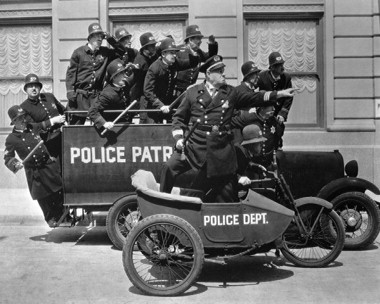
Archbishop Vincent Nichols, we need Shepherds not Keystone Cops who fall asleep while on duty

Writing from the UK, my good friend Deacon Nick Donnelly of Protect the Pope reports that:

Archbishop Nichols has re-affirmed the Archdiocese of Westminster’s provision of pastoral care to homosexuals through the so called Soho Masses, while at the same time announcing that he is undertaking a review of the current provision to ensure these Masses are not occasions for opposition to the Church’s teaching on sexuality: ‘At the present time consideration is being given to the circumstances in which these Masses are celebrated to ensure that their purpose is respected and that they are not occasions for confusion or opposition concerning the positive teaching of the Church on the meaning of human sexuality or the moral imperatives that flow from that teaching, which we uphold and towards which we all strive.' (See full article here).

Deacon Nick comments: "This is good news from Archbishop Nichols,and signifies an important shift in his position on the Soho Masses. Before the Holy Father’s visit the archbishop expressed, in intemperate language, that those Catholics concerned about public dissent at the Soho Masses should ‘hold their tongues.’ Now 18 months later Archbishop Nichols has admitted the concern that the Soho Masses could be occasions for confusion and opposition to the Church’s teaching, and needs investigating. This is exactly the claim made by Daphne McLeod and Pro Ecclesia et Pontifice....Protect the Pope recommends that the archbishop includes in his review an examination of the website Queering the Church, run by a member of the organising council Terence Weldon."

So Archbishop Nichols is going to conduct a "review" to ensure that the infamous Soho Masses "are not occasions for confusion or opposition" to the Church's moral teaching regarding homosexuality?  Why is it that I have an image of The Keystone Cops playing in my head?  Your Excellency, Terence Weldon, who serves as an Extraordinary Minister of the Eucharist at these Masses, has been engaging in public dissent from the Church's teaching in this area for years.

In his latest post at "Queering the Church," Mr. Weldon writes that, "One part of conventional Catholic teaching on homosexual persons, is that our orientation is the cross that we must take up, and deal with. I disagree – orientation in itself is a gift from God, not an ordeal to survive. The cross that we carry, as I wrote in a Lenten post last year, is the disordered teaching of the Church, the persecution that it brings in discrimination bullying, gay -bashing and hate-crime murders – and the internalized homophobia that drives a disproportionate number of us to suicide, or to less extreme pathological behaviour, in addictions or in the closet....CDF documents claim, with no evidence whatsoever, that homosexuality/homosexual acts lead us away from God. That is certainly not my experience, which shows the exact reverse." (See here).

What do you think Your Excellency?  Does this passage indicate that Terence Weldon is striving to conform to Church teaching or that he is openly dissenting from the same?

Thursday, February 23, 2012

Sir Trevor Phillips: Christians, and only Christians, should be denied religious freedom and conscience rights

Saint Thomas Aquinas explains that a law is just if it corresponds to the divine law.  If civil law does conform to the divine law, then it has the power to bind us in conscience and to disobey such a law would be a sin.  But human law cannot exceed the power of its human authors.  Aquinas teaches that the law which is promulgated must correspond to the divine law.  No human authority can declare what is morally evil to be morally good.  For this reason, laws permitting slavery, abortion, euthanasia, divorce and "marriages" between persons of the same gender are immoral, and therefore unjust (Summa theologiae, I-II, q. 96, a.5).

In his Encyclical Letter Evangelium Vitae, Nos. 72-74, Pope John Paul II teaches that, "The doctrine on the necessary conformity of civil law with the moral law is in continuity with the whole tradition of the Church. This is clear once more from John XXIII’s Encyclical: 'Authority is a postulate of the moral order and derives from God. Consequently,laws and decrees enacted in contravention of the moral order,and hence of the divine will,can have no binding force in conscience…;indeed,the passing of such laws undermines the very nature of authority and results in shameful abuse'. This is the clear teaching of Saint Thomas Aquinas,who writes that 'human law is law inasmuch as it is in conformity with right reason and thus derives from the eternal law. But when a law is contrary to reason,it is called an unjust law; but in this case it ceases to be a law and becomes instead an act of violence'. And again: 'Every law made by man can be called a law insofar as it derives from the natural law. But if it is somehow opposed to the natural law, then it is not really a law but rather a corruption of the law'.


Now the first and most immediate application of this teaching concerns a human law which disregards the fundamental right and source of all other rights which is the right to life, a right belonging to every individual. Consequently, laws which legitimize the direct killing of innocent human beings through abortion or euthanasia are in complete opposition to the inviolable right to life proper to every individual; they thus deny the equality of everyone before the law. It might be objected that such is not the case in euthanasia, when it is requested with full awareness by the person involved. But any State which made such a request legitimate and authorized it to be carried out would be legalizing a case of suicide-murder, contrary to the fundamental principles of absolute respect for life and of the protection of every innocent life. In this way the State contributes to lessening respect for life and opens the door to ways of acting which are destructive of trust in relations between people. Laws which authorize and promote abortion and euthanasia are therefore radically opposed not only to the good of the individual but also to the common good ;as such they are completely lacking in authentic juridical validity. Disregard for the right to life, precisely because it leads to the killing of the person whom society exists to serve, is what most directly conflicts with the possibility of achieving the common good. Consequently, a civil law authorizing abortion or euthanasia ceases by that very fact to be a true, morally binding civil law.

Abortion and euthanasia are thus crimes which no human law can claim to legitimize. There is no obligation in conscience to obey such laws; instead there is a grave and clear obligation to oppose them by conscientious objection. From the very beginnings of the Church, the apostolic preaching reminded Christians of their duty to obey legitimately constituted public authorities (cf. Rom 13:1-7;1 Pet 2:13-14), but at the same time it firmly warned that 'we must obey God rather than men'(Acts 5:29). In the Old Testament, precisely in regard to threats against life, we find a significant example of resistance to the unjust command of those in authority. After Pharaoh ordered the killing of all newborn males, the Hebrew midwives refused. 'They did not do as the king of Egypt commanded them, but let the male children live'(Ex 1:17). But the ultimate reason for their action should be noted: 'the midwives feared God' (ibid.). It is precisely from obedience to God-to whom alone is due that fear which is acknowledgment of his absolute sovereignty-that the strength and the courage to resist unjust human laws are born. It is the strength and the courage of those prepared even to be imprisoned or put to the sword, in the certainty that this is what makes for 'the endurance and faith of the saints' (Rev 13:10).

In the case of an intrinsically unjust law, such as a law permitting abortion or euthanasia, it is therefore never licit to obey it, or to 'take part in a propaganda campaign in favour of such a law, or vote for it'.

A particular problem of conscience can arise in cases where a legislative vote would be decisive for the passage of a more restrictive law, aimed at limiting the number of authorized abortions,in place of a more permissive law already passed or ready to be voted on. Such cases are not infrequent. It is a fact that while in some parts of the world there continue to be campaigns to introduce laws favouring abortion,often supported by powerful international organizations, in other nations-particularly those which have already experienced the bitter fruits of such permissive legislation-there are growing signs of a rethinking in this matter. In a case like the one just mentioned,when it is not possible to overturn or completely abrogate a pro-abortion law, an elected official,whose absolute personal opposition to procured abortion was well known, could licitly support proposals aimed at limiting the harm done by such a law and at lessening its negative consequences at the level of general opinion and public morality. This does not in fact represent an illicit cooperation with an unjust law, but rather a legitimate and proper attempt to limit its evil aspects.

The passing of unjust laws often raises difficult problems of conscience for morally upright people with regard to the issue of cooperation, since they have a right to demand not to be forced to take part in morally evil actions. Sometimes the choices which have to be made are difficult; they may require the sacrifice of prestigious professional positions or the relinquishing of reasonable hopes of career advancement. In other cases, it can happen that carrying out certain actions,which are provided for by legislation that overall is unjust, but which in themselves are indifferent, or even positive,can serve to protect human lives under threat. There may be reason to fear, however, that willingness to carry out such actions will not only cause scandal and weaken the necessary opposition to attacks on life, but will gradually lead to further capitulation to a mentality of permissiveness.

In order to shed light on this difficult question,it is necessary to recall the general principles concerning cooperation in evil actions. Christians, like all people of good will, are called upon under grave obligation of conscience not to cooperate formally in practices which, even if permitted by civil legislation, are contrary to God’s law. Indeed, from the moral standpoint,it is never licit to cooperate formally in evil. Such cooperation occurs when an action, either by its very nature or by the form it takes in a concrete situation, can be defined as a direct participation in an act against innocent human life or a sharing in the immoral intention of the person committing it. This cooperation can never be justified either by invoking respect for the freedom of others or by appealing to the fact that civil law permits it or requires it. Each individual in fact has moral responsibility for the acts which he personally performs;no one can be exempted from this responsibility, and on the basis of it everyone will be judged by God himself (cf. Rom 2:6;14:12).

To refuse to take part in committing an injustice is not only a moral duty; it is also a basic human right. Were this not so, the human person would be forced to perform an action intrinsically incompatible with human dignity, and in this way human freedom itself, the authentic meaning and purpose of which are found in its orientation to the true and the good, would be radically compromised. What is at stake therefore is an essential right which, precisely as such, should be acknowledged and protected by civil law. In this sense,the opportunity to refuse to take part in the phases of consultation, preparation and execution of these acts against life should be guaranteed to physicians, health-care personnel, and directors of hospitals, clinics and convalescent facilities. Those who have recourse to conscientious objection must be protected not only from legal penalties but also from any negative effects on the legal, disciplinary,financial and professional plane."

Deacon Nick Donnelly over at Protect the Pope is reporting that Sir Trevor Phillips, the Head of the Equality and Human Rights Commission, has stated categorically that freedom of religion and freedom of conscience is restricted to within the confines of church buildings if they conflict with secular law.  Sir Phillips has been quoted as having said that, "the law stops at the door of the temple as far as I am concerned."  He has accused Christians who insist upon following the teachings of Christ and their consciences of wanting to impose "sharia law"on the UK.

Deacon Nick comments, "The Equality Commissioner, like the Obama administration, is attempting to re-define freedom of religion as freedom to worship. It’s a verbal slight of hand that seeks to strip away our basic human rights as religious believers in public life and wider society. Basically he’s saying we’re free to practice our faith within our church buildings but nowhere else in society.

Trevor Phillips has already removed our right to practice the moral teachings of the faith within our own homes, because, for example, if we run a bed and breakfast we have to allow homosexuals to sleep together in rooms in our houses, or else be taken to court and fined.

Trevor Phillips, and his like, have removed the rights of parents to bring their children up in the faith, because if our children, as young as 13, want contraception or abortion the State will provide it without parental knowledge or consent.

Trevor Phillips trivializes Catholic moral teaching on sexuality and parenthood by saying that we just 'decided we’re different’and that we need a different set of laws'. Catholics didn’t decide we’re different when parliament changed the law, we remained steadfast in upholding the moral law...
Trevor Phillips is also hypocritical by saying Christian demands to follow their teachings and consciences are equivalent to wanting to impose sharia law. Sharia law is being exercised in the UK, creating a parallel legal system with the support of the liberal establishment in this country as an expression of 'diversity'. Here’s the BBC’s support for sharia law in the UK:

http://news.bbc.co.uk/1/hi/uk/7234870.stm

http://www.telegraph.co.uk/news/religion/9088957/Trevor-Phillips-stands-by-ridiculous-Sharia-comparison.html

Deacon Nick raises an excellent point here.  When the Archbishop of Canterbury, Rowan Williams, said that it "seems unavoidable" that the UK will have to "face up to the fact" that millions of Muslims do not relate to the British legal system and implied that British law should accommodate Sharia law, where was Sir Phillips?  When the Archbishop said that, "There's a place for finding what would be a constructive accommodation with some aspects of Muslim law," ("Sharia Law for UK is 'Unavoidable,'" BBC News, Feb 7, 2008), Sir Phillips was strangely silent.
It's obvious that Sir Phillip is anxious to strip Christians of their religious freedoms and to deny them - and apparently only them - of the right to follow their conscience.

Interesting no?

Thursday, July 29, 2010

More on Stuart Reid and what it means to be a Christian...


"Wherefore the Church does in every place, because of that love which she cherishes towards God, send forward, throughout all time, a multitude of martyrs to the Father; while all others not only have nothing of this kind to point to among themselves, but even maintain that such witness-bearing is not at all necessary." (St. Irenaeus, Against Heresies, Bk. 4, Chap. 33).


When Mr. Stuart Reid over at The Catholic Herald [an English Catholic newspaper] wrote a piece somewhat critical of the new website Protect the Pope, I responded by refuting his arguments. One concern I had was Mr. Reid's assertion that, "Catholics may one day be persecuted as Jews once were, in which case they will have two choices: either to be brave and die as martyrs or to deny their religion and join their persecutors. The Jews of the Holocaust had no such choice."

I responded to this statement by writing, "This says much about his level of faith. For the authentic Christian, there is no choice. We cannot abandon Christ."

Now Mr. Reid has written that, "Mr. Melanson should sit down in a darkened room and have a little think. One of the key beliefs of Christianity is that we have free will: No free will, no Christianity. For the authentic Christian therefore there is the choice I outline...but the Jews of the Holocaust had no such choice...They could not stop being Jews.."

Now, I never denied the reality of free will. But our free choices have consequences. This point was addressed by Peter [a regular reader of this Blog], who wrote:

"No serious Catholic would consider that a real choice Mr. Reid. Our Catholic identity is deeper than you would acknowledge. Just as Jews cannot 'stop being Jews,' the authentic Christian cannot 'stop being Christian.' We don't put on our faith and take it off as a coat. Baptism imparts a sacred character. If we use our free will to reject Christ, then we place our salvation in peril. Maybe that's a choice for you. For those of us who are Catholic in more than name, it is not."

Through Baptism, the Christian is made an adoptive member of the divine family. Which is why, "When we cry, 'Abba! Father!' it is that very spirit bearing witness with our spirit that we are children of God." (Romans 8: 15-16). Just as families live together, so the three Divine Persons dwell in those have received the gift of faith and who are faithful to it: "Those who love me will keep my word, and my Father will love them, and we will come to them and make our home with them." (John 14: 23).

Martyrdom bears witness to faith. The martyr prizes heavenly glory more than any other good, even life itself. To choose to abandon the Catholic faith and Christ Jesus to avoid martyrdom would mean placing limits on fidelity to the Lord Jesus. Which is why I wrote, "For the authentic Christian, there is no choice." The authentic Christian will not abandon the Lord Jesus or His Mystical Body which is the Church. He or she will not set limits on his or her fidelity to the Divine Master.

As Peter so eloquently put it: "We don't put on our faith and take it off as a coat." We do not abandon our Divine Family to avoid persecution or even death. Instead we keep His Word and hold onto it at all costs. Even unto death.

Saturday, July 24, 2010

Stuart Reid gets it wrong...

Stuart Reid over at The Catholic Herald, one of England's leading Catholic newspapers, isn't very happy with the new website founded by Deacon Nick Donnelly entitled Protect the Pope. Mr. Reid writes, "What troubles me especially is that they seem to encourage a ghetto mentality among the faithful....On their website they encourage frightened and intimidated Catholics - when was the last time you met a Catholic who was genuinely frightened and intimidated? - to register complaints about hate crimes with their local police force.." (See full article here).

I don't actually have to look very far Mr. Reid. I was personally threatened by a homosexual activist who promised to execute me with his high-powered rifle simply because I promote and defend the Church's authentic teaching regarding homosexuality which includes respect for the homosexual person. Does that work for you? One could just as easily ask how many homosexual persons have been genuinely frightened and intimidated. And yet the homosexual community continues to claim victim status as part of its propaganda campaign to advance the homosexual lifestyle. There is more than ample evidence of a mounting Christianophobia throughout the world. See here for some specific cases.

Mr. Reid would appear to defend a freedom of expression which is divorced from Catholic teaching. He writes, "The Protect the Pope website declares: 'Of course people in this country have freedom of expression, but this does not mean they have the right to create a climate of hostility and fear.' But that, of course, is precisely what it does mean, in practice..." This might indeed be the accepted notion of freedom of expression 'in practice," but Mr. Donnelly is correct, such a notion of freedom of speech is distorted. Reid continues, "It is by creating a climate of fear and hostility that press barons sell newspapers, political parties win votes and Boots the chemist sells deodorants."

But are we not called to something better Mr. Reid? Or have you bought into the secularistic-materialistic mindset to such an extent that you see no problem whatsoever with such manipulation carried out by the media? Inter Mirifica, the Decree on the Media of Social Communications of Vatican II, had this to say, "Since public opinion exercises the greatest power and authority today in every sphere of life, both private and public, every member of society must fulfill the demands of justice and charity in this area. As a result, all must strive, through these media as well, to form and spread sound public opinion." (No. 8).

The Decree continues, "The principle moral responsibility for the proper use of the media of social communication falls on newsmen, writers, actors, designers, producers, displayers, distributors, operators and sellers, as well as critic and all others who play any part in the production and transmission of mass presentations. It is quite evident what gravely important responsibilities they have in the present day when they are in a position to lead the human race to good or evil by informing or arousing mankind. Thus, they must adjust their economic, political or artistic and technical aspects so as never to oppose the common good." (No. 11).

In short, freedom implies responsibility Mr. Reid. There is an intimate relationship between freedom and truth. Thus the Catechism of the Catholic Church teaches us that, "The more one does what is good, the freer one becomes. There is no true freedom except in the service of what is good and just. The choice to disobey and do evil is an abuse of freedom and leads to 'the slavery of sin." (CCC, 1733).

The choice to do evil is an abuse of freedom. Which is why Deacon Donnelly said that people have a right to freedom of expression but not a right to create a climate of hostility and fear. There can never be a right to do evil. Such a notion is an abuse of freedom.

Aleksandr Solzhenitsyn so eloquently warned that: "Destructive and irresponsible freedom has been granted boundless space. Society appears to have little defense against the abyss of human decadence, such as, for example, the misuse of liberty for moral violence against young people, motion pictures full of pornography, crime and horror. This is considered to be part of freedom, and theoretically counterbalanced by the young peoples' right not to look or not to accept. Life organized legalistically has thus shown its inability to defend itself against the corrosion of evil." ("A World Split Apart," Commencement Address at Harvard University, June 8, 1978, reprinted in National Review, July 7, 1978).

Which is why we are now facing what Pope Benedict XVI has rightly termed a "Dictatorship of Relativism." It is this dictatorship of relativism which is gradually placing Catholics in a ghetto. Not the actions of devout Catholics like Deacon Donnelly who love the Vicar of Christ and the Mystical Body of Christ which is the Catholic Church.
Site Meter