Showing posts with label Cardinal Timothy Dolan. Show all posts

Monday, June 18, 2018

Intelligent people of good will are able to discern bovine scatology..

Remember when Francis chided President Donald Trump for wanting to build a border wall?  He referred to the President as "Non-Christiano."

Why was he silent about this?


Is Francis really interested in the Gospel of Life and Gospel values or is he merely a liberal partisan looking to prop up a political party which has become a tool of the Devil?

 As Dr. David Carlin has said, "..when clerical leadership is weak or foolish, we can't be surprised when the quality of lay Catholicism sinks." (Can a Catholic Be a Democrat? How the Party I Loved Became the Enemy of My Religion," p. 106).

Pope Benedict XVI once said that while, "everyone has the right to leave home to seek better conditions of life in another country...At the same time, states have the right to regulate migration flows and to defend their own frontiers, always guaranteeing the respect due to the dignity of each and every human person."

Pope Benedict XVI also said that immigrants have the duty to integrate into their host countries and respect their laws and national identities.

The challenge, as the Holy Father noted, is to "combine the welcome due to every human being, especially when in need, with a reckoning of what is necessary for both the local inhabitants and the new arrivals to live a dignified and peaceful life”.  See here.

Why is it that President Trump is demonized as a "bigot" and "non-Christian" for defending the United States frontier when President Obama was given a free pass to do the same?

Clerics such as Francis and Cardinal Dolan (see here) need to provide us with an answer.

In the meantime, intelligent people of good will can see through the bovine scatology.

Thursday, September 18, 2014

Cardinal Timothy Dolan argues that he is not capitulating to an "aggressive 'Gay' agenda." Actually he is.

Writing for his column in New York Catholic, Cardinal Timothy Dolan complains that he is receiving much criticism for deciding to serve as Grand Marshall in next year's St. Patrick's Day parade which will feature homosexuals marching under their own banner.  The Cardinal writes, I haven’t been in this much hot water since I made the comment, right after I arrived as your archbishop five-and-a-half years ago, that Stan Musial—my boyhood hero of my hometown St. Louis Cardinals—was a much better ballplayer than Joe DiMaggio!

 Now I’m getting as much fiery mail and public criticism over my decision to accept the honor of Grand Marshal of this year’s St. Patrick’s Day Parade. According to the critics, I should have refused, due to the Parade Committee’s decision to allow a group of self-identified Gays of Irish ancestry to march in the parade with their own banner.

As with Stan Musial, I’ll stand by my decision. However, enough of you have courteously expressed some confusion and dismay, that, as your pastor, I owe you an explanation. Let me try.
For one, the decision to change the parade protocol was not mine. The archbishops of New York have never been “in charge” of the parade. Although my predecessors and I have always enjoyed friendly cooperation with the Parade Committee—and still do—and deeply appreciate the identity of the Parade as a celebration purely of Irish heritage, intimately linked to the Catholic Faith, we’ve never had a say in Parade policy or the choice of the Grand Marshal. Nor did we expect or want one!

 So, in the current 'brawl,' (they have been hardly rare in the Parade’s grand 253-year history!), I did not make the decision! You will recall that I in the past often expressed support for the former policy—that the only banners and identification to be carried was that the group was Irish—and that I found it logical and fair. To those who charged that the policy was “anti-Gay,” I often observed that no one person, Gay or not, was excluded from the parade. This was simply a reasonable policy about banners and public identification, not about the sexual inclinations of participants.

I did not oppose the former policy; nor did I push, condone, or oppose the new one. While the Parade committee was considerate in advising me of the change, they did not ask my approval, nor did they need to.

However, I admit that, for most folks, this is not the reason they are upset with me, and this brings us to point two. Many of you, while acknowledging that the decision to change policy was not mine, feel strongly that I should protest it, publicly condemn it, no longer support the Parade, and refuse the invitation to serve as Grand Marshal.

While a handful have been less than charitable in their reactions, I must admit that many of you have rather thoughtful reasons for criticizing the committee’s decision: you observe that the former policy was fair; you worry that this is but another example of a capitulation to an 'aggressive Gay agenda,' which still will not appease their demands; and you wonder if this could make people think the Church no longer has a clear teaching on the nature of human sexuality. Thank you for letting me know of such concerns. I share some of them.

However, the most important question I had to ask myself was this: does the new policy violate Catholic faith or morals? If it does, then the Committee has compromised the integrity of the Parade, and I must object and refuse to participate or support it. From my review, it does not. Catholic teaching is clear: “being Gay” is not a sin, nor contrary to God’s revealed morals. Homosexual actions are—as are any sexual relations outside of the lifelong, faithful, loving, lifegiving bond of a man and woman in marriage—a moral teaching grounded in the Bible, reflected in nature, and faithfully taught by the Church.So, while actions are immoral, identity is not! In fact, as the Catechism of the Catholic Church reminds us, people with same-sex attraction are God’s children, deserving dignity and respect, never to be treated with discrimination or injustice."

Full article here.

The Cardinal argues that he is not capitulating to an aggressive homosexual agenda.  But his use of the word "gay" betrays the very opposite.  The Roman Catholic apostolate Courage, which assists those with a homosexual inclination to live authentically Catholic lives, embracing chastity, explains why it will not use the terms "gay" and "lesbian":

Q. Why doesn’t Courage use the terms “gay” and “lesbian”?

A. Courage discourages persons with same-sex attractions from labeling themselves “gay” and “lesbian” for the following reasons:

1) The secular world usually uses those terms to refer to someone who is either actively homosexual or intends to be. When a person decides to “come out” and say “I am gay” or “I am lesbian”, the person usually means “this is who I am – I was born this way and I intend to live this way. I have a right to find a same-sex partner with whom to have a romantic sexual relationship.” To “come out” as being “gay” or “lesbian” doesn’t usually mean “I have homosexual attractions and I have a deep commitment to living a chaste life”.

The Cardinal hasn't thought out his policy has he?

Courage continues:

2) By labeling someone [as the Cardinal does by referring to people with a homosexual inclination as "gay"], we discourage those who may wish to try and move beyond homosexual attractions. Some people, especially young people, are able to further their psychosexual development with spiritual and psychological aid. If we labeled them “gay” and “lesbian”, they might think there’s no possibility of moving beyond these attractions.

3) There is more to a person than one’s sexual attractions. Even if one experienced same-sex attractions for most of one’s life, he or she is first and foremost a child of God created in His image. To refer to that person as “gay” or “lesbian” is a reductionist way of speaking about someone. We are even trying now to avoid using the term homosexual as a noun, or as an adjective directly describing the person (i.e. homosexual person). Although it takes more words, we prefer to speak of “persons with same-sex attractions”. Fr. Harvey has said that, if he could, he would rename his first book “The Homosexual Person” to something else like “The Person With Homosexual Attractions”.

There are people within the Catholic Church who might argue that those who label themselves “gay” or “lesbian” aren’t necessarily living unchastely. That’s true, but the implications of the terms in today’s society don’t commonly connote chaste living. Furthermore, they are limiting their own possibilities of growth by such self-labeling, and reducing their whole identity by defining themselves according to their sexual attractions. At Courage, we choose not to label people according to an inclination which, although psychologically understandable, is still objectively disordered."

The Cardinal errs as well when he suggests that only homosexual acts are sinful.  In its document entitled Letter to the Bishops of the Catholic Church on the Pastoral Care of Homosexual Persons, which was published on October 1, 1986, the Sacred Congregation for the Doctrine of the Faith recalled the distinction between homosexual tendencies and homosexual practices: "Although the particular inclination of the homosexual person is not a sin, it is a more or less strong tendency ordered toward an intrinsic moral evil; and thus the inclination itself must be seen as an objective disorder."

Many interpret the Church's teaching as meaning that a homosexual person only sins if he or she actually engages in homosexual acts.  I have received comments at this Blog suggesting that only homosexual acts are sinful But this is not the Church's teachingAlthough the homosexual inclination itself is not a sin, still, the homosexual person sins if he or she makes a concession to this tendency in his or her mind.
It is Catholic doctrine that any disorderly tendency, and most especially toward a vice which is contrary to nature, cannot have a right to citizenship in a person's thoughts.  Recall the teaching of Our Lord Jesus in Matthew 5: 27, 28: "You have heard that it was said, 'You shall not commit adultery.'  But I say to you that every one who looks at a woman lustfully has already committed adultery with her in his heart."

This is why in the Confiteor [Latin: I confess], which is part of the Penitential Rite, one asks for forgiveness for thoughts, words and deeds.

We know as well that homosexual persons also sin when their external behavior expresses a homosexual tendency.  Which is why we read in Isaiah 3:9 that, "Their very look bears witness against them; their sin like Sodom they vaunt, They hide it not.  Woe to them!  they deal out evil to themselves."  And in Deuteronomy 22:5 we read, "A woman shall not wear an article proper to a man, nor shall a man put on a woman's dress; for anyone who does such things is an abomination to the Lord, your God."

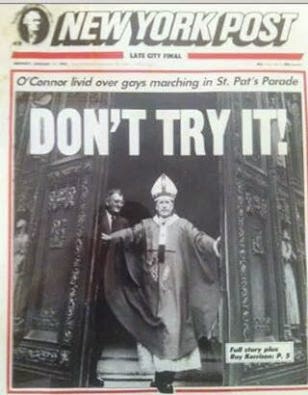
While Cardinal Dolan tries to convince you that he is not capitulating to the Culture of Softness, examine the photo of the late (Great) John Cardinal O'Connor and ask yourself: Who is the real Shepherd of souls?

You know the answer....unless you too have succumbed to homosexual agitprop.  For more on the blind leading the blind, go here.

Thursday, September 04, 2014

Could this be the reason Fulton Sheen's cause has been stalled?


Way back in the 1970's, I purchased an excellent book written by my hero and good friend Fulton J. Sheen entitled "The Electronic Christian" and published by the Macmillan Publishing Company. In this important book (indeed every book written By Sheen could be labelled as important), the saintly Archbishop who thoroughly intrigued his audience throughout the 1950's as "Uncle Fultie" - a Catholic counterpart if you will to Milton Berle's "Uncle Miltie," explains the importance and indeed the necessity of a religion with Dogma. Here is his essay:


The modern man must decide for himself whether he is going to have a religion with thought or a religion without it. He already knows that thoughtless policies lead to the ruin of society, and he may begin to suspect that thoughtless religion ends in confusion worse confounded.

The problem is simple. The modern man has two maps before him: one the map of sentimental religion, the other the map of dogmatic religion. The first is very simple. It has been constructed only in the last few years by a topographer who has just gone into the business of map making and is extremely adverse to explicit directions. He believes that each man should find his own way and not have his liberty taken away by dogmatic directions. The other map is much more complicated and full of dogmatic detail. It has been made by topographers who have been over every inch of the road for centuries and know each detour and each pitfall. It has explicit directions and dogmas such as, 'Do not take this road - it is swampy,' or 'Follow this road; although rough and rocky at first, it leads to a smooth road on a mountaintop.'

The simple map is very easy to read, but those who are guided by it are generally lost in a swamp of mushy sentimentalism. The other map takes a little more scrutiny, but it is simpler in the end, for it takes you up through the rocky road of the world's scorn to the everlasting hills where is seated the original Map Maker, the only One who ever has associated rest with learning: 'Learn of Me...and you shall find rest for your souls.'

Every new coherent doctrine and dogma add to the pabulum for thought; it is an extra bit of garden upon which we can intellectually browse; it is new food into which we can put our teeth and thence absorb nourishment; it is the discovery of a new intellectual planet that adds fullness and spaciousness to our mental world. And simply because it is solid and weighty, because it is dogmatic and not gaseous and foggy like a sentiment, it is intellectually invigorating, for it is with weights that the best drill is done, and not with feathers.

It is the very nature of a man to generate children of his brain in the shape of thoughts, and as he piles up thought on thought, truth on truth, doctrine on doctrine, conviction on conviction, and dogma on dogma, a very coherent and orderly fashion, so as to produce a system complex as a body and yet one and harmonious, the more and more human he becomes. When, however, in response to false cries for progress, he lops off dogmas, breaks with the memory of his forefathers, denies intellectual parentage, pleads for a religion without dogmas, substitutes mistiness for mystery, mistakes sentiment for sediment, he is sinking back slowly, surely, and inevitably into the senselessness of stones and into the irresponsible unconsciousness of weeds. Grass is broad-minded. Cabbages have heads - but no dogmas. (pp. 74-74).

It would seem that "modern man," as Sheen so generously referred to him, has made his choice: he has opted for a religion without thought, a religion where dogma is considered a liability.  Could this be why the Archdiocese of New York has stalled Fulton Sheen's cause.  See here: http://www.pantagraph.com/news/local/sheen-sainthood-process-suspended/article_d43c4d13-dea7-5af5-b8bc-97ed8184cd21.html

The same Archdiocese which has just decided to allow homosexuals and lesbians march in the Saint Patrick Day's Parade.  We have now entered the time of the final confrontation between good and evil, Gospel and Anti-Gospel. The Devil is sending false prophets to prepare the way for his Antichrist who will do his best to destroy the Catholic Church. We've witnessed false prophets of a humanitarian religion and a theology of violence. We have seen a priest of the Boston Archdiocese advance a sentimental religion free of dogma. And we have watched as the Boston Archdiocese permits "Gay Pride" celebrations while calling evil good and good evil.


More false prophets will come. And many will be seduced by them because they do not have a love for the truth and because they do not pray. Fr. Vincent Miceli notes that, "The contrast between Christ and the Antichrist could not be more pronounced than in their respective relations to revealed truth. The Incarnate Truth has chosen the poor, uncultured, and simple to preach the inestimable truths of the Gospel. The Antichrist, the condemned man, whose form the apostate angel, Satan, possesses at the end of the world, chooses the wise of this world, the double-minded, the arrogant intellectuals to preach lies about revealed truth." (The Antichrist, p.78).

Romano Guardini alludes to this in his book The Lord. He notes how those who refuse to accept the specious arguments of the arrogant intellectuals and the "wise" of this world will be a source of scandal:

"One day the Antichrist will come: a human being who introduces an order of things in which rebellion against God will attain its ultimate power. He will be filled with enlightenment and strength. The ultimate aim of all aims will be to prove that existence without Christ is possible - nay rather, that Christ is the enemy of existence, which can be fully realized only when all Christian values have been destroyed. His arguments will be so impressive, supported by means of such tremendous power - violent and diplomatic, material and intellectual - that to reject them will result in almost insurmountable scandal, and everyone whose eyes are not opened by grace will be lost. Then it will be clear what the Christian essence really is: that which stems not from the world, but from the heart of God; victory of grace over the world; redemption of the world, for her true essence is not to be found in herself, but in God, from whom she has received it. When God becomes all in all, the world will finally burst into flower." (The Lord p. 513).

Is there really any doubt that the Man of Sin will soon reveal himself to the world? When he does, he will attempt to tear the very idea of God from the consciousness of men. And according to Scripture, God's Holy Word, he will succeed in seducing the vast majority of believers away from Christ and into his own ranks of the idolatrous. But those who do not trust in their own intellect or powers and who seek refuge in the Immaculate Heart of Mary will find it. For the humble Virgin, Mother of the Church, will crush the Devil's head - the seat of his intellect - as surely as Judith saved her people by slaying Holofernes. Recall
how she accomplished this


Related reading here: http://lasalettejourney.blogspot.com/2014/07/pope-francis-man-is-king-of-universe.html

Wednesday, November 13, 2013

The Pope Francis Effect: False compassion which leads to a weariness of proclaiming the moral norm

Writing for the Associated Press, Rachel Zoll notes that, "The Vatican ambassador to the U.S., addressing American bishops at their first national meeting since Pope Francis was elected, said Monday they should not 'follow a particular ideology' and should make Roman Catholics feel more welcome in church.  Archbishop Carlo Maria Vigano noted the challenges from broader society to Christian teaching....'the Holy Father wants bishops in tune with their people....He made a special point of saying that he wants pastoral bishops, not bishops who profess or follow a particular ideology.'  In a September interview, Francis said Catholic leaders should give greater emphasis to compassion and mercy, arguing the Church's focus on abortion, marriage and contraception has been too narrow and alienating..."

Too narrow?  But Our Lord insisted that we must, "Enter by the narrow gate; for the gate is wide and the way is easy that leads to destruction, and those who enter by it are many.  For the gate is narrow and the way is hard that leads to life, and those who find it are few" (Matthew 7: 13, 14).

Why is the Holy Father insisting that the Church's focus on moral norms is something "alienating"?  Pope John Paul II has already refuted this lie.  In his Encyclical Letter Veritatis Splendor, he explained that, "The Church's teaching, and in particular her firmness in defending the universal and permanent validity of the precepts prohibiting intrinsically evil acts [such as abortion, homosexual acts and contraception], is not infrequently seen as the sign of an intolerable intransigence, particularly with regard to the enormously complex and conflict-filled situations present in the moral life of individuals and of society today; this intransigence is said to be in contrast with the Church's motherhood.  The Church, one hears, is lacking in understanding and compassion.  But the Church's motherhood can never in fact be separated from her teaching mission, which she must always carry out as the faithful Bride of Christ, who is the Truth in person.  'As Teacher, she never tires of proclaiming the moral norm....The Church is in no way the author or the arbiter of this norm.  In obedience to the truth which is Christ, whose image is reflected in the nature and dignity of the human person, the Church interprets the moral norm and proposes it to all people of good will, without concealing its demands of radicalness and perfection." (Veritatis Splendor, No. 95, citing Familiaris Consortio).

The Holy Father goes on to remind us that, "..genuine understanding and compassion must mean love for the person, for his true good [the greatest of which is his soul and his salvation], for his authentic freedom.  And this does not result, certainly, from concealing or weakening moral truth, but rather from proposing it in its most profound meaning as an outpouring of God's eternal Wisdom, which we have received in Christ, and as a service to man, to the growth of his freedom and to the attainment of his happiness." (Veritatis Splendor, No. 95).

While it is true that everything must be done to help sinners, this cannot include helping them to sin or to remain in sin. Because of human frailty, every sinner deserves both pity and compassion. However, vice and sin must be excluded from this compassion. This because sin can never be the proper object of compassion. (Summa Theologica, II-II, q. 30, a.1, ad 1).


It is a false compassion which supplies the sinner with the means to remain attached to sin. Such 'compassion' provides an assistance (whether material or moral) which actually enables the sinner to remain firmly attached to his evil ways. By contrast, true compassion leads the sinner away from vice and back to virtue. As Thomas Aquinas explains: "We love sinners out of charity, not so as to will what they will, or to rejoice in what gives them joy, but so as to make them will what we will, and rejoice in what rejoices us. Hence it is written: 'They shall be turned to thee, and thou shalt not be turned to them.'" (St. Thomas Aquinas, Summa Theologica, II-II, q. 25, a.6, ad 4, citing Jeremiah 15:19).

St. Thomas Aquinas teaches us that the sentiment of compassion only becomes a virtue when it is guided by reason, since "it is essential to human virtue that the movements of the soul should be regulated by reason." (Summa Theologica, II-II, q. 30, c.3). Without such regulation, compassion is merely a passion. A false compassion is a compassion not regulated and tempered by reason and is, therefore, a potentially dangerous inclination. This because it is subject to favoring not only that which is good but also that which is evil (Summa Theologica, II-II, q. 30, a.1, ad 3).

An authentic compassion always stems from charity. True compassion is an effect of charity (Summa Theologica, II-II, q. 30, a.3, ad 3). But it must be remembered that the object of this virtue is God, whose love extends to His creatures. (Summa Theologica, II-II, q. 25, a.3). Therefore, the virtue of compassion seeks to bring God to the one who suffers so that he may thereby participate in the infinite love of God. As St. Augustine explains: "'Thou shalt love thy neighbor as thyself.' Now, you love yourself suitably when you love God better than yourself. What, then, you aim at in yourself you must aim at in your neighbor, namely, that he may love God with a perfect affection." (St. Augustine, Of the Morals of the Catholic Church, No. 49,

Weakening or watering-down moral norms is not an act of charity.  It is an act of counterfeit charity, an act of spiritual violence.

Related reading here:   http://lasalettejourney.blogspot.com/2013/08/a-new-masonic-pope-imbued-with-italian.html

Monday, September 09, 2013

Cardinal Timothy Dolan: Sinful clergy behavior one of the main reasons for defections from the Church


In an article published in The Christian Post, New York Cardinal Timothy Dolan is quoted as having said that, said that "sinful" clergy behavior is one of the main reasons people are leaving Roman Catholicism and called on believers to hold on to the Church despite its flaws, during a speaking engagement in Milwaukee, Wis., on Thursday.

The Cardinal said that, "It's not a bad idea to fess up to the sinful side of the church...In her human side, the church can be imperfect, sloppy and corrupt. We admit her flaws, but we love her all the more because she is Christ on the cross."  See here:

http://www.christianpost.com/news/cardinal-dolan-admits-sinful-clergy-pushing-people-away-from-catholic-church-103942/print.html

In these times of scandal it is critical to remember that the Church remains spotless even when Her members sin. There is absolutely no doubt that the human history of the Church, like all of human history, has its dark pages. But if anyone cares to take an objective look at this history, one must quickly acknowledge that the doctrine of the Church has always implicitly condemned abuses introduced by Her members.


In the words of Dr. Dietrich Von Hildebrand, "There were sinners in the Church yesterday and there are sinners in the Church today. But the Church Herself, in her divine teaching, emerges gloriously unspotted in a history stained by human weaknesses, errors, imperfections, and sins." In the words of the great Cardinal Journet:

"All contradictions are eliminated as soon as we understand that the members of the Church do indeed sin, but they do so by their betraying the Church. The Church is thus not without sinners, but She is without sin. The Church as person is responsible for penance. She is not responsible for sins....The members of the Church themselves - laity, clerics, priests, Bishops, and Popes - who disobey the Church are responsible for their sins, but the Church as person is not responsible...It is forgotten that the Church as person is the Bride of Christ, 'Whom He has purchased with His own blood.'" (Acts 20:28).

There are those priests who wish to assign the blame elsewhere.  During a recent homily given at the 10 AM Mass at Our Lady Immaculate Parish in Athol, Massachusetts, Fr. Krzysztof Korcz noted how churches are emptying and closing everywhere and laid the blame almost entirely on parents for not imparting Gospel values to their children.

This does not square with the words of Our Lady to Father Stefano Gobbi.  The humble Italian priest, who received interior locutions from the Mother of God, was told that, "The cause of such a vast diffusion of errors and of this great apostasy rests with unfaithful pastors. They remain silent when they should speak with courage to condemn error and to defend the truth. They do not intervene when they should be unmasking the rapacious wolves who, hidden beneath the clothing of lambs, have insinuated themselves into the flock of Christ. They are mute dogs who allow their flocks to be torn to pieces...."


Which is why some priests dismiss the messages of Our Lady to Father Gobbi.  The message is not one they want to hear.
To whom much has been given, much will be required (Luke 12:48). How quickly some priests forget this as they attempt to shift the blame for virtually everything that goes wrong in the Church to the laity, and especially parents. This is not, of course, to excuse those parents who have in fact neglected to pass along the faith to their children or who have been poor examples of what it means to be Christian. But we have had more than our share of priests who have failed miserably to sanctify others and to provide a model of holiness.

Fr. Garrigou-Lagrange, O.P., whom many consider to have been one of the finest theologians of the 20th century, a Dominican who was a master of the spiritual life, explains in his book "The Priest In Union With Christ, that "St. Thomas writes: 'They who belong to the divine ministry assume a royal dignity and ought to be perfect in virtue' (cf. IV Sent., dist. 24, q. 2); this is also repeated in the Pontifical (Cf. Suppl. Summae Theol., q. 35, a. 1,2, de Ordine). And thus priestly Ordination is certainly superior to religious profession. This sacramental grace of Holy Orders is a modal reality added to habitual grace, which gives the priest a right to receive all the actual graces he needs for an increasingly holier celebration of the Mass. See the Imitation of Christ, Bk. iv, c. 5: 'Thou art made a priest and art consecrated to celebrate; see now that faithfully and devoutly, in due time, thou offer up the sacrifice to God, and that thou show thyself blameless. Thou hast not lightened thy burden, but art now bound by a stricter bond of discipline and obliged to greater perfection of sanctity. A priest ought to be adorned with all virtues and set the example to others of a good life.'...the priest's special obligation to tend to perfection is confirmed by his duties toward the Mystical Body of Christ. He is called upon to sanctify others by preaching the word and by spiritual direction both inside and outside the confessional." (The Priest In Union With Christ, pp. 54-55).

But many priests today are not preaching the word. They are not instructing the faithful. Many have abandoned prayer. And this has led to a satanic pride which resulted in priests abusing innocent and vulnerable children. We read in Galatians 5: 22-23 that: "..the fruit of the Spirit is charity, joy, peace, patience, benignity, goodness, longanimity, mildness, faith, modesty, continency, chastity." But as Fr. Lagrange notes, "In contrast to the spirit of God, the spirit of the Devil at first lifts the soul to the heights of pride and then plunges it down into turmoil and despair, just as the Devil himself sinned through pride and is now condemned to an eternity of despair and hatred of God...humility is never encouraged by this spirit, for it gradually distorts the soul's vision to see itself greater than anyone else. Almost unconsciously it makes the prayer of the Pharisee its own: 'O God, I give thee thanks that I am not as the rest of men...as also this publican" (Luke 18: 11). (The Priest In Union With Christ, pp. 238, 239).

It is this spirit of pride which has infected much of the clergy in our time. And it is pride which goes before a fall. Although the priesthood "has been instituted for the good of men and the communion of the Church" and "The Lord said clearly that concern for his flock was proof of love for him" (Catechism of the Catholic Church, 1551), so many of the clergy have not shown any concern for Christ's flock. They have not preached the hard truths which the People of God need to hear. One Worcester-area priest was actually encouraging some of his parishioners to remain in a sinful lifestyle while another gave a homily, broadcast over Gardner, Massachusetts radio, actually denigrating Our Lady.

The fruit of the Spirit is charity, joy, peace, patience, benignity, goodness, longanimity, mildness, faith, modesty, continency, chastity." But corruption of dogma and the works of the flesh are the work of the evil spirit.


Site Meter