More on substituting the Apostle's Creed for the Nicene Creed every Sunday here.
My last post on the subject may be found here.
Showing posts with label Creed. Show all posts
Showing posts with label Creed. Show all posts
Wednesday, December 26, 2018


Thursday, July 28, 2016
Francis exhorts youth to disorder, which is a mark of the Devil
Father Patrick McHugh explains that, "The angels, like ourselves, have free will. Some of them turned from God; we humans can also reject grace in our turn. The beginning of hell is to listen to the serpent who urges us to decide for ourselves what is good or evil with out reference to God. Satan knows, if we do not, that there is no goodness or beauty or truth or love that are not sparks cast off from the Pure Source of Goodness and Beauty and Love and Truth that God is. We can no more create moral goodness on our own than we can create the stars. The goodness of honesty or integrity or chastity exists outside and beyond anything we may elect, vote for or decide.
Pope John Paul II has brilliantly analyzed this objectivity of moral goodness in his Encyclical, The Splendor of Truth (Veritatis splendor). What he insists on, if not in these exact words, is that the the moral law, like the law of gravitation, does not come from our consensus. It does not come from earth but from heaven. We are free to accept or reject it but we are not free to accept or reject the consequences. If we turn from the goodness of honesty or fidelity or compassion or responsibility or truth or love, if we turn from God deliberately and with malice, we enter into the realm of disorder, alienation and hate. We carry our personalities with us into eternity. We ratify what we have chosen to become. If we leave this world locked into ego, our choice of self apart from God becomes final, irrevocable and complete. This is known as hell."
The realm of disorder. Another word for disorder is chaos. Is this where Francis wants to take us? At World Youth Day in Krakow, Francis exhorted youth to create chaos. See here.
Fr. Vincent P. Miceli, in an essay entitled "The Taproot of Violence," explains: "...violence entered creation from the rebellion of Lucifer. This rebellion arose from the heart of pride. But the sin of pride is the offspring of the vice known as hatred of truth. Hatred of truth is the result of the creature's attempt to rearrange God's hierarchy of beings and values into an order which the creature prefers to the plan of God. This attempt immediately produces the violence of disorder, the chaos of falsity and immorality. For hatred of truth is really hatred of God who creates all things wisely and governs them lovingly. Lucifer, the Morning Star, was instantly deformed into the Prince of Darkness because he attempted to live a lie. He wanted to dethrone God and become God himself..."
We live in an environment where there is a "violence of disorder" because we have abandoned truth. And hatred of truth leads to violence. It is the very root of violence.
Dorothy Sayers warned that the choice before us is Creed (read Christ) or chaos. Francis has obviously chosen the latter and wants the youth to follow him.

Pope John Paul II has brilliantly analyzed this objectivity of moral goodness in his Encyclical, The Splendor of Truth (Veritatis splendor). What he insists on, if not in these exact words, is that the the moral law, like the law of gravitation, does not come from our consensus. It does not come from earth but from heaven. We are free to accept or reject it but we are not free to accept or reject the consequences. If we turn from the goodness of honesty or fidelity or compassion or responsibility or truth or love, if we turn from God deliberately and with malice, we enter into the realm of disorder, alienation and hate. We carry our personalities with us into eternity. We ratify what we have chosen to become. If we leave this world locked into ego, our choice of self apart from God becomes final, irrevocable and complete. This is known as hell."
The realm of disorder. Another word for disorder is chaos. Is this where Francis wants to take us? At World Youth Day in Krakow, Francis exhorted youth to create chaos. See here.
Fr. Vincent P. Miceli, in an essay entitled "The Taproot of Violence," explains: "...violence entered creation from the rebellion of Lucifer. This rebellion arose from the heart of pride. But the sin of pride is the offspring of the vice known as hatred of truth. Hatred of truth is the result of the creature's attempt to rearrange God's hierarchy of beings and values into an order which the creature prefers to the plan of God. This attempt immediately produces the violence of disorder, the chaos of falsity and immorality. For hatred of truth is really hatred of God who creates all things wisely and governs them lovingly. Lucifer, the Morning Star, was instantly deformed into the Prince of Darkness because he attempted to live a lie. He wanted to dethrone God and become God himself..."
We live in an environment where there is a "violence of disorder" because we have abandoned truth. And hatred of truth leads to violence. It is the very root of violence.
Dorothy Sayers warned that the choice before us is Creed (read Christ) or chaos. Francis has obviously chosen the latter and wants the youth to follow him.

Wednesday, September 23, 2015
Pope Francis: Do you want to pray the Creed?
Dorothy Sayers, in her classic work Creed or Chaos, reminds us that, "The Christian faith is the most exciting drama that ever staggered the imagination of man — and the dogma is the drama.
That drama is summarised quite clearly in the creeds of the Church, and if we think it dull it is because we either have never really read those amazing documents, or have recited them so often and so mechanically as to have lost all sense of their meaning. The plot pivots upon a single character, and the whole action is the answer to a single central problem: What think ye of Christ?
The Church's answer is categorical and uncompromising, and it is this: That Jesus Bar-Joseph, the carpenter of Nazareth, was in fact and in truth, and in the most exact and literal sense of the words, the God "by Whom all things were made." His body and brain were those of a common man; His personality was the personality of God, so far as that personality could be expressed in human terms. He was not a kind of dæmon or fairy pretending to be human; He was in every respect a genuine living man. He was not merely a man so good as to be "like God" — He was God…This is the dogma we find so dull — this terrifying drama of which God is the victim and hero.
If this is dull, then what, in Heaven's name, is worthy to be called exciting? The people who hanged Christ never, to do them justice, accused Him of being a bore — on the contrary; they thought Him too dynamic to be safe. It has been left for later generations to muffle up that shattering personality and surround Him with an atmosphere of tedium. We have very efficiently pared the claws of the Lion of Judah, certified Him "meek and mild," and recommended Him as a fitting household pet for pale curates and pious old ladies. To those who knew Him, however, He in no way suggested a milk-and-water person; they objected to Him as a dangerous firebrand."
For authentic Christians then, the Creeds are essential. They are our response to the question, "What think ye of Christ?"
But for Pope Francis, the Creed seems to be of little importance. As related here, when challenged on some of his views (which many consider far to the left), Francis responded, "..if they want me to recite the Creed, I can!"
It was Archbishop Fulton Sheen who cautioned, "The modern man must decide for himself whether he is going to have a religion with thought or a religion without it. He already knows that thoughtless policies lead to the ruin of society, and he may begin to suspect that thoughtless religion ends in confusion worse confounded.
The problem is simple. The modern man has two maps before him: one the map of sentimental religion, the other the map of dogmatic religion. The first is very simple. It has been constructed only in the last few years by a topographer who has just gone into the business of map making and is extremely adverse to explicit directions. He believes that each man should find his own way and not have his liberty taken away by dogmatic directions. The other map is much more complicated and full of dogmatic detail. It has been made by topographers who have been over every inch of the road for centuries and know each detour and each pitfall. It has explicit directions and dogmas such as, 'Do not take this road - it is swampy,' or 'Follow this road; although rough and rocky at first, it leads to a smooth road on a mountaintop.'
The simple map is very easy to read, but those who are guided by it are generally lost in a swamp of mushy sentimentalism. The other map takes a little more scrutiny, but it is simpler in the end, for it takes you up through the rocky road of the world's scorn to the everlasting hills where is seated the original Map Maker, the only One who ever has associated rest with learning: 'Learn of Me...and you shall find rest for your souls.'
Every new coherent doctrine and dogma add to the pabulum for thought; it is an extra bit of garden upon which we can intellectually browse; it is new food into which we can put our teeth and thence absorb nourishment; it is the discovery of a new intellectual planet that adds fullness and spaciousness to our mental world. And simply because it is solid and weighty, because it is dogmatic and not gaseous and foggy like a sentiment, it is intellectually invigorating, for it is with weights that the best drill is done, and not with feathers.
It is the very nature of a man to generate children of his brain in the shape of thoughts, and as he piles up thought on thought, truth on truth, doctrine on doctrine, conviction on conviction, and dogma on dogma, a very coherent and orderly fashion, so as to produce a system complex as a body and yet one and harmonious, the more and more human he becomes. When, however, in response to false cries for progress, he lops off dogmas, breaks with the memory of his forefathers, denies intellectual parentage, pleads for a religion without dogmas, substitutes mistiness for mystery, mistakes sentiment for sediment, he is sinking back slowly, surely, and inevitably into the senselessness of stones and into the irresponsible unconsciousness of weeds. Grass is broad-minded. Cabbages have heads - but no dogmas."
A religion with thought or a religion without it. Which do you think Francis advances?
Related reading here.

That drama is summarised quite clearly in the creeds of the Church, and if we think it dull it is because we either have never really read those amazing documents, or have recited them so often and so mechanically as to have lost all sense of their meaning. The plot pivots upon a single character, and the whole action is the answer to a single central problem: What think ye of Christ?
The Church's answer is categorical and uncompromising, and it is this: That Jesus Bar-Joseph, the carpenter of Nazareth, was in fact and in truth, and in the most exact and literal sense of the words, the God "by Whom all things were made." His body and brain were those of a common man; His personality was the personality of God, so far as that personality could be expressed in human terms. He was not a kind of dæmon or fairy pretending to be human; He was in every respect a genuine living man. He was not merely a man so good as to be "like God" — He was God…This is the dogma we find so dull — this terrifying drama of which God is the victim and hero.
If this is dull, then what, in Heaven's name, is worthy to be called exciting? The people who hanged Christ never, to do them justice, accused Him of being a bore — on the contrary; they thought Him too dynamic to be safe. It has been left for later generations to muffle up that shattering personality and surround Him with an atmosphere of tedium. We have very efficiently pared the claws of the Lion of Judah, certified Him "meek and mild," and recommended Him as a fitting household pet for pale curates and pious old ladies. To those who knew Him, however, He in no way suggested a milk-and-water person; they objected to Him as a dangerous firebrand."
For authentic Christians then, the Creeds are essential. They are our response to the question, "What think ye of Christ?"
But for Pope Francis, the Creed seems to be of little importance. As related here, when challenged on some of his views (which many consider far to the left), Francis responded, "..if they want me to recite the Creed, I can!"
First of all, the Creed is a prayer. It should be prayed and not simply recited. Secondly, we should possess the desire to pray the Creed, and not simply recite it as some sort of formula to convince others that we really believe.
It was Archbishop Fulton Sheen who cautioned, "The modern man must decide for himself whether he is going to have a religion with thought or a religion without it. He already knows that thoughtless policies lead to the ruin of society, and he may begin to suspect that thoughtless religion ends in confusion worse confounded.
The problem is simple. The modern man has two maps before him: one the map of sentimental religion, the other the map of dogmatic religion. The first is very simple. It has been constructed only in the last few years by a topographer who has just gone into the business of map making and is extremely adverse to explicit directions. He believes that each man should find his own way and not have his liberty taken away by dogmatic directions. The other map is much more complicated and full of dogmatic detail. It has been made by topographers who have been over every inch of the road for centuries and know each detour and each pitfall. It has explicit directions and dogmas such as, 'Do not take this road - it is swampy,' or 'Follow this road; although rough and rocky at first, it leads to a smooth road on a mountaintop.'
The simple map is very easy to read, but those who are guided by it are generally lost in a swamp of mushy sentimentalism. The other map takes a little more scrutiny, but it is simpler in the end, for it takes you up through the rocky road of the world's scorn to the everlasting hills where is seated the original Map Maker, the only One who ever has associated rest with learning: 'Learn of Me...and you shall find rest for your souls.'
Every new coherent doctrine and dogma add to the pabulum for thought; it is an extra bit of garden upon which we can intellectually browse; it is new food into which we can put our teeth and thence absorb nourishment; it is the discovery of a new intellectual planet that adds fullness and spaciousness to our mental world. And simply because it is solid and weighty, because it is dogmatic and not gaseous and foggy like a sentiment, it is intellectually invigorating, for it is with weights that the best drill is done, and not with feathers.
It is the very nature of a man to generate children of his brain in the shape of thoughts, and as he piles up thought on thought, truth on truth, doctrine on doctrine, conviction on conviction, and dogma on dogma, a very coherent and orderly fashion, so as to produce a system complex as a body and yet one and harmonious, the more and more human he becomes. When, however, in response to false cries for progress, he lops off dogmas, breaks with the memory of his forefathers, denies intellectual parentage, pleads for a religion without dogmas, substitutes mistiness for mystery, mistakes sentiment for sediment, he is sinking back slowly, surely, and inevitably into the senselessness of stones and into the irresponsible unconsciousness of weeds. Grass is broad-minded. Cabbages have heads - but no dogmas."
A religion with thought or a religion without it. Which do you think Francis advances?
Related reading here.

Thursday, April 10, 2014
Whom shall we take as our model: Our Lady and the Saints or the devils?
Remember Janice Potter? She is the secretary over at Saint Joseph's Parish in Fitchburg who told me I shouldn't return to the parish because I had a problem with the liturgical abuses there. Most notably, the parish was omitting the Creed on Sundays. See here. She is still serving at the parish. See here.
A reader named Stewart informed us that, "Janice Potter is known on Facebook by the alias Jancanman. She has 'liked' a Facebook page titled 'Hope There's Wine In Hell.'
That page may be found here: https://www.facebook.com/winetimeanytime
Jan has also posed as a devil for a photo which she uses on various internet profiles.
In order to live our lives completely for God, we have to struggle against the principalities and powers of this world. So many Catholics today refuse to acknowledge this truth. For such people, belief in evil spirits is a matter of "superstition." Pope Paul VI, in a general audience on November 15, 1972, refuted this notion saying, "What are the Church's greatest needs at the present time? Don't be surprised at our answer and don't write it off as simplistic or even superstitious: one of the Church's greatest needs is to be defended against the evil which we call the Devil...Evil is not merely an absence of something but an active force, a living, spiritual being that is perverted and that perverts others....It is a departure from the picture provided by biblical and Church teaching to refuse to acknowledge the Devil's existence...or to explain the Devil as a pseudoreality, a conceptual, fanciful, personification of the unknown causes of our misfortunes...St. Paul calls him the 'god of this world,' and warns us of the struggle we Christians must carry on in the dark, not only against one Devil, but against a frightening multiplicity of them.."
Our spiritual struggle, then, is against a host of evil spirits. And these evil spirits are extremely cunning. Although they are fallen angels, they are still far more intelligent than us because of their angelic natures. Pope Paul VI, during the same audience, stressed that the Devil, "..undermines man's moral equilibrium with his sophistry. He is the malign, clever seducer who knows how to make his way into us through the senses, the imagination and the libido, through utopian logic, or through disordered social contacts in the give and take of our social activities, so that he can bring in us deviations that are all the more harmful because they seem to conform to our physical or mental make-up, or to our profound, instinctive aspirations....The matter of the Devil and of the influence he can exert on individuals as well as on communities, entire societies or events, is a very important chapter of Catholic doctrine which should be studied again, although it is given little attention today.."
Forty years later, we can still say the same. Little if any attention is paid to this critical aspect of Catholic doctrine. Mostly, I think, because we believe (in our arrogance) that we can solve all problems and difficulties ourselves. We forget Jesus' warning that some spirits can only be driven out through much prayer and fasting.
Jesus gives us power and authority over demonic forces. The demons were subject to the seventy disciples (Luke 10: 17-20). They were subject to Saint Paul and the first Christians. And they are subject to us as present-day followers of the Lord Jesus. But in order to use this power over the evil spirits, those of us who profess to be Christian must grow and develop in our spiritual lives. This means that we must strive to "live for God completely" as Archbishop Chaput reminded us. We must attend Holy Mass faithfully (and reverently), pray daily - the Rosary is a spiritual weapon which Satan fears, and spend time with Sacred Scripture - God's Holy Word.
As Christians, we are MORE THAN CONQUERORS through the shed Blood of Jesus Christ (Romans 8: 37-39). Let's live our lives accordingly. This means listening to the Magisterium of the Church with docility and submitting our minds and wills to that teaching authority which has been established by Jesus Himself. Without such obedience, how can we expect the evil spirits to obey our command - in the name of Jesus - to depart? Disobedience and sin will not drive out the demons. Only a life of faith lived in humility, taking the Virgin Mother of God as our model.

The answer to that question will determine whether we re-evangelize our culture or come to resemble the demons whose doctrines we follow.
Monday, December 17, 2012
The "Social Gospel" is more concerned about an earthly future than eternity
Standing before a statue of Mary near the Spanish Steps on the Feast of the Immaculate Conception, Pope Benedict XVI reminded his listeners that the Gospel is the good news of freedom from sin, that it is "the proclamation of the victory of grace over sin, of life over death." Proponents of the "social gospel" have forgotten this. The mission of the Church is not to eradicate poverty or social injustice. As Dr. Dietrich von Hildebrand explains, while "a deep interest in the earthly welfare of our neighbor is a central duty of the Christian and an essential demand of the love of neighbor," still, "it is definitely no part of the message of Christ that there is to be no more poverty, no more war, that the earth is to become a natural paradise."
Proponents of the "social gospel" fail to understand, as Dr. Hildebrand reminds us, that "..the primary task of the Church is the proclamation of the divine Revelation, the protection of it against all heresies, the the sanctification of the soul of the individual, the securing of his eternal salvation - this is the spreading of the kingdom of God on earth, and not the attempt to build up an earthly paradise." (Essay entitled This-Worldliness).
Dr. Hildebrand explains that, "...the motive of many for eliminating poverty (which itself is not morally wicked, but only a morally relevant evil) is not rooted in the spirit of Christ or His Gospel, but in a humanitarian ideal. The widespread tendency today to demand everything as a right and to refuse to accept any gifts is surely no manifestation of a Christian spirit. There is in reality a clear, sharply delineated difference between justice and love. Justice can and should be protected and demanded by state law; but love of neighbor could never be demanded by any law. For it is a duty before God, and no state law could or should prescribe it or enforce it. Love of neighbor presupposes the fulfillment of the claims of justice, but it goes far beyond this. The words of the Gospel, 'if someone asks you to go one mile, go two miles with him,' clearly go far beyond the sphere of justice. Of course, it is a pharisaical hypocrisy to the demands of justice as if one were giving alms. But it is a terrible pride not to want to accept any alms, and to demand that which comes as a gift. The true Christian should be happier to receive alms and to be grateful for them, than simply to receive what he has a right to. When he receives a gift he is happy not only over the good which is the gift, but also over the goodness of the giver; and he experiences it as a great source of happiness that he can and should be grateful."
Priests and deacons who have succumbed to the distortions of the "social gospel" seldom, if ever, preach against sin or remind their listeners of the reality of Hell. Dr. Hildebrand addresses this fact saying that, "this-worldly tendency can be detected in various pastoral letters, and above all in countless sermons. One speaks more about the fight against poverty and for social justice and world peace - in a word, more about improving the world - than about offending God by our sins, sanctifying the individual, about heaven and hell, eternity and the hope of eternal union with God in the beatific vision. The this-worldly tendency emphasizes the earthly future more than eternity..." (This-Worldliness).
The true Christian, in the Creed, proclaims: Et exspecto resurrectionem mortuorum, et vitam venturi saeculi - 'We look for the resurrection of the dead, and the life of the world to come." But proponents of the "social gospel" have largely abandoned such a hope and prefer instead to embrace a humanitarian religion and to work for an earthly "utopia." Robert Hugh Benson, in his classic work entitled The Lord of the World, describes this humanitarian religion:
"Humanitarianism..is becoming an actual religion itself; though anti-supernatural. It is a pantheism. Pantheism deifies all nature, God is the world, but naturally, man above all is God since he is the highest expression of nature. It is a religion devoid of the 'super' natural, because since God is nature itself, there is no longer a distinction between Creator and creature. The creature is God and hence arbitrator of his own destiny and establishes the moral law for himself....Humanitarianism is a religion devoid of the supernatural. It is developing a ritual under Freemasonry; it has a creed, 'God is man'; and the rest. It has, therefore, a real food of a sort to offer religious cravings: it idealizes and yet makes no demands upon the spiritual faculties..." (Introduction, p. xvii).
The Church's mission is not to solve poverty. In fact, Jesus said that we would always have the poor with us (Mark 14: 7). The Church's mission is the salvation of souls. When a crowd of people went searching for Jesus and found Him on the other side of the Sea of Galilee, they said to Him, 'Rabbi, when did you come here?' And Jesus answered them, 'Truly, truly, I say to you you seek me, not because you saw signs, but because you ate your fill of the loaves. Do not labour for the food which perishes, but for the food which endures to eternal life, which the Son of Man will give to you; for on Him has God the Father set His seal." The crowd said to Him, "What must we do, to be doing the works of God?" And Jesus answered them: "This is the work of God, that you believe in Him who He has sent." (John 6: 25-29).
The work of God is believing in Him whom the Father has sent. Jesus reveals Himself as the Bread of Life. He reveals in the synagogue who He is, where He comes from and the good things He has in store for those who believe in Him: faith, the Eucharist and eternal life.
Proponents of the 'social gospel" have forgotten that "man shall not live by bread alone, but by every word that proceeds from the mouth of God" (Matthew 4: 4). Crippled by distorted humanitarian ideals, such confused souls forget Our Lord's injunction to "seek first the kingdom of God and His righteousness, and all these things (food, drink, clothing etc) shall be yours as well." (Matthew 6: 33).
Wednesday, June 27, 2012
Jan, a parishioner at St. Joseph's Parish in Fitchburg: If you don't care for the falsification of Catholic Liturgy, don't come
In my last post, I noted how Saint Joseph's Parish in Fitchburg omitted the Nicene Creed at Holy Mass and that, because I took exception to this, a parishioner left a comment at this Blog calling me an idiot. Now another parishioner named Jan (who some have indicated is most likely the parish secretary Janice Potter), left a comment here saying, "What a wonderful church. I love it here. If you have a problem with it, which you obviously do as you seem to slam it every chance you get, then don't come."
In other words, if I believe that the priests who celebrate Mass at Saint Joseph's should not omit the Creed, that's my problem and I am the one who should solve the problem by leaving.
In other words, Jan is implying that that the priest has a right to alter the liturgy at will and to omit the Creed [or anything else he desires] and if I don't like it, I am the problem.
The Instruction Redemptionis Sacramentum stresses that, "Whenever an abuse is committed in the celebration of the sacred Liturgy, it is to be seen as a real falsification of Catholic Liturgy. St Thomas wrote, 'the vice of falsehood is perpetrated by anyone who offers worship to God on behalf of the Church in a manner contrary to that which is established by the Church with divine authority, and to which the Church is accustomed.'" (RS, 169).
The same document tells us that, "In order that a remedy may be applied to such abuses, 'there is a pressing need for the biblical and liturgical formation of the people of God, both pastors and faithful,' so that the Church’s faith and discipline concerning the sacred Liturgy may be accurately presented and understood. Where abuses persist, however, proceedings should be undertaken for safeguarding the spiritual patrimony and rights of the Church in accordance with the law, employing all legitimate means." (RS, 170).
An excellent article over at EWTN tells us that:
"When the justice of obedience to ecclesiastical law is not rendered and thus the proper Order of the Mass is violated, there can be no real unity in the parish and thus no peace. As a result, the Catholic unity of communion with the bishop and with and through the bishop with Peter is disturbed. Hierarchical Communion is one of the three marks of unity to be found in the Church, the others being unity of faith and unity in the discipline of the Sacraments. Liturgical disobedience uniquely disturbs all three! This is not surprising since the Eucharist is the principal source and sign of the unity of the Church. By its very nature, it MUST be either a sign of unity or a sign of disunity.
Of course, many other evils enter in by liturgical disobedience, including the serious injustice of depriving the faithful of licit, and in some cases valid, sacraments, something to which as Catholics they have a right.
Canon 214 The Christian faithful have the right to worship God according to the prescriptions of their own rite approved by the legitimate pastors of the Church, and to follow their own form of spiritual life consonant with the teaching of the Church.
When these evils occur they have the right, and even the responsibility, to make their voices heard.
Canon 212
1. The Christian faithful, conscious of their own responsibility, are bound by Christian obedience to follow what the sacred pastors, as representatives of Christ, declare as teachers of the faith or determine as leaders of the Church.
2. The Christian faithful are free to make known their needs, especially spiritual ones, and their desires to the pastors of the Church.
3. In accord with the knowledge, competence and preeminence which they possess, they have the right and even at times a duty to manifest to the sacred pastors their opinion on matters which pertain to the good of the Church, and they have a right to make their opinion known to the other Christian faithful, with due regard for the integrity of faith and morals and reverence toward their pastors, and with consideration of the common good and dignity of persons.
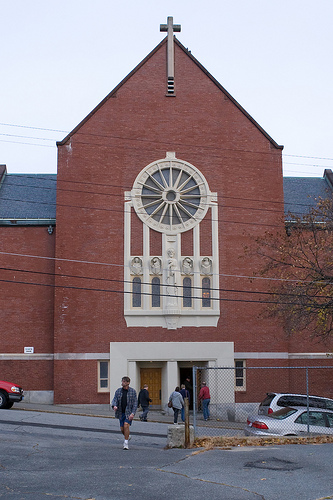
Bishop Robert McManus needs to look into this situation. Liturgical abuses are very serious. The solution is not for faithful Catholics to be told to "move on." The solution is for the priests at Saint Joseph's Parish to return to fidelity, to cease abusing the liturgy and disrupting the Church's unity.
Tuesday, June 26, 2012
Parishioner from St. Joseph's Parish in Fitchburg: "You're an idiot."
In a previous post, I noted that the Creed is often omitted during Holy Mass in certain parishes throughout the Worcester Diocese. One of these parishes where the Creed was recently omitted is Saint Joseph's Parish in Fitchburg, Massachusetts.
Evidently my post struck a nerve. I received a couple of hateful comments, one of them calling me an idiot and suggesting that the celebrant that day, Father Richard Trainor, simply forgot to include the Creed. The problem with this theory is that Father Trainor concelebrated the Mass with a visiting La Salette priest that day and there were two deacons also present - Deacon Jim Couture and retired Deacon Bob Leger. Surely with two priests and two deacons present, somebody could have remembered the Creed.
There is a point when the lying and the excuses have to stop. We are told in Ephesians that, "Speaking the truth in love, we are to grow up in every way into Him who is the head, into Christ....Therefore, putting away falsehood, let everyone speak the truth with his neighbor, for we are members one of another." (Eph 4: 15, 25).
The anonymous person who called me an idiot then asserted that I am "unmanly" because I didn't approach Father Trainor with my concerns. Two things: First, Father Trainor should understand his role in the liturgy without my holding his hand. Secondly, when I approached the pastoral leaders at Saint Joseph's in the past with suggestions, I was treated with outright hatred and hostility. I was also excluded from participation in the life of the parish. I really do not care to subject myself to more of their abuse.
But here's the thing folks. Sacrosanctum Concilium of the Second Vatican Council states clearly in No. 22 that:
"1. Regulation of the sacred liturgy depends solely on the authority of the Church, that is, on the Apostolic See and, as laws may determine, on the bishop.
2. In virtue of power conceded by the law, the regulation of the liturgy within certain defined limits belongs also to various kinds of competent territorial bodies of bishops legitimately established.
3. Therefore no other person, even if he be a priest, may add, remove, or change anything in the liturgy on his own authority."
Canon 846 of the Code of Canon Law states clearly that:
"The liturgical books, approved by the competent authority, are to be faithfully followed in the celebration of the sacraments. Accordingly, no one may on a personal initiative add to or omit or alter anything in those books."
And I'm an idiot for expecting the two priests and the two deacons present to abide by the Church's teaching and Canon Law?

Thursday, June 14, 2012
Bill Tammeus and the National "Catholic" Reporter: Dogma stands in the way of our relationship with Christ Jesus
There is an all out assault on dogma in our modern world. And I've been documenting that fact at this Blog for years. Bill Tammeus, a Presbyterian elder and former columnist for The Kansas City Star, isn't too crazy about dogma either. Writing for the National Catholic Reporter online, Mr. Tammeus complains, "Ultimately, truth in Christianity is not a doctrine, not a dogma, not a creed, not a papal bull, not what's said in a sermon, not even the words in the Bible. Rather, truth in Christianity is a person, Christ Jesus...We prefer to nail down our truths, to measure our reality in meters and pounds, light years and ohms. But when we do that, we miss the scenery and the breath-taking cosmos found along the path of those meters and light years, the complexity of life that makes up those pounds, the power and light resulting from those ohms. In Christian terms, we miss the living Lord."
What of this? Does dogma really stand in the way of our relationship with Christ Jesus? Do we really "miss the scenery" in our spiritual journey when we embrace dogmas? The Catechism of the Catholic Church tells us that, "The Church's Magisterium exercises the authority it holds from Christ to the fullest extent when it defines dogmas, that is, when it proposes, in a form obliging the Christian people to an irrevocable adherence of faith, truths contained in divine Revelation or also when it proposes, in a definitive way, truths having a necessary connection with these." (CCC, 88).
In his book entitled The Electronic Christian, Archbishop Fulton John Sheen so eloquently warned that, "The modern man must decide for himself whether he is going to have a religion with thought or a religion without it. He already knows that thoughtless policies lead to the ruin of society, and he may begin to suspect that thoughtless religion ends in confusion worse confounded.
The problem is simple. The modern man has two maps before him: one the map of sentimental religion, the other the map of dogmatic religion. The first is very simple. It has been constructed only in the last few years by a topographer who has just gone into the business of map making and is extremely adverse to explicit directions. He believes that each man should find his own way and not have his liberty taken away by dogmatic directions. The other map is much more complicated and full of dogmatic detail. It has been made by topographers who have been over every inch of the road for centuries and know each detour and each pitfall. It has explicit directions and dogmas such as, 'Do not take this road - it is swampy,' or 'Follow this road; although rough and rocky at first, it leads to a smooth road on a mountaintop.'
The simple map is very easy to read, but those who are guided by it are generally lost in a swamp of mushy sentimentalism. The other map takes a little more scrutiny, but it is simpler in the end, for it takes you up through the rocky road of the world's scorn to the everlasting hills where is seated the original Map Maker, the only One who ever has associated rest with learning: 'Learn of Me...and you shall find rest for your souls.'
Every new coherent doctrine and dogma add to the pabulum for thought; it is an extra bit of garden upon which we can intellectually browse; it is new food into which we can put our teeth and thence absorb nourishment; it is the discovery of a new intellectual planet that adds fullness and spaciousness to our mental world. And simply because it is solid and weighty, because it is dogmatic and not gaseous and foggy like a sentiment, it is intellectually invigorating, for it is with weights that the best drill is done, and not with feathers.
It is the very nature of a man to generate children of his brain in the shape of thoughts, and as he piles up thought on thought, truth on truth, doctrine on doctrine, conviction on conviction, and dogma on dogma, a very coherent and orderly fashion, so as to produce a system complex as a body and yet one and harmonious, the more and more human he becomes. When, however, in response to false cries for progress, he lops off dogmas, breaks with the memory of his forefathers, denies intellectual parentage, pleads for a religion without dogmas, substitutes mistiness for mystery, mistakes sentiment for sediment, he is sinking back slowly, surely, and inevitably into the senselessness of stones and into the irresponsible unconsciousness of weeds. Grass is broad-minded. Cabbages have heads - but no dogmas." (pp. 74-75).
The dogma is the drama as Dorothy Sayers reminded us. We have two roads before us: Creed or Chaos. And I think we all know which road the National Catholic Reporter and the LCWR have chosen.
Sunday, June 10, 2012
Why is the Creed disappearing in some parishes?
The aim of Freemasonry is the destruction of holy Church. It was Pope Leo XIII, in his Encyclical Letter Humanum Genus, who warned that, "At this period....the partisans of evil seems to be combining together, and to be struggling with united vehemence, led on or assisted by that strongly organized and widespread association called the Freemasons. No longer making any secret of their purposes, they are now boldly rising up against God Himself. They are planning the destruction of holy Church publicly and openly, and this with the set purpose of utterly despoiling the nations of Christendom, if it were possible, of the blessings obtained for us through Jesus Christ our Saviour.
Lamenting these evils, We are constrained by the charity which urges Our heart to cry out often to God: "For lo, Thy enemies have made a noise; and they that hate Thee have lifted up the head. They have taken a malicious counsel against Thy people, and they have consulted against Thy saints. They have said, `come, and let us destroy them, so that they be not a nation.' (Ps. 81:24)
At so urgent a crisis, when so fierce and so pressing an onslaught is made upon the Christian name, it is Our office to point out the danger, to mark who are the adversaries, and to the best of Our power to make head against their plans and devices, that those may not perish whose salvation is committed to Us, and that the kingdom of Jesus Christ entrusted to Our charge may not stand and remain whole, but may be enlarged by an ever-increasing growth throughout the world.
For as soon as the constitution and the spirit of the masonic sect were clearly discovered by manifest signs of its actions, by the investigation of its causes, by publication of its laws, and of its rites and commentaries, with the addition often of the personal testimony of those who were in the secret, this Apostolic See denounced the sect of the Freemasons, and publicly declared its constitution, as contrary to law and right, to be pernicious no less to Christendom than to the State; and it forbade any one to enter the society, under the penalties which the Church is wont to inflict upon exceptionally guilty persons.
The sect of Freemasons grew with a rapidity beyond conception in the course of a century and a half, until it came to be able, by means of fraud or of audacity, to gain such entrance into every rank of the State as to seem to be almost its ruling power. This swift and formidable advance has brought upon the Church, upon the power of princes, upon the public well-being, precisely that grievous harm which Our predecessors had long before foreseen. Such a condition has been reached that henceforth there will be grave reason to fear, not indeed for the Church — for her foundation is much too firm to be overturned by the effort of men — but for those States in which prevails the power, either of the sect of which we are speaking or of other sects not dissimilar which lend themselves to it as disciples and subordinates.
For, from what We have above most clearly shown, that which is their ultimate purpose forces itself into view-namely, the utter overthrow of that whole religious and political order of the world which the Christian teaching has produced, and the substitution of a new state of things in accordance with their ideas, of which the foundations and laws shall be drawn from mere naturalism.
What We have said, and are about to say, must be understood of the sect of the Freemasons taken generically, and in so far as it comprises the associations kindred to it and confederated with it, but not of the individual members of them. There may be persons amongst these, and not a few who, although not free from the guilt of having entangled themselves in such associations, yet are neither themselves partners in their criminal acts nor aware of the ultimate object which they are endeavoring to attain.
Now, the fundamental doctrine of the naturalists, which they sufficiently make known by their very name, is that human nature and human reason ought in all things to be mistress and guide. Laying this down, they care little for duties to God, or pervert them by erroneous and vague opinions. For they deny that anything has been taught by God; they allow no dogma of religion or truth which cannot be understood by the human intelligence, nor any teacher who ought to be believed by reason of his authority. And since it is the special and exclusive duty of the Catholic Church fully to set forth in words truths divinely received, to teach, besides other divine helps to salvation, the authority of its office, and to defend the same with perfect purity, it is against the Church that the rage and attack of the enemies are principally directed."
Ecclesiastical masonry has made significant inroads into the Church. I have already shown that at this Blog. And this probably explains why some parishes within the Diocese of Worcester (which promotes New Age advocate Joyce Rupp) routinely omit the Nicene Creed during Holy Mass. Just yesterday, while attending Mass at Saint Joseph's Parish in Fitchburg, I was struck by the fact that the celebrant omitted the Creed. Last week, at Holy Cross Parish in Templeton, the Creed was omitted.
Is this permissible? In a word, no. According to the General Instruction of the Roman Missal: "The purpose of the Symbolum or Profession of Faith, or Creed, is that the whole gathered people may respond to the word of God proclaimed in the readings taken from Sacred Scripture and explained in the homily and that they may also call to mind and confess the great mysteries of the faith by reciting the rule of faith in a formula approved for liturgical use, before these mysteries are celebrated in the Eucharist." (GIRM, 67).
No. 68 of GIRM states that, "The Creed is to be sung or said by the priest together with the people on Sundays and Solemnities. It may be said also at particular celebrations of a more solemn character...If it is sung, it is begun by the priest or, if this is appropriate, by a cantor or by the choir. It is sung, however, either by all together or by the people alternating with the choir...If not sung, it is to be recited by all together or by two parts of the assembly responding one to the other."
Therefore, there is no provision for omitting the creed when prescribed and no priest has the authority to do so.
So why the omission of the Profession of Faith? Pope Benedict XVI, in his work entitled "Truth and Tolerance: Christian Belief and World Religions," tells us that, "The great fundamental decisions of the early councils, which were expressed in the creeds, do not bend the faith into a philosophical theory; rather, they give verbal expression to two essential, unchanging elements of the biblical faith: they assure the realism of the biblical faith and prevent a merely symbolic or mythological interpretation; they assure the rational nature of the biblical faith, which in fact goes beyond reason itself and any possible 'experiences' it may have yet nonetheless appeals to the reason and comes forward with the claim to be telling the truth - to be opening up access for man to the very heart of reality.." (pp. 92-93).
The Catechism of the Catholic Church teaches us that, "Whoever says 'I believe' says 'I pledge myself to what we believe.' Communion in faith needs a common language of faith, normative for all and uniting all in the same confession of faith." (CCC, 185). And, "From the beginning, the apostolic Church expressed and handed on her faith in brief formulae for all...Such syntheses are called 'professions of faith' since they summarize the faith that Christians profess. They are called 'creeds' on account of what is usually their first word in Latin: credo ('I believe'). They are also called 'symbols of faith'." (CCC, Nos. 186, 187).
 This is why some are working to remove the Creed. Communion in faith needs a common language of faith which is normative for all and which unites all in the same confession of faith. Ecclesiastical masonry seeks to divide Christians in an effort to bring down the Church and replace Catholic Faith with a new humanitarian religion which the world will not find offensive. The goal is to eliminate dogma and to fashion a new church which will be made in the image and likeness of man.
Related reading here.
Lamenting these evils, We are constrained by the charity which urges Our heart to cry out often to God: "For lo, Thy enemies have made a noise; and they that hate Thee have lifted up the head. They have taken a malicious counsel against Thy people, and they have consulted against Thy saints. They have said, `come, and let us destroy them, so that they be not a nation.' (Ps. 81:24)
At so urgent a crisis, when so fierce and so pressing an onslaught is made upon the Christian name, it is Our office to point out the danger, to mark who are the adversaries, and to the best of Our power to make head against their plans and devices, that those may not perish whose salvation is committed to Us, and that the kingdom of Jesus Christ entrusted to Our charge may not stand and remain whole, but may be enlarged by an ever-increasing growth throughout the world.
For as soon as the constitution and the spirit of the masonic sect were clearly discovered by manifest signs of its actions, by the investigation of its causes, by publication of its laws, and of its rites and commentaries, with the addition often of the personal testimony of those who were in the secret, this Apostolic See denounced the sect of the Freemasons, and publicly declared its constitution, as contrary to law and right, to be pernicious no less to Christendom than to the State; and it forbade any one to enter the society, under the penalties which the Church is wont to inflict upon exceptionally guilty persons.
The sect of Freemasons grew with a rapidity beyond conception in the course of a century and a half, until it came to be able, by means of fraud or of audacity, to gain such entrance into every rank of the State as to seem to be almost its ruling power. This swift and formidable advance has brought upon the Church, upon the power of princes, upon the public well-being, precisely that grievous harm which Our predecessors had long before foreseen. Such a condition has been reached that henceforth there will be grave reason to fear, not indeed for the Church — for her foundation is much too firm to be overturned by the effort of men — but for those States in which prevails the power, either of the sect of which we are speaking or of other sects not dissimilar which lend themselves to it as disciples and subordinates.
For, from what We have above most clearly shown, that which is their ultimate purpose forces itself into view-namely, the utter overthrow of that whole religious and political order of the world which the Christian teaching has produced, and the substitution of a new state of things in accordance with their ideas, of which the foundations and laws shall be drawn from mere naturalism.
What We have said, and are about to say, must be understood of the sect of the Freemasons taken generically, and in so far as it comprises the associations kindred to it and confederated with it, but not of the individual members of them. There may be persons amongst these, and not a few who, although not free from the guilt of having entangled themselves in such associations, yet are neither themselves partners in their criminal acts nor aware of the ultimate object which they are endeavoring to attain.
Now, the fundamental doctrine of the naturalists, which they sufficiently make known by their very name, is that human nature and human reason ought in all things to be mistress and guide. Laying this down, they care little for duties to God, or pervert them by erroneous and vague opinions. For they deny that anything has been taught by God; they allow no dogma of religion or truth which cannot be understood by the human intelligence, nor any teacher who ought to be believed by reason of his authority. And since it is the special and exclusive duty of the Catholic Church fully to set forth in words truths divinely received, to teach, besides other divine helps to salvation, the authority of its office, and to defend the same with perfect purity, it is against the Church that the rage and attack of the enemies are principally directed."
Ecclesiastical masonry has made significant inroads into the Church. I have already shown that at this Blog. And this probably explains why some parishes within the Diocese of Worcester (which promotes New Age advocate Joyce Rupp) routinely omit the Nicene Creed during Holy Mass. Just yesterday, while attending Mass at Saint Joseph's Parish in Fitchburg, I was struck by the fact that the celebrant omitted the Creed. Last week, at Holy Cross Parish in Templeton, the Creed was omitted.
Is this permissible? In a word, no. According to the General Instruction of the Roman Missal: "The purpose of the Symbolum or Profession of Faith, or Creed, is that the whole gathered people may respond to the word of God proclaimed in the readings taken from Sacred Scripture and explained in the homily and that they may also call to mind and confess the great mysteries of the faith by reciting the rule of faith in a formula approved for liturgical use, before these mysteries are celebrated in the Eucharist." (GIRM, 67).
No. 68 of GIRM states that, "The Creed is to be sung or said by the priest together with the people on Sundays and Solemnities. It may be said also at particular celebrations of a more solemn character...If it is sung, it is begun by the priest or, if this is appropriate, by a cantor or by the choir. It is sung, however, either by all together or by the people alternating with the choir...If not sung, it is to be recited by all together or by two parts of the assembly responding one to the other."
Therefore, there is no provision for omitting the creed when prescribed and no priest has the authority to do so.
So why the omission of the Profession of Faith? Pope Benedict XVI, in his work entitled "Truth and Tolerance: Christian Belief and World Religions," tells us that, "The great fundamental decisions of the early councils, which were expressed in the creeds, do not bend the faith into a philosophical theory; rather, they give verbal expression to two essential, unchanging elements of the biblical faith: they assure the realism of the biblical faith and prevent a merely symbolic or mythological interpretation; they assure the rational nature of the biblical faith, which in fact goes beyond reason itself and any possible 'experiences' it may have yet nonetheless appeals to the reason and comes forward with the claim to be telling the truth - to be opening up access for man to the very heart of reality.." (pp. 92-93).
The Catechism of the Catholic Church teaches us that, "Whoever says 'I believe' says 'I pledge myself to what we believe.' Communion in faith needs a common language of faith, normative for all and uniting all in the same confession of faith." (CCC, 185). And, "From the beginning, the apostolic Church expressed and handed on her faith in brief formulae for all...Such syntheses are called 'professions of faith' since they summarize the faith that Christians profess. They are called 'creeds' on account of what is usually their first word in Latin: credo ('I believe'). They are also called 'symbols of faith'." (CCC, Nos. 186, 187).

Related reading here.
Subscribe to:
Posts (Atom)
