Showing posts with label Liturgical Abuse. Show all posts

Thursday, April 10, 2014

Whom shall we take as our model: Our Lady and the Saints or the devils?


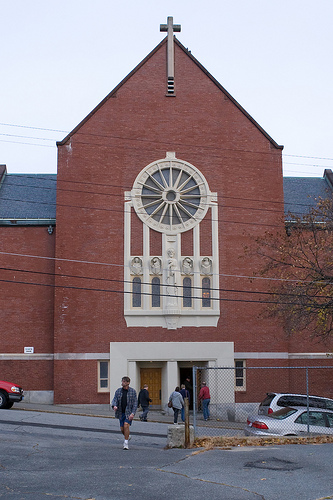
Remember Janice Potter?  She is the secretary over at Saint Joseph's Parish in Fitchburg who told me I shouldn't return to the parish because I had a problem with the  liturgical abuses there.  Most notably, the parish was omitting the Creed on Sundays.  See here.  She is still serving at the parish.  See here.

A reader named Stewart informed us that, "Janice Potter is known on Facebook by the alias Jancanman. She has 'liked' a Facebook page titled 'Hope There's Wine In Hell.'

That page may be found here:  https://www.facebook.com/winetimeanytime

Jan has also posed as a devil for a photo which she uses on various internet profiles.

In order to live our lives completely for God, we have to struggle against the principalities and powers of this world.  So many Catholics today refuse to acknowledge this truth.  For such people, belief in evil spirits is a matter of "superstition."  Pope Paul VI, in a general audience on November 15, 1972, refuted this notion saying, "What are the Church's greatest needs at the present time?  Don't be surprised at our answer and don't write it off as simplistic or even superstitious: one of the Church's greatest needs is to be defended against the evil which we call the Devil...Evil is not merely an absence of something but an active force, a living, spiritual being that is perverted and that perverts others....It is a departure from the picture provided by biblical and Church teaching to refuse to acknowledge the Devil's existence...or to explain the Devil as a pseudoreality, a conceptual, fanciful, personification of the unknown causes of our misfortunes...St. Paul calls him the 'god of this world,' and warns us of the struggle we Christians must carry on in the dark, not only against one Devil, but against a frightening multiplicity of them.."

Our spiritual struggle, then, is against a host of evil spirits.  And these evil spirits are extremely cunning.  Although they are fallen angels, they are still far more intelligent than us because of their angelic natures.  Pope Paul VI, during the same audience, stressed that the Devil, "..undermines man's moral equilibrium with his sophistry.  He is the malign, clever seducer who knows how to make his way into us through the senses, the imagination and the libido, through utopian logic, or through disordered social contacts in the give and take of our social activities, so that he can bring in us deviations that are all the more harmful because they seem to conform to our physical or mental make-up, or to our profound, instinctive aspirations....The matter of the Devil and of the influence he can exert on individuals as well as on communities, entire societies or events, is a very important chapter of Catholic doctrine which should be studied again, although it is given little attention today.."

Forty years later, we can still say the same.  Little if any attention is paid to this critical aspect of Catholic doctrine.  Mostly, I think, because we believe (in our arrogance) that we can solve all problems and difficulties ourselves.  We forget Jesus' warning that some spirits can only be driven out through much prayer and fasting.

Jesus gives us power and authority over demonic forces.  The demons were subject to the seventy disciples (Luke 10: 17-20).  They were subject to Saint Paul and the first Christians.  And they are subject to us as present-day followers of the Lord Jesus.  But in order to use this power over the evil spirits, those of us who profess to be Christian must grow and develop in our spiritual lives.  This means that we must strive to "live for God completely" as Archbishop Chaput reminded us.  We must attend Holy Mass faithfully (and reverently), pray daily - the Rosary is a spiritual weapon which Satan fears, and spend time with Sacred Scripture - God's Holy Word.

As Christians, we are MORE THAN CONQUERORS through the shed Blood of Jesus Christ (Romans 8: 37-39).  Let's live our lives accordingly.  This means listening to the Magisterium of the Church with docility and submitting our minds and wills to that teaching authority which has been established by Jesus Himself.  Without such obedience, how can we expect the evil spirits to obey our command - in the name of Jesus - to depart?  Disobedience and sin will not drive out the demons.  Only a life of faith lived in humility, taking the Virgin Mother of God as our model.


What are we waiting for? And whom shall we take as our model: Our Lady and the Saints who lived for God completely or the devils who reject God's saving plan?

The answer to that question will determine whether we re-evangelize our culture or come to resemble the demons whose doctrines we follow.

Tuesday, April 08, 2014

Saint Vincent de Paul Parish in Baldwinville and silence before Mass

Those who are bent on making their own unauthorized changes to the liturgy or who otherwise promote or tolerate various liturgical abuses often fail to appreciate how such an endeavor can constitute grave sin.  I know this because some have accused me of making a mountain out of a molehill for my opposition to various liturgical abuses.  Dr. Germain Grisez explains: "There are many reasons why it is wrong for priests intentionally to make unauthorized liturgical changes.  Two are especially important.  First, such changes sometimes embody or imply deviations from Catholic faith; even when they do not, they often omit (see here for example) or obscure something of the liturgy's expression of faith.  Thus, the Church teaches: 'The law of prayer is the law of faith: the Church believes as she prays.  Liturgy is a constitutive element of the holy and living Tradition' (cf. DV 8).  For this reason no sacramental rite may be modified or manipulated at the will of the minister or the communityEven the supreme authority in the Church may not change the liturgy arbitrarily, but only in the obedience of faith and with religious respect for the mystery of the liturgy.' (CCC, 1124-1125).

Dr. Grisez continues, "..in the Eucharist, a priest acts in the person of Christ, who joins humankind to the Father; but in making unauthorized changes, a priest obscures Jesus' action, focuses attention on himself, and becomes an obstacle to the relationship between God and His People that priests are ordained to serve...Priests are agents ordained to deliver God's gifts to His People.  If they deliver some substitute for what Jesus has entrusted to them, they interpose themselves between - and defraud - both God and His People...

There are five additional reasons why unauthorized changes should not be made in the liturgy.  First, the liturgy is the worship of the Church as a body, and those who are ordained act as Church officials in performing liturgical roles.  So, insofar as a priest makes unauthorized changes, he misrepresents as the Church's what is in fact only his or some limited group's.  Even if this misrepresentation deceives no one and is intended for some good end, it is at odds with the reverence necessary for true worship.  Second, this essential irreverence and the obvious arbitrariness of intentional unauthorized changes strongly suggest that the Eucharist is not sacred, and this suggestion tends to undermine not only faith in Jesus' bodily presence in the consecrated elements, but faith that the Eucharist is Jesus' sacrifice made present for the faithful to share in.  Third, a priest who makes intentional, unauthorized changes acts with deplorable clericalism by imposing his personal preferences on the laity and violating the rights of those who quite reasonably wish only to participate in the Church's worship.  Fourth, intentionally making unauthorized changes sets a bad example of serious disobedience to the Church's norms, and this bad example is likely to encourage some people to think and do as they please not only in liturgical and canonical matters, but in matters of faith and morals.  Fifth...unauthorized liturgical changes often become a needless, divisive issue for the faithful, thus impeding the charity that the Eucharist should express and foster."

Still think that liturgical abuse is a small matter of little significance?  If so, this reflects on your own immaturity and not the objective truth that liturgical abuse constitutes grave matter.  How grave?  Again, Dr. Grisez:

"The reasons why priests should not make unauthorized liturgical changes also make it clear..that a priest's intentionally doing so is of itself matter of grave sin.  Of course, many changes are in themselves very minor, and a few perhaps even are real improvements.  But though this kind of sin admits  parvity, such small changes also are scandalous, not only because they give the faithful a bad example of disobedience but because they contribute to a clerical culture in which liturgical abuse is widely tolerated and sometimes even expected, so that some are encouraged to engage in far graver abuses.  Now, even a sin venial in itself becomes grave scandal when one foresees that it is likely to lead others to commit grave sin; thus, the element of scandal makes grave matter of even minor liturgical abuses likely to encourage more serious abuses by other priestsDue to widespread confusion and negligence of some bishops, many priests undoubtedly lack sufficient reflection regarding this sin."


This past Sunday and the previous Sunday at Saint Vincent de Paul Parish in Baldwinville, Massachusetts, devout Catholics attempting to prepare for Holy Mass through prayer (including myself - I was attempting to pray my Rosary) were subjected to loud conversation and riotous laughter from a group of women who were taking part in some sort of support group.  The group sat in church - in front of the tabernacle no less - and engaged in inappropriate socializing without any regard for Jesus truly present in the Eucharist within the tabernacle Body, Blood, Soul and Divinity.

And this with the blessing of the "pastor" Father Francis Roberge.  At every Vigil Mass on Saturday afternoons, the choir and band will rehearse without any regard for the faithful who are trying to prepare for Mass.

As Father Peter M.J. Stravinskas, Ph.D., S.T.L., says in his book The Catholic Answer, Book 2: "Socializing is inappropriate in the body of the Church; that is for the vestibule and parish hall." (p. 195).  Monsignor Peter J. Elliott, in his book entitled Ceremonies of the Modern Roman Rite, has this to say: "The Church should be open well before the liturgy for those who wish to pray privately.  Silence is the best preparation for the celebration of the liturgy.  Apart from suitable music, no intrusion on the people's right to tranquility before the Eucharist should be tolerated, for example, musical or choral rehearsals, announcements which could be given later, or distractions in the sanctuary or elsewhere.  People may meet and talk before Mass, but in an area set well apart from the place where the liturgy is about to be celebrated." (Ceremonies of the Modern Roman Rite, No. 233, p. 87).

The General Instruction of the Roman Missal has this to say: "Sacred silence also, as part of the celebration, is to be observed at the designated times....Its purpose, however, depends on the time it occurs in each part of the celebration. Thus within the Act of Penitence and again after the invitation to pray, all recollect themselves; but at the conclusion of a reading or the homily, all meditate briefly on what they have heard; then after Communion, they praise and pray to God in their hearts. Even before the celebration itself, it is commendable that silence be observed in the church, in the sacristy, in the vesting room, and in adjacent areas, so that all may dispose themselves to carry out the sacred action in a devout and fitting manner."  (GIRM, No. 45).  

Silence should also be observed after Mass until one is outside the Church building, both for respect toward the Blessed Sacrament, and toward those members of the faithful who wish to prolong their thanksgiving after Mass.

When I politely informed the women who were engaging in inappropriate and loud conversation and laughter of this and that perhaps they could meet downstairs in the parish hall, I was told there was no room there.  I was also subjected to hate-filled glares and angry commentary from a small group of unhappy souls who obviously have a problem with the Church's teaching and liturgical rubrics.

As Father Vincent Miceli, S.J., reminded us some years back, "Rampant immorality is [an] obstacle opposing the work of evangelization.  Since conduct follows from convictions, once Catholics cancel their creed from their lives, their conduct inevitably becomes depraved....The decay on all sides of Christian morals makes it not only difficult to bring in those outside the Church, but even to stay in themselves and hold their fellow Catholics within the Church." (Essay entitled The Evangelization of the United States).

Small wonder parishes are not thriving.  Indeed many are in crisis as the pews continue to empty.  Conduct flows from convictions.  What then shall we make of the conduct of Catholics who disrespect Jesus' Presence in the Most Blessed Sacrament while keeping other Catholics from their prayer?  What shall we make of a "pastor" who permits such a situation?

At no time have I witnessed either the "pastor" of St. Vincent de Paul Parish or its deacon preparing for Mass through prayer.  I have witnessed both of them engaging in conversation and running to and fro in the church.  But I have not witnessed a spirit of prayer.

 
What a shame!


Because I tell the truth about the dissent and liturgical abuse which has been part and parcel of the Worcester Diocese, I will, no doubt, continue to be ostracized.  But I will be in good company:  See here: http://protectthepope.com/?p=10315

Monday, March 25, 2013

The gravity of liturgical abuse and the Diocese of Worcester


Many Catholics today, priests and laity as well as consecrated religious, possess a lust for innovation which they use to assault the stability of sacred rites.  Referring to these liturgical terrorists who seek to violently replace divine forms with their own reckless innovations, John Henry Cardinal Newman warned that, "No one can really respect religion and insult its forms.  Granted that forms are not immediately from God, still long use has made them divine to us; for the spirit of religion has so penetrated and quickened them, that to destroy them is, in respect to the multitude of men, to unsettle and dislodge the religious principle itself.  In most minds usage has so identified them with the notion of religion, that one cannot be extirpated without the other.  Their faith will not bear transplanting...Precious doctrines are strung like jewels upon slender threads." (John Henry Cardinal Newman, Parochial and Plain Sermons, Vol. II, Christian Classics Inc, pp. 75-76).

Those who are bent on making their own unauthorized changes to the liturgy often fail to appreciate how such an endeavor can constitute grave sin.  I know this because some have accused me of making a mountain out of a molehill for my opposition to various liturgical abuses.  Dr. Germain Grisez explains: "There are many reasons why it is wrong for priests intentionally to make unauthorized liturgical changes.  Two are especially important.  First, such changes sometimes embody or imply deviations from Catholic faith; even when they do not, they often omit (see here for example) or obscure something of the liturgy's expression of faith.  Thus, the Church teaches: 'The law of prayer is the law of faith: the Church believes as she prays.  Liturgy is a constitutive element of the holy and living Tradition' (cf. DV 8).  For this reason no sacramental rite may be modified or manipulated at the will of the minister or the communityEven the supreme authority in the Church may not change the liturgy arbitrarily, but only in the obedience of faith and with religious respect for the mystery of the liturgy.' (CCC, 1124-1125).

Dr. Grisez continues, "..in the Eucharist, a priest acts in the person of Christ, who joins humankind to the Father; but in making unauthorized changes, a priest obscures Jesus' action, focuses attention on himself, and becomes an obstacle to the relationship between God and His People that priests are ordained to serve...Priests are agents ordained to deliver God's gifts to His People.  If they deliver some substitute for what Jesus has entrusted to them, they interpose themselves between - and defraud - both God and His People...

There are five additional reasons why unauthorized changes should not be made in the liturgy.  First, the liturgy is the worship of the Church as a body, and those who are ordained act as Church officials in performing liturgical roles.  So, insofar as a priest makes unauthorized changes, he misrepresents as the Church's what is in fact only his or some limited group's.  Even if this misrepresentation deceives no one and is intended for some good end, it is at odds with the reverence necessary for true worship.  Second, this essential irreverence and the obvious arbitrariness of intentional unauthorized changes strongly suggest that the Eucharist is not sacred, and this suggestion tends to undermine not only faith in Jesus' bodily presence in the consecrated elements, but faith that the Eucharist is Jesus' sacrifice made present for the faithful to share in.  Third, a priest who makes intentional, unauthorized changes acts with deplorable clericalism by imposing his personal preferences on the laity and violating the rights of those who quite reasonably wish only to participate in the Church's worship.  Fourth, intentionally making unauthorized changes sets a bad example of serious disobedience to the Church's norms, and this bad example is likely to encourage some people to think and do as they please not only in liturgical and canonical matters, but in matters of faith and morals.  Fifth...unauthorized liturgical changes often become a needless, divisive issue for the faithful, thus impeding the charity that the Eucharist should express and foster."

Still think that liturgical abuse is a small matter of little significance?  If so, this reflects on your own immaturity and not the objective truth that liturgical abuse constitutes grave matter.  How grave?  Again, Dr. Grisez:

"The reasons why priests should not make unauthorized liturgical changes also make it clear..that a priest's intentionally doing so is of itself matter of grave sin.  Of course, many changes are in themselves very minor, and a few perhaps even are real improvements.  But though this kind of sin admits  parvity, such small changes also are scandalous, not only because they give the faithful a bad example of disobedience but because they contribute to a clerical culture in which liturgical abuse is widely tolerated and sometimes even expected, so that some are encouraged to engage in far graver abuses.  Now, even a sin venial in itself becomes grave scandal when one foresees that it is likely to lead others to commit grave sin; thus, the element of scandal makes grave matter of even minor liturgical abuses likely to encourage more serious abuses by other priests.  Due to widespread confusion and negligence of some bishops, many priests undoubtedly lack sufficient reflection regarding this sin."

Serious matter this.  But how many priests within our own Diocese of Worcester routinely make unauthorized liturgical changes and think nothing of it?  Only recently I had to address the fact that several area priests were omitting the Creed from the liturgy.  At one parish where I often attend Holy Mass, a woman who serves as an Office Manager for the parish called me an idiot and indicated that if I don't care for the liturgical abuses, I should stay away.

But is this really the answer?  Insulting Catholics who want to participate in a faithful liturgy? 

Liturgical abuse is most serious.  But thus far, Bishop Robert McManus has not dealt in any meaningful way with this ongoing problem.  Read Michael Poulin's comment at my post dealing with our new Pope Francis.

Wednesday, June 27, 2012

Jan, a parishioner at St. Joseph's Parish in Fitchburg: If you don't care for the falsification of Catholic Liturgy, don't come


In my last post, I noted how Saint Joseph's Parish in Fitchburg omitted the Nicene Creed at Holy Mass and that, because I took exception to this, a parishioner left a comment at this Blog calling me an idiot.  Now another parishioner named Jan (who some have indicated is most likely the parish secretary Janice Potter), left a comment here  saying, "What a wonderful church. I love it here. If you have a problem with it, which you obviously do as you seem to slam it every chance you get, then don't come."

In other words, if I believe that the priests who celebrate Mass at Saint Joseph's should not omit the Creed, that's my problem and I am the one who should solve the problem by leaving.

In other words, Jan is implying that that the priest has a right to alter the liturgy at will and to omit the Creed [or anything else he desires] and if I don't like it, I am the problem.

The Instruction Redemptionis Sacramentum stresses that, "Whenever an abuse is committed in the celebration of the sacred Liturgy, it is to be seen as a real falsification of Catholic Liturgy. St Thomas wrote, 'the vice of falsehood is perpetrated by anyone who offers worship to God on behalf of the Church in a manner contrary to that which is established by the Church with divine authority, and to which the Church is accustomed.'" (RS, 169).


The same document tells us that, "In order that a remedy may be applied to such abuses, 'there is a pressing need for the biblical and liturgical formation of the people of God, both pastors and faithful,' so that the Church’s faith and discipline concerning the sacred Liturgy may be accurately presented and understood. Where abuses persist, however, proceedings should be undertaken for safeguarding the spiritual patrimony and rights of the Church in accordance with the law, employing all legitimate means." (RS, 170).

An excellent article over at EWTN tells us that:


"When the justice of obedience to ecclesiastical law is not rendered and thus the proper Order of the Mass is violated, there can be no real unity in the parish and thus no peace. As a result, the Catholic unity of communion with the bishop and with and through the bishop with Peter is disturbed. Hierarchical Communion is one of the three marks of unity to be found in the Church, the others being unity of faith and unity in the discipline of the Sacraments. Liturgical disobedience uniquely disturbs all three! This is not surprising since the Eucharist is the principal source and sign of the unity of the Church. By its very nature, it MUST be either a sign of unity or a sign of disunity.


Of course, many other evils enter in by liturgical disobedience, including the serious injustice of depriving the faithful of licit, and in some cases valid, sacraments, something to which as Catholics they have a right.

Canon 214 The Christian faithful have the right to worship God according to the prescriptions of their own rite approved by the legitimate pastors of the Church, and to follow their own form of spiritual life consonant with the teaching of the Church.

When these evils occur they have the right, and even the responsibility, to make their voices heard.


Canon 212

1. The Christian faithful, conscious of their own responsibility, are bound by Christian obedience to follow what the sacred pastors, as representatives of Christ, declare as teachers of the faith or determine as leaders of the Church.

2. The Christian faithful are free to make known their needs, especially spiritual ones, and their desires to the pastors of the Church.

3. In accord with the knowledge, competence and preeminence which they possess, they have the right and even at times a duty to manifest to the sacred pastors their opinion on matters which pertain to the good of the Church, and they have a right to make their opinion known to the other Christian faithful, with due regard for the integrity of faith and morals and reverence toward their pastors, and with consideration of the common good and dignity of persons.

Bishop Robert McManus needs to look into this situation.  Liturgical abuses are very serious.  The solution is not for faithful Catholics to be told to "move on."  The solution is for the priests at Saint Joseph's Parish to return to fidelity, to cease abusing the liturgy and disrupting the Church's unity.


Tuesday, June 26, 2012

Parishioner from St. Joseph's Parish in Fitchburg: "You're an idiot."


In a previous post, I noted that the Creed is often omitted during Holy Mass in certain parishes throughout the Worcester Diocese.  One of these parishes where the Creed was recently omitted is Saint Joseph's Parish in Fitchburg, Massachusetts.

Evidently my post struck a nerve.  I received a couple of hateful comments, one of them calling me an idiot and suggesting that the celebrant that day, Father Richard Trainor, simply forgot to include the Creed.  The problem with this theory is that Father Trainor concelebrated the Mass with a visiting La Salette priest that day and there were two deacons also present - Deacon Jim Couture and retired Deacon Bob Leger.  Surely with two priests and two deacons present, somebody could have remembered the Creed.

There is a point when the lying and the excuses have to stop.  We are told in Ephesians that, "Speaking the truth in love, we are to grow up in every way into Him who is the head, into Christ....Therefore, putting away falsehood, let everyone speak the truth with his neighbor, for we are members one of another." (Eph 4: 15, 25).

The anonymous person who called me an idiot then asserted that I am "unmanly" because I didn't approach Father Trainor with my concerns.  Two things: First, Father Trainor should understand his role in the liturgy without my holding his hand.  Secondly, when I approached the pastoral leaders at Saint Joseph's in the past with suggestions, I was treated with outright hatred and hostility.  I was also excluded from participation in the life of the parish.  I really do not care to subject myself to more of their abuse.

But here's the thing folks.  Sacrosanctum Concilium of the Second Vatican Council states clearly in No. 22 that:

"1. Regulation of the sacred liturgy depends solely on the authority of the Church, that is, on the Apostolic See and, as laws may determine, on the bishop.


2. In virtue of power conceded by the law, the regulation of the liturgy within certain defined limits belongs also to various kinds of competent territorial bodies of bishops legitimately established.

3. Therefore no other person, even if he be a priest, may add, remove, or change anything in the liturgy on his own authority."

Canon 846 of the Code of Canon Law states clearly that:

"The liturgical books, approved by the competent authority, are to be faithfully followed in the celebration of the sacraments.  Accordingly, no one may on a personal initiative add to or omit or alter anything in those books."
And I'm an idiot for expecting the two priests and the two deacons present to abide by the Church's teaching and Canon Law?


Site Meter