Showing posts with label Euthanasia. Show all posts

Sunday, August 03, 2025

The notion that there is such a thing as a life not worthy to be lived


 As reported here:


"In a recent video, Kelsi Sheren, a Canadian combat veteran, host of The Kelsi Sheren Perspective, and an outspoken opponent of Canada’s Medical Assistance in Dying (MAiD) policies, shared how Canada’s government-controlled healthcare system plans to euthanize an estimated 15 million Canadians between 2027 and 2047, a staggering figure justified under the pretext of cost savings.

While doctor-assisted suicide in the U.S. has not yet reached the alarming extremes observed in Canada, the 'death with dignity' movement is actively attempting to change that. Pending Governor Hochul’s signature on New York’s recently passed bill, 11 states and Washington, D.C., will permit this abhorrent and immoral practice.

Fortunately, dedicated coalitions – including the disability rights community, pro-life organizations, leaders within the Catholic Church, and other advocates – have helped slow its expansion.

Since Oregon first legalized assisted suicide in 1997, nearly 10,000 deaths have occurred under such laws. Nevertheless, with a culture increasingly embracing death as a solution, it’s difficult to predict whether the U.S. will ultimately follow Canada’s troubling example by normalizing assisted death instead of prioritizing compassionate care.

What often goes unnoticed, however, is that existing U.S. healthcare policies are already enabling the quiet killing of vulnerable Americans – not through legalized suicide, but through hospital protocols and policies that deny care, withdraw treatment, or subtly hasten death.


______________________________________________


For the Nazis, "euthanasia" (which is translated as "good death") represented a euphemistic term for a clandestine murder program created for the systematic killing of mentally and physically disabled patients living in institutional settings throughout Germany. The National Socialist's "Euthanasia" program would set the stage for the Holocaust: the mass murder of Jews and others who were deemed either racially inferior or ideologically unsuitable. In the words of Dr. Leo Alexander, Chief U.S. Medical Consultant at the Nuremberg War Crimes Trials: 'Whatever proportions these crimes finally assumed, it became evident to all who investigated them that they had started from small beginnings."

Dr. Alexander referred to "a subtle shift in emphasis in the basic attitude of physicians." These physicians came to accept the notion that there is such a thing as a life not worthy to be lived. We are witnessing what appears to be a similar "subtle shift in emphasis" with regard to human life today.

In his Encyclical Letter Centesimus Annus, Pope John Paul II reminded us that: "Authentic democracy is possible only in a State ruled by law, and on the basis of a correct conception of the human person. It requires that the necessary conditions be present for the advancement both of the individual through education and formation in true ideals, and of the "subjectivity" of society through the creation of structures of participation and shared responsibility. Nowadays there is a tendency to claim that agnosticism and sceptical relativism are the philosophy and the basic attitude which correspond to democratic forms of political life. Those who are convinced that they know the truth and firmly adhere to it are considered unreliable from a democratic point of view, since they do not accept that truth is determined by the majority, or that it is subject to variation according to different political trends. It must be observed in this regard that if there is no ultimate truth to guide and direct political activity, then ideas and convictions can easily be manipulated for reasons of power. As history demonstrates, a democracy without values easily turns into open or thinly disguised totalitarianism."

We ignore this warning at our own peril.


Friday, June 27, 2025

Exorcist: Raise the alarm

 We read here: "I am aware of more and more events in society that are causing me to alarm.  Most recently this month, the Satanic Temple (TST) announced it is opening another abortion clinic.  This is not its first.  It encourages the women to engage in its Satanic abortion ritual which concludes:  "By my body, my blood; by my will, it is done."  This ritual will certainly yoke these people to Satan. 

In one of our cases of possession (see Exorcist Diary #275), the young woman had had an abortion and Satan taunted her mercilessly.  At one point, the demons texted the Team:  "She would have been a wonderful mother but she killed her own baby." And then, addressing the woman directly, they texted: "Don't forget to sing your lullaby; your dead baby is burning down here with me." As part of their tormenting, the demons made her experience the abortion procedure all over again and then hold her dead baby.  Yes, Satan is a huge proponent of abortion, as the Satanic Temple unwittingly gives witness.

Should not pro-abortionists rethink their position if Satan is supporting them?  Society should be alarmed at the rise of Satanism and its setting up abortion clinics and more.  Who is raising the alarm?

Similarly, witchcraft is becoming mainstream.  Witchtok, a subset of TikTok for witches, boasts of more than 40 billion views.  It is currently fashionable for young people, especially women, to identify as witches and to cast spells.  A 2024 Pew research study found that 30% of Americans have engaged in some form of occult practice in the past year such as astrology, tarot cards or fortune tellers.  

In our exorcism center, we have received a number of requests for help from women who were involved in witchcraft and the occult.  They dabbled in Tarot Cards, crystals, shamans, casting spells and magic rituals.  Most professed to be practicing "white witchcraft" and/or they said it was just for fun.  Others realized they were tapping into a spiritual force, which they knew was not God, but they were reluctant to give up the power and feeling of control.

Whenever these witches come to us for deliverance, there is a dark cloud around them.  The longer they practice, the deeper their darkness and despair.  More than a few long practitioners of Satanism and witchcraft take their own lives.  Satan strongly promotes death and, in particular, suicide.  

Who, in our society, is raising the alarm about the rise of witchcraft and the occult?  Who is speaking out about its true connection with the dark world and its inevitable personal destruction?  Who is raising the alarm?

Satan promotes death in all its manifestations.  I have no doubt the rise in euthanasia and physician-assisted suicide is cheered on by the dark world (see Exorcist Diary #338).  As the Catholic Catechism (#2777) teaches: "Whatever its motives and means, direct euthanasia consists in putting an end to the lives of handicapped, sick, or dying persons. It is morally unacceptable."

And yet, euthanasia, physician-assisted suicide, or medical aid in dying are becoming increasingly available.  People are increasingly offered the option of ending their own lives including those with mental health issues, those with non-life-threatening illnesses, and even the young. 

It is always the case that a fully possessed person will be tempted by Satan to commit suicide.  Suicide is always his end-game.  I have never seen it otherwise.  If Satan is such a proponent and advocate of suicide, what should that tell us?  Who in our society is raising the alarm about the rise of euthanasia and suicide?  

What especially surprises me is that few seemed alarmed by these and similar developments.  Only a few years ago a public profession of witchcraft, satanism, or the occult was unheard off and would have been seen as bizarre and a grave evil.  Today, it is mostly accepted by society and even applauded.  How did this happen?  Only a few years ago, it would have been unthinkable to promote suicide and to make it publicly available. What has changed?

I have a theory.  I notice that when people are into evil, witchcraft and satanism for years, bizarre things come out of their mouths.  Some will say, "Satan loves you" or "Satanism promotes human freedom and self-realization" or "Satan doesn't really exist."  Moreover, they will critically reject Christianity and the Church.  These people have begun to think like demons and believe their lies.  I call this "demon brain."  

Our society is becoming increasingly "demon brained."  How can a society remain silent in the face of Satanism, and stand by while its minions promote abortion, euthanasia, suicide, and the occult?  As the faith declines and as people begin to practice witchcraft, satanism, and the occult, Satan's influence over their minds increases.  They will increasingly accept, if not downright promote, the death-dealing agenda of Satan.

The antidote is simple: the Truth.  Jesus the way, the truth, and the life (Jn 14:6).  With the very public rise of the dark world, there is also a perceptible rise in the actions of the Holy Spirit, the intercession of the Mother of God, and the growing vibrancy of the faith among some, especially the young.  Two thousand years ago Jesus definitively triumphed over Satan.  In our time, Jesus triumphs over him again."

________________________________________________


My commentary


Father Jeffrey Steffon, in his book entitled "Satanism: Is It Real?", reminds us that, "Deliverance prayer is one of the oldest traditions of the Catholic Church. In the Our Father we pray, 'Deliver us from evil.' That prayer is a prayer for deliverance. Christians are able to pray for deliverance from evil spirits because Jesus gave them that power. In Luke 10 Jesus commissioned the seventy disciples to spread the kingdom of God. In this action Jesus gave them authority over demonic spirits. The seventy, upon their return to Jesus, exclaimed, 'Even the demons are subject to us in your name!'

Though Jesus gave His followers such power, it is up to individual Christians to use it...Deliverance prayer is not exorcism. There are two forms of exorcism: solemn and private. Solemn exorcism is a liturgical rite and public action of the Catholic Church. Solemn exorcism is performed only by an official delegate of the Bishop. Private exorcism is not a public, liturgical rite. The terms private (or simple) exorcism and deliverance refer to the same action. This style of prayer is used to curb the influence of Satan in the lives of Christians. Whereas in solemn exorcism only the delegate of the Bishop may perform the exorcism, any Christian can say the deliverance prayer.

Deliverance prayer is said in the name of the person of Jesus. Solemn exorcism is prayed in the name of Jesus and the whole Catholic Church. It would seem logical that a priest, by the power of the sacrament of Holy Orders, has a greater commission than the laity to pray the deliverance prayer. This is not always the case, however, because this prayer is a charism. God can give charisms to whomever He chooses..." (pp. 174-175).

The Congregation for the Doctrine of the Faith, responding to certain questionable activities, published a statement which said (in part): "


..the Bishops are requested to watch that, even in cases where a true diabolical possession is excluded, those who lack the proper permission do not supervise or direct the assemblies in which prayers are used to obtain a releasing, in the course of which the devils are disturbed and their identities sought. However, the declaration of these norms by no means should keep the faithful from praying to be delivered from evil, as Jesus taught. Moreover, the Bishops will be able to use any given opportunity to recall what the tradition of the Church teaches about the role played by the sacraments and the intervention of the Blessed Virgin Mary, of the Angels, and of the Saints in the spiritual struggle of Christians against evil spirits."


What are we waiting for then?

Sunday, February 12, 2017

New Vatican Healthcare Manual opening door to euthanasia

Is the Vatican opening the door to euthanasia?  See here

For the Nazis, "euthanasia" (which is translated as "good death") represented a euphemistic term for a clandestine murder program created for the systematic killing of mentally and physically disabled patients living in institutional settings throughout Germany. The National Socialist's "Euthanasia" program would set the stage for the Holocaust: the mass murder of Jews and others who were deemed either racially inferior or ideologically unsuitable. In the words of Dr. Leo Alexander, Chief U.S. Medical Consultant at the Nuremberg War Crimes Trials: 'Whatever proportions these crimes finally assumed, it became evident to all who investigated them that they had started from small beginnings."

Dr. Alexander referred to "a subtle shift in emphasis in the basic attitude of physicians." These physicians came to accept the notion that there is such a thing as a life not worthy to be lived.

We are witnessing what appears to be a similar "subtle shift in emphasis" with regard to human life in our own time. The new Vatican Healthcare Manual is a reason for concern.


In his Encyclical Letter Centesimus Annus, Pope John Paul II reminded us that:

"Authentic democracy is possible only in a State ruled by law, and on the basis of a correct conception of the human person. It requires that the necessary conditions be present for the advancement both of the individual through education and formation in true ideals, and of the "subjectivity" of society through the creation of structures of participation and shared responsibility. Nowadays there is a tendency to claim that agnosticism and sceptical relativism are the philosophy and the basic attitude which correspond to democratic forms of political life. Those who are convinced that they know the truth and firmly adhere to it are considered unreliable from a democratic point of view, since they do not accept that truth is determined by the majority, or that it is subject to variation according to different political trends. It must be observed in this regard that if there is no ultimate truth to guide and direct political activity, then ideas and convictions can easily be manipulated for reasons of power. As history demonstrates, a democracy without values easily turns into open or thinly disguised totalitarianism."

We ignore this warning at our own peril

Saturday, July 16, 2016

The American Medical Association wants to kill terminally ill patients

Life News reports that the American Medical Association wants to empower doctors to refuse medical care to terminally ill patients.

The National Socialist's "Euthanasia" program would set the stage for the Holocaust: the mass murder of Jews and others who were deemed either racially inferior or ideologically unsuitable. In the words of Dr. Leo Alexander, Chief U.S. Medical Consultant at the Nuremberg War Crimes Trials: 'Whatever proportions these crimes finally assumed, it became evident to all who investigated them that they had started from small beginnings."

Dr. Alexander referred to "a subtle shift in emphasis in the basic attitude of physicians." These physicians came to accept the notion that there is such a thing as a life not worthy to be lived. We are witnessing what appears to be a similar "subtle shift in emphasis" with regard to human life in the United States and other Western nations.

In its Declaration on Euthanasia issued on May 5, 1980, the Sacred Congregation for the Doctrine of the Faith had this to say:


"Human life is the basis of all goods, and is the necessary source and condition of every human activity and of all society. Most people regard life as something sacred and hold that no one may dispose of it at will, but believers see in life something greater, namely, a gift of God's love, which they are called upon to preserve and make fruitful. And it is this latter consideration that gives rise to the following consequences:

1. No one can make an attempt on the life of an innocent person without opposing God's love for that person, without violating a fundamental right, and therefore without committing a crime of the utmost gravity.

2. Everyone has the duty to lead his or her life in accordance with God's plan. That life is entrusted to the individual as a good that must bear fruit already here on earth, but that finds its full perfection only in eternal life.

3. Intentionally causing one's own death, or suicide, is therefore equally as wrong as murder; such an action on the part of a person is to be considered as a rejection of God's sovereignty and loving plan. Furthermore, suicide is also often a refusal of love for self, the denial of a natural instinct to live, a flight from the duties of justice and charity owed to one's neighbor, to various communities or to the whole of society - although, as is generally recognized, at times there are psychological factors present that can diminish responsibility or even completely remove it. However, one must clearly distinguish suicide from that sacrifice of one's life whereby for a higher cause, such as God's glory, the salvation of souls or the service of one's brethren, a person offers his or her own life or puts it in danger (cf. Jn. 15:14).

II.

EUTHANASIA

In order that the question of euthanasia can be properly dealt with, it is first necessary to define the words used. Etymologically speaking, in ancient times Euthanasia meant an easy death without severe suffering. Today one no longer thinks of this original meaning of the word, but rather of some intervention of medicine whereby the suffering of sickness or of the final agony are reduced, sometimes also with the danger of suppressing life prematurely. Ultimately, the word Euthanasia is used in a more particular sense to mean 'mercy killing,' for the purpose of putting an end to extreme suffering, or having abnormal babies, the mentally ill or the incurably sick from the prolongation, perhaps for many years of a miserable life, which could impose too heavy a burden on their families or on society.

It is, therefore, necessary to state clearly in what sense the word is used in the present document. By euthanasia is understood an action or an omission which of itself or by intention causes death, in order that all suffering may in this way be eliminated. Euthanasia's terms of reference, therefore, are to be found in the intention of the will and in the methods used. It is necessary to state firmly once more that nothing and no one can in any way permit the killing of an innocent human being, whether a fetus or an embryo, an infant or an adult, an old person, or one suffering from an incurable disease, or a person who is dying. Furthermore, no one is permitted to ask for this act of killing, either for himself or herself or for another person entrusted to his or her care, nor can he or she consent to it, either explicitly or implicitly. nor can any authority legitimately recommend or permit such an action. For it is a question of the violation of the divine law, an offense against the dignity of the human person, a crime against life, and an attack on humanity. 

It may happen that, by reason of prolonged and barely tolerable pain, for deeply personal or other reasons, people may be led to believe that they can legitimately ask for death or obtain it for others. Although in these cases the guilt of the individual may be reduced or completely absent, nevertheless the error of judgment into which the conscience falls, perhaps in good faith, does not change the nature of this act of killing, which will always be in itself something to be rejected. The pleas of gravely ill people who sometimes ask for death are not to be understood as implying a true desire for euthanasia; in fact, it is almost always a case of an anguished plea for help and love. What a sick person needs, besides medical care, is love, the human and supernatural warmth with which the sick person can and ought to be surrounded by all those close to him or her, parents and children, doctors and nurses."

A sick person needs love, human and supernatural warmth.  They do not need to be treated as a burden and discarded as useless. At a time when the value of human life is being thrown into question by the medical community itself, it is all the more necessary for Christians to stand up for and witness to the dignity of human life from the moment of conception to the final stages of a natural death.

Let us pray:


"O Mary, bright dawn of the new world,
Mother of the living, to you do we entrust the cause of life

Look down, O Mother, upon the vast numbers of babies not allowed to be born, of the poor whose lives are made difficult, of men and women who are victims of brutal violence, of the elderly and the sick killed by indifference or out of misguided mercy.

Grant that all who believe in your Son may proclaim the Gospel of life with honesty and love to the people of our time.

Obtain for them the grace to accept that Gospel as a gift ever new, the joy of celebrating it with gratitude throughout their lives and the courage to bear witness to it resolutely, in order to build, together with all people of good will, the civilization of truth and love, to the praise and glory of God, the Creator and lover of life." (Pope John Paul II, Evangelium Vitae).


Friday, October 16, 2015

As twilight fades....The Moloch State emerges

Russell Shaw writes, "As Robert Hugh Benson’s apocalyptic novel Lord of the World moves toward its shocking conclusion, a naïve young woman who has placed simple-minded faith in the utter goodness of the Antichrist figure at the center of the story awakens to the fact that her hero has artfully constructed a regime of violence, oppression and thought control.

Profoundly disillusioned, she turns to one of the new state-run euthanasia ‘homes’ for help in ending her life. As she ponders what has happened and what lies ahead, she thinks of the humanist belief system that has brought here: “There seemed no way out of it. The Humanity-Religion was the only one. Man was God, or at least His highest manifestation; and He was a God with which she did not wish to have anything more to do.”

It’s easy to see why Benson’s century-old tale is one of Pope Francis’s favorite books. Driven by a compelling narrative, the story depicts the frightening reality of a dystopian society without religion that in many respects resembles Western secular society now.

I thought of Lord of the World while absorbing the news from California that Gov. Jerry Brown—who the media obsessively kept reminding us is a “lifelong Catholic”—had signed into law a bill making his state the fifth in the U.S. where assisted suicide is legal. The others are Oregon, Washington, Vermont and Montana. Proponents of assisted suicide were quoted as saying they would turn next to New Jersey and Massachusetts.

Curiously enough, though, around the same time California was joining the ranks of states where doctors can help their patients do away with themselves without falling afoul of the law, Britain’s House of Commons was overwhelmingly rejecting an assisted suicide bill. The vote against was 330 to 118.

Our British cousins have hardly been slouches when it comes to endorsing whatever the secular establishment is currently pushing as the application du jour of utilitarian morality. Is it possible, then, that the lawmakers discerned some flaws in assisted suicide that have escaped the attention of Governor Brown and others like him?

Although even advocates of the right to die generally concede the need for safeguards against abuses, the dynamic of the underlying ideology encourages step by step movement in a radical direction. Perhaps the MPs who voted no were impressed by a medical journal report containing—along with other disturbing facts—the information that in one recent year a right-to-die clinic that had been set up in the Netherlands to serve people whose regular doctors wouldn’t give them lethal injections approved the killing of eleven whose only complaint was that they were “tired of living.”
Reviewing this and similar cases, the authors of the article in JAMA Internal Medicine concluded that European trends in euthanasia and assisted suicide were “very worrisome” and “should give us pause.” Really? That’s a bit like saying that you wonder if the neighbors have a problem while you watch the smoke and flames pouring out of the windows of their house.

Is America bent on going the same way? Are the rise of moral libertarianism and the decline of religious faith having the predictable result of making Americans increasingly vulnerable to an ideology of self-destruction promoted under the banner of liberation? Should we expect sooner or later to see the Supreme Court deliver a 5-4 decision announcing that the court has discovered a constitutional right to assisted suicide—complete with paper thin safeguards of course? This isn’t scare talk. I only wish it were.

Is there really any doubt where we are heading?


It was Edmund Leach who warned that, "Having abandoned the God of love, the Supreme Creator, 21st-century man is now ready to worship himself and to usurp the divine powers of creation and destruction. In the words of Dr. Edmund Leach of King's College at Cambridge: 'The scientist can now play God in his role as wonder-worker, but can he - and should he - also play God as moral arbiter?...There can be no source for these moral judgments except the scientist himself. In traditional religion, morality was held to derive from God, but God was only credited with the authority to establish and enforce moral laws because He was also credited with supernatural powers of creation and destruction. Those powers have now been usurped by man, and he must take on the moral responsibility that goes with them' (Edmund Leach, "We Scientists Have the Right to Play God," The Saturday Evening Post, November 16, 1968, p. 16).

But make no mistake about it, when man becomes God society becomes, in the words of the French philosopher Gabriel Marcel (who inspired my philosophy), 'a termite colony.' We are still in the twilight . But unless we take a stand now, we will have the Moloch state. As at Auschwitz, men will determine who has quality of life and who should be "mercifully terminated."

Wednesday, April 25, 2012

Dignity2012 in Massachusetts: Saying no to an anguished plea for help and love

In its Declaration on Euthanasia issued on May 5, 1980, the Sacred Congregation for the Doctrine of the Faith had this to say:


"Human life is the basis of all goods, and is the necessary source and condition of every human activity and of all society. Most people regard life as something sacred and hold that no one may dispose of it at will, but believers see in life something greater, namely, a gift of God's love, which they are called upon to preserve and make fruitful. And it is this latter consideration that gives rise to the following consequences:

1. No one can make an attempt on the life of an innocent person without opposing God's love for that person, without violating a fundamental right, and therefore without committing a crime of the utmost gravity.

2. Everyone has the duty to lead his or her life in accordance with God's plan. That life is entrusted to the individual as a good that must bear fruit already here on earth, but that finds its full perfection only in eternal life.

3. Intentionally causing one's own death, or suicide, is therefore equally as wrong as murder; such an action on the part of a person is to be considered as a rejection of God's sovereignty and loving plan. Furthermore, suicide is also often a refusal of love for self, the denial of a natural instinct to live, a flight from the duties of justice and charity owed to one's neighbor, to various communities or to the whole of society - although, as is generally recognized, at times there are psychological factors present that can diminish responsibility or even completely remove it. However, one must clearly distinguish suicide from that sacrifice of one's life whereby for a higher cause, such as God's glory, the salvation of souls or the service of one's brethren, a person offers his or her own life or puts it in danger (cf. Jn. 15:14).

II.

EUTHANASIA

In order that the question of euthanasia can be properly dealt with, it is first necessary to define the words used. Etymologically speaking, in ancient times Euthanasia meant an easy death without severe suffering. Today one no longer thinks of this original meaning of the word, but rather of some intervention of medicine whereby the suffering of sickness or of the final agony are reduced, sometimes also with the danger of suppressing life prematurely. Ultimately, the word Euthanasia is used in a more particular sense to mean 'mercy killing,' for the purpose of putting an end to extreme suffering, or having abnormal babies, the mentally ill or the incurably sick from the prolongation, perhaps for many years of a miserable life, which could impose too heavy a burden on their families or on society.

It is, therefore, necessary to state clearly in what sense the word is used in the present document. By euthanasia is understood an action or an omission which of itself or by intention causes death, in order that all suffering may in this way be eliminated. Euthanasia's terms of reference, therefore, are to be found in the intention of the will and in the methods used. It is necessary to state firmly once more that nothing and no one can in any way permit the killing of an innocent human being, whether a fetus or an embryo, an infant or an adult, an old person, or one suffering from an incurable disease, or a person who is dying. Furthermore, no one is permitted to ask for this act of killing, either for himself or herself or for another person entrusted to his or her care, nor can he or she consent to it, either explicitly or implicitly. nor can any authority legitimately recommend or permit such an action. For it is a question of the violation of the divine law, an offense against the dignity of the human person, a crime against life, and an attack on humanity.

It may happen that, by reason of prolonged and barely tolerable pain, for deeply personal or other reasons, people may be led to believe that they can legitimately ask for death or obtain it for others. Although in these cases the guilt of the individual may be reduced or completely absent, nevertheless the error of judgment into which the conscience falls, perhaps in good faith, does not change the nature of this act of killing, which will always be in itself something to be rejected. The pleas of gravely ill people who sometimes ask for death are not to be understood as implying a true desire for euthanasia; in fact, it is almost always a case of an anguished plea for help and love. What a sick person needs, besides medical care, is love, the human and supernatural warmth with which the sick person can and ought to be surrounded by all those close to him or her, parents and children, doctors and nurses."

Dignity2012, which describes itself as "a coalition of concerned citizens supporting the proposed Massachusetts Death with Dignity Act," has gathered nearly 80,000 signatures from Massachusetts residents when only about 70,000 signatures are required to put a measure on the ballot.  If you're not concerned about this, you should be.  You should be very concerned. 

Stephen Crawford, spokesman for Dignity2012, argues that the petition, "..is not physician-assisted suicide in the sense we traditionally think of it.  These are self-administered drugs."  Maybe so Mr. Crawford.  But, as the Church teaches us, "Intentionally causing one's own death, or suicide, is therefore equally as wrong as murder."  And history has shown us, Mr. Crawford, that mass murder can begin with very small steps until a society becomes desensitized by all the killing.

The drugs might be "self-administered" under the "Death with Dignity Act," but patients would still be "under the care of a physician" who would guide them through the process of euthanasia even though they have taken the Hippocratic Oath and sworn to "do no harm." 

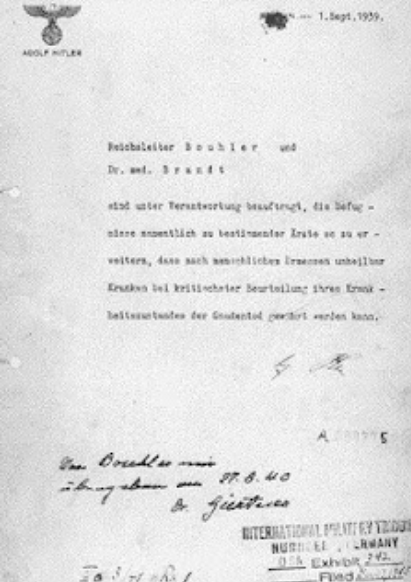
Death with Dignity you call it.  Adolph Hitler issued a decree in October of 1939 which was back dated to September 1, 1939, and which widened, "the authority of certain physicians to be designated by name in such manner that persons who, according to human judgment, are incurable can, upon a most careful diagnosis of their condition of sickness, be accorded a mercy death."  See photo.

And we all know where Nazi Germany went from there.  Soon after, Jews, Catholics and others who were ideologically unwanted (not to mention those who suffered from developmental disabilities) were put to death.

"Death with Dignity" sounds very much like "Mercy Death."


The Psalmist tells us that, "Unless the Lord builds the house, they labor in vain who build it" (Psalm 126). This scriptural truth holds for the building of families, societies, nations, international communities and, most of all, Churches. Ignoring this immutable truth, the culture-of-death advocates are determined to create a Moloch state where the God of love is replaced by "the god of technocracy who experiments and flouts the law of love in the laboratory" (Fr. Miceli).


Having abandoned the God of love, the Supreme Creator, 21st-century man is now ready to worship himself and to usurp the divine powers of creation and destruction. In the words of Dr. Edmund Leach of King's College at Cambridge: "The scientist can now play God in his role as wonder-worker, but can he - and should he - also play God as moral arbiter?...There can be no source for these moral judgments except the scientist himself. In traditional religion, morality was held to derive from God, but God was only credited with the authority to establish and enforce moral laws because He was also credited with supernatural powers of creation and destruction. Those powers have now been usurped by man, and he must take on the moral responsibility that goes with them" (Edmund Leach, "We Scientists Have the Right to Play God," The Saturday Evening Post, November 16, 1968, p. 16).


Saturday, January 02, 2010

Montana Becomes Third U.S. State To Embrace Euthanasia


"The eclipse of the sense of God and of man inevitably leads to a practical materialism, which breeds individualism, utilitarianism and hedonism. Here too we see the permanent validity of the words of the Apostle: "And since they did not see fit to acknowledge God, God gave them up to a base mind and to improper conduct" (Rom 1:28). The values of being are replaced by those of having. The only goal which counts is the pursuit of one's own material well-being. The so-called "quality of life" is interpreted primarily or exclusively as economic efficiency, inordinate consumerism, physical beauty and pleasure, to the neglect of the more profound dimensions-interpersonal, spiritual and religious-of existence.

In such a context suffering, an inescapable burden of human existence but also a factor of possible personal growth, is "censored", rejected as useless, indeed opposed as an evil, always and in every way to be avoided. When it cannot be avoided and the prospect of even some future well-being vanishes, then life appears to have lost all meaning and the temptation grows in man to claim the right to suppress it.

Within this same cultural climate, the body is no longer perceived as a properly personal reality, a sign and place of relations with others, with God and with the world. It is reduced to pure materiality: it is simply a complex of organs, functions and energies to be used according to the sole criteria of pleasure and efficiency. Consequently, sexuality too is depersonalized and exploited: from being the sign, place and language of love, that is, of the gift of self and acceptance of another, in all the other's richness as a person, it increasingly becomes the occasion and instrument for self-assertion and the selfish satisfaction of personal desires and instincts. Thus the original import of human sexuality is distorted and falsified, and the two meanings, unitive and procreative, inherent in the very nature of the conjugal act, are artificially separated: in this way the marriage union is betrayed and its fruitfulness is subjected to the caprice of the couple. Procreation then becomes the "enemy" to be avoided in sexual activity: if it is welcomed, this is only because it expresses a desire, or indeed the intention, to have a child "at all costs", and not because it signifies the complete acceptance of the other and therefore an openness to the richness of life which the child represents.

In the materialistic perspective described so far, interpersonal relations are seriously impoverished. The first to be harmed are women, children, the sick or suffering, and the elderly. The criterion of personal dignity-which demands respect, generosity and service-is replaced by the criterion of efficiency, functionality and usefulness: others are considered not for what they "are", but for what they "have, do and produce". This is the supremacy of the strong over the weak." (Pope John Paul II, Evangelium Vitae, No. 23).
Supremacy of the strong over the weak. This is the Molochian Gospel. It is a "gospel" advanced by President Barack Obama who has said that, "We are God's partners in matters of life and death" - see here.

Wednesday, September 23, 2009

Mary Alexander: Does she even understand what calumny is?

A friend of mine forwarded a Blog post link from last June and written by a woman named Mary Alexander who authors a Blog entitled "Against all Heresies." In this bizarre post, Ms. Alexander writes (in part): "Hi Anonymous and Brett (aka Paul Anthony Melanson)..Blessed shall you be when men shall hate you, and when they shall separate you, and shall reproach you, and cast out your name as evil, for the Son of Man's sake...Bless them that curse you, and pray for them that calumniate you...Keep the comments coming. I'm just building up treasure in heaven. Cheers, Mary." (Full Blog post with comment here).

Now, I am not "Brett." But I suspect there is a motive for Ms. Alexander's false accusation. You see, Ms. Alexander has defended the late Father Leonard Feeney. And I am, of course, on record as opposing Father Feeney's interpretation of the dogma "Outside the Church there is no salvation." This wouldn't be the first time Ms. Alexander has demonstrated some sort of problem with me or an animosity. In the comments section of a previous post here at La Salette Journey, Ms. Alexander left a comment implying that the Church's 1980 Instruction on Euthanasia was somehow "out-of-date." She was immediately corrected by others who reminded her that the Catechism of the Catholic Church cites this document as authoritative (see here).

And this wouldn't be the first time that Ms. Alexander has engaged in uncharitable rhetoric. In her Blog post defending Father Leonard Feeney, whose interpretation of the dogma "Outside the Church there is no salvation" was condemned by Pope Pius XII, she had some rather unkind words for the late Fr. Richard John Neuhaus, a very-well respected priest who was loyal to the Church and her teaching. Ms. Alexander referred to this heroic priest and solid-Catholic thinker as being simple-minded and naive (see here).

I submit that Ms. Alexander would benefit from visiting this link to read up on calumny. This excellent entry says (in part): "..the calumniator is bound to adequate reparation for the injury perpetrated by the blackening of another's good name. He is obliged to retract his false statements."

Ms. Alexander is right about one thing though. We all need to pray for those who calumniate us. I will get right on that.

Related reading here.

Friday, August 14, 2009

Senate Bill Will Not Address End-of-Life Care: Will President Obama now apologize to critics of H.R. 3200?


Senator Charles E. Grassley of Iowa said that the Senate Finance Committee "dropped end-of-life provisions from consideration entirely because of the way they could be misinterpreted and implemented incorrectly." Could be? It gets better. The Iowa Senator then admits that the House legislation was "so poorly cobbled together that it will have all kinds of unintended consequences."

President Obama, who always seems to be calling for "reason, calm and dialogue," should follow his own advice. Speaking to a crowd of about 1,800 at Portsmouth High School in New Hampshire, Obama was quoted as having said that opponents of H.R. 3200 [and most especially those concerned over Section 1233] "will try to scare the heck out of folks and they'll create bogeymen out there that just aren't real." But this bogeyman was real. Which is why the Senate Finance Committee is dropping the end-of-life provisions.

This isn't the first time the president has attempted to demonize his opponents. Just recently he went on record as saying that Americans who disapprove of homosexuality are clinging to "worn arguments and old attitudes." Clearly no one has ever gifted Obama with a copy of Dale Carnegie's best-selling book.


Sophocles, in Antigone 1. 1023, says, "Stubborness and stupidity are twins." How so? Dr. Montague Brown explains as he makes the distinction between tenacity and stubborness: "Tenacity is the dedicated adherence to something we know to be worthwhile. As such, tenacity is positive. It involves a clear purpose - to persevere in what is good - and welcomes new evidence and perspectives that clarify or enrich that good...Tenacity is particularly evident when the adherence required is difficult. If my perseverance requires great effort of body or mind, or if it requires me to face a great deal of peer pressure and perhaps even ridicule, then my holding fast to my good purpose shows strength of mind and courage. In such cases, there may be little to gain in terms of social standing, but much in moral standing. Tenaciously holding to what is true and good not only benefits me in terms of virtue; it also works to ensure the stability of these goods in the community....Stubborness is the uncompromising insistence on having our own way. As such, stubborness is negative. It involves a kind of blindness, along with a willful rejection of evidence and the perspectives of others. Stubborness is particularly evident when the compromise required is easy. If the evidence I need to convince me to change my mind is readily available, or if accepting another's perspective would mean giving up little of importance, then my refusal to yield is not reasonable, but is motivated by stubborness. There is little to lose except my desire to be in control. Such rigid clinging to my own will hurts the community, because I refuse to cooperate with others, and it also prevents me from becoming successful and virtuous." (Dr. Montague Brown, Ph.D, The One-Minute Philosopher, pp. 162-163, Sophia Institute Press).

Is President Obama tenacious or stubborn? Is he interested in creating real and meaningful dialogue or demonizing his opponents? His track record, thus far, provides us with an answer.

Thursday, August 13, 2009

Sarah Palin responds to President Obama on Facebook


Concerning the "Death Panels"
Yesterday at 8:55pm

Yesterday President Obama responded to my statement that Democratic health care proposals would lead to rationed care; that the sick, the elderly, and the disabled would suffer the most under such rationing; and that under such a system these “unproductive” members of society could face the prospect of government bureaucrats determining whether they deserve health care.

The President made light of these concerns. He said:

“Let me just be specific about some things that I’ve been hearing lately that we just need to dispose of here. The rumor that’s been circulating a lot lately is this idea that somehow the House of Representatives voted for death panels that will basically pull the plug on grandma because we’ve decided that we don’t, it’s too expensive to let her live anymore....It turns out that I guess this arose out of a provision in one of the House bills that allowed Medicare to reimburse people for consultations about end-of-life care, setting up living wills, the availability of hospice, etc. So the intention of the members of Congress was to give people more information so that they could handle issues of end-of-life care when they’re ready on their own terms. It wasn’t forcing anybody to do anything.” [1]

The provision that President Obama refers to is Section 1233 of HR 3200, entitled “Advance Care Planning Consultation.” [2] With all due respect, it’s misleading for the President to describe this section as an entirely voluntary provision that simply increases the information offered to Medicare recipients. The issue is the context in which that information is provided and the coercive effect these consultations will have in that context.

Section 1233 authorizes advanced care planning consultations for senior citizens on Medicare every five years, and more often “if there is a significant change in the health condition of the individual ... or upon admission to a skilled nursing facility, a long-term care facility... or a hospice program." [3] During those consultations, practitioners must explain “the continuum of end-of-life services and supports available, including palliative care and hospice,” and the government benefits available to pay for such services. [4]

Now put this in context. These consultations are authorized whenever a Medicare recipient’s health changes significantly or when they enter a nursing home, and they are part of a bill whose stated purpose is “to reduce the growth in health care spending.” [5] Is it any wonder that senior citizens might view such consultations as attempts to convince them to help reduce health care costs by accepting minimal end-of-life care? As Charles Lane notes in the Washington Post, Section 1233 “addresses compassionate goals in disconcerting proximity to fiscal ones.... If it’s all about obviating suffering, emotional or physical, what’s it doing in a measure to “bend the curve” on health-care costs?” [6]

As Lane also points out:

Though not mandatory, as some on the right have claimed, the consultations envisioned in Section 1233 aren’t quite “purely voluntary,” as Rep. Sander M. Levin (D-Mich.) asserts. To me, “purely voluntary” means “not unless the patient requests one.” Section 1233, however, lets doctors initiate the chat and gives them an incentive -- money -- to do so. Indeed, that’s an incentive to insist.

Patients may refuse without penalty, but many will bow to white-coated authority. Once they’re in the meeting, the bill does permit “formulation” of a plug-pulling order right then and there. So when Rep. Earl Blumenauer (D-Ore.) denies that Section 1233 would “place senior citizens in situations where they feel pressured to sign end-of-life directives that they would not otherwise sign,” I don’t think he’s being realistic. [7]

Even columnist Eugene Robinson, a self-described “true believer” who “will almost certainly support” “whatever reform package finally emerges”, agrees that “If the government says it has to control health-care costs and then offers to pay doctors to give advice about hospice care, citizens are not delusional to conclude that the goal is to reduce end-of-life spending.” [8]

So are these usually friendly pundits wrong? Is this all just a “rumor” to be “disposed of”, as President Obama says? Not according to Democratic New York State Senator Ruben Diaz, Chairman of the New York State Senate Aging Committee, who writes:

Section 1233 of House Resolution 3200 puts our senior citizens on a slippery slope and may diminish respect for the inherent dignity of each of their lives.... It is egregious to consider that any senior citizen ... should be placed in a situation where he or she would feel pressured to save the government money by dying a little sooner than he or she otherwise would, be required to be counseled about the supposed benefits of killing oneself, or be encouraged to sign any end of life directives that they would not otherwise sign. [9]

Of course, it’s not just this one provision that presents a problem. My original comments concerned statements made by Dr. Ezekiel Emanuel, a health policy advisor to President Obama and the brother of the President’s chief of staff. Dr. Emanuel has written that some medical services should not be guaranteed to those “who are irreversibly prevented from being or becoming participating citizens....An obvious example is not guaranteeing health services to patients with dementia.” [10] Dr. Emanuel has also advocated basing medical decisions on a system which “produces a priority curve on which individuals aged between roughly 15 and 40 years get the most chance, whereas the youngest and oldest people get chances that are attenuated.” [11]

President Obama can try to gloss over the effects of government authorized end-of-life consultations, but the views of one of his top health care advisors are clear enough. It’s all just more evidence that the Democratic legislative proposals will lead to health care rationing, and more evidence that the top-down plans of government bureaucrats will never result in real health care reform.

[1] See http://blogs.abcnews.com/politicalpunch/2009/08/president-obama-addresses-sarah-palin-death-panels-wild-representations.html.
[2] See http://edlabor.house.gov/documents/111/pdf/publications/AAHCA-BillText-071409.pdf
[3] See HR 3200 sec. 1233 (hhh)(1); Sec. 1233 (hhh)(3)(B)(1), above.
[4] See HR 3200 sec. 1233 (hhh)(1)(E), above.
[5] See http://edlabor.house.gov/documents/111/pdf/publications/AAHCA-BillText-071409.pdf
[6] See http://www.washingtonpost.com/wp-dyn/content/article/2009/08/07/AR2009080703043.html].
[7] Id.
[8] See http://www.washingtonpost.com/wp-dyn/content/article/2009/08/10/AR2009081002455.html].
[9] See http://www.nysenate.gov/press-release/letter-congressman-henry-waxman-re-section-1233-hr-3200.
[10] See http://www.ncpa.org/pdfs/Where_Civic_Republicanism_and_Deliberative_Democracy_Meet.pdf
[11] See http://www.scribd.com/doc/18280675/Principles-for-Allocation-of-Scarce-Medical-Interventions.
Related reading here and here. It was President Obama who said: "The chronically ill and those toward the end of their lives are accounting for potentially 80 percent of the total health-care bill out here." See here.
Critics of the president's health-care bill don't have to create "bogeymen." Not when they have statements like the one above.

Tuesday, August 04, 2009

Patrick J. Buchanan on the emerging Moloch State...


"I am absolutely convinced that the gas chambers of Auschwitz, Treblinka, and Maidanek were ultimately prepared not in some ministry or other in Berlin, but rather at the desks and in the lecture halls of nihilistic scientists and philosophers."

- Viktor E. Frankl, 1905-1997.


"...being frequently driven into straits where rules are useless, and being often kept fluctuating pitiably between hope and fear by the uncertainty of fortune's greedily coveted favors, they are consequently, for the most part, very prone to credulity. The human mind is readily swayed this way or that in times of doubt, especially when hope and fear are struggling for the mastery...in adversity they know not where to turn, but beg and pray for counsel from every passer-by. No plan is then too futile, too absurd, or too fatuous for their adoption...."

- Spinoza


“I will give no deadly medicine to any one if asked, nor suggest any such counsel”
- The Hippocratic Oath


"At the other end of life's spectrum, men and women find themselves facing the mystery of death. Today, as a result of advances in medicine and in a cultural context frequently closed to the transcendent, the experience of dying is marked by new features. When the prevailing tendency is to value life only to the extent that it brings pleasure and well-being, suffering seems like an unbearable setback, something from which one must be freed at all costs. Death is considered 'senseless' if it suddenly interrupts a life still open to a future of new and interesting experiences. But it becomes a 'rightful liberation' once life is held to be no longer meaningful because it is filled with pain and inexorably doomed to even greater suffering.

Furthermore, when he denies or neglects his fundamental relationship to God, man thinks he is his own rule and measure, with the right to demand that society should guarantee him the ways and means of deciding what to do with his life in full and complete autonomy. It is especially people in the developed countries who act in this way: they feel encouraged to do so also by the constant progress of medicine and its ever more advanced techniques. By using highly sophisticated systems and equipment, science and medical practice today are able not only to attend to cases formerly considered untreatable and to reduce or eliminate pain, but also to sustain and prolong life even in situations of extreme frailty, to resuscitate artifi- cially patients whose basic biological functions have undergone sudden collapse, and to use special procedures to make organs available for transplanting.

In this context the temptation grows to have recourse to euthanasia, that is, to take control of death and bring it about before its time, 'gently' ending one's own life or the life of others. In reality, what might seem logical and humane, when looked at more closely is seen to be senseless and inhumane. Here we are faced with one of the more alarming symptoms of the 'culture of death', which is advancing above all in prosperous societies, marked by an attitude of excessive preoccupation with efficiency and which sees the growing number of elderly and disabled people as intolerable and too burdensome. These people are very often isolated by their families and by society, which are organized almost exclusively on the basis of criteria of productive efficiency, according to which a hopelessly impaired life no longer has any value.


For a correct moral judgment on euthanasia, in the first place a clear definition is required. Euthanasia in the strict sense is understood to be an action or omission which of itself and by intention causes death, with the purpose of eliminating all suffering. 'Euthanasia's terms of reference, therefore, are to be found in the intention of the will and in the methods used'.

Euthanasia must be distinguished from the decision to forego so-called 'aggressive medical treatment', in other words, medical procedures which no longer correspond to the real situation of the patient, either because they are by now disproportionate to any expected results or because they impose an excessive burden on the patient and his family. In such situations, when death is clearly imminent and inevitable, one can in conscience 'refuse forms of treatment that would only secure a precarious and burdensome prolongation of life, so long as the normal care due to the sick person in similar cases is not interrupted'. Certainly there is a moral obligation to care for oneself and to allow oneself to be cared for, but this duty must take account of concrete circumstances. It needs to be determined whether the means of treatment available are objectively proportionate to the prospects for improvement. To forego extraordinary or disproportionate means is not the equivalent of suicide or euthanasia; it rather expresses acceptance of the human condition in the face of death.

In modern medicine, increased attention is being given to what are called 'methods of palliative care', which seek to make suffering more bearable in the final stages of illness and to ensure that the patient is supported and accompanied in his or her ordeal. Among the questions which arise in this context is that of the licitness of using various types of painkillers and sedatives for relieving the patient's pain when this involves the risk of shortening life. While praise may be due to the person who voluntarily accepts suffering by forgoing treatment with pain-killers in order to remain fully lucid and, if a believer, to share consciously in the Lord's Passion, such 'heroic' behaviour cannot be considered the duty of everyone. Pius XII affirmed that it is licit to relieve pain by narcotics, even when the result is decreased consciousness and a shortening of life, 'if no other means exist, and if, in the given circumstances, this does not prevent the carrying out of other religious and moral duties'. In such a case, death is not willed or sought, even though for reasonable motives one runs the risk of it: there is simply a desire to ease pain effectively by using the analgesics which medicine provides. All the same, 'it is not right to deprive the dying person of consciousness without a serious reason': as they approach death people ought to be able to satisfy their moral and family duties, and above all they ought to be able to prepare in a fully conscious way for their definitive meeting with God.

Taking into account these distinctions, in harmony with the Magisterium of my Predecessors and in communion with the Bishops of the Catholic Church, I confirm that euthanasia is a grave violation of the law of God, since it is the deliberate and morally unacceptable killing of a human person. This doctrine is based upon the natural law and upon the written word of God, is transmitted by the Church's Tradition and taught by the ordinary and universal Magisterium.

Depending on the circumstances, this practice involves the malice proper to suicide or murder.


Suicide is always as morally objectionable as murder. The Church's tradition has always rejected it as a gravely evil choice. Even though a certain psychological, cultural and social conditioning may induce a person to carry out an action which so radically contradicts the innate inclination to life, thus lessening or removing subjective responsibility, suicide, when viewed objectively, is a gravely immoral act. In fact, it involves the rejection of love of self and the renunciation of the obligation of justice and charity towards one's neighbour, towards the communities to which one belongs, and towards society as a whole. In its deepest reality, suicide represents a rejection of God's absolute sovereignty over life and death, as proclaimed in the prayer of the ancient sage of Israel: 'You have power over life and death; you lead men down to the gates of Hades and back again' (Wis 16:13; cf. Tob 13:2).

To concur with the intention of another person to commit suicide and to help in carrying it out through so-called 'assisted suicide' means to cooperate in, and at times to be the actual perpetrator of, an injustice which can never be excused, even if it is requested. In a remarkably relevant passage Saint Augustine writes that 'it is never licit to kill another: even if he should wish it, indeed if he request it because, hanging between life and death, he begs for help in freeing the soul struggling against the bonds of the body and longing to be released; nor is it licit even when a sick person is no longer able to live'. Even when not motivated by a selfish refusal to be burdened with the life of someone who is suffering, euthanasia must be called a false mercy, and indeed a disturbing 'perversion' of mercy. True 'compassion' leads to sharing another's pain; it does not kill the person whose suffering we cannot bear. Moreover, the act of euthanasia appears all the more perverse if it is carried out by those, like relatives, who are supposed to treat a family member with patience and love, or by those, such as doctors, who by virtue of their specific profession are supposed to care for the sick person even in the most painful terminal stages.

The choice of euthanasia becomes more serious when it takes the form of a murder committed by others on a person who has in no way requested it and who has never consented to it. The height of arbitrariness and injustice is reached when certain people, such as physicians or legislators, arrogate to themselves the power to decide who ought to live and who ought to die. Once again we find ourselves before the temptation of Eden: to become like God who 'knows good and evil' (cf. Gen 3:5). God alone has the power over life and death: 'It is I who bring both death and life' (Dt 32:39; cf. 2 Kg 5:7; 1 Sam 2:6). But he only exercises this power in accordance with a plan of wisdom and love. When man usurps this power, being enslaved by a foolish and selfish way of thinking, he inevitably uses it for injustice and death. Thus the life of the person who is weak is put into the hands of the one who is strong; in society the sense of justice is lost, and mutual trust, the basis of every authentic interpersonal relationship, is undermined at its root.

Quite different from this is the way of love and true mercy, which our common humanity calls for, and upon which faith in Christ the Redeemer, who died and rose again, sheds ever new light. The request which arises from the human heart in the supreme confrontation with suffering and death, especially when faced with the temptation to give up in utter desperation, is above all a request for companionship, sympathy and support in the time of trial. It is a plea for help to keep on hoping when all human hopes fail. As the Second Vatican Council reminds us: 'It is in the face of death that the riddle of human existence becomes most acute' and yet 'man rightly follows the intuition of his heart when he abhors and repudiates the absolute ruin and total disappearance of his own person. Man rebels against death because he bears in himself an eternal seed which cannot be reduced to mere matter'.

This natural aversion to death and this incipient hope of immortality are illumined and brought to fulfilment by Christian faith, which both promises and offers a share in the victory of the Risen Christ: it is the victory of the One who, by his redemptive death, has set man free from death, 'the wages of sin' (Rom 6:23), and has given him the Spirit, the pledge of resurrection and of life (cf. Rom 8:11). The certainty of future immortality and hope in the promised resurrection cast new light on the mystery of suffering and death, and fill the believer with an extraordinary capacity to trust fully in the plan of God.

The Apostle Paul expressed this newness in terms of belonging completely to the Lord who embraces every human condition: 'None of us lives to himself, and none of us dies to himself. If we live, we live to the Lord, and if we die, we die to the Lord; so then, whether we live or whether we die, we are the Lord's' (Rom 14:7-8). Dying to the Lord means experiencing one's death as the supreme act of obedience to the Father (cf. Phil 2:8), being ready to meet death at the 'hour' willed and chosen by him (cf.Jn 13:1), which can only mean when one's earthly pilgrimage is completed. Living to the Lord also means recognizing that suffering, while still an evil and a trial in itself, can always become a source of good. It becomes such if it is experienced for love and with love through sharing, by God's gracious gift and one's own personal and free choice, in the suffering of Christ Crucified. In this way, the person who lives his suffering in the Lord grows more fully conformed to him (cf. Phil 3:10; 1 Pet 2:21) and more closely associated with his redemptive work on behalf of the Church and humanity. This was the experience of Saint Paul, which every person who suffers is called to relive: 'I rejoice in my sufferings for your sake, and in my flesh I complete what is lacking in Christ's afflictions for the sake of his Body, that is, the Church' (Col 1:24)." (Pope John Paul II, Evangelium Vitae, Nos. 64-67).


Related reading here, here and here.

Saturday, August 01, 2009

"..it is a question of the violation of the divine law...and an attack on humanity


In its Declaration on Euthanasia issued on May 5, 1980, the Sacred Congregation for the Doctrine of the Faith had this to say:


"Human life is the basis of all goods, and is the necessary source and condition of every human activity and of all society. Most people regard life as something sacred and hold that no one may dispose of it at will, but believers see in life something greater, namely, a gift of God's love, which they are called upon to preserve and make fruitful. And it is this latter consideration that gives rise to the following consequences:

1. No one can make an attempt on the life of an innocent person without opposing God's love for that person, without violating a fundamental right, and therefore without committing a crime of the utmost gravity.

2. Everyone has the duty to lead his or her life in accordance with God's plan. That life is entrusted to the individual as a good that must bear fruit already here on earth, but that finds its full perfection only in eternal life.

3. Intentionally causing one's own death, or suicide, is therefore equally as wrong as murder; such an action on the part of a person is to be considered as a rejection of God's sovereignty and loving plan. Furthermore, suicide is also often a refusal of love for self, the denial of a natural instinct to live, a flight from the duties of justice and charity owed to one's neighbor, to various communities or to the whole of society - although, as is generally recognized, at times there are psychological factors present that can diminish responsibility or even completely remove it. However, one must clearly distinguish suicide from that sacrifice of one's life whereby for a higher cause, such as God's glory, the salvation of souls or the service of one's brethren, a person offers his or her own life or puts it in danger (cf. Jn. 15:14).

II.
EUTHANASIA

In order that the question of euthanasia can be properly dealt with, it is first necessary to define the words used. Etymologically speaking, in ancient times Euthanasia meant an easy death without severe suffering. Today one no longer thinks of this original meaning of the word, but rather of some intervention of medicine whereby the suffering of sickness or of the final agony are reduced, sometimes also with the danger of suppressing life prematurely. Ultimately, the word Euthanasia is used in a more particular sense to mean "mercy killing," for the purpose of putting an end to extreme suffering, or having abnormal babies, the mentally ill or the incurably sick from the prolongation, perhaps for many years of a miserable life, which could impose too heavy a burden on their families or on society. It is, therefore, necessary to state clearly in what sense the word is used in the present document. By euthanasia is understood an action or an omission which of itself or by intention causes death, in order that all suffering may in this way be eliminated. Euthanasia's terms of reference, therefore, are to be found in the intention of the will and in the methods used. It is necessary to state firmly once more that nothing and no one can in any way permit the killing of an innocent human being, whether a fetus or an embryo, an infant or an adult, an old person, or one suffering from an incurable disease, or a person who is dying. Furthermore, no one is permitted to ask for this act of killing, either for himself or herself or for another person entrusted to his or her care, nor can he or she consent to it, either explicitly or implicitly. nor can any authority legitimately recommend or permit such an action. For it is a question of the violation of the divine law, an offense against the dignity of the human person, a crime against life, and an attack on humanity. It may happen that, by reason of prolonged and barely tolerable pain, for deeply personal or other reasons, people may be led to believe that they can legitimately ask for death or obtain it for others. Although in these cases the guilt of the individual may be reduced or completely absent, nevertheless the error of judgment into which the conscience falls, perhaps in good faith, does not change the nature of this act of killing, which will always be in itself something to be rejected. The pleas of gravely ill people who sometimes ask for death are not to be understood as implying a true desire for euthanasia; in fact, it is almost always a case of an anguished plea for help and love. What a sick person needs, besides medical care, is love, the human and supernatural warmth with which the sick person can and ought to be surrounded by all those close to him or her, parents and children, doctors and nurses."

In New Hampshire, there is a proposed bill to eliminate those who deserve such love and supernatural warmth. Concerns have been expressed that the federal government might become involved in euthanasia.

The Psalmist tells us that, "Unless the Lord builds the house, they labor in vain who build it" (Psalm 126). This scriptural truth holds for the building of families, societies, nations, international communities and, most of all, Churches. Ignoring this immutable truth, the culture-of-death advocates are determined to create a Moloch state where the God of love is replaced by "the god of technocracy who experiments and flouts the law of love in the laboratory" (Fr. Miceli).

Having abandoned the God of love, the Supreme Creator, 21st-century man is now ready to worship himself and to usurp the divine powers of creation and destruction. In the words of Dr. Edmund Leach of King's College at Cambridge: "The scientist can now play God in his role as wonder-worker, but can he - and should he - also play God as moral arbiter?...There can be no source for these moral judgments except the scientist himself. In traditional religion, morality was held to derive from God, but God was only credited with the authority to establish and enforce moral laws because He was also credited with supernatural powers of creation and destruction. Those powers have now been usurped by man, and he must take on the moral responsibility that goes with them" (Edmund Leach, "We Scientists Have the Right to Play God," The Saturday Evening Post, November 16, 1968, p. 16).

But make no mistake about it, when man becomes God society becomes, in the words of the French philosopher Gabriel Marcel, "a termite colony." We are still in the twilight. But unless we take a stand now, we will have the Moloch state. As at Auschwitz, men will determine who has quality of life and who should be "mercifully terminated."

Friday, July 31, 2009

Catholic League: Bill implies federal government may become involved in euthanasia


Bill Donohue, president of the Catholic League, issued the following statement in response to Section 1233 of H.R 3200, the health care reform bill that was introduced in the House:


There is language in this section of the bill that implies that the federal government may become involved in euthanasia. So over the past two days, July 27-28, Catholic League staff contacted the following persons, committees or offices looking for clarification:

Rep. Nancy Pelosi; Rep. John Dingell; Rep. Rob Andrews; Rep. Frank Pallone, Jr.; Rep. Charles Rangel; Rep. Pete Stark; Rep. Henry Waxman; Rep. George Miller; Rep. Dale Kildee; Rep. Carolyn Maloney; Health and Human Services (HHS) Secretary Kathleen Sebelius; HHS Center for Faith-Based and Community Initiatives; HHS Office of the Assistant Secretary for Aging; HHS Office of the Deputy Assistant Secretary for Legislation for Discretionary Health Programs; HHS Office of the Deputy Assistant Secretary for Legislation for Mandatory Health Programs; HHS Office of the Assistant Secretary for Planning and Evaluation; HHS Congressional Liaison Office; HHS Office of Human Services Policy; HHS Office of Disability, Aging and Long-Term Care Policy; HHS Office of Planning and Policy Support; HHS Office of the Deputy Assistant Secretary for Legislation for Human Services; Ways and Means Committee; Education and Labor Committee; Energy and Commerce Committee; Oversight and Government Reform Committee; Budget Committee; White House Health Reform Office.

No one with whom we spoke said the government is entering the business of euthanasia. But this is not enough. We need to know exactly what is meant by the following: “An explanation by the practitioner of the continuum of end-of-life services and supports available….” We also need to know exactly what is meant by “The Secretary shall publish in the Federal Register proposed quality measures on end of life care and advanced care planning….” The public has a right to know exactly what is meant by terms like “end-of-life services” and “quality measures.” Now is the time to settle this issue.

Contact healthreform@hhs.gov


Related reading: New Hampshire: En Route to Mass Murder?


New Hampshire House Bill 304 (and especially Section XIII), is chilling. And brings to mind a decree issued by Adolph Hitler in October of 1939 and back dated to September 1, 1939, which widened, "the authority of certain physicians to be designated by name in such manner that persons who, according to human judgment, are incurable can, upon a most careful diagnosis of their condition of sickness, be accorded a mercy death."


Is that where health care in the United States is heading? Are we traveling a familar road to euthanasia?
Photo is of Hitler's euthanasia order.

Wednesday, July 29, 2009

New Hampshire: En Route to Mass Murder?


For the Nazis, "euthanasia" (which is translated as "good death") represented a euphemistic term for a clandestine murder program created for the systematic killing of mentally and physically disabled patients living in institutional settings throughout Germany. The National Socialist's "Euthanasia" program would set the stage for the Holocaust: the mass murder of Jews and others who were deemed either racially inferior or ideologically unsuitable. In the words of Dr. Leo Alexander, Chief U.S. Medical Consultant at the Nuremberg War Crimes Trials: 'Whatever proportions these crimes finally assumed, it became evident to all who investigated them that they had started from small beginnings."

Dr. Alexander referred to "a subtle shift in emphasis in the basic attitude of physicians." These physicians came to accept the notion that there is such a thing as a life not worthy to be lived. We are witnessing what appears to be a similar "subtle shift in emphasis" with regard to human life in the state of New Hampshire. New Hampshire House Bill 304 (HB304), which was introduced on January 8, 2009 and is currently retained in committee (read the proposed bill here), would radically redefine who is eligible for "assisted suicide." See here.

Is it a coincidence that the four sponsors of HB304 (Charles Weed, Barbara Richardson, Rick Watrous and Bonnie Mitchell) are all Democrats with no religious affiliation?


In his Encyclical Letter Centesimus Annus, Pope John Paul II reminded us that:

"Authentic democracy is possible only in a State ruled by law, and on the basis of a correct conception of the human person. It requires that the necessary conditions be present for the advancement both of the individual through education and formation in true ideals, and of the "subjectivity" of society through the creation of structures of participation and shared responsibility. Nowadays there is a tendency to claim that agnosticism and sceptical relativism are the philosophy and the basic attitude which correspond to democratic forms of political life. Those who are convinced that they know the truth and firmly adhere to it are considered unreliable from a democratic point of view, since they do not accept that truth is determined by the majority, or that it is subject to variation according to different political trends. It must be observed in this regard that if there is no ultimate truth to guide and direct political activity, then ideas and convictions can easily be manipulated for reasons of power. As history demonstrates, a democracy without values easily turns into open or thinly disguised totalitarianism."

We ignore this warning at our own peril.


Related reading here and here.
Site Meter