Showing posts with label Embrace. Show all posts

Sunday, February 28, 2021

Francis: We should caress our neuroses


You just can't make this up.  Francis, whose mental health has been in question for many years, said that we should "caress our neuroses."  See here.

Pope Francis has admitted that he has "some nerve problems" which require treatment as well as various neuroses. See here. A neuroses is defined as, "A relatively mild mental illness* that is not caused by organic disease, involving symptoms of stress such as depression, anxiety, obsessive behavior and hypochondria."


* Francis has been described as a "sociopath." See here.


Profile of the sociopath here.

Tuesday, February 20, 2018

Father Shaun O'Connor, Pastor of Saint Mary's Church in Orange, Massachusetts and the Evangelical Counsels...

During his pontificate, Pope Benedict XVI emphasized that the laity are co-responsible for the Church. In other words, the laity are not "second-class" citizens within the Church.


"Since, like all the faithful, lay Christians are entrusted by God with the apostolate by virtue of their Baptism and Confirmation, they have the right and duty, individually or grouped in associations, to work so that the divine message of salvation may be known and accepted by all men throughout the earth. This duty is the more pressing when it is only through them that men can hear the Gospel and know Christ. Their activity in ecclesial communities is so necessary that, for the most part, the apostolate of the pastors cannot be fully effective without it." (Catechism of the Catholic Church, 900).

In his Post-Synodal Apostolic Exhortation Christifideles Laici (The Lay Members of Christ's Faithful People), Pope John Paul II reminded us that, "The voice of the Lord clearly resounds in the depths of each of Christ's followers who, through faith and the sacraments of Christian initiation is made like to Jesus Christ, is incorporated as a living member in the Church and has an active part in her mission of salvation." (No. 3).

Sadly, there are all too many clerics who haven't really embraced this authentic teaching of the Magisterium. For such clerics, the laity are second-class citizens who are tolerated but not really embraced fully as collaborators in the life and mission of the Church.

This is most unfortunate. It was Pope Pius XII who said that, "The Faithful, more precisely the lay faithful, find themselves on the front lines of the Church's life; for them the Church is the animating principle for human society. Therefore, they in particular, ought to have an ever-clearer consciousness not only of belonging the Church, but of being the Church, that is to say, the community of the faithful on earth under the leadership of the Pope, the head of all, and of the Bishops in communion with him. These are the Church..." (Pius XII, Discourse to the New Cardinals, February 20, 1946: AAS 38 (1946), 149).

The truth of lay participation in the priesthood of Christ follows logically from the doctrine of the Mystical Body. Everyone who is incorporated into the Mystical Body participates in the dignities, honors, and offices of the Mystical Head (Jesus). "Because Christ is our head," says St. Thomas Aquinas, "that which was conferred upon him, was also in him conferred upon us" (Summa Theologica, III, q. 58, a.4, ad 1).

Or, as Pope John Paul II put it: "Referring to the baptized as 'new born babes', the apostle Peter writes: 'Come to him, to that living stone, rejected by men but in God's sight chosen and precious; and like living stones be yourselves built into a spiritual house, to be a holy priesthood to offer spiritual sacrifices acceptable to God through Jesus Christ ... you are a chosen race, a royal priesthood, a holy nation, God's own people, that you may declare the wonderful deeds of him who called you out of darkness into his marvelous light' (1 Pt 2:4-5, 9).

A new aspect to the grace and dignity coming from Baptism is here introduced: the lay faithful participate, for their part, in the threefold mission of Christ as Priest, Prophet and King. This aspect has never been forgotten in the living tradition of the Church, as exemplified in the explanation which St. Augustine offers for Psalm 26: 'David was anointed king. In those days only a king and a priest were anointed. These two persons prefigured the one and only priest and king who was to come, Christ (the name "Christ" means "anointed"). Not only has our head been anointed but we, his body, have also been anointed ... therefore anointing comes to all Christians, even though in Old Testament times it belonged only to two persons. Clearly we are the Body of Christ because we are all "anointed" and in him are "christs", that is, "anointed ones", as well as Christ himself, "The Anointed One". In a certain way, then, it thus happens that with head and body the whole Christ is formed..'

In the wake of the Second Vatican Council, at the beginning of my pastoral ministry, my aim was to emphasize forcefully the priestly, prophetic and kingly dignity of the entire People of God..." (Christifideles Laici, No. 14).

Lay Catholics, called to be co-responsible for the Church, must embrace the Evangelical Counsels of Poverty, Chastity and Obedience.  As Monsignor Owen Campion has reminded us:

"These virtues [Poverty, Chastity and Obedience], called the 'Evangelical Counsels,' apply not just to women Religious. They apply not just to men Religious. Actually, they apply to every baptized Catholic. They are the ideals we all should honor and seek to put into our lives and lifestyles.

The Catholic Church calls these ideals Evangelical Counsels because no less a source than the Gospels themselves recommends them to us, advising us to embrace them if we wish truly to follow Christ."

Father Shaun O'Connor, Pastor of Saint Mary's Church in Orange, Massachusetts, reminded parishioners of this fact in his homily this past weekend.  It is always encouraging when pastors encourage the lay apostolate and that spiritual formation which is rooted in the Evangelical Counsels.


Thursday, January 11, 2018

RISE: A call to embrace an authentic masculinity

A New movement (see here) is challenging men to, "rise up and embrace an authentic masculinity."

As reported by the Religion News Service:

"As male secular icons are falling almost daily, a group of Catholic men are issuing a 30-day challenge to all men to rise up and embrace an authentic masculinity. RISE: A 30-Day Challenge is co-authored by Chris Stefanick, host of EWTN’s 'Real Life Catholic,' and Bill Donaghy, a curriculum specialist at the Theology of the Body Institute.

'There’s never been a more important time than now for men to step up, lead their families and communities, and live an authentic masculinity rooted in understanding their identity as sons of God,' said Stefanick, co-author and video presenter.

'RISE is a unique 30-day series of videos and challenges that walks men through a battle plan for life. It’s simple, but the results are extraordinary. Whether they’re faithful or just seeking, RISE will profoundly impact their lives for the better,' said Stefanick.

RISE is an individual journey for each man with practical challenges based on their life situation. Men are encouraged to walk with a 'brother,' and to hold each other accountable through the 30 days, and there are resources provided for parish and group settings.

'RISE is all about stepping up and claiming your true identity as a son of God, embracing your natural and profound gifts as a man. That changes everything,' said Stefanick. 'Imagine if a million men in the Church were living intentionally as disciples of Christ. Families, parishes and communities would be transformed. That’s our goal.'

Men can choose to begin RISE at different start-dates throughout the year. Many are starting with Ash Wednesday, the first day of Lent. Parishes may review RISE at no cost.

'This isn’t just a program, it’s a movement,' said Donaghy, co-author. 'RISE meets men where they are, and gives them practical tools to live their faith out every day. With men all around the world stepping up, RISE will be revolutionary.'

RISE is published by Cardinal Studios LLC, in collaboration with Real Life Catholic and in association with Ecce! Films.

To learn more about RISE, visit https://www.menriseup.org/

This represents a real critical need.  The Church has been infected by radical feminism and feminization and caters to women while ignoring masculine men.  See here.

Monday, July 18, 2016

Christine Horner calls on Francis to embrace pride in the liturgy

Christine Horner writes:

"Dear Pope Francis,

Every single day before communion, millions of Christians verbally declare one of the most destructive phrases in human history. On Sunday, it’s tens of millions if not a half billion of the over one billion Catholic Christians worldwide—and not without repercussions.

In the Bible, a Centurion soldier relates, “Lord, I am not worthy to have you enter under my roof...” (Matthew 8:8) before recounting the inner workings of the blindness of patriarchal hierarchies and slavery that exists to this day.

Applying religious context, what’s important for Christians to note is that the soldier uttered the phrase pre-salvation. An unsaved (ignorant) man sharing his feelings and a religion demanding a billion saved Christians repeat the phrase daily post-salvation are entirely two different matters.

Dialogue and constructs that perpetuate “I am not worthy” are the root of all evil behavior. It is divisiveness personified. By believing we are not worthy, we open the door for the mistreatment of ourselves and the mistreatment of others as we seek to assuage the psychological pain the false belief imparts..."

Enough insanity.

As this article explains:

In his apostolic exhortation, “Verbum Domini” (“The Word of the Lord”) Pope Benedict XVI advocates for a much more aggressive biblical formation in the Church, even recommending diocesan-level programs of study for the laity.

In connection with the subject of catechesis, the pope says: “A knowledge of biblical personages, events, and well-known sayings should thus be encouraged; this can also be promoted by the judicious memorization of some passages which are particularly expressive of the Christian mysteries.”

This emphasis on knowledge of the Scriptures is reflected in the liturgical renewal fostered by Blessed John Paul II and Pope Benedict XVI. The new English translation of the Mass is part of a concerted liturgical pastoring by both these popes and in many elements is very strictly biblical.

That is the case of the change of the prayer of the assembly directly before communion. The priest holds up the host (and maybe the chalice with it) and says: “Behold the Lamb of God, behold him who takes away the sins of the world. Blessed are those called to the supper of the Lamb.” There are a few notable changes, although these are stylistic and not theological.

The double “behold” reflects the two times the Latin says, “Ecce.” The word used to translate “Beati” has been changed in the new version. Formerly, this word was rendered as “happy.”

This reflects the ways in which the word “beatus” can be translated from Latin to English. The Latin itself is in turn a translation of a Greek word, “makarios” that includes ideas like “blessed,” “happy,” and “fortunate”. It is easy to see that true blessedness means happiness and is also good fortune. A comparison of the translations of the Beatitudes reveals the different nuances of the single Greek word.


The blessedness of being invited to the supper of the Lamb calls forth a response from the faithful, which the priest must also recite, “Lord I am not worthy that you should enter under my roof, but only say the word and my soul shall be healed.”

This is based on the prayer of the centurion from Matthew 8:5-13 and Luke 7:1-10. It is certainly worth our while to go to the Scripture to understand the words we repeat and apply to ourselves. The Church invites the centurion to Mass with us each time we celebrate the Eucharist.

He is invisibly present to us because our memory makes him so. Although we don’t see the plumes of his helmet we hear him speak in our own voices, as we repeat his words. We want to have his humble attitude of faith in Jesus and we seek to imitate it.

Why is the memory of this Roman officer so important that the Church should makes his words echo around the globe each day? We do not even know his name, just some details of his life. He was a compassionate man, concerned about his servant. The word in Greek is “doulos,” which is also translated “boy,” even though it is important to note that this is not his son but his slave, a usage of the time. The centurion also was respected by the Jewish community and his leaders were grateful to him. He had built the synagogue, St. Luke tells us. When he heard about Jesus, he assumed that the prophet could heal his servant.

We know also that the Roman official was a no-nonsense sort of guy. He respect for the Jewish religion must mean he considered its God the true one. And he had no pretenses about his own worthiness. The prophet did not need to come to his house. He was asking a favor but he knew in his heart that the mere presence of Jesus would be another undeserved blessing.

The few words the centurion speaks and his plain but clear military example about authority bespeak a wonderful sincerity and a lack of pride, something usually rare among troops occupying a foreign land. In fact, St. Luke says that the centurion didn’t even feel worthy to speak to Jesus personally. Instead he sent the Jewish leaders to him, and then some “friends” with messages.

The discrepancy between the two Gospel accounts is interesting, although not irreconcilable. St. Matthew has the official speak directly to Jesus, St. Luke through intermediaries. This could be because the official did not speak the same language as Jesus.

There are disputes about whether Jesus spoke Greek, which the centurion would probably speak along with Latin. I think he did because he grew up in Galilee, but I also think it a good bet that his circle of disciples did not necessarily speak it, or at least were not fluent in the language.

St. Luke’s detail might be just a case of stricter accuracy. What the centurion said he did so through others. But the variation also has a thematic function because it underscores the interior disposition of the Roman soldier. He was so humble, so convinced of his unworthiness, that he did not speak directly to Jesus but sent messengers.

His humility and his faith elicited the praise of the Son of God Himself. “I assure you I have not found such faith in Israel,” Jesus said (Matt. 8.10).

This statement represents an invitation by Jesus to his Jewish listeners to a humble trust in imitation of the pagan foreigner. It is the wisdom of the Church that we recall this anonymous centurion of Capernaum before we receive the Lord because we need his awareness of the surpassing greatness of Jesus Christ.

The Son of God comes to us and offers us intimacy, a personal communion with him. We need at least to recognize the disproportion of God’s mercy. His love is certainly not congruent to our unworthiness.

That is why there is a poetic justice to the humility of reciting the centurion’s prayer before partaking of the bread from heaven. We receive the Lord not into our homes but into our hearts in communion. We beg the healing not of a servant boy but of our very selves.

It is as a recognition of the tremendous gift of God’s love that we use the words from the Scripture. The ineffable generosity of God beggars our vocabulary. The metaphor of coming under our roof is inexact, in fact a terrific understatement, but it is right to clothe our thoughts with the prayer of another because otherwise we would be speechless.

The Lord himself used the metaphor of a house when he spoke of communion with his disciples. “Here I stand, knocking at the door. If anyone hears me calling and opens the door, I will enter his house and have supper with him, and he with me” (Rev. 3:20).

This could have been said in other language, without the imagery of someone opening up a door for a guest, but the Lord chose to speak poetically. When we say “under my roof” we can recall these words of Jesus about coming into a house to dine and thus our words will have a double scriptural resonance.

Let us recall the quote from “Verbum Domini” with which I began this reflection: “A knowledge of biblical personages, events, and well-known sayings should thus be encouraged; this can also be promoted by the judicious memorization of some passages which are particularly expressive of the Christian mysteries.”

As I said in a previous post, "Our culture - and this includes large segments of the Church - has succumbed to satanic pride. As the sexual abuse crisis explodes throughout the Church, as errors cripple the Mystical Body of Christ, as the Culture of Sodomy continues to metastasize like a cancer, officials in the Church hold committee meetings and form panels and conduct studies. All in the vain hope of solving these problems themselves. Pride. What then is the solution? It is right before our eyes. But it is so simple the proud of this world are not capable of seeing it:

Satan,

proud-winged!

Bold and brazen,

Crushed by

Simple

Sandalled Maiden!


It was Saint Louis de Montfort who explained that, "Mary must become as terrible as an army in battle array to the devil and his followers, especially in these latter times. For Satan, knowing that he has little time - even less now than ever - to destroy souls, intensifies his efforts and his onslaughts every day. He will not hesitate to stir up savage persecutions and set treacherous snares for Mary's faithful servants and children whom he finds more difficult to overcome than others.

It is chiefly in reference to these last wicked persecutions of the devil, daily increasing until the advent of the reign of anti- Christ, that we should understand that first and well-known prophecy and curse of God uttered against the serpent in the garden of paradise. It is opportune to explain it here for the glory of the Blessed Virgin, the salvation of her children and the confusion of the devil. "I will place enmities between you and the woman, between your race and her race; she will crush your head and you will lie in wait for her heel" (Gen. 3:15).

God has established only one enmity - but it is an irreconcilable one - which will last and even go on increasing to the end of time. That enmity is between Mary, his worthy Mother, and the devil, between the children and the servants of the Blessed Virgin and the children and followers of Lucifer.

Thus the most fearful enemy that God has set up against the devil is Mary, his holy Mother. From the time of the earthly paradise, although she existed then only in his mind, he gave her such a hatred for his accursed enemy, such ingenuity in exposing the wickedness of the ancient serpent and such power to defeat, overthrow and crush this proud rebel, that Satan fears her not only more than angels and men but in a certain sense more than God himself. This does not mean that the anger, hatred and power of God are not infinitely greater than the Blessed Virgin's, since her attributes are limited. It simply means that Satan, being so proud, suffers infinitely more in being vanquished and punished by a lowly and humble servant of God, for her humility humiliates him more than the power of God. Moreover, God has given Mary such great power over the evil spirits that, as they have often been forced unwillingly to admit through the lips of possessed persons, they fear one of her pleadings for a soul more than the prayers of all the saints, and one of her threats more than all their other torments.

What Lucifer lost by pride Mary won by humility. What Eve ruined and lost by disobedience Mary saved by obedience. By obeying the serpent, Eve ruined her children as well as herself and delivered them up to him. Mary by her perfect fidelity to God saved her children with herself and consecrated them to his divine majesty.

God has established not just one enmity but "enmities", and not only between Mary and Satan but between her race and his race. That is, God has put enmities, antipathies and hatreds between the true children and servants of the Blessed Virgin and the children and slaves of the devil. They have no love and no sympathy for each other. The children of Belial, the slaves of Satan, the friends of the world, - for they are all one and the same - have always persecuted and will persecute more than ever in the future those who belong to the Blessed Virgin, just as Cain of old persecuted his brother Abel, and Esau his brother Jacob. These are the types of the wicked and of the just. But the humble Mary will always triumph over Satan, the proud one, and so great will be her victory that she will crush his head, the very seat of his pride. She will unmask his serpent's cunning and expose his wicked plots. She will scatter to the winds his devilish plans and to the end of time will keep her faithful servants safe from his cruel claws.

But Mary's power over the evil spirits will especially shine forth in the latter times, when Satan will lie in wait for her heel, that is, for her humble servants and her poor children whom she will rouse to fight against him. In the eyes of the world they will be little and poor and, like the heel, lowly in the eyes of all, down-trodden and crushed as is the heel by the other parts of the body. But in compensation for this they will be rich in God's graces, which will be abundantly bestowed on them by Mary. They will be great and exalted before God in holiness. They will be superior to all creatures by their great zeal and so strongly will they be supported by divine assistance that, in union with Mary, they will crush the head of Satan with their heel, that is, their humility, and bring victory to Jesus Christ." (True Devotion to Mary, 50-54).

Pope John XXIII looked forward to a New Pentecost and Pope John Paul II spoke of a new Civilization of Love. And we shall have these. Even if they do not occur in the manner most people expect. In many places a cleansing, a purification is needed in individual temples before the Holy Spirit will enter with His Bride. We read in the Gospel of Matthew how, "Jesus entered the temple area and drove out all those engaged in selling and buying there. He overturned the tables of the money changers and the seats of those who were selling doves. And he said to them, 'It is written: My house shall be a house of prayer, but you are making it a den of thieves.'" (21: 12, 13).

And what is our soul but His temple? Have we made His house a house of prayer? Or have we succumbed to lust, materialism and pride and made His house a den of thieves who have no place there? We have to become Marian. We have to become Mary-like before Christ is reborn again in our modern world through the power of the Holy Spirit.

There will indeed be a New Pentecost in the hearts of men and a Civilization of Love which will endure forever. But only after the Church has been purified through Calvary:

"Before Christ's second coming the Church must pass through a final trial that will shake the faith of many believers. The persecution that accompanies her pilgrimage on earth will unveil the "mystery of iniquity" in the form of a religious deception offering men an apparent solution to their problems at the price of apostasy from the truth. The supreme religious deception is that of the Antichrist, a pseudo-messianism by which man glorifies himself in place of God and of his Messiah come in the flesh." (Catechism of the Catholic Church, 675).

Satan's goal is to make a physical and spiritual wreckage of all God's creation. To accomplish this, he enlists men through the lust of the flesh, lust of the eyes and pride of life. And isn't this what we've witnessed even in the Church? Priests - ministers of the Living God - who have become so arrogant, so puffed up with pride, that they came to view even innocent children as objects to be used for their own sexual gratification and a laity which has also [for the most part] lost the sense of sin and no longer feels a need to confess and live a truly sacramental life.

Pride has brought the Church to her present state. We must become more Mary-like. We don't need more committee meetings, panels, studies, seminars and countless "experts" - men and women with a string of letters after their names but lacking wisdom - to bring us back to sanity. They are not up to the task. If a blind man lead another blind man, both end up in a ditch.

We need holy men and women who are on fire for the Lord Jesus and who recognize their poverty, their smallness. What we need is children of Mary - the same children (despised by this proud world) whom Saint Louis de Montfort says, "..will become, in Mary's powerful hands, like sharp arrows, with which she will transfix her enemies." (True Devotion, No. 56), It is such prayer-warriors who "..will be like thunder-clouds flying through the air at the slightest breath of the Holy Spirit. Attached to nothing, surprised at nothing, troubled at nothing, they will shower down the rain of God's word and of eternal life. They will thunder against sin, they will storm against the world, they will strike down the devil and his followers and for life and for death, they will pierce through and through with the two-edged sword of God's word all those against whom they are sent by almighty God." (True Devotion, No. 57).

This isn't a time for hand-wringing. Neither is it a time to look to so-called "experts," intellectual frauds who rely on their own intelligence. Fools. Now is the time to have recourse to Mary. The victory has been promised to the simple sandalled maiden. This is something the proud cannot understand or accept. Our Lady will crush the Devil's head - the seat of his intellect - and she will accomplish this without an academic degree or countless meetings. She will accomplish what the proud cannot. And she will do this through her children, her heel, those little souls consecrated to her."

And so, remembering the words of the Cure of Ars St. Jean Vianney (the Patron Saint of parish priests): "Humility is to the various virtues what the chain is to the Rosary; take away the chain and the beads are scattered, remove humility and all virtues vanish," we pray:

O Lord,
all our powers of body and spirit,
every gift both natural and supernatural,
outward and inward,
comes as a blessing from You
and reveals Your goodness,
generosity, and love,
for You have given us all that is good.
You know what is best to give each one;
and since it is clear
to You what each one's merits are,
it is for You and not for us to decide
why one has less and another more.
And so, O Lord God,
I can even consider it a great blessing
if I do not have much to bring me
praise and glory from man;
for when one does not have much,
he can look at his poverty and worthlessness,
and far from being burdened and sorrowful and dejected,
he can feel comforted and glad,
for it is the poor and humble
and despised in the eyes of the world
that You have chosen,
O god, to be familiar members
of Your household.


Saturday, July 16, 2016

The American Medical Association wants to kill terminally ill patients

Life News reports that the American Medical Association wants to empower doctors to refuse medical care to terminally ill patients.

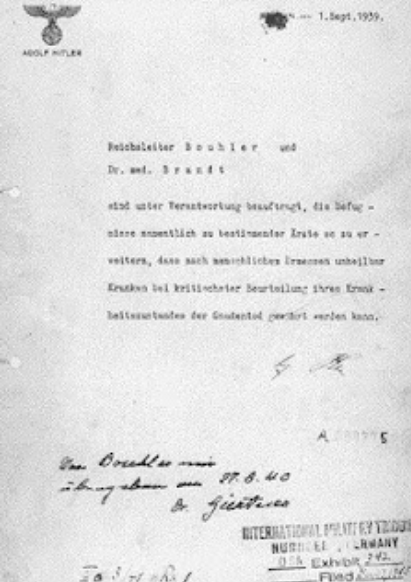
The National Socialist's "Euthanasia" program would set the stage for the Holocaust: the mass murder of Jews and others who were deemed either racially inferior or ideologically unsuitable. In the words of Dr. Leo Alexander, Chief U.S. Medical Consultant at the Nuremberg War Crimes Trials: 'Whatever proportions these crimes finally assumed, it became evident to all who investigated them that they had started from small beginnings."

Dr. Alexander referred to "a subtle shift in emphasis in the basic attitude of physicians." These physicians came to accept the notion that there is such a thing as a life not worthy to be lived. We are witnessing what appears to be a similar "subtle shift in emphasis" with regard to human life in the United States and other Western nations.

In its Declaration on Euthanasia issued on May 5, 1980, the Sacred Congregation for the Doctrine of the Faith had this to say:


"Human life is the basis of all goods, and is the necessary source and condition of every human activity and of all society. Most people regard life as something sacred and hold that no one may dispose of it at will, but believers see in life something greater, namely, a gift of God's love, which they are called upon to preserve and make fruitful. And it is this latter consideration that gives rise to the following consequences:

1. No one can make an attempt on the life of an innocent person without opposing God's love for that person, without violating a fundamental right, and therefore without committing a crime of the utmost gravity.

2. Everyone has the duty to lead his or her life in accordance with God's plan. That life is entrusted to the individual as a good that must bear fruit already here on earth, but that finds its full perfection only in eternal life.

3. Intentionally causing one's own death, or suicide, is therefore equally as wrong as murder; such an action on the part of a person is to be considered as a rejection of God's sovereignty and loving plan. Furthermore, suicide is also often a refusal of love for self, the denial of a natural instinct to live, a flight from the duties of justice and charity owed to one's neighbor, to various communities or to the whole of society - although, as is generally recognized, at times there are psychological factors present that can diminish responsibility or even completely remove it. However, one must clearly distinguish suicide from that sacrifice of one's life whereby for a higher cause, such as God's glory, the salvation of souls or the service of one's brethren, a person offers his or her own life or puts it in danger (cf. Jn. 15:14).

II.

EUTHANASIA

In order that the question of euthanasia can be properly dealt with, it is first necessary to define the words used. Etymologically speaking, in ancient times Euthanasia meant an easy death without severe suffering. Today one no longer thinks of this original meaning of the word, but rather of some intervention of medicine whereby the suffering of sickness or of the final agony are reduced, sometimes also with the danger of suppressing life prematurely. Ultimately, the word Euthanasia is used in a more particular sense to mean 'mercy killing,' for the purpose of putting an end to extreme suffering, or having abnormal babies, the mentally ill or the incurably sick from the prolongation, perhaps for many years of a miserable life, which could impose too heavy a burden on their families or on society.

It is, therefore, necessary to state clearly in what sense the word is used in the present document. By euthanasia is understood an action or an omission which of itself or by intention causes death, in order that all suffering may in this way be eliminated. Euthanasia's terms of reference, therefore, are to be found in the intention of the will and in the methods used. It is necessary to state firmly once more that nothing and no one can in any way permit the killing of an innocent human being, whether a fetus or an embryo, an infant or an adult, an old person, or one suffering from an incurable disease, or a person who is dying. Furthermore, no one is permitted to ask for this act of killing, either for himself or herself or for another person entrusted to his or her care, nor can he or she consent to it, either explicitly or implicitly. nor can any authority legitimately recommend or permit such an action. For it is a question of the violation of the divine law, an offense against the dignity of the human person, a crime against life, and an attack on humanity. 

It may happen that, by reason of prolonged and barely tolerable pain, for deeply personal or other reasons, people may be led to believe that they can legitimately ask for death or obtain it for others. Although in these cases the guilt of the individual may be reduced or completely absent, nevertheless the error of judgment into which the conscience falls, perhaps in good faith, does not change the nature of this act of killing, which will always be in itself something to be rejected. The pleas of gravely ill people who sometimes ask for death are not to be understood as implying a true desire for euthanasia; in fact, it is almost always a case of an anguished plea for help and love. What a sick person needs, besides medical care, is love, the human and supernatural warmth with which the sick person can and ought to be surrounded by all those close to him or her, parents and children, doctors and nurses."

A sick person needs love, human and supernatural warmth.  They do not need to be treated as a burden and discarded as useless. At a time when the value of human life is being thrown into question by the medical community itself, it is all the more necessary for Christians to stand up for and witness to the dignity of human life from the moment of conception to the final stages of a natural death.

Let us pray:


"O Mary, bright dawn of the new world,
Mother of the living, to you do we entrust the cause of life

Look down, O Mother, upon the vast numbers of babies not allowed to be born, of the poor whose lives are made difficult, of men and women who are victims of brutal violence, of the elderly and the sick killed by indifference or out of misguided mercy.

Grant that all who believe in your Son may proclaim the Gospel of life with honesty and love to the people of our time.

Obtain for them the grace to accept that Gospel as a gift ever new, the joy of celebrating it with gratitude throughout their lives and the courage to bear witness to it resolutely, in order to build, together with all people of good will, the civilization of truth and love, to the praise and glory of God, the Creator and lover of life." (Pope John Paul II, Evangelium Vitae).


Sunday, June 12, 2016

Francis: Preparing the generation which will embrace the man-god

In his Encyclical Letter Arcanum Divinae Sapientiae, Pope Leo XIII reminds is that, ..."what was decreed and constituted in respect to marriage by the authority of God has been more fully and more clearly handed down to us, by tradition and the written Word, through the Apostles, those heralds of the laws of God. To the Apostles, indeed, as our masters, are to be referred the doctrines which 'our holy Fathers, the Councils, and the Tradition of the Universal Church have always taught,'namely, that Christ our Lord raised marriage to the dignity of a sacrament; that to husband and wife, guarded and strengthened by the heavenly grace which His merits Rained for them, He gave power to attain holiness in the married state; and that, in a wondrous way, making marriage an example of the mystical union between Himself and His Church, He not only perfected that love which is according to nature, but also made the naturally indivisible union of one man with one woman far more perfect through the bond of heavenly love. Paul says to the Ephesians: "Husbands, love your wives, as Christ also loved the Church, and delivered Himself up for it, that He might sanctify it. . . So also ought men to love their wives as their own bodies. . . For no man ever hated his own flesh, but nourisheth and cherisheth it, as also Christ doth the Church; because we are members of His body, of His flesh, and of His bones. For this cause shall a man leave his father and mother, and shall cleave to his wife, and they shall be two in one flesh. This is a great sacrament; but I speak in Christ and in the Church." In like manner from the teaching of the Apostles we learn that the unity of marriage and its perpetual indissolubility, the indispensable conditions of its very origin, must, according to the command of Christ, be holy and inviolable without exception."

Pope Pius XI in his famous Encyclical "On Christian Marriage," had this to say:

"First of all, let this remain the unchanged and unshakable foundation: Matrimony was neither established nor restored by man but by God. It has been protected, strengthened, and elevated not by the laws of men, but by those of God, the author of human nature, and of Christ who restored that same nature. Consequently, these laws cannot be changed according to men's pleasure, nor by any agreement of the spouses themselves that is contrary to these laws. This is the teaching of Sacred Scripture (see Gen 1:27; 2:22f.; Mt 19:3ff.; Eph 5:23ff.); this is the constant, universal tradition of the Church; this is the solemn definition of the holy Council of Trent, which in the words of Sacred Scripture teaches and reasserts that the permanent and indissoluble bond of matrimony, its unity and strength, have their origin in God."

The Catechism of the Catholic Church, Nos. 1603-1605, explain marriage in the order of creation:

"The intimate community of life and love which constitutes the married state has been established by the Creator and endowed by him with its own proper laws. . . . God himself is the author of marriage." The vocation to marriage is written in the very nature of man and woman as they came from the hand of the Creator. Marriage is not a purely human institution despite the many variations it may have undergone through the centuries in different cultures, social structures, and spiritual attitudes. These differences should not cause us to forget its common and permanent characteristics. Although the dignity of this institution is not transparent everywhere with the same clarity, some sense of the greatness of the matrimonial union exists in all cultures. "The well-being of the individual person and of both human and Christian society is closely bound up with the healthy state of conjugal and family life."


God who created man out of love also calls him to love the fundamental and innate vocation of every human being. For man is created in the image and likeness of God who is himself love. Since God created him man and woman, their mutual love becomes an image of the absolute and unfailing love with which God loves man. It is good, very good, in the Creator's eyes. And this love which God blesses is intended to be fruitful and to be realized in the common work of watching over creation: "And God blessed them, and God said to them: 'Be fruitful and multiply, and fill the earth and subdue it.'"


Holy Scripture affirms that man and woman were created for one another: "It is not good that the man should be alone." The woman, "flesh of his flesh," his equal, his nearest in all things, is given to him by God as a "helpmate"; she thus represents God from whom comes our help. "Therefore a man leaves his father and his mother and cleaves to his wife, and they become one flesh." The Lord himself shows that this signifies an unbreakable union of their two lives by recalling what the plan of the Creator had been "in the beginning": "So they are no longer two, but one flesh."

Again, we may choose to reject these truths. But in so doing, we lose our grip on sanity as it were. In the words of the late (great) F.J. Sheed:

"..if we see anything - ourself or some other man, or the Universe as a whole or any part of it - without at the same time seeing God holding it there, then we are seeing it all wrong. If we saw a coat hanging on a wall and did not realize that it was held there by a hook, we should not be living in the real world at all, but in some fantastic world of our own in which coats defied the law of gravity and hung on walls by their own power. Similarly if we see things in existence and do not in the same act see that they are held in existence by God, then equally we are living in a fantastic world, not the real world. Seeing God everywhere and all things upheld by Him [such as marriage, my note] is not a matter of sanctity; but of plain sanity, because God is everywhere and all things are upheld by Him...To overlook God's presence is not simply to be irreligious; it is a kind of insanity, like overlooking anything else that is actually there." (Theology and Sanity, p.6).

We see this insanity, in the form of the disease of modernism, in Francis.  See here.

This insanity, see here, will continue to metastasize, and will eventually infect much of the Mystical Body of Christ. For men have grown weary of the truth and are prepared to worship the Devil.

Any moment now, the man-God (John 5:43) will reveal himself and demand that very worship.  For now, his False Prophet continues to tickle ears, preparing the generation which will turn toward, and enthusiastically embrace, doctrines of demons.

Friday, May 11, 2012

"Men imitate the gods whom they adore.."


President Obama has now publically stated his support for same-sex "marriage."  Nancy Pelosi has asserted that her Catholic Faith compels her to support sodomy.  A radical homosexual activist who serves as an Extraordinary Minister of the Eucharist in England proudly proclaims that a majority of Catholics now support same-sex "marriage."

I have been warning for years that just prior to the Man of Sin revealing himself to the world, there would be a tremendous push for societal acceptance of homosexuality and same-sex "marriage."  Back in 2009, I warned that: "President Obama wants all Americans to accept and embrace homosexuality....And this really shouldn't surprise us. Those who abandon Divine Revelation and the Natural Law will no longer seek God and His precepts and Commandments but will instead pursue their own lusts and fantasies. Such people will create and adore their own gods which are almost always a mythical projection of their own vices. They attribute a religious dimension to these vices to 'baptize' them, to justify them in their own darkened minds*.


It was Saint Cyprian of Carthage, writing against the Greco-Roman pagan world and its vices, who said: 'That Jupiter of theirs is not more supreme in dominion than in vice, inflamed with earthly love in the midst of his own thunders...now breaking forth by the help of birds to violate the purity of boys. And now put the question: Can he who looks upon such things be healthy-minded or modest? Men imitate the gods whom they adore, and to such miserable beings their crimes become their religion.' (Letters 1:8).

In a series of letters written from 1969-1970, Sister Lucia [of the Fatima apparition] wrote: 'It is indeed sad that so many people let themselves be dominated by the diabolical wave that is sweeping the world, and that they are blinded to the point of being incapable of seeing error! Their principal fault is they have abandoned prayer; in this way they have become estranged from God, and without God everything fails. The devil is very cunning and looks for our weak points in order to attack us. If we are not diligent and careful to obtain strength from God, we shall fall, for our age is very wicked and we are weak. Only the strength of God can keep us on our feet.'

There is a retreat from truth. Those of us who refuse to abandon our Christian faith must be demonized. We must be placed in a ghetto. Isolated. Portrayed as 'backward' and 'archaic.' And eventually placed in internment camps or simply eliminated altogether should we refuse to accept the New Order."

* Have I been wrong so far?  President Obama has attempted to use the Scriptures to justify his decision.  Speaker Pelosi asserts that her Catholic Faith "compels" her to support sodomy.

Benjamin Wiker notes that, "Making [homosexuality] monogamous does not make it any better, any more than a man promising to have sex with only one child would make it any less a reprehensible act of pedophilia."  Why then the push for "gay marriage"?  Because, as Wiker explains, this desire makes sense to "a materialist still nagged by subliminal, vestigial Christian moral habits" or the Christian "who has sold nearly everything in his universe to the materialist."  Or, as I've put it so many times before here at La Salette Journey, the Christian who has lost his faith but who hasn't steeled himself or herself to admit of this. 

Wiker wisely asserts that, "The notion of sanctifying homosexual unions by demanding that they be monogamous will soon enough go the way of limiting abortions to the first trimester.  Furthermore, the push for pedophilia is now the 'extreme' which will push homosexuality out of the spotlight of public debate and into full normality.  That pedophilia is even being debated, rather than simply rejected as unimaginably vile, means that it is likely the next item of sexual liberation due for normalization." ( Benjamin Wiker, Ph.D, Moral Darwinism: How We Became Hedonists, p. 312).

During the Reign of Antichrist, which is almost upon us, every sin, every vile act will be celebrated with abandon.  And every Commandment of God, every principle of morality will not only be laughed to scorn but will be outlawed.

Pray and watch.

Tuesday, January 24, 2012

Clark University not only promotes radical homosexual agitprop but seems to embrace historical revisionism

During the Second World War, the Nazis had a special hatred for Pope Pius XII.  The Reich Central Security Office had no doubts about where this great Pontiff stood with regard to the Jewish People. They considered him "the mouthpiece of the Jewish war criminals."


Following Pope Pius XII's sermon at Christmas, 1942, the Reich Central Security Office prepared a detailed analysis of the Pope's address for Reinhard Heydrich which was submitted on January 22, 1943:

"In a manner never known before, the Pope has repudiated the National Socialist New European Order. His radio allocution was a masterpiece of clerical falsification of the National Socialist Weltanschauung. It is true, the Pope does not refer to the National Socialists in Germany by name, but his speech is one long attack on everything we stand for....God, he says, regards all peoples and races as worthy of the same consideration. Here he is clearly speaking on behalf of the Jews...That this speech is directed exclusively against the New Order in Europe as seen in National Socialism is clear in the Papal statement that mankind owes a debt to 'all who during the war have lost their Fatherland and who, although personally blameless have, simply on account of their nationality and origin, been killed or reduced to utter destitution.' Here he is virtually accusing the German people of injustice towards the Jews, and makes himself the mouthpiece of the Jewish war criminals."

But Deborah Dwork, Director of Clark University's Strassler Center for Holocaust & Genocide Studies, doesn't see it that way.  Speaking of the fact that Pope Benedict XVI named Pope Pius XII as Venerable, Ms. Dwork replied, "Who the Church elevates is its business, but history is MY business, and Pius XII failed Europe's Jews miserably, unconscionably."  See page 21 of this pdf file.

I think Ms. Dwork needs to find another line of business.


The Israeli consul, Pinchas E. Lapide, in his book, Three Popes and the Jews (New York: Hawthorn Books, Inc., 1967) critically examines Pope Pius XII. According to his research, the Catholic Church under Pius XII was instrumental in saving 860,000 Jews from Nazi death camps (p. 214). Could Pius have saved more lives by speaking out more forcefully? According to Lapide, the concentration camp prisoners did not want Pius to speak out openly (p. 247). As one jurist from the Nuremberg Trials said on WNBC in New York (Feb. 28, 1964), "Any words of Pius XII, directed against a madman like Hitler, would have brought on an even worse catastrophe... [and] accelerated the massacre of Jews and priests." (Ibid.)

Yet Pius was not totally silent either. Lapide notes a book by the Jewish historian, Jenoe Levai, entitled, The Church Did Not Keep Silent (p. 256). He admits that everyone, including himself, could have done more. If we condemn Pius, then justice would demand condemning everyone else. He concludes by quoting from the Talmud that "whosoever preserves one life, it is accounted to him by Scripture as if he had preserved a whole world." With this he claims that Pius XII deserves a memorial forest of 860,000 trees in the Judean hills (pp. 268-9). It should be noted that six million Jews and three million Catholics were killed in the Holocaust.


We must remember that the Holocaust was also anti-Christian. After Hitler revealed his true intentions, the Catholic Church opposed him. Even the famous Albert Einstein testified to that. According to the December 23, 1940 issue of Time magazine on page 38, Einstein said:

Being a lover of freedom, when the revolution came in Germany, I looked to the universities to defend it, knowing that they had always boasted of their devotion to the cause of truth; but, no, the universities immediately were silenced. Then I looked to the great editors of the newspapers whose flaming editorials in days gone by had proclaimed their love of freedom; but they, like the universities, were silenced in a few short weeks...Only the Church stood squarely across the path of Hitler's campaign for suppressing truth. I never had any special interest in the Church before, but now I feel a great affection and admiration because the Church alone has had the courage and persistence to stand for intellectual truth and moral freedom. I am forced thus to confess that what I once despised I now praise unreservedly.

I invite readers of this Blog to visit the website of The Catholic League for Religious and Civil Rights to read the extensive documentation on Pope Pius XII which shows clearly that this saintly Pontiff was nothing less than heroic.  My father had an audience with Pope Pius XII in April of 1958, just six months before the Holy Father died.  It was an experience he would always cherish. 

All too often, the record of history is clouded with the prejudices and presumptions of those who are commenting and reporting on it.  Often history is twisted and reinterpreted for ideological purposes.  We have seen that Clark University has embraced the radical homosexual agenda. It would appear that the university also embraces historical revisionism.  Is this an attempt to discredit the Catholic Church because of its moral opposition toward homosexuality and same-sex "marriage"?


Saturday, April 16, 2011

Shall we embrace excuses or the Cardinal Virtue of Fortitude?

In an essay entitled One Solitary Life which was adapted from a sermon by Dr. James Allan Francis, we are reminded about certain aspects of Jesus' life:


Here is a man who was born in an obscure village, the child of a peasant woman. He grew up in another village. He worked in a carpenter shop until He was thirty. Then for three years He was an itinerant preacher.

He never owned a home. He never wrote a book. He never held an office. He never had a family. He never went to college. He never put His foot inside a big city. He never traveled two hundred miles from the place He was born. He never did one of the things that usually accompany greatness. He had no credentials but Himself...

While still a young man, the tide of popular opinion turned against him. His friends ran away. One of them denied Him. He was turned over to His enemies. He went through the mockery of a trial. He was nailed upon a cross between two thieves. While He was dying His executioners gambled for the only piece of property He had on earth – His coat. When He was dead, He was laid in a borrowed grave through the pity of a friend.

Nineteen long centuries have come and gone, and today He is a centerpiece of the human race and leader of the column of progress.

I am far within the mark when I say that all the armies that ever marched, all the navies that were ever built; all the parliaments that ever sat and all the kings that ever reigned, put together, have not affected the life of man upon this earth as powerfully as has that one solitary life.

Omnia possum in eo qui me confortat. I can do all things in Him who strengthens me. (Phil 4:13).  These words are engraved on a bracelet which I wear.  Do we really believe this?  Or do we let others define who we are?


Issue the battle cry! Let's take back our cities!

Those who walk in the Spirit know no fear. What are we waiting for? The Lord Jesus waits. He grows tired of our excuses:


I’m not holy enough:
Is 6:1-9; Lk 5:1-11

I’m afraid I will fail:
Ex 14:10-31; Lk 15

I’ve made mistakes and I’m a sinner:
Jn 21:15-23; Mt 9:9-13; Lk 7:36-50

I’m too young:
1 Sam 3:1-18; Jer 1:4-10; Lk 1:26-38

I’m not talented enough:
1 Sam 17:32-51; Lk 1:26-38

I want to have a family:
Gn 12:1-3; Mt 12:46-50; Mk 10:28-30

I’m afraid of making a permanent commitment:
Ruth 1:15-17; Mt 28:16-20

I’m afraid of public speaking:
Ex 4:10-17; Jer 1:4-10

I’m not smart enough:
2 Cor 4:7-18; Ex 4:10-17

I’m afraid of being alone:
Ex 3:4-22; Lk 1:28-38

I want to be happy:
Ps 37:4; Mt 5:1-12; Jn 10:10; Mk 10:28-31

I can do all things in Him who strengthens me. There are no obstacles we can't overcome in His holy name.  Even while others attempt to label us and dismiss us as useless, as having no worth.  I knew a young man with developmental disabilities whose father told him he was "worthless."  He was told by his father that the best thing for him would be a bullet in the head. When he asked me one day if he was worthless, I reminded him of his many gifts: his sense of humor, his ability to love others, his ability to pray to God and a litany of other gifts.  And I assured him that he is not "worthless."

We live in a sad, broken world.  There are many people who are heavily burdened with sin who are hurting.  And because they are hurting, they want to hurt others.  If you could read some of the comments which have been left at this Blog you would cringe.  Sad time.  Hurting time. And we pray for such people.

But we cannot let others define who we are.  We are children of God who have access to the Holy Spirit's Gifts just by asking for them.

The Son of God loves us.  What does that suggest about those who hate us?

Site Meter