For more than 25 years now, I have been warning anyone who would listen about the counterfeit church being fashioned in the image and likeness of man and subject to doctrines of demons. This church, the Mystical Body of Antichrist, has now become more open and therefore more visible under the pontificate of Francis. This church, a work of the Devil within the True Church, is making itself known during this month's Synod. See here.
Here is what Blessed Emmerich saw.
The Masonic plan to elect a false pope to deliver the Church up to sin explained here.
In the end, this Dark Church will fail. God has other plans. But Jesus's promise that the Gates of Hell will not prevail against
His Church does not mean that the Adversary will not have much success in pulling a significant portion of the Church down with him.
Remain under the sure refuge which is the Immaculata. The Turis Davidica will protect your faith. Pray the Rosary daily. Consecrate yourself and your loved ones to the Immaculate Heart of Mary. Place yourself under Our Savior's Precious Blood. Remain in the Sacraments. Do Penance.
The Demon has launched his final campaign against Our Savior, His sinless Mother and her children..
Friday, October 10, 2014
Wednesday, October 08, 2014
Pope Francis' attitude toward dogma and his Brothers in the Episcopate: Evidence of Satanic pride?
"Pride is to be avoided, that pride of intellect which is more dangerous and more difficult to overcome than the pride of will, as Scupoli says.
This is the pride that renders faith and obedience to superiors difficult. One wants to be self-sufficient; the more confidence one has in one's own judgment the more reluctantly does one accept the teachings of faith, or the more readily does one submit these to criticism and to personal interpretation. In like manner, one so trusts to one's own wisdom, that it is with repugnance that others are consulted, especially superiors. Hence, regrettable mistakes occur. Hence comes also obstinacy of judgment, resulting in the final and sweeping condemnation of such opinions as differ from our own. Herein lies one of the most common causes of strife between Christian and Christian, at times even between Catholic writers. St. Augustine calls those who cause unfortunate dissensions, destructive of peace and of the bond of charity, 'Dividers of unity, enemies of peace, without charity, puffed up with vanity, well pleased with themselves and great in their own eyes.'*
To heal this intellectual pride: 1) we must first of all submit ourselves with childlike docility to the teachings of faith. We are undoubtedly allowed to seek that understanding of our dogmas which is obtained by a patient and laborious quest with the aid of the Fathers and Doctors of the Church, especially St. Augustine and St. Thomas; but as the Vatican Council says, this must be done with piety and with discretion, following the maxim of St. Anselm: 'Faith seeking understanding.' Thus we avoid that hypercritical attitude that attenuates and minimizes our dogmas under pretense of explaining them. We submit our judgment not only to the truths of faith but to the directions of the Holy See.." (Fr. Adolphe Tanquerey, S.S., D.D., The Spiritual Life: A Treatise on Ascetical and Mystical Theology, p. 388, Tan Books).
Docility to the teachings of faith is a remedy for pride of intellect. But do we witness such docility in Pope Francis?
Recently he told an Argentinian newspaper that, “The world has changed and the Church can not withdraw into supposed interpretations of dogma."
Supposed interpretations? The Church's dogmas represent more than "supposed interpretations" of truth. As the Catechism explains in paragraphs 88 and 89.
It was Archbishop Fulton Sheen who said that, "The modern man must decide for himself whether he is going to have a religion with thought or a religion without it. He already knows that thoughtless policies lead to the ruin of society, and he may begin to suspect that thoughtless religion ends in confusion worse confounded.
The problem is simple. The modern man has two maps before him: one the map of sentimental religion, the other the map of dogmatic religion. The first is very simple. It has been constructed only in the last few years by a topographer who has just gone into the business of map making and is extremely adverse to explicit directions. He believes that each man should find his own way and not have his liberty taken away by dogmatic directions. The other map is much more complicated and full of dogmatic detail. It has been made by topographers who have been over every inch of the road for centuries and know each detour and each pitfall. It has explicit directions and dogmas such as, 'Do not take this road - it is swampy,' or 'Follow this road; although rough and rocky at first, it leads to a smooth road on a mountaintop.'
The simple map is very easy to read, but those who are guided by it are generally lost in a swamp of mushy sentimentalism. The other map takes a little more scrutiny, but it is simpler in the end, for it takes you up through the rocky road of the world's scorn to the everlasting hills where is seated the original Map Maker, the only One who ever has associated rest with learning: 'Learn of Me...and you shall find rest for your souls.'
Every new coherent doctrine and dogma add to the pabulum for thought; it is an extra bit of garden upon which we can intellectually browse; it is new food into which we can put our teeth and thence absorb nourishment; it is the discovery of a new intellectual planet that adds fullness and spaciousness to our mental world. And simply because it is solid and weighty, because it is dogmatic and not gaseous and foggy like a sentiment, it is intellectually invigorating, for it is with weights that the best drill is done, and not with feathers.
It is the very nature of a man to generate children of his brain in the shape of thoughts, and as he piles up thought on thought, truth on truth, doctrine on doctrine, conviction on conviction, and dogma on dogma, a very coherent and orderly fashion, so as to produce a system complex as a body and yet one and harmonious, the more and more human he becomes. When, however, in response to false cries for progress, he lops off dogmas, breaks with the memory of his forefathers, denies intellectual parentage, pleads for a religion without dogmas, substitutes mistiness for mystery, mistakes sentiment for sediment, he is sinking back slowly, surely, and inevitably into the senselessness of stones and into the irresponsible unconsciousness of weeds. Grass is broad-minded. Cabbages have heads - but no dogmas." (The Electronic Christian, pp. 74-74).
We have a pope who says that he likes to argue with "conservative" Bishops (read orthodox, political terms do not belong in the Church). Does this suggest humility or pride?
This is the pride that renders faith and obedience to superiors difficult. One wants to be self-sufficient; the more confidence one has in one's own judgment the more reluctantly does one accept the teachings of faith, or the more readily does one submit these to criticism and to personal interpretation. In like manner, one so trusts to one's own wisdom, that it is with repugnance that others are consulted, especially superiors. Hence, regrettable mistakes occur. Hence comes also obstinacy of judgment, resulting in the final and sweeping condemnation of such opinions as differ from our own. Herein lies one of the most common causes of strife between Christian and Christian, at times even between Catholic writers. St. Augustine calls those who cause unfortunate dissensions, destructive of peace and of the bond of charity, 'Dividers of unity, enemies of peace, without charity, puffed up with vanity, well pleased with themselves and great in their own eyes.'*
To heal this intellectual pride: 1) we must first of all submit ourselves with childlike docility to the teachings of faith. We are undoubtedly allowed to seek that understanding of our dogmas which is obtained by a patient and laborious quest with the aid of the Fathers and Doctors of the Church, especially St. Augustine and St. Thomas; but as the Vatican Council says, this must be done with piety and with discretion, following the maxim of St. Anselm: 'Faith seeking understanding.' Thus we avoid that hypercritical attitude that attenuates and minimizes our dogmas under pretense of explaining them. We submit our judgment not only to the truths of faith but to the directions of the Holy See.." (Fr. Adolphe Tanquerey, S.S., D.D., The Spiritual Life: A Treatise on Ascetical and Mystical Theology, p. 388, Tan Books).
Docility to the teachings of faith is a remedy for pride of intellect. But do we witness such docility in Pope Francis?
Recently he told an Argentinian newspaper that, “The world has changed and the Church can not withdraw into supposed interpretations of dogma."
Supposed interpretations? The Church's dogmas represent more than "supposed interpretations" of truth. As the Catechism explains in paragraphs 88 and 89.
It was Archbishop Fulton Sheen who said that, "The modern man must decide for himself whether he is going to have a religion with thought or a religion without it. He already knows that thoughtless policies lead to the ruin of society, and he may begin to suspect that thoughtless religion ends in confusion worse confounded.
The problem is simple. The modern man has two maps before him: one the map of sentimental religion, the other the map of dogmatic religion. The first is very simple. It has been constructed only in the last few years by a topographer who has just gone into the business of map making and is extremely adverse to explicit directions. He believes that each man should find his own way and not have his liberty taken away by dogmatic directions. The other map is much more complicated and full of dogmatic detail. It has been made by topographers who have been over every inch of the road for centuries and know each detour and each pitfall. It has explicit directions and dogmas such as, 'Do not take this road - it is swampy,' or 'Follow this road; although rough and rocky at first, it leads to a smooth road on a mountaintop.'
The simple map is very easy to read, but those who are guided by it are generally lost in a swamp of mushy sentimentalism. The other map takes a little more scrutiny, but it is simpler in the end, for it takes you up through the rocky road of the world's scorn to the everlasting hills where is seated the original Map Maker, the only One who ever has associated rest with learning: 'Learn of Me...and you shall find rest for your souls.'
Every new coherent doctrine and dogma add to the pabulum for thought; it is an extra bit of garden upon which we can intellectually browse; it is new food into which we can put our teeth and thence absorb nourishment; it is the discovery of a new intellectual planet that adds fullness and spaciousness to our mental world. And simply because it is solid and weighty, because it is dogmatic and not gaseous and foggy like a sentiment, it is intellectually invigorating, for it is with weights that the best drill is done, and not with feathers.
It is the very nature of a man to generate children of his brain in the shape of thoughts, and as he piles up thought on thought, truth on truth, doctrine on doctrine, conviction on conviction, and dogma on dogma, a very coherent and orderly fashion, so as to produce a system complex as a body and yet one and harmonious, the more and more human he becomes. When, however, in response to false cries for progress, he lops off dogmas, breaks with the memory of his forefathers, denies intellectual parentage, pleads for a religion without dogmas, substitutes mistiness for mystery, mistakes sentiment for sediment, he is sinking back slowly, surely, and inevitably into the senselessness of stones and into the irresponsible unconsciousness of weeds. Grass is broad-minded. Cabbages have heads - but no dogmas." (The Electronic Christian, pp. 74-74).
We have a pope who says that he likes to argue with "conservative" Bishops (read orthodox, political terms do not belong in the Church). Does this suggest humility or pride?
Tuesday, October 07, 2014
Strange proposals at the Vatican
Lifesite News notes how there are proposals at the Vatican to abolish terms such as "living in sin" and "contraceptive mentality." See here
The thrust of such proposals is that truthful and accurate language, calling something that which it is, is somehow less than charitable because it includes a judgment.
Those behind these proposals apparently believe that love of enemies means condoning vice and sin. In the words of Dr. Germain Grisez, one of the finest moral theologians of our time, "It might seem to follow that love must accept everyone, even enemies, just as they are, and to affirm them even in the error or sin which is present in them. But the law of lovedoes not require indiscriminate affirmation of everything about other persons (see Saint Thomas Aquinas, S.t., 2-2, q.34, a.3). One's love must be like Jesus'. He loves sinners and brings them into communion with himself in order to overcome their error and sin. When the scribes and pharisees bring a woman caught in adultery to Jesus, he not only saves her from being stoned to death but warns her not to sin again (see John 8:3-11). In a true sense, Jesus is not judgmental, he sets aside the legalistic mentality, readily forgives sinners, does not condemn the world, and points out that those who refuse to acknowledge their sinfulness are self-condemned by the truth they violate (see John 3:16-21). But he realistically recognizes sinners as sinners and never accepts error as truth...Similarly, if Christians' love of neighbor is genuine, it not only permits but REQUIRES THEM both to 'hold fast to what is good' and to 'hate what is evil' (Romans 12:9)."
And again, according to Dr. Grisez, "Vatican II neatly formulates the prohibition against judging others" 'God alone is the judge and searcher of hearts; for that reason, he forbids us to make judgments about the internal guiltof anyone' (Gaudium et Spes, No. 28). This norm, however, does not preclude JUDGMENTS necessary for determining that one should try to dissuade others from committing sins or to encourage them to repent if they have sinned."
Very often, the poorly instructed Catholic will be heard to remark "I don't like the word 'judge,' or to those of us who defend the Church's authentic Magisterial teaching while exposing error they will say: "You're judging."
What if we are? Judging isn't always sinful. It is only sinful when we judge another's interior dispositions, when we judge their soul. But we are entirely free to judge words, ideas and actions which fail to hold up when placed in the Lumen Christi (Light of Christ). Sacred Scripture (which these confused souls obviously don't spend much time with) makes this abundantly clear: "should you not judge those inside the Church"? (1 Corinthians 5:12), and again: "the saints will judge the world and angels" (1 Corinthians 6:2-3), and again: "the spiritual man judges all things" (1 Corinthians 2:15), and again: "Let prophets speak and the others judge" (1 Corinthians 14:29).
Not all judging is sinful. This is just common sense. Our legal system is structured in such a way that when a person commits a crime, he or she is tried before a judge and sentenced (judged) if found guilty. Likewise, it is our right (and duty) to judge words, ideas and actions which are not in conformity with the Gospels or which fail to conform to the Magisterial teaching of Christ's Church and to expose these as fallacious and/or sinful. In so doing, we are not rendering a judgment against a person. We are following the teaching of the great Saint Augustine (Bishop, Father and Doctor of the Church), who said: "Interficere errorem, diligere errantem" - kill the error, love the one who errs. This killing of what is sinful or erroneous is necessary if our charity - our love of neighbor - is to be genuine. Otherwise, our love is counterfeit. It is a fraud.
I an not really surprised that Father Thomas Rosica would lend his support to such proposals given his defense of the scandalous funeral Mass for the late Senator Ted Kennedy, a confused and lost soul.
The thrust of such proposals is that truthful and accurate language, calling something that which it is, is somehow less than charitable because it includes a judgment.
Those behind these proposals apparently believe that love of enemies means condoning vice and sin. In the words of Dr. Germain Grisez, one of the finest moral theologians of our time, "It might seem to follow that love must accept everyone, even enemies, just as they are, and to affirm them even in the error or sin which is present in them. But the law of lovedoes not require indiscriminate affirmation of everything about other persons (see Saint Thomas Aquinas, S.t., 2-2, q.34, a.3). One's love must be like Jesus'. He loves sinners and brings them into communion with himself in order to overcome their error and sin. When the scribes and pharisees bring a woman caught in adultery to Jesus, he not only saves her from being stoned to death but warns her not to sin again (see John 8:3-11). In a true sense, Jesus is not judgmental, he sets aside the legalistic mentality, readily forgives sinners, does not condemn the world, and points out that those who refuse to acknowledge their sinfulness are self-condemned by the truth they violate (see John 3:16-21). But he realistically recognizes sinners as sinners and never accepts error as truth...Similarly, if Christians' love of neighbor is genuine, it not only permits but REQUIRES THEM both to 'hold fast to what is good' and to 'hate what is evil' (Romans 12:9)."
And again, according to Dr. Grisez, "Vatican II neatly formulates the prohibition against judging others" 'God alone is the judge and searcher of hearts; for that reason, he forbids us to make judgments about the internal guiltof anyone' (Gaudium et Spes, No. 28). This norm, however, does not preclude JUDGMENTS necessary for determining that one should try to dissuade others from committing sins or to encourage them to repent if they have sinned."
Very often, the poorly instructed Catholic will be heard to remark "I don't like the word 'judge,' or to those of us who defend the Church's authentic Magisterial teaching while exposing error they will say: "You're judging."
What if we are? Judging isn't always sinful. It is only sinful when we judge another's interior dispositions, when we judge their soul. But we are entirely free to judge words, ideas and actions which fail to hold up when placed in the Lumen Christi (Light of Christ). Sacred Scripture (which these confused souls obviously don't spend much time with) makes this abundantly clear: "should you not judge those inside the Church"? (1 Corinthians 5:12), and again: "the saints will judge the world and angels" (1 Corinthians 6:2-3), and again: "the spiritual man judges all things" (1 Corinthians 2:15), and again: "Let prophets speak and the others judge" (1 Corinthians 14:29).
Not all judging is sinful. This is just common sense. Our legal system is structured in such a way that when a person commits a crime, he or she is tried before a judge and sentenced (judged) if found guilty. Likewise, it is our right (and duty) to judge words, ideas and actions which are not in conformity with the Gospels or which fail to conform to the Magisterial teaching of Christ's Church and to expose these as fallacious and/or sinful. In so doing, we are not rendering a judgment against a person. We are following the teaching of the great Saint Augustine (Bishop, Father and Doctor of the Church), who said: "Interficere errorem, diligere errantem" - kill the error, love the one who errs. This killing of what is sinful or erroneous is necessary if our charity - our love of neighbor - is to be genuine. Otherwise, our love is counterfeit. It is a fraud.
I an not really surprised that Father Thomas Rosica would lend his support to such proposals given his defense of the scandalous funeral Mass for the late Senator Ted Kennedy, a confused and lost soul.
Sunday, October 05, 2014
Geoffrey Robinson at the Synod: A bad omen indeed
Homosexual groups and prominent leaders in the LGBT movement have converged upon Rome for the Synod. Read here for why this is so disturbing.
Geoffrey Robinson, the retired Bishop of Sydney, Australia, will be a key speaker. This apostate has questioned compulsory celibacy among other things. And this comes as no surprise. For this would be reformer has lost his faith and is a false prophet pointing the way toward sexual licentiousness. This modern-day Judas has said that there is a "crying need" in the Catholic Church to reconsider such issues as sex outside of marriage, contraception and homosexuality. Puffed up with worldly pride and a lust for worldly recognition and fame, this arrogant cleric is anxious to jettison 2,000 years of Catholic Tradition as he proposes stripping considerable power and authority from the Pope, who would only be pemitted to speak formally on behalf of the Church after consulting it.
Bishop Robinson is a lover of this world with a haughty contempt for the Church of Christ. His mind has been moulded by vanity and opinions immersed in materialism. Pope John Paul II, in his Apostolic Exhortation Familiaris Consortio (The Role of the Christian Family in the Modern World), exposes the philosophical underpinnings of this wicked flight from family responsibility. He writes, "At the root of these negative phemonena there frequently lies a corruption of the idea and the experience of freedom, conceived not as a capacity for realizing the truth of God's plan for marriage and the family, but as an autonomous power of self-affirmation, often against others, for one's own selfish being." (No. 6).
Bishop Robinson's theology is a theology from Hell. It is a demand for sex without love, for a licentiousness in sex which has wrought a heartless society in which individuals do not care for anyone but themselves. The fruit of this demonic theology is the slaughter through abortion and euthanasia of human beings created in the Imago Dei. It is a theology of violence which is rooted in hatred of truth. For at the heart of immorality is falsity, the hatred of truth. Fr. Miceli explains:
"...violence entered creation from the rebellion of Lucifer. This rebellion arose from the heart of pride. But the sin of pride is the offspring of the vice known as hatred of truth. Hatred of truth is the result of the creature's attempt to rearrange God's hierarchy of beings and values into an order which the creature prefers to the plan of God. This attempt immediately produces the violence of disorder, the chaos of falsity and immorality. For hatred of truth is really hatred of God who creates all things wisely and governs them lovingly. Lucifer, the Morning Star, was instantly deformed into the Prince of Darkness because he attempted to live a lie. He wanted to dethrone God and become God himself..." ( Essay entitled The Taproot of Violence).
Bishop Robinson is not a reformer. He is merely a lost soul who is rebelling at God's created order. He is anxious to do the will not of the heavenly Father but of another master. (John 8: 44). And his presence at this month's Synod on the family and married life is indeed a troubling development.
Geoffrey Robinson, the retired Bishop of Sydney, Australia, will be a key speaker. This apostate has questioned compulsory celibacy among other things. And this comes as no surprise. For this would be reformer has lost his faith and is a false prophet pointing the way toward sexual licentiousness. This modern-day Judas has said that there is a "crying need" in the Catholic Church to reconsider such issues as sex outside of marriage, contraception and homosexuality. Puffed up with worldly pride and a lust for worldly recognition and fame, this arrogant cleric is anxious to jettison 2,000 years of Catholic Tradition as he proposes stripping considerable power and authority from the Pope, who would only be pemitted to speak formally on behalf of the Church after consulting it.
Bishop Robinson is a lover of this world with a haughty contempt for the Church of Christ. His mind has been moulded by vanity and opinions immersed in materialism. Pope John Paul II, in his Apostolic Exhortation Familiaris Consortio (The Role of the Christian Family in the Modern World), exposes the philosophical underpinnings of this wicked flight from family responsibility. He writes, "At the root of these negative phemonena there frequently lies a corruption of the idea and the experience of freedom, conceived not as a capacity for realizing the truth of God's plan for marriage and the family, but as an autonomous power of self-affirmation, often against others, for one's own selfish being." (No. 6).
Bishop Robinson's theology is a theology from Hell. It is a demand for sex without love, for a licentiousness in sex which has wrought a heartless society in which individuals do not care for anyone but themselves. The fruit of this demonic theology is the slaughter through abortion and euthanasia of human beings created in the Imago Dei. It is a theology of violence which is rooted in hatred of truth. For at the heart of immorality is falsity, the hatred of truth. Fr. Miceli explains:
"...violence entered creation from the rebellion of Lucifer. This rebellion arose from the heart of pride. But the sin of pride is the offspring of the vice known as hatred of truth. Hatred of truth is the result of the creature's attempt to rearrange God's hierarchy of beings and values into an order which the creature prefers to the plan of God. This attempt immediately produces the violence of disorder, the chaos of falsity and immorality. For hatred of truth is really hatred of God who creates all things wisely and governs them lovingly. Lucifer, the Morning Star, was instantly deformed into the Prince of Darkness because he attempted to live a lie. He wanted to dethrone God and become God himself..." ( Essay entitled The Taproot of Violence).
Bishop Robinson is not a reformer. He is merely a lost soul who is rebelling at God's created order. He is anxious to do the will not of the heavenly Father but of another master. (John 8: 44). And his presence at this month's Synod on the family and married life is indeed a troubling development.
Tuesday, September 30, 2014
Proximate preparation for the Man of Sin, soon to reveal himself
In England, there is talk of creating a "No social media list" for those deemed to be dangerous extremists. This initiative would run much deeper than the Obama administration's failed attempt at creating a "Domestic Terrorism Lexicon."
How dangerous is this initiative? Read here.
"The chief function of propaganda is to convince the masses, who slowness of understanding needs to be given time in order that they may absorb information; and only constant repetition will finally succeed in imprinting an idea on their mind.........the slogan must of course be illustrated in many ways and from several angles, but in the end one must always return to the assertion of the same formula. The one will be rewarded by the surprising and almost incredible results that such a personal policy secures."
Adolf Hitler from "Mein Kampf"
As one website explains:
"Once they succeeded in ending democracy and turning Germany into a one-party dictatorship, the Nazis orchestrated a massive propaganda campaign to win the loyalty and cooperation of Germans. The Nazi Propaganda Ministry, directed by Dr. Joseph Goebbels, took control of all forms of communication in Germany: newspapers, magazines, books, public meetings, and rallies, art, music, movies, and radio. Viewpoints in any way threatening to Nazi beliefs or to the regime were censored or eliminated from all media.
During the spring of 1933, Nazi student organizations, professors, and librarians made up long lists of books they thought should not be read by Germans. Then, on the night of May 10, 1933, Nazis raided libraries and bookstores across Germany. They marched by torchlight in nighttime parades, sang chants, and threw books into huge bonfires. On that night more than 25,000 books were burned. Some were works of Jewish writers, including Albert Einstein and Sigmund Freud. Most of the books were by non-Jewish writers, including such famous Americans as Jack London, Ernest Hemingway, and Sinclair Lewis, whose ideas the Nazis viewed as different from their own and therefore not to be read.
The Nazi censors also burned the books of Helen Keller, who had overcome her deafness and blindness to become a respected writer; told of the book burnings, she responded: "Tyranny cannot defeat the power of ideas." Hundreds of thousands of people in the United States protested the book burnings, a clear violation of freedom of speech, in public rallies in New York, Philadelphia, Chicago, and St. Louis.
Schools also played an important role in spreading Nazi ideas. While some books were removed from classrooms by censors, other textbooks, newly written, were brought in to teach students blind obedience to the party, love for Hitler, and antisemitism. After-school meetings of the Hitler Youth and the League of German Girls trained children to be faithful to the Nazi party. In school and out, young people celebrated such occasions as Adolf Hitler's birthday and the anniversary of his taking power."
Today, censorship is beginning to be used against Christians to silence moral opposition to abortion and homosexuality. Today's censors do not have to gather up thousands of books, march by torchlight in nighttme parades and throw books into huge bonfires. They have merely to strike a few keys from the comfort of their offices.
Inflated in their rebellion against the God-Man, the Sons of Satan, those committed toward the atheistic program of attacking the Church from without and undermining it from within in preparation for the Man-God, will continue to intensify their persecution of craftiness and subversion until it reaches its culmination in an explosion of hate-filled rage which will bear much blood and death. Father Livio Fanzaga, writing about the Antichrist, says that, "Catholicism alone will resist him. How then do we destroy this superstition which alone obstructs the world's self-revelation? How do we destroy this superstition which divides mankind and which prevents man from being truly brotherly and free? The true Antichrist is revealed in the replies to these questions. Here is perceived his profound being as the man of iniquity. He will not tolerate the idea of men who adore any god other than himself. His intolerance obliges him to make an exception to his pacifism and his philosophy of non-violence. He is the greatest pacifist in the history of the human race, but because peace and justice really reign on earth he will make an exception to kill and destroy the great superstition of Catholicism, once and for all time..." (Wrath of God: The Days of the Antichrist, p. 124).
On September 15, 1992, Our Lady told Father Gobbi of the Marian Movement of Priests that, "..It is the hour of my great sorrow for the Church, my dearly beloved Daughter. How grievously the Church is suffering in these times, as she carries her great cross and climbs the bloodstained Calvary of her passion and her bloody immolation! Never before, as today, has the Church been made so utterly like my Son Jesus. She is like Him in solitude and abandonment; she is like Him in denial and betrayal; she is like Him in contempt and condemnation; she is like Him in her crucifixion and in her agony. This is the hour of my great sorrow for the Church, because the hour of her redemptive passion has come. It is the gour of my great sorrow for humanity, so ill and so reduced to slavery by the spirits of evil. The diabolical powers are ruling the earth and producing everywhere the wicked fruits of their dark reign. And thus this humanity has again become pagan, after almost two thousand years of its redemption and of the first announcement of the Gospel of salvation. Faithlessness and impiety again cover it; sins wound it; evil poisons it; pride rules it; impurity seduces it; egoism and hatred enchain it; Satan reduces it more and more to slavery and reigns over you with his diabolical power...This is the hour of my great sorrow for all of you, my poor children, because the time of your great suffering has come. Take refuge in me. Hasten to the sure refuge of my Immaculate Heart, because we must live together through the hour of the greatest trial, which has now come for you, for the Church and for all humanity."
Sunday, September 28, 2014
Let us give everything for Holy Mother Church: Even our very lives
Shall we embrace excuses or the Cardinal Virtue of Fortitude?
In an essay entitled One Solitary Life which was adapted from a sermon by Dr. James Allan Francis, we are reminded about certain aspects of Jesus' life:
Here is a man who was born in an obscure village, the child of a peasant woman. He grew up in another village. He worked in a carpenter shop until He was thirty. Then for three years He was an itinerant preacher.
He never owned a home. He never wrote a book. He never held an office. He never had a family. He never went to college. He never put His foot inside a big city. He never traveled two hundred miles from the place He was born. He never did one of the things that usually accompany greatness. He had no credentials but Himself...
While still a young man, the tide of popular opinion turned against him. His friends ran away. One of them denied Him. He was turned over to His enemies. He went through the mockery of a trial. He was nailed upon a cross between two thieves. While He was dying His executioners gambled for the only piece of property He had on earth – His coat. When He was dead, He was laid in a borrowed grave through the pity of a friend.
Nineteen long centuries have come and gone, and today He is a centerpiece of the human race and leader of the column of progress.
I am far within the mark when I say that all the armies that ever marched, all the navies that were ever built; all the parliaments that ever sat and all the kings that ever reigned, put together, have not affected the life of man upon this earth as powerfully as has that one solitary life.
Omnia possum in eo qui me confortat. I can do all things in Him who strengthens me. (Phil 4:13). These words are engraved on a bracelet which I wear. Do we really believe this? Or do we let others define who we are?
Issue the battle cry! Let's take back our cities!
Those who walk in the Spirit know no fear. What are we waiting for? The Lord Jesus waits. He grows tired of our excuses:
I’m not holy enough:
Is 6:1-9; Lk 5:1-11
I’m afraid I will fail:
Ex 14:10-31; Lk 15
I’ve made mistakes and I’m a sinner:
Jn 21:15-23; Mt 9:9-13; Lk 7:36-50
I’m too young:
1 Sam 3:1-18; Jer 1:4-10; Lk 1:26-38
I’m not talented enough:
1 Sam 17:32-51; Lk 1:26-38
I want to have a family:
Gn 12:1-3; Mt 12:46-50; Mk 10:28-30
I’m afraid of making a permanent commitment:
Ruth 1:15-17; Mt 28:16-20
I’m afraid of public speaking:
Ex 4:10-17; Jer 1:4-10
I’m not smart enough:
2 Cor 4:7-18; Ex 4:10-17
I’m afraid of being alone:
Ex 3:4-22; Lk 1:28-38
I want to be happy:
Ps 37:4; Mt 5:1-12; Jn 10:10; Mk 10:28-31
I can do all things in Him who strengthens me. There are no obstacles we can't overcome in His holy name. Even while others attempt to label us and dismiss us as useless, as having no worth. I knew a young man with developmental disabilities whose father told him he was "worthless." He was told by his father that the best thing for him would be a bullet in the head. When he asked me one day if he was worthless, I reminded him of his many gifts: his sense of humor, his ability to love others, his ability to pray to God and a litany of other gifts. And I assured him that he is not "worthless."
We live in a sad, broken world. There are many people who are heavily burdened with sin who are hurting. And because they are hurting, they want to hurt others. If you could read some of the comments which have been left at this Blog you would cringe. Sad time. Hurting time. And we pray for such people.
But we cannot let others define who we are. We are children of God who have access to the Holy Spirit's Gifts just by asking for them.
The Son of God loves us. What does that suggest about those who hate us?
Courage Lord. Magnificent courage like yours.
Labels:
Courage,
Even,
Everything,
Excuses,
Fortitude,
Give,
Holy Mother Church,
Let,
Lives,
No,
Our,
Us,
Very
Wednesday, September 24, 2014
Catholic school in Toronto: Boy must be allowed to share bathroom with girls
Writing for LifeSiteNews, Pete Baklinski notes how, "Girls in first grade in a Toronto Catholic school will be sharing a washroom this year with a biological boy whose lesbian parent has chosen to identify him as a 'girl.'
A mother whose young daughter attends the school in the Toronto Catholic District School Board is concerned about the implications of allowing a biological boy to share her daughter’s washroom and changing room, especially as the boy moves into puberty. The mother, under condition of anonymity, shared her concerns with Phil Lees, president of Public Education Advocates for Christian Equity (P.E.A.C.E.), who published a report on his website.
“My greatest concern is that its going to lead to confusion in the minds of children of faith about what’s right or wrong for them,” Lees told LifeSiteNews.
The mother related how the boy attended junior kindergarten with her daughter two years ago. At the end of the year, the lesbian parent withdrew the boy. Now, after a one-year absence, she has reenrolled her child in grade one, claiming he must now be treated as a 'girl.'
The lesbian parent allegedly told the principal that under the federal 'gender identity' Bill C-279, along with the provincial 'gender identity' Bill 33 (Toby’s Law), her child could not be discriminated against and must be allowed to use whatever washroom he chooses.
Bill C-279, which life-and-family leaders warned would open society to a host of “problematic sexual activities,” stalled in the Senate in June 2013 prior to its third and final reading. Parliament being prorogued two months later had the effect of killing all legislation being considered by the government, including Bill C-279. The fate of the bill has yet to be determined.
The lesbian parent used the two bills to insist her biological boy use the girl’s facilities, even though the bills contain nothing about bathroom usage. The lesbian parent was not content with the suggestion to let the boy use the single stall handicap washroom or the teacher’s washroom.
The mother told Lees that the principal instructed the children and parents that the biological boy was now to be treated as a “girl” at the request of the parent.
When the mother approached the principal with her concerns, the principal expressed surprise that the matter was a concern for anyone. The principal heard the mother’s concerns and brought them to the attention of the superintendent of education. The matter has not yet been resolved.
LifeSiteNews asked the Toronto Catholic District School Board for comment, but did not receive a response by press time.
Lees told LifeSiteNews that the mother is 'deathly afraid of being targeted' by activists if she were to go public with her concerns.
According to the mother, even school staff are afraid to say anything about the situation for fear of losing their job or being dragged before a human rights tribunal.
Lees told LifeSiteNews that he believes 'LGBT' activists are using the woman and her boy as a 'test case' to advance the homosexual agenda in Catholic schools.
While Lees said he has “no problem” with persons who express themselves in a way different from their biological makeup, he does have a problem when they force everyone else to comply with their demands.
Lees said the case emphasizes what happens when society rejects God’s ways, such as the creation of human beings as male and female, and replaces them with man-made laws and norms that run contrary to the created order.
'Man desires to rule and to be god,' he said.
'The reasons why we have these problems in our schools is because for the last two or three generations, people of faith have withdrawn. People of faith have become so busy with other aspects of their lives and they don’t know how to reengage.' See here.
___________________________________________________________
Deacon Keith Fournier, in an article for Catholic Online a few years ago, wrote: "The 'Gender Identity Movement' is dangerous. It is a part of a broader Cultural Revolution which substitutes an entirely different view of the dignity of the human person, human freedom, human flourishing, human sexuality, marriage and the family and the moral basis of a free society than that which formed Western Civilization." See here.
Indeed Pope Benedict XVI, in a Christmas Address given in 2008, denounced the contemporary notion that gender is a malleable definition and said, "The Church speaks of the human being as man and woman, and asks that this order is respected."
Fr. Vincent Miceli, S.J., has noted that, "It has been a special scar on the worst pagan cultures and the worst idolatrous religions that they openly attacked the gender identities of the sexes. They celebrated sexual indulgence, sexual experimentation, sexual symbols, fertility rites, temple prostitution, seasonal sex orgies, sexual abuse and enslavement of young women, girls and boys....But sex is not an accidental characteristic of man and woman. A human person without sex is a monstrous abstraction. Sex entails the very identity of each person; sex plunges to the deepest mystery of each person. Hence the sexes and the vocations pertaining thereto are not interchangeable. Each person is called to serve God and his fellowman, accepting gladly the sex with which one is endowed and the vocation attached to that sex." (The Antichrist, P. 231).
In the comments section of a previous post, Mr. Michael Cole noted how, "Homosexuals, lesbians and transsexuals are often afflicted by evil spirits. Gender confusion is often a sign of demonic possession. Fr. Malachi Martin recounts the story of a possessed transsexual in his bestselling book 'Hostage to the Devil.' In the chapter titled 'The Virgin and the Girl-Fixer,' he writes, 'At one moment, Father Gerald, the exorcist, was bending over the possessed, Richard/Rita, who had sunk his teeth into his own instep. In the next instant, the glaze in Richard/Rita's eyes broke, melting into a lurid gleam of mockery. Greenish. The teeth loosened their grip on the instep. The mouth opened, baring gums and throat, the tongue protruded, quivering on a stream of gray foam bubbles. The whole face was furrowed in irregular lines, as Richard/Rita broke into peals of laughter. Great buffeting gusts of mocking, jeering, Schadenfreude laughter. Laugter pouring from a belly of amused scorn and contemptuous hate.'"
How quickly we forget this. Gender confusion represents something more than a cultural revolution. It is often the result of demonic possession. The more a culture rejects the Living God and His Commandments, the more it sinks into an abyss of depravity.
A mother whose young daughter attends the school in the Toronto Catholic District School Board is concerned about the implications of allowing a biological boy to share her daughter’s washroom and changing room, especially as the boy moves into puberty. The mother, under condition of anonymity, shared her concerns with Phil Lees, president of Public Education Advocates for Christian Equity (P.E.A.C.E.), who published a report on his website.
“My greatest concern is that its going to lead to confusion in the minds of children of faith about what’s right or wrong for them,” Lees told LifeSiteNews.
The mother related how the boy attended junior kindergarten with her daughter two years ago. At the end of the year, the lesbian parent withdrew the boy. Now, after a one-year absence, she has reenrolled her child in grade one, claiming he must now be treated as a 'girl.'
The lesbian parent allegedly told the principal that under the federal 'gender identity' Bill C-279, along with the provincial 'gender identity' Bill 33 (Toby’s Law), her child could not be discriminated against and must be allowed to use whatever washroom he chooses.
Bill C-279, which life-and-family leaders warned would open society to a host of “problematic sexual activities,” stalled in the Senate in June 2013 prior to its third and final reading. Parliament being prorogued two months later had the effect of killing all legislation being considered by the government, including Bill C-279. The fate of the bill has yet to be determined.
The lesbian parent used the two bills to insist her biological boy use the girl’s facilities, even though the bills contain nothing about bathroom usage. The lesbian parent was not content with the suggestion to let the boy use the single stall handicap washroom or the teacher’s washroom.
The mother told Lees that the principal instructed the children and parents that the biological boy was now to be treated as a “girl” at the request of the parent.
When the mother approached the principal with her concerns, the principal expressed surprise that the matter was a concern for anyone. The principal heard the mother’s concerns and brought them to the attention of the superintendent of education. The matter has not yet been resolved.
LifeSiteNews asked the Toronto Catholic District School Board for comment, but did not receive a response by press time.
Lees told LifeSiteNews that the mother is 'deathly afraid of being targeted' by activists if she were to go public with her concerns.
According to the mother, even school staff are afraid to say anything about the situation for fear of losing their job or being dragged before a human rights tribunal.
Lees told LifeSiteNews that he believes 'LGBT' activists are using the woman and her boy as a 'test case' to advance the homosexual agenda in Catholic schools.
While Lees said he has “no problem” with persons who express themselves in a way different from their biological makeup, he does have a problem when they force everyone else to comply with their demands.
Lees said the case emphasizes what happens when society rejects God’s ways, such as the creation of human beings as male and female, and replaces them with man-made laws and norms that run contrary to the created order.
'Man desires to rule and to be god,' he said.
'The reasons why we have these problems in our schools is because for the last two or three generations, people of faith have withdrawn. People of faith have become so busy with other aspects of their lives and they don’t know how to reengage.' See here.
___________________________________________________________
Deacon Keith Fournier, in an article for Catholic Online a few years ago, wrote: "The 'Gender Identity Movement' is dangerous. It is a part of a broader Cultural Revolution which substitutes an entirely different view of the dignity of the human person, human freedom, human flourishing, human sexuality, marriage and the family and the moral basis of a free society than that which formed Western Civilization." See here.
Indeed Pope Benedict XVI, in a Christmas Address given in 2008, denounced the contemporary notion that gender is a malleable definition and said, "The Church speaks of the human being as man and woman, and asks that this order is respected."
Fr. Vincent Miceli, S.J., has noted that, "It has been a special scar on the worst pagan cultures and the worst idolatrous religions that they openly attacked the gender identities of the sexes. They celebrated sexual indulgence, sexual experimentation, sexual symbols, fertility rites, temple prostitution, seasonal sex orgies, sexual abuse and enslavement of young women, girls and boys....But sex is not an accidental characteristic of man and woman. A human person without sex is a monstrous abstraction. Sex entails the very identity of each person; sex plunges to the deepest mystery of each person. Hence the sexes and the vocations pertaining thereto are not interchangeable. Each person is called to serve God and his fellowman, accepting gladly the sex with which one is endowed and the vocation attached to that sex." (The Antichrist, P. 231).
In the comments section of a previous post, Mr. Michael Cole noted how, "Homosexuals, lesbians and transsexuals are often afflicted by evil spirits. Gender confusion is often a sign of demonic possession. Fr. Malachi Martin recounts the story of a possessed transsexual in his bestselling book 'Hostage to the Devil.' In the chapter titled 'The Virgin and the Girl-Fixer,' he writes, 'At one moment, Father Gerald, the exorcist, was bending over the possessed, Richard/Rita, who had sunk his teeth into his own instep. In the next instant, the glaze in Richard/Rita's eyes broke, melting into a lurid gleam of mockery. Greenish. The teeth loosened their grip on the instep. The mouth opened, baring gums and throat, the tongue protruded, quivering on a stream of gray foam bubbles. The whole face was furrowed in irregular lines, as Richard/Rita broke into peals of laughter. Great buffeting gusts of mocking, jeering, Schadenfreude laughter. Laugter pouring from a belly of amused scorn and contemptuous hate.'"
How quickly we forget this. Gender confusion represents something more than a cultural revolution. It is often the result of demonic possession. The more a culture rejects the Living God and His Commandments, the more it sinks into an abyss of depravity.
Labels:
Allowed,
Bathroom,
Be,
Bill C-279,
Boy,
Catholic,
Demonic Possession,
District,
Gender Identity,
Girls,
Must,
Satanic,
School,
Share,
Toby's Law,
Toronto,
With
Tuesday, September 23, 2014
Our Lady Immaculate Parish in Athol, Massachusetts: A circus-like atmosphere inspired by lukewarm clerics
Father Peter M.J. Stravinskas, Ph.D., S.T.L., in "The Catholic Answer, Book 2" says that,"Socializing is inappropriate in the body of the Church; that is for the vestibule and parish hall." (p. 195). Monsignor Peter J. Elliott, in his book entitled Ceremonies of the Modern Roman Rite, has this to say: "The Church should be open well before the liturgy for those who wish to pray privately. Silence is the best preparation for the celebration of the liturgy. Apart from suitable music, no intrusion on the people's right to tranquility before the Eucharist should be tolerated, for example, musical or choral rehearsals, announcements which could be given later, or distractions in the sanctuary or elsewhere. People may meet and talk before Mass, but in an area set well apart from the place where the liturgy is about to be celebrated." (Ceremonies of the Modern Roman Rite, No. 233, p. 87).
The General Instruction of the Roman Missal has this to say: "Sacred silence also, as part of the celebration, is to be observed at the designated times....Its purpose, however, depends on the time it occurs in each part of the celebration. Thus within the Act of Penitence and again after the invitation to pray, all recollect themselves; but at the conclusion of a reading or the homily, all meditate briefly on what they have heard; then after Communion, they praise and pray to God in their hearts. Even before the celebration itself, it is commendable that silence be observed in the church, in the sacristy, in the vesting room, and in adjacent areas, so that all may dispose themselves to carry out the sacred action in a devout and fitting manner." (GIRM, No. 45).
Silence should also be observed after Mass until one is outside the Church building, both for respect toward the Blessed Sacrament, and toward those members of the faithful who wish to prolong their thanksgiving after Mass.
At Our Lady Immaculate parish in Athol, Massachusetts, there is no silence before Holy Mass, no reverence. This because there is no real leadership or holy example there. It is routine practice for Catholics to disrespect Jesus' Presence in the Most Blessed Sacrament while keeping other Catholics from their prayer. See the above video taken this past Saturday at the parish's 4 PM Vigil Mass.
In the Church, everyone has a duty to be salt and light and to work for the renewal of society. Deacons are no exception. The Constitution on the Church [Lumen Gentium] of the Second Vatican Council had this to say: "At a lower level of the hierarchy are deacons, upon whom hands are imposed 'not unto the priesthood, but unto a ministry of service.' For strengthened in sacramental grace, in communion with the bishop and his group of priests they serve in the diaconate of the liturgy, of the Word, and of charity to the People of God...Dedicated to duties of charity and administration, let deacons be mindful of the admonition of Blessed Polycarp: 'Be merciful, diligent, walking according to the truth of the Lord, who became the servant of all.'" (Lumen Gentium, No. 29). Later in the same document we read, "Ministers of lesser rank are also sharers in the mission and grace of the supreme priest" and that Deacons are "dispensers of Christ's mysteries and servants of the Church" who should in holiness "stand before men as personifications of goodness and friends of God." (Lumen Gentium, No. 41).
But the Deacons who "serve" at Our Lady Immaculate are not "personifications of goodness" or "charity to the People of God." Neither Deacon Scott Colley [who has displayed hatred toward me for defending reverence at Mass, see here] nor Deacon James Linderman serve as models for prayer. In fact, Deacon Linderman spent his time before Mass (as usual) engaging in loud conversation with several people in the congregation, and especially with two women who sing in the choir. It was Deacon Linderman who interrupted my Rosary before a Christmas Eve Mass several years ago - his attitude seems to be "If I'm not going to pray, neither are you."
Father Vincent Miceli, S.J., reminded us some years back, "Rampant immorality is [an] obstacle opposing the work of evangelization. Since conduct follows from convictions, once Catholics cancel their creed from their lives, their conduct inevitably becomes depraved....The decay on all sides of Christian morals makes it not only difficult to bring in those outside the Church, but even to stay in themselves and hold their fellow Catholics within the Church." (Essay entitled The Evangelization of the United States).
It is no surprise that OLI has succumbed to a circus-like atmosphere. The Deacons do not pray. And the people are following their bad example.
Saturday, September 20, 2014
Rome is losing the faith
The Termite Nations have dispensed with God and His Commandments in their quest for unbridled hedonism. We are being prepared for the Reign of Antichrist. The Rev. P. Huchede, in his work entitled "History of Antichrist," explains the religious preparation, both intellectual and moral, for the Reign of Antichrist which will arrive after economic collapse: "But how shall he deprive the world of Christianity and have himself adored as God? Alas, it is only too true that the minds and hearts of men are admirably disposed for revolution and consequently ready to accept and bear the cruel yoke of such a tyrant. Revolution as the word itself implies means a subversion, but a subversion of all that is true, good, beautiful, and grand in the universe. It is the subversion of religion, representing its dogmas as myths and its moral teachings as tyranical. It is the subversion of authority. Licentiousness under the name of liberty becomes the order of the day; each one is invested with the right to govern himself. It is the subversion of reason: and do we not find leading minds in some of the most enlightened nations denying the principle of contradiction and maintaining the absolute identity of all beings? Revolution is therefore essentially destructive, and it becomes cosmopolitan by the action of secret societies scattered throughout the world. Is it not true to say that the 'mystery of iniquity' is prepared in secret revolutionary dens? But it does not suffice to destroy; it is absolutely necessary to build up again. The world cannot subsist long in a vacuum. It must have a religion; it must have a philosophy; it must have an authority. Revolution will furnish all these. Instead of the reasonable and supernatural religion of Jesus Christ, Revolution will preach Pantheism. The God-humanity will impart the theurgic spirit and thus lead men to adore the demon as the author of universal emancipation...What frightful immorality must follow in the train of this shameless prostitution of religion! Never has the threefold concupiscence made greater ravage among mankind. And this is the religion sought and hoped for as the cherished boon of the aspirations of our modern free thinkers. To our Christian philosophy, the honor of humanity's revolution will substitute a babel of extravagant and absurd ideas. Instead of a mild and efficient authority consecrated alike by Church and state, despotism and anarchy will rise up and contend for the shreds of religious liberty and human policy...if the state of perversion continue for a while longer, he [Antichrist] will find the world prepared to receive and serve him." (Rev. P. Huchede, History of Antichrist, pp. 13-14, Tan Books).
The preparation is intensifying. Gloria TV explains that: "Kasper (Cardinal Walter Kasper, who has the Pope's ear) was the oldest cardinal eligible to vote in the Papal conclave of 2013.
Francis, on 17 March 2013, four days after his election as Pope, called Kasper "a clever theologian, a good theologian" in the course of a sermon in which he reported that Kasper's book on mercy "did me a lot of good".
The Theses of Professor Walter Kasper
Sept. 11, 2004
From the IK (Initiativ Kreis) News of 8-9/2003
"Faith does not mean a believing-to-be-true of wonderful facts and sets of beliefs that have authoritatively been put before us."
"Dogmas can certainly be one-sided, superficial, bossy, dumb, and rash."
Christ "presumably did not call himself either Messiah or Servant of God or Son of God and probably not Son of Man either."
The dogma that Jesus is "completely man and completely God" is able to be superseded.
Kasper writes "that we must call the many miracle stories in the Gospels legendary."
Even when [if] Kasper admits Jesus performed healings: "On the other hand, with some probability one need not consider [the] so-called miracles of nature as historical."
The Resurrection of Jesus is "no objectively and neutrally ascertainable historical fact."
Regarding the oldest account of the Easter event (Mk 16:1-8), Kasper comments "that here we are not talking about historical characteristics but [linguistic] means of style which are to get people's attention and create tension [suspense, excitement]." Other New Testament factual claims about the Easter and Ascension accounts, too, are mere "means of style" for Kasper.
Statements about the immanent Trinity or about the pre-existence of Christ are, according to Kasper, "not direct statements of faith but theological statements of reflection."
Kasper also speaks of the "Resurrection of each individual in [at] death." Hence "any talk of life after death is misleading." In addition, any talk of heaven, hell, and purgatory is "a very inappropriate, indeed misleading way of speaking."
By the "not very fortunate expression 'infallibility of the Church'" is meant "that the Church . . . cannot definitively fall back to the status of the Synagogue and cannot deny Christ definitively."
The dogma of the Church's universal mediatorship of salvation, clothed in the words "extra ecclesiam nulla salus" ["no salvation outside the Church"], which is most important for ecumenical dialogue, Kasper calls a "most misunderstandable phrase."
http://www.cardinalrating.com/cardinal_45__article_83.htm
.....
"For Walter Kasper, the miracles narrated in the Gospels are not historical facts related as eyewitness testimony by two Apostles, and as testimony heard by two of the Apostles' disciples, nor are they "segni certessimi” of Our Lord Jesus Christ's divinity as defined by Vatican I dogma. Rather, they are "instead, a problem which makes Jesus' activity strange, and difficult for modern man to understand."1,2 So, in homage to "modern man," or to be precise, to prideful man who believes only in himself, Walter Kasper deems himself authorized to put into perspective the "undeniable tradition which witnesses these miracles to us."3
For Kasper, what are Jesus' miracles?
"These non-historical stories," he writes, "are statements of belief in the salvific meaning of the person and message of Jesus."5 Briefly, for Walter Kasper, Jesus never raised either Jairus' daughter or the widow of Naim's son from the dead, nor did He even call Lazarus from his tomb. Neither did He ever calm tempests, nor multiply the loaves, nor walk on water, etc.
According to Kasper, the evangelists invented these "non-historical stories" the way that our grandmothers made up fables at the fireside when there was no television to corrupt children. And just as our grandmothers' fables only sought to inculcate a "morality," so too the Evangelists' "fables" about Jesus' miracles "did not intend to present Jesus as Lord over life and death."
In any case, for Walter Kasper, also as to his assumption that the miracles did occur-which, like all of the "new theologians" he firmly doubts-Jesus could not have performed miracles simply because he was not God. Jesus, he says, never advanced such "claims," and at Caesarea Philippi, Peter merely confessed, "You are the Messiah," and Jesus also proclaimed this before the Sanhedrin.7 But when the first Christian community confessed that Jesus is the Son of God, it did not in fact mean that Jesus really is the Son of God, but only wished "to express the idea that God manifests and communicates Himself in an absolute and definite way in the story of Jesus." End of story. In fact, the first Christian community did not intend "to acknowledge a dignity for him that would further his claims." Naturally, it was St. Paul's and St. John's habit to further Jesus' "claims."8
Walter Kasper negates the Resurrection. For him, "the empty tomb represents an ambiguous phenomenon, open to different possibilities of interpretation."10 And interpretations of the Resurrection are "beliefs and testimonies produced by people who believe," and who, via the "new theology's" strange logic, necessarily lie, and who also simply attest to whatever facts that they have been lead to believe.
he continues, a certain "grossly erroneous type of assertion that Jesus was touched by their hands and ate at the table with his disciples...runs the risk of justifying a too coarse Paschal faith."11W. Kasper, Gesù Cristo, Queriniana, 6th edition, p. 115. Translated by Suzanne Rini from the Italian edition
Rome is losing the faith. The Man of Sin approaches. Opposition to the Lord Jesus and His Commandments
is the order of the day.
Thursday, September 18, 2014
Cardinal Timothy Dolan argues that he is not capitulating to an "aggressive 'Gay' agenda." Actually he is.
Writing for his column in New York Catholic, Cardinal Timothy Dolan complains that he is receiving much criticism for deciding to serve as Grand Marshall in next year's St. Patrick's Day parade which will feature homosexuals marching under their own banner. The Cardinal writes, I haven’t been in this much hot water since I made the comment, right after I arrived as your archbishop five-and-a-half years ago, that Stan Musial—my boyhood hero of my hometown St. Louis Cardinals—was a much better ballplayer than Joe DiMaggio!
Now I’m getting as much fiery mail and public criticism over my decision to accept the honor of Grand Marshal of this year’s St. Patrick’s Day Parade. According to the critics, I should have refused, due to the Parade Committee’s decision to allow a group of self-identified Gays of Irish ancestry to march in the parade with their own banner.
As with Stan Musial, I’ll stand by my decision. However, enough of you have courteously expressed some confusion and dismay, that, as your pastor, I owe you an explanation. Let me try.
For one, the decision to change the parade protocol was not mine. The archbishops of New York have never been “in charge” of the parade. Although my predecessors and I have always enjoyed friendly cooperation with the Parade Committee—and still do—and deeply appreciate the identity of the Parade as a celebration purely of Irish heritage, intimately linked to the Catholic Faith, we’ve never had a say in Parade policy or the choice of the Grand Marshal. Nor did we expect or want one!
So, in the current 'brawl,' (they have been hardly rare in the Parade’s grand 253-year history!), I did not make the decision! You will recall that I in the past often expressed support for the former policy—that the only banners and identification to be carried was that the group was Irish—and that I found it logical and fair. To those who charged that the policy was “anti-Gay,” I often observed that no one person, Gay or not, was excluded from the parade. This was simply a reasonable policy about banners and public identification, not about the sexual inclinations of participants.
I did not oppose the former policy; nor did I push, condone, or oppose the new one. While the Parade committee was considerate in advising me of the change, they did not ask my approval, nor did they need to.
However, I admit that, for most folks, this is not the reason they are upset with me, and this brings us to point two. Many of you, while acknowledging that the decision to change policy was not mine, feel strongly that I should protest it, publicly condemn it, no longer support the Parade, and refuse the invitation to serve as Grand Marshal.
While a handful have been less than charitable in their reactions, I must admit that many of you have rather thoughtful reasons for criticizing the committee’s decision: you observe that the former policy was fair; you worry that this is but another example of a capitulation to an 'aggressive Gay agenda,' which still will not appease their demands; and you wonder if this could make people think the Church no longer has a clear teaching on the nature of human sexuality. Thank you for letting me know of such concerns. I share some of them.
However, the most important question I had to ask myself was this: does the new policy violate Catholic faith or morals? If it does, then the Committee has compromised the integrity of the Parade, and I must object and refuse to participate or support it. From my review, it does not. Catholic teaching is clear: “being Gay” is not a sin, nor contrary to God’s revealed morals. Homosexual actions are—as are any sexual relations outside of the lifelong, faithful, loving, lifegiving bond of a man and woman in marriage—a moral teaching grounded in the Bible, reflected in nature, and faithfully taught by the Church.So, while actions are immoral, identity is not! In fact, as the Catechism of the Catholic Church reminds us, people with same-sex attraction are God’s children, deserving dignity and respect, never to be treated with discrimination or injustice."
Full article here.
The Cardinal argues that he is not capitulating to an aggressive homosexual agenda. But his use of the word "gay" betrays the very opposite. The Roman Catholic apostolate Courage, which assists those with a homosexual inclination to live authentically Catholic lives, embracing chastity, explains why it will not use the terms "gay" and "lesbian":
Q. Why doesn’t Courage use the terms “gay” and “lesbian”?
A. Courage discourages persons with same-sex attractions from labeling themselves “gay” and “lesbian” for the following reasons:
1) The secular world usually uses those terms to refer to someone who is either actively homosexual or intends to be. When a person decides to “come out” and say “I am gay” or “I am lesbian”, the person usually means “this is who I am – I was born this way and I intend to live this way. I have a right to find a same-sex partner with whom to have a romantic sexual relationship.” To “come out” as being “gay” or “lesbian” doesn’t usually mean “I have homosexual attractions and I have a deep commitment to living a chaste life”.
The Cardinal hasn't thought out his policy has he?
Courage continues:
2) By labeling someone [as the Cardinal does by referring to people with a homosexual inclination as "gay"], we discourage those who may wish to try and move beyond homosexual attractions. Some people, especially young people, are able to further their psychosexual development with spiritual and psychological aid. If we labeled them “gay” and “lesbian”, they might think there’s no possibility of moving beyond these attractions.
3) There is more to a person than one’s sexual attractions. Even if one experienced same-sex attractions for most of one’s life, he or she is first and foremost a child of God created in His image. To refer to that person as “gay” or “lesbian” is a reductionist way of speaking about someone. We are even trying now to avoid using the term homosexual as a noun, or as an adjective directly describing the person (i.e. homosexual person). Although it takes more words, we prefer to speak of “persons with same-sex attractions”. Fr. Harvey has said that, if he could, he would rename his first book “The Homosexual Person” to something else like “The Person With Homosexual Attractions”.
There are people within the Catholic Church who might argue that those who label themselves “gay” or “lesbian” aren’t necessarily living unchastely. That’s true, but the implications of the terms in today’s society don’t commonly connote chaste living. Furthermore, they are limiting their own possibilities of growth by such self-labeling, and reducing their whole identity by defining themselves according to their sexual attractions. At Courage, we choose not to label people according to an inclination which, although psychologically understandable, is still objectively disordered."
The Cardinal errs as well when he suggests that only homosexual acts are sinful. In its document entitled Letter to the Bishops of the Catholic Church on the Pastoral Care of Homosexual Persons, which was published on October 1, 1986, the Sacred Congregation for the Doctrine of the Faith recalled the distinction between homosexual tendencies and homosexual practices: "Although the particular inclination of the homosexual person is not a sin, it is a more or less strong tendency ordered toward an intrinsic moral evil; and thus the inclination itself must be seen as an objective disorder."
Many interpret the Church's teaching as meaning that a homosexual person only sins if he or she actually engages in homosexual acts. I have received comments at this Blog suggesting that only homosexual acts are sinful. But this is not the Church's teaching. Although the homosexual inclination itself is not a sin, still, the homosexual person sins if he or she makes a concession to this tendency in his or her mind.
It is Catholic doctrine that any disorderly tendency, and most especially toward a vice which is contrary to nature, cannot have a right to citizenship in a person's thoughts. Recall the teaching of Our Lord Jesus in Matthew 5: 27, 28: "You have heard that it was said, 'You shall not commit adultery.' But I say to you that every one who looks at a woman lustfully has already committed adultery with her in his heart."
This is why in the Confiteor [Latin: I confess], which is part of the Penitential Rite, one asks for forgiveness for thoughts, words and deeds.
We know as well that homosexual persons also sin when their external behavior expresses a homosexual tendency. Which is why we read in Isaiah 3:9 that, "Their very look bears witness against them; their sin like Sodom they vaunt, They hide it not. Woe to them! they deal out evil to themselves." And in Deuteronomy 22:5 we read, "A woman shall not wear an article proper to a man, nor shall a man put on a woman's dress; for anyone who does such things is an abomination to the Lord, your God."
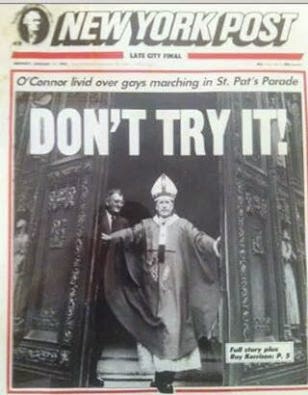
While Cardinal Dolan tries to convince you that he is not capitulating to the Culture of Softness, examine the photo of the late (Great) John Cardinal O'Connor and ask yourself: Who is the real Shepherd of souls?
You know the answer....unless you too have succumbed to homosexual agitprop. For more on the blind leading the blind, go here.
Now I’m getting as much fiery mail and public criticism over my decision to accept the honor of Grand Marshal of this year’s St. Patrick’s Day Parade. According to the critics, I should have refused, due to the Parade Committee’s decision to allow a group of self-identified Gays of Irish ancestry to march in the parade with their own banner.
As with Stan Musial, I’ll stand by my decision. However, enough of you have courteously expressed some confusion and dismay, that, as your pastor, I owe you an explanation. Let me try.
For one, the decision to change the parade protocol was not mine. The archbishops of New York have never been “in charge” of the parade. Although my predecessors and I have always enjoyed friendly cooperation with the Parade Committee—and still do—and deeply appreciate the identity of the Parade as a celebration purely of Irish heritage, intimately linked to the Catholic Faith, we’ve never had a say in Parade policy or the choice of the Grand Marshal. Nor did we expect or want one!
So, in the current 'brawl,' (they have been hardly rare in the Parade’s grand 253-year history!), I did not make the decision! You will recall that I in the past often expressed support for the former policy—that the only banners and identification to be carried was that the group was Irish—and that I found it logical and fair. To those who charged that the policy was “anti-Gay,” I often observed that no one person, Gay or not, was excluded from the parade. This was simply a reasonable policy about banners and public identification, not about the sexual inclinations of participants.
I did not oppose the former policy; nor did I push, condone, or oppose the new one. While the Parade committee was considerate in advising me of the change, they did not ask my approval, nor did they need to.
However, I admit that, for most folks, this is not the reason they are upset with me, and this brings us to point two. Many of you, while acknowledging that the decision to change policy was not mine, feel strongly that I should protest it, publicly condemn it, no longer support the Parade, and refuse the invitation to serve as Grand Marshal.
While a handful have been less than charitable in their reactions, I must admit that many of you have rather thoughtful reasons for criticizing the committee’s decision: you observe that the former policy was fair; you worry that this is but another example of a capitulation to an 'aggressive Gay agenda,' which still will not appease their demands; and you wonder if this could make people think the Church no longer has a clear teaching on the nature of human sexuality. Thank you for letting me know of such concerns. I share some of them.
However, the most important question I had to ask myself was this: does the new policy violate Catholic faith or morals? If it does, then the Committee has compromised the integrity of the Parade, and I must object and refuse to participate or support it. From my review, it does not. Catholic teaching is clear: “being Gay” is not a sin, nor contrary to God’s revealed morals. Homosexual actions are—as are any sexual relations outside of the lifelong, faithful, loving, lifegiving bond of a man and woman in marriage—a moral teaching grounded in the Bible, reflected in nature, and faithfully taught by the Church.So, while actions are immoral, identity is not! In fact, as the Catechism of the Catholic Church reminds us, people with same-sex attraction are God’s children, deserving dignity and respect, never to be treated with discrimination or injustice."
Full article here.
The Cardinal argues that he is not capitulating to an aggressive homosexual agenda. But his use of the word "gay" betrays the very opposite. The Roman Catholic apostolate Courage, which assists those with a homosexual inclination to live authentically Catholic lives, embracing chastity, explains why it will not use the terms "gay" and "lesbian":
Q. Why doesn’t Courage use the terms “gay” and “lesbian”?
A. Courage discourages persons with same-sex attractions from labeling themselves “gay” and “lesbian” for the following reasons:
1) The secular world usually uses those terms to refer to someone who is either actively homosexual or intends to be. When a person decides to “come out” and say “I am gay” or “I am lesbian”, the person usually means “this is who I am – I was born this way and I intend to live this way. I have a right to find a same-sex partner with whom to have a romantic sexual relationship.” To “come out” as being “gay” or “lesbian” doesn’t usually mean “I have homosexual attractions and I have a deep commitment to living a chaste life”.
The Cardinal hasn't thought out his policy has he?
Courage continues:
2) By labeling someone [as the Cardinal does by referring to people with a homosexual inclination as "gay"], we discourage those who may wish to try and move beyond homosexual attractions. Some people, especially young people, are able to further their psychosexual development with spiritual and psychological aid. If we labeled them “gay” and “lesbian”, they might think there’s no possibility of moving beyond these attractions.
3) There is more to a person than one’s sexual attractions. Even if one experienced same-sex attractions for most of one’s life, he or she is first and foremost a child of God created in His image. To refer to that person as “gay” or “lesbian” is a reductionist way of speaking about someone. We are even trying now to avoid using the term homosexual as a noun, or as an adjective directly describing the person (i.e. homosexual person). Although it takes more words, we prefer to speak of “persons with same-sex attractions”. Fr. Harvey has said that, if he could, he would rename his first book “The Homosexual Person” to something else like “The Person With Homosexual Attractions”.
There are people within the Catholic Church who might argue that those who label themselves “gay” or “lesbian” aren’t necessarily living unchastely. That’s true, but the implications of the terms in today’s society don’t commonly connote chaste living. Furthermore, they are limiting their own possibilities of growth by such self-labeling, and reducing their whole identity by defining themselves according to their sexual attractions. At Courage, we choose not to label people according to an inclination which, although psychologically understandable, is still objectively disordered."
The Cardinal errs as well when he suggests that only homosexual acts are sinful. In its document entitled Letter to the Bishops of the Catholic Church on the Pastoral Care of Homosexual Persons, which was published on October 1, 1986, the Sacred Congregation for the Doctrine of the Faith recalled the distinction between homosexual tendencies and homosexual practices: "Although the particular inclination of the homosexual person is not a sin, it is a more or less strong tendency ordered toward an intrinsic moral evil; and thus the inclination itself must be seen as an objective disorder."
Many interpret the Church's teaching as meaning that a homosexual person only sins if he or she actually engages in homosexual acts. I have received comments at this Blog suggesting that only homosexual acts are sinful. But this is not the Church's teaching. Although the homosexual inclination itself is not a sin, still, the homosexual person sins if he or she makes a concession to this tendency in his or her mind.
It is Catholic doctrine that any disorderly tendency, and most especially toward a vice which is contrary to nature, cannot have a right to citizenship in a person's thoughts. Recall the teaching of Our Lord Jesus in Matthew 5: 27, 28: "You have heard that it was said, 'You shall not commit adultery.' But I say to you that every one who looks at a woman lustfully has already committed adultery with her in his heart."
This is why in the Confiteor [Latin: I confess], which is part of the Penitential Rite, one asks for forgiveness for thoughts, words and deeds.
We know as well that homosexual persons also sin when their external behavior expresses a homosexual tendency. Which is why we read in Isaiah 3:9 that, "Their very look bears witness against them; their sin like Sodom they vaunt, They hide it not. Woe to them! they deal out evil to themselves." And in Deuteronomy 22:5 we read, "A woman shall not wear an article proper to a man, nor shall a man put on a woman's dress; for anyone who does such things is an abomination to the Lord, your God."
While Cardinal Dolan tries to convince you that he is not capitulating to the Culture of Softness, examine the photo of the late (Great) John Cardinal O'Connor and ask yourself: Who is the real Shepherd of souls?
You know the answer....unless you too have succumbed to homosexual agitprop. For more on the blind leading the blind, go here.
Tuesday, September 16, 2014
Purging the supernatural faith of Roman Catholicism in preparation for the Satanic World Order
In the emerging satanic New Order, orthodoxy and orthodox Catholics will have to be purged as incompatible with the New Humanitarian Religion. The purge is already beginning.
Speaking about the Earth Charter and related globalism, Msgr. Michel Schooyans said, "In order to consolidate this holistic vision of globalism, certain obstacles have to be smoothed out and instruments put to work. Religions in general, and in the first place the Catholic religion, figure among the obstacles that have to be neutralized."
According to its founders, the Earth Charter is "a declaration of fundamental principles for building a just, sustainable, and peaceful global society in the 21st century." The Earth Charter Commission hopes that the Charter will become the common standard "by which the conduct of all individuals, organizations, businesses, governments, and transnational institutions [such as the Roman Catholic Church, my note] is to be guided and assessed."
The globalists who are behind the Earth Charter seek to promote a New Age religion which will neutralize the supernatural faith of Roman Catholicism. In the words of Archbishop Javier Lozano Barragan, "Clearly, we are faced with the total denial of Christianity."
In order for the supernatural faith of Roman Catholicism to be purged, the faithful remnant must be marginalized, must be placed in a ghetto.
And when the Man of Sin makes his appearance, hunted down and murdered.
Speaking about the Earth Charter and related globalism, Msgr. Michel Schooyans said, "In order to consolidate this holistic vision of globalism, certain obstacles have to be smoothed out and instruments put to work. Religions in general, and in the first place the Catholic religion, figure among the obstacles that have to be neutralized."
According to its founders, the Earth Charter is "a declaration of fundamental principles for building a just, sustainable, and peaceful global society in the 21st century." The Earth Charter Commission hopes that the Charter will become the common standard "by which the conduct of all individuals, organizations, businesses, governments, and transnational institutions [such as the Roman Catholic Church, my note] is to be guided and assessed."
The globalists who are behind the Earth Charter seek to promote a New Age religion which will neutralize the supernatural faith of Roman Catholicism. In the words of Archbishop Javier Lozano Barragan, "Clearly, we are faced with the total denial of Christianity."
In order for the supernatural faith of Roman Catholicism to be purged, the faithful remnant must be marginalized, must be placed in a ghetto.
And when the Man of Sin makes his appearance, hunted down and murdered.
Monday, September 15, 2014
Pope Francis: The Destroyer prophesied by Saint Francis? What do you think?
Irish Central reports:
"Pope Francis continues to amaze. He married 20 couples on Sunday in Rome several of them “living in sin” having had children outside marriage.
The Pope said marriage was 'real life, not some TV show.'
In marrying them he he kicked away one of the bulwark beliefs of the sex-obsessed hierarchy in the old church, the belief that sex outside marriage was a heinous and immoral act.
All of us Irish Catholics grew up with that unfortunate characterization of those who did not conform to the absolute orthodoxy of only having sex and children within marriage.
All others were fallen sinners. This led to some mighty hypocrisy on all sides as fallen men and women were considered far below the virtuous few – most of whom on closer scrutiny were not such virtuous souls.
The scandal around the unfortunate Bishop Eamon Casey, when it was revealed he had a child, was subsequently utterly dwarfed by the pedophile crisis that hit the church in Ireland like a hurricane.
It seems likely that contraception could be next. Francis is nothing but a realist, and over 90 percent of Catholic couples use contraception.
Francis is trying to make the church more inclusive, to absorb those who have been driven away by right wing ideology bordering on the dictatorial.
Old line conservatives like Cardinal Raymond Burke from St,Louis, once a powerful figure in the Vatican who Francis replaced in the Congregation for Bishops, had held fast to the old teachings. .
Their day is done under this new pope.The words of his 2013 September interview make that clear.
It is not necessary to talk about these issues all the time,” Francis said. “We cannot insist only on issues related to abortion, gay marriage and the use of contraceptive methods.
“The church’s pastoral ministry cannot be obsessed with the transmission of a disjointed multitude of doctrines."
In that same interview Francis cast himself as first and foremost a sinner. It was a remarkable statement, but his papacy is infused with it. We are all sinners, weak, sometimes immoral he says, but we can find our way back to God if we seek to do so. 'Judge not, lest you be judged.'
One can only imagine the privileged conservative old guard choking on their fine Italian wine as they hear this latest pronouncement." (See here).
I've got news for you Francis: The teaching of the Church on cohabitation is also real life and not some TV show. Here's what the Bishops of Pennsylvania had to say about cohabitation not so long ago:
Living Together: Questions and Answers Regarding Cohabitation and the Church's Moral Teaching
Dear Engaged Couple:
We congratulate you on your engagement and want to offer a word of encouragement to you during this special period of preparation for marriage.
While there are many issues which you will discuss over the course of your preparation period, one important area in which many priests and couples have shared their concerns with us is that of engaged couples living together before marriage. While many in our society may see no problem with this arrangement, living together and having sexual relations before marriage can never be reconciled with what God expects of us.
In addition, countless studies have shown that couples who live together before marriage have higher rates of divorce and a poorer quality of marital relationship than those who do not.
Your engagement is meant to be a time of grace and growth in preparing for your marriage. In the months ahead, we urge all engaged couples who are living together to separate. All Catholics should seek to be reconciled with God and the Church by going to confession and by going to Mass and Holy Communion regularly.
Living chastely during your remaining months of engagement will teach you many things about one another. It will help you to grow in the virtues of generous love, sacrificial giving, self-restraint and good communication - virtues which are essential for a good and lasting marriage.
We pray that as you seek God and his way more deeply, you will be rewarded with an abundance of his grace. May your love for each other always be strong and life-giving.
With every prayerful best wish, we remain,
Sincerely yours in Christ,
The Bishops of Pennsylvania
1. What is cohabitation?
"Cohabitation" is commonly referred to as "living together." It describes the relationship of a man and woman who are sexually active and share a household, though they are not married.
2. Why is cohabitation such a concern for the Church?
As you work with your priest during this time of preparation for marriage, you will speak with him about many issues. But the Church is particularly concerned about cohabitation because the practice is so common today and because, in the long run, it is causing great unhappiness for families in the Church. This is true, above all, because - even though society may approve of the practice - cohabitation simply cannot be squared with God's plan for marriage. This may be why most couples who live together before marriage find married life difficult to sustain for very long.
The Church does not invent laws. It passes on and interprets what God has revealed through the ages. No one in the Church has the right to change what Jesus has taught. To do so would be to deprive people of saving truths that were meant for all time. Our Christian faith teaches that a sexual relationship belongs only in marriage. Sex outside of marriage shows disrespect for the sacrament of marriage, the sacredness of sex, and human dignity.
3. We have good reasons for living together before our wedding. Why can't the Church just accept that?
The Church cares for you as a parent cares for a beloved son or daughter. Knowing that cohabitation increases a couples' chance of marital failure, the Church wants to protect you and preserve your happiness. Besides, most couples don't really evaluate the reasons they give to justify their decision. Think about it:
Reason 1: "It's more convenient for us."
"Convenience" is a good thing, but it's not the basis for making a decision that will affect your entire life. Married life is sometimes inconvenient and even demanding. Cohabitation for convenience is poor preparation for that kind of commitment. Research bears this out. Studies show that those who live together before marriage tend to prefer "change," "experimentation" and open-ended lifestyles - all of which could lead to instability in marriage. One study, conducted by researchers at the University of Chicago and the University of Michigan, concluded that couples who cohabit tend to experience superficial communication and uncommitted decision-making once they are married. Cohabitation for convenience does not allow for the careful thought and adequate "space" necessary for making wise life decisions.
Reason 2: "We're trying to save money for the wedding, so living together is more economical."
Sure, you might save the price of monthly rent, but you're sacrificing something more valuable. Engagement is more than just time to plan the party. It is a time for deeper discussion and more thorough reflection, which are best carried out in a detached way. Couples who are living together do not have the luxury of such detachment. So whatever expenses you save, you'll likely pay more in the end. Dr. Joyce Brothers said it well in an article on cohabitation: "short-term savings are less important than investing in a lifetime relationship."
Reason 3: "Because of the high divorce rate, we want to see if things work out first."
Studies consistently show that couples who live together score significantly lower in both marital communications and overall satisfaction. On the surface, a trial run at marriage may seem to make sense, allowing one to screen out less compatible mates. But it doesn't work out that way. Couples who live together before marriage actually have a 50% greater chance of divorce than those who don't. And about 60% of couples who cohabit break up without marrying. Living together before marriage is different from living together in marriage, because there is no binding commitment to support the relationship.
Reason 4: "We need to get to know one another first. Later we'll start having kids."
Cohabitation is actually the worst way to get to know another person, because it shortcuts the true development of lasting friendship. Those who live together before marriage often report an over-reliance on sexual expression and less emphasis on conversation and other ways of communication - ways that ultimately lead to a more fulfilling sexual union after marriage. Traditionally, the process of dating or "courtship" has led couples to a deeper appreciation of one another through conversation, shared ideals and dreams, and a mutual understanding of one another's values.
Reason 5: "The Church is just outdated and out of touch with its thinking in this matter. Birth control made those old rules obsolete."
That's just not true. In the early days of the Church, living together outside of marriage was common among the non-Christians in the Roman Empire - as was the use of artificial contraception. But these practices were devastating for individuals, families, and society. Women were treated as disposable objects, mere toys for sexual pleasure, to be discarded when passions waned. The Christian vision of marriage and family led to happiness and fulfillment for individuals and families - and a great renewal of culture and society. Far from being outmoded, then as now, the Church's teaching is revolutionary - and it works!
4. Why does the Church interfere in the sex lives of couples? It's really just a private matter between us.
Sex is intensely private and personal, but it also has deep moral and social dimensions. Sex works as a primary bonding agent in families and the family is the building block of society. Sexual rights and wrongs influence the health and happiness of individuals, families and neighborhoods. That's why sexual behavior has always been the subject of many civil laws. The Church, of course, wishes to safeguard the family and society. But, more than that, the Church wishes to safeguard your relationship with your future spouse and with God. Sex is the act that seals and renews the couple's marriage covenant before God. Sexual sins, then, are not just between a man and a woman, but between the couple and God. And that's the Church's responsibility. Sex is not simply a private matter. If it's between you and God, it's between you and the Church. You need to ask yourself: "When do I stop being a Christian? When I close the bedroom door? When does my relationship with God cease to matter?"
5. But, really, how does what we do with our own bodies affect our relationship with each other and our spiritual relationship with God?
The gift of your body in sexual intercourse is a profound symbol of the giving of your whole self. In making love, the husband and wife are saying to one another in "body language" what they said to each other at the altar on their wedding day: "I am yours, for life!" God created sex to be physically pleasurable and emotionally fulfilling. But it is even greater than all that. It is, above all, the deepest sign of the complete gift of self that a husband and wife pledge to each other. This mutual gift empowers the couple to become co-creators with God in giving life to a new person, a baby. According to God's design, the gift of sexual union has two primary purposes: strengthening married love and sharing that love with children. The only "place" where this total self-giving between a man and a woman is to take place is in marriage. It is the only "place" where children can be raised with the secure, committed love of a mother and a father. So sexual intimacy belongs only in marriage. Outside of marriage, sex is a lie. The action says: "I give you my whole self" - but the man and woman are really holding back their commitment, their fertility, and their relationship with God.
Before giving your body to another person, you need to give your whole life, and you need to receive your spouse's whole life in return - and that can only happen in marriage.
6. Why can't I just follow my conscience if I believe living together is okay?
People can be wrong in matters of conscience, and people often are. Where our self-interest is concerned, our capacity for self-deception is huge. Here, as in everything we do, we need an objective standard to tell us if our conscience is properly formed and able to make right judgments. Morality is not a matter of opinion or "gut feeling." Conscience is God's voice, speaking the truth deep within your heart. It's unlikely - if not impossible - that God would contradict His own commandments just for your convenience or desires. You are acting in good conscience when you choose to do what God intends. The choice to live together outside a marriage is always wrong and sinful.
7. Why does the Church claim that living together is a scandal to others?
Many of our family and friends are doing the same thing. Just because everyone does something doesn't make it right or any less serious. A couple's choice to live together is not simply made in isolation. It affects everyone in relationship with these two people - parents, brothers, sisters, friends, and even other members of the parish. A cohabiting couple implicitly communicates that there is nothing wrong breaking God's law. This can be especially misleading to young children - nieces, nephews, and children of
friends - who are impressionable and whose moral reasoning is immature.
8. What is the best way to prepare ourselves spiritually for our upcoming marriage?
"A wedding is for a day, but a marriage is for a lifetime." That can be a long and happy time, but only with good preparation. The best way to get ready for marriage is to practice your faith. Catholics do this by faithful attendance at weekly Sunday Mass, by going to the Sacrament of Penance (confession), by prayer, and by practicing works of charity. If you haven't been attending Mass regularly, your parish priest will want to see you back. If it's been a long time since your last confession, your priest will help you. Confession is a necessary step if you have already been cohabiting. During the days of preparation, you are strongly encouraged to pray together as a couple, read Scripture, and lead a virtuous life. For guidance, look to other couples with strong Christian values.
9. Why should we need to separate now? It's just an arbitrary rule of the Church.
The Church's teaching on cohabitation is not an "arbitrary" rule. Living together before marriage is a sin because it violates God's commandments and the law of the Church. St. Paul lists this sin - technically called "fornication" among the sins (whether within or outside cohabitation) that can keep a person from reaching heaven (see 1 Corinthians 6:9) Cohabitation works against the heart's deepest desires and greatly increases the chances of a failed marriage. If you are honest with yourself, every practical consideration will tell you that separating before marriage is the right thing to do. It is a decision to turn away from sin and to follow Christ and His teaching. That is always the right decision. But it's a good decision for other important reasons, too:-it will strengthen your marriage -it will deepen your friendship -it will foster deeper intimacy and communion -it will build up your problem-solving and communications skills -it will give your marriage a greater chance for success. You may think you are unique and that your passion for each other will never wane. But that's what most couples think. No one goes into marriage planning for a breakup; yet a majority of couples today do break up. You want to be one of the exceptional couples who not only succeed in marriage, but also live together in happiness and fulfillment. Some couples who are living together think that separation before marriage is artificial or meaningless. Some fear that halting sexual activity will be harmful to the relationship. But this is rarely the case. Sometimes in marriage, too, a sexual relationship will have to be suspended for a time due to illness, military service, business travel, or the good of a spouse. Relationships not only survive this , but actually grow stronger. God rewards such sacrifices with graces for a good relationship. Abstaining from sex will also enable you to rely on other means of communication, which ultimately will empower you to get to know each other in a deeper, lasting way.
10. What good will following the Church's teachings do for us anyway?
Catholic teaching in this matter brings rich blessings to those couples who willingly accept it. The Good News of Jesus frees you to enjoy intimacy even more:
-by appreciating your spouse as a person, not an object
-by living in a stable, secure, permanent, and faithful relationship
-by expressing true, committed love rather than simply satisfying a physical urge
Married life has a special place in God's plan. Like everything good, it require sacrifices. But they're small compared to the rewards. Seek first the Kingdom of God; everything else you desire will be given to you - and more!
Questions for Reflection and Prayer:
1. As an engaged couple, why did you choose to cohabit before marriage?
2. What have the two of you learned from your experience of living together? What have you learned about yourselves as a couple and as individuals?
3. What is the driving force behind your decision to marry at this time? What has changed in the relationship and made you wish to marry and have your marriage blessed in this Church?
4. Was there a previous reluctance or hesitation to marry? If so, why? Have those issues been completely resolved?
5. Why are you seeking marriage in the Catholic Church?
6. What does marriage as a sacrament mean to the two of you?
7. How do you see your faith and love for each other as an intimate part of your marriage?
8. How do you want your marriage to be open to life?
"At the beginning, the Creator made them male and female and declared for this reason a man shall leave his father and mother and cleave to his wife. And the two shall become as one. Thus, they are no longer two but one flesh. Therefore, let no man separate what God has joined."
- Matthew 19:4-6
"The intimate community of life and love which constitutes the married state has been established by the Creator and endowed by him with its own proper laws . . . God himself is the author of marriage."
- The Church in the Modern World, Vatican II, 48
"The conjugal covenant of marriage opens the spouses to a lasting communion of love and life, and it is brought to completion in a full and specific way with the procreation of children. The communion of spouses gives rise to the community of the family." - Letter to Families, Pope John Paul II, 7
"Sexuality, by means of which man and woman give themselves to one another through the acts which are proper and exclusive to spouses . . . is realized in a truly human way only if it is an integral part of the love by which a man and woman commit themselves totally to one another until death . . .That total physical self-giving would be a lie if it were not the sign and fruit of a total personal self-giving."
- Familiaris Consortio, Pope John Paul II, 11
"The spouses' union achieves the twofold end of marriage: the good of the spouses themselves and the transmission of life. These two meanings or values of marriage cannot be separated without altering the couple's spiritual life and compromising the goods of marriage and the future of the family. The conjugal love of man and woman thus stands under the twofold obligation of fidelity and fecundity."
- Catechism of the Catholic Church, 2363
"The very preparation for Christian marriage is itself a journey of faith. It is a special opportunity for the engaged to rediscover and deepen the faith received in Baptism and nourished by their Christian upbringing. In this way they come to recognize and freely accept their vocation to follow Christ and to serve the Kingdom of God in the married state."
- Pope John Paul II, The Role of the Christian Family in the Modern World
Father Malachi Martin, a Jesuit scholar who served as a member of the Vatican Advisory Council as well as personal secretary to Cardinal Augustin Bea, was known to be in possession of detailed information pertaining to the Third Secret of Fatima, which he said addressed a plan to install the False Prophet during a "Final Conclave."
Is it just a coincidence that the current Pontiff took the name Francis - after Saint Francis of Assisi - when the same saint was given a prophecy which enabled him to prophesy that, "...a man, not canonically elected, will be raised to the Pontificate, who, by his cunning, will endeavor to draw many into error and death.....some preachers will keep silence about the truth, an others will trample it under foot and deny it....for in those days Jesus Christ will send them not a true Pastor, but a destroyer."
This prophecy of an anti-pope seizing papal authority and the faithful remnant of the Church being subjected to persecution like never before in history has been spoken of by many seers. Blessed Joachim prophesied that, "Toward the end of the world, Antichrist will overthrow the pope and usurp his See." Malvenda says that, "...Rome itself in the last times of the world will return to its ancient idolatry, power and imperial greatness. It will cast out its Pontiff, altogether apostasize from the Christian faith, terribly persecute the Church, shed the blood of martyrs more cruelly than ever, and will recover its former state of abundant wealth, or even greater than it had under its first rulers."
The priest-mystic Father Herman Bernard Kramer, in his classic work "The Book of Destiny," interprets the twelfth chapter of the Book of Revelation thusly: "The 'sign' in heaven is that of a woman with child crying out in travail and anguish of delivery. In that travail, she gives birth to some definite 'person' who is to rule the Church with a rod of iron (verse 5). It then points to a conflict-waged within the Church to elect one who was to 'rule all nations' in the manner clearly stated. In accord with the text this is unmistakably a papal election, for only Christ and His Vicar have the divine right to rule all nations.....But at this time the great powers may take a menacing attitude to hinder the election of the logical and expected candidate...."
What else does this describe but a revolution in the Church? See here for what's going on in Pope Francis' Argentina.
Gregory the Great, Pope (d. 604): In those days, near the end…an army of priests and two-thirds of the Christians will join the Schism. (Culleton, R. Gerald. The Reign of Antichrist, p. 122)
"Pope Francis continues to amaze. He married 20 couples on Sunday in Rome several of them “living in sin” having had children outside marriage.
'The people getting married on Sunday are couples like many others,' the diocese of Rome said in a statement. 'Some already live together, some already have children.'
In marrying them he he kicked away one of the bulwark beliefs of the sex-obsessed hierarchy in the old church, the belief that sex outside marriage was a heinous and immoral act.
All of us Irish Catholics grew up with that unfortunate characterization of those who did not conform to the absolute orthodoxy of only having sex and children within marriage.
All others were fallen sinners. This led to some mighty hypocrisy on all sides as fallen men and women were considered far below the virtuous few – most of whom on closer scrutiny were not such virtuous souls.
The scandal around the unfortunate Bishop Eamon Casey, when it was revealed he had a child, was subsequently utterly dwarfed by the pedophile crisis that hit the church in Ireland like a hurricane.
It seems likely that contraception could be next. Francis is nothing but a realist, and over 90 percent of Catholic couples use contraception.
Francis is trying to make the church more inclusive, to absorb those who have been driven away by right wing ideology bordering on the dictatorial.
Old line conservatives like Cardinal Raymond Burke from St,Louis, once a powerful figure in the Vatican who Francis replaced in the Congregation for Bishops, had held fast to the old teachings. .
Their day is done under this new pope.The words of his 2013 September interview make that clear.
It is not necessary to talk about these issues all the time,” Francis said. “We cannot insist only on issues related to abortion, gay marriage and the use of contraceptive methods.
“The church’s pastoral ministry cannot be obsessed with the transmission of a disjointed multitude of doctrines."
In that same interview Francis cast himself as first and foremost a sinner. It was a remarkable statement, but his papacy is infused with it. We are all sinners, weak, sometimes immoral he says, but we can find our way back to God if we seek to do so. 'Judge not, lest you be judged.'
One can only imagine the privileged conservative old guard choking on their fine Italian wine as they hear this latest pronouncement." (See here).
I've got news for you Francis: The teaching of the Church on cohabitation is also real life and not some TV show. Here's what the Bishops of Pennsylvania had to say about cohabitation not so long ago:
Living Together: Questions and Answers Regarding Cohabitation and the Church's Moral Teaching
Dear Engaged Couple:
We congratulate you on your engagement and want to offer a word of encouragement to you during this special period of preparation for marriage.
While there are many issues which you will discuss over the course of your preparation period, one important area in which many priests and couples have shared their concerns with us is that of engaged couples living together before marriage. While many in our society may see no problem with this arrangement, living together and having sexual relations before marriage can never be reconciled with what God expects of us.
In addition, countless studies have shown that couples who live together before marriage have higher rates of divorce and a poorer quality of marital relationship than those who do not.
Your engagement is meant to be a time of grace and growth in preparing for your marriage. In the months ahead, we urge all engaged couples who are living together to separate. All Catholics should seek to be reconciled with God and the Church by going to confession and by going to Mass and Holy Communion regularly.
Living chastely during your remaining months of engagement will teach you many things about one another. It will help you to grow in the virtues of generous love, sacrificial giving, self-restraint and good communication - virtues which are essential for a good and lasting marriage.
We pray that as you seek God and his way more deeply, you will be rewarded with an abundance of his grace. May your love for each other always be strong and life-giving.
With every prayerful best wish, we remain,
Sincerely yours in Christ,
The Bishops of Pennsylvania
1. What is cohabitation?
"Cohabitation" is commonly referred to as "living together." It describes the relationship of a man and woman who are sexually active and share a household, though they are not married.
2. Why is cohabitation such a concern for the Church?
As you work with your priest during this time of preparation for marriage, you will speak with him about many issues. But the Church is particularly concerned about cohabitation because the practice is so common today and because, in the long run, it is causing great unhappiness for families in the Church. This is true, above all, because - even though society may approve of the practice - cohabitation simply cannot be squared with God's plan for marriage. This may be why most couples who live together before marriage find married life difficult to sustain for very long.
The Church does not invent laws. It passes on and interprets what God has revealed through the ages. No one in the Church has the right to change what Jesus has taught. To do so would be to deprive people of saving truths that were meant for all time. Our Christian faith teaches that a sexual relationship belongs only in marriage. Sex outside of marriage shows disrespect for the sacrament of marriage, the sacredness of sex, and human dignity.
3. We have good reasons for living together before our wedding. Why can't the Church just accept that?
The Church cares for you as a parent cares for a beloved son or daughter. Knowing that cohabitation increases a couples' chance of marital failure, the Church wants to protect you and preserve your happiness. Besides, most couples don't really evaluate the reasons they give to justify their decision. Think about it:
Reason 1: "It's more convenient for us."
"Convenience" is a good thing, but it's not the basis for making a decision that will affect your entire life. Married life is sometimes inconvenient and even demanding. Cohabitation for convenience is poor preparation for that kind of commitment. Research bears this out. Studies show that those who live together before marriage tend to prefer "change," "experimentation" and open-ended lifestyles - all of which could lead to instability in marriage. One study, conducted by researchers at the University of Chicago and the University of Michigan, concluded that couples who cohabit tend to experience superficial communication and uncommitted decision-making once they are married. Cohabitation for convenience does not allow for the careful thought and adequate "space" necessary for making wise life decisions.
Reason 2: "We're trying to save money for the wedding, so living together is more economical."
Sure, you might save the price of monthly rent, but you're sacrificing something more valuable. Engagement is more than just time to plan the party. It is a time for deeper discussion and more thorough reflection, which are best carried out in a detached way. Couples who are living together do not have the luxury of such detachment. So whatever expenses you save, you'll likely pay more in the end. Dr. Joyce Brothers said it well in an article on cohabitation: "short-term savings are less important than investing in a lifetime relationship."
Reason 3: "Because of the high divorce rate, we want to see if things work out first."
Studies consistently show that couples who live together score significantly lower in both marital communications and overall satisfaction. On the surface, a trial run at marriage may seem to make sense, allowing one to screen out less compatible mates. But it doesn't work out that way. Couples who live together before marriage actually have a 50% greater chance of divorce than those who don't. And about 60% of couples who cohabit break up without marrying. Living together before marriage is different from living together in marriage, because there is no binding commitment to support the relationship.
Reason 4: "We need to get to know one another first. Later we'll start having kids."
Cohabitation is actually the worst way to get to know another person, because it shortcuts the true development of lasting friendship. Those who live together before marriage often report an over-reliance on sexual expression and less emphasis on conversation and other ways of communication - ways that ultimately lead to a more fulfilling sexual union after marriage. Traditionally, the process of dating or "courtship" has led couples to a deeper appreciation of one another through conversation, shared ideals and dreams, and a mutual understanding of one another's values.
Reason 5: "The Church is just outdated and out of touch with its thinking in this matter. Birth control made those old rules obsolete."
That's just not true. In the early days of the Church, living together outside of marriage was common among the non-Christians in the Roman Empire - as was the use of artificial contraception. But these practices were devastating for individuals, families, and society. Women were treated as disposable objects, mere toys for sexual pleasure, to be discarded when passions waned. The Christian vision of marriage and family led to happiness and fulfillment for individuals and families - and a great renewal of culture and society. Far from being outmoded, then as now, the Church's teaching is revolutionary - and it works!
4. Why does the Church interfere in the sex lives of couples? It's really just a private matter between us.
Sex is intensely private and personal, but it also has deep moral and social dimensions. Sex works as a primary bonding agent in families and the family is the building block of society. Sexual rights and wrongs influence the health and happiness of individuals, families and neighborhoods. That's why sexual behavior has always been the subject of many civil laws. The Church, of course, wishes to safeguard the family and society. But, more than that, the Church wishes to safeguard your relationship with your future spouse and with God. Sex is the act that seals and renews the couple's marriage covenant before God. Sexual sins, then, are not just between a man and a woman, but between the couple and God. And that's the Church's responsibility. Sex is not simply a private matter. If it's between you and God, it's between you and the Church. You need to ask yourself: "When do I stop being a Christian? When I close the bedroom door? When does my relationship with God cease to matter?"
5. But, really, how does what we do with our own bodies affect our relationship with each other and our spiritual relationship with God?
The gift of your body in sexual intercourse is a profound symbol of the giving of your whole self. In making love, the husband and wife are saying to one another in "body language" what they said to each other at the altar on their wedding day: "I am yours, for life!" God created sex to be physically pleasurable and emotionally fulfilling. But it is even greater than all that. It is, above all, the deepest sign of the complete gift of self that a husband and wife pledge to each other. This mutual gift empowers the couple to become co-creators with God in giving life to a new person, a baby. According to God's design, the gift of sexual union has two primary purposes: strengthening married love and sharing that love with children. The only "place" where this total self-giving between a man and a woman is to take place is in marriage. It is the only "place" where children can be raised with the secure, committed love of a mother and a father. So sexual intimacy belongs only in marriage. Outside of marriage, sex is a lie. The action says: "I give you my whole self" - but the man and woman are really holding back their commitment, their fertility, and their relationship with God.
Before giving your body to another person, you need to give your whole life, and you need to receive your spouse's whole life in return - and that can only happen in marriage.
6. Why can't I just follow my conscience if I believe living together is okay?
People can be wrong in matters of conscience, and people often are. Where our self-interest is concerned, our capacity for self-deception is huge. Here, as in everything we do, we need an objective standard to tell us if our conscience is properly formed and able to make right judgments. Morality is not a matter of opinion or "gut feeling." Conscience is God's voice, speaking the truth deep within your heart. It's unlikely - if not impossible - that God would contradict His own commandments just for your convenience or desires. You are acting in good conscience when you choose to do what God intends. The choice to live together outside a marriage is always wrong and sinful.
7. Why does the Church claim that living together is a scandal to others?
Many of our family and friends are doing the same thing. Just because everyone does something doesn't make it right or any less serious. A couple's choice to live together is not simply made in isolation. It affects everyone in relationship with these two people - parents, brothers, sisters, friends, and even other members of the parish. A cohabiting couple implicitly communicates that there is nothing wrong breaking God's law. This can be especially misleading to young children - nieces, nephews, and children of
friends - who are impressionable and whose moral reasoning is immature.
8. What is the best way to prepare ourselves spiritually for our upcoming marriage?
"A wedding is for a day, but a marriage is for a lifetime." That can be a long and happy time, but only with good preparation. The best way to get ready for marriage is to practice your faith. Catholics do this by faithful attendance at weekly Sunday Mass, by going to the Sacrament of Penance (confession), by prayer, and by practicing works of charity. If you haven't been attending Mass regularly, your parish priest will want to see you back. If it's been a long time since your last confession, your priest will help you. Confession is a necessary step if you have already been cohabiting. During the days of preparation, you are strongly encouraged to pray together as a couple, read Scripture, and lead a virtuous life. For guidance, look to other couples with strong Christian values.
9. Why should we need to separate now? It's just an arbitrary rule of the Church.
The Church's teaching on cohabitation is not an "arbitrary" rule. Living together before marriage is a sin because it violates God's commandments and the law of the Church. St. Paul lists this sin - technically called "fornication" among the sins (whether within or outside cohabitation) that can keep a person from reaching heaven (see 1 Corinthians 6:9) Cohabitation works against the heart's deepest desires and greatly increases the chances of a failed marriage. If you are honest with yourself, every practical consideration will tell you that separating before marriage is the right thing to do. It is a decision to turn away from sin and to follow Christ and His teaching. That is always the right decision. But it's a good decision for other important reasons, too:-it will strengthen your marriage -it will deepen your friendship -it will foster deeper intimacy and communion -it will build up your problem-solving and communications skills -it will give your marriage a greater chance for success. You may think you are unique and that your passion for each other will never wane. But that's what most couples think. No one goes into marriage planning for a breakup; yet a majority of couples today do break up. You want to be one of the exceptional couples who not only succeed in marriage, but also live together in happiness and fulfillment. Some couples who are living together think that separation before marriage is artificial or meaningless. Some fear that halting sexual activity will be harmful to the relationship. But this is rarely the case. Sometimes in marriage, too, a sexual relationship will have to be suspended for a time due to illness, military service, business travel, or the good of a spouse. Relationships not only survive this , but actually grow stronger. God rewards such sacrifices with graces for a good relationship. Abstaining from sex will also enable you to rely on other means of communication, which ultimately will empower you to get to know each other in a deeper, lasting way.
10. What good will following the Church's teachings do for us anyway?
Catholic teaching in this matter brings rich blessings to those couples who willingly accept it. The Good News of Jesus frees you to enjoy intimacy even more:
-by appreciating your spouse as a person, not an object
-by living in a stable, secure, permanent, and faithful relationship
-by expressing true, committed love rather than simply satisfying a physical urge
Married life has a special place in God's plan. Like everything good, it require sacrifices. But they're small compared to the rewards. Seek first the Kingdom of God; everything else you desire will be given to you - and more!
Questions for Reflection and Prayer:
1. As an engaged couple, why did you choose to cohabit before marriage?
2. What have the two of you learned from your experience of living together? What have you learned about yourselves as a couple and as individuals?
3. What is the driving force behind your decision to marry at this time? What has changed in the relationship and made you wish to marry and have your marriage blessed in this Church?
4. Was there a previous reluctance or hesitation to marry? If so, why? Have those issues been completely resolved?
5. Why are you seeking marriage in the Catholic Church?
6. What does marriage as a sacrament mean to the two of you?
7. How do you see your faith and love for each other as an intimate part of your marriage?
8. How do you want your marriage to be open to life?
"At the beginning, the Creator made them male and female and declared for this reason a man shall leave his father and mother and cleave to his wife. And the two shall become as one. Thus, they are no longer two but one flesh. Therefore, let no man separate what God has joined."
- Matthew 19:4-6
"The intimate community of life and love which constitutes the married state has been established by the Creator and endowed by him with its own proper laws . . . God himself is the author of marriage."
- The Church in the Modern World, Vatican II, 48
"The conjugal covenant of marriage opens the spouses to a lasting communion of love and life, and it is brought to completion in a full and specific way with the procreation of children. The communion of spouses gives rise to the community of the family." - Letter to Families, Pope John Paul II, 7
"Sexuality, by means of which man and woman give themselves to one another through the acts which are proper and exclusive to spouses . . . is realized in a truly human way only if it is an integral part of the love by which a man and woman commit themselves totally to one another until death . . .That total physical self-giving would be a lie if it were not the sign and fruit of a total personal self-giving."
- Familiaris Consortio, Pope John Paul II, 11
"The spouses' union achieves the twofold end of marriage: the good of the spouses themselves and the transmission of life. These two meanings or values of marriage cannot be separated without altering the couple's spiritual life and compromising the goods of marriage and the future of the family. The conjugal love of man and woman thus stands under the twofold obligation of fidelity and fecundity."
- Catechism of the Catholic Church, 2363
"The very preparation for Christian marriage is itself a journey of faith. It is a special opportunity for the engaged to rediscover and deepen the faith received in Baptism and nourished by their Christian upbringing. In this way they come to recognize and freely accept their vocation to follow Christ and to serve the Kingdom of God in the married state."
- Pope John Paul II, The Role of the Christian Family in the Modern World
Father Malachi Martin, a Jesuit scholar who served as a member of the Vatican Advisory Council as well as personal secretary to Cardinal Augustin Bea, was known to be in possession of detailed information pertaining to the Third Secret of Fatima, which he said addressed a plan to install the False Prophet during a "Final Conclave."
Is it just a coincidence that the current Pontiff took the name Francis - after Saint Francis of Assisi - when the same saint was given a prophecy which enabled him to prophesy that, "...a man, not canonically elected, will be raised to the Pontificate, who, by his cunning, will endeavor to draw many into error and death.....some preachers will keep silence about the truth, an others will trample it under foot and deny it....for in those days Jesus Christ will send them not a true Pastor, but a destroyer."
This prophecy of an anti-pope seizing papal authority and the faithful remnant of the Church being subjected to persecution like never before in history has been spoken of by many seers. Blessed Joachim prophesied that, "Toward the end of the world, Antichrist will overthrow the pope and usurp his See." Malvenda says that, "...Rome itself in the last times of the world will return to its ancient idolatry, power and imperial greatness. It will cast out its Pontiff, altogether apostasize from the Christian faith, terribly persecute the Church, shed the blood of martyrs more cruelly than ever, and will recover its former state of abundant wealth, or even greater than it had under its first rulers."
The priest-mystic Father Herman Bernard Kramer, in his classic work "The Book of Destiny," interprets the twelfth chapter of the Book of Revelation thusly: "The 'sign' in heaven is that of a woman with child crying out in travail and anguish of delivery. In that travail, she gives birth to some definite 'person' who is to rule the Church with a rod of iron (verse 5). It then points to a conflict-waged within the Church to elect one who was to 'rule all nations' in the manner clearly stated. In accord with the text this is unmistakably a papal election, for only Christ and His Vicar have the divine right to rule all nations.....But at this time the great powers may take a menacing attitude to hinder the election of the logical and expected candidate...."
What else does this describe but a revolution in the Church? See here for what's going on in Pope Francis' Argentina.
Frederick William Faber (died 1863):
Antichrist…Many believe in a demonical incarnation—this will not be
so—but he will be utterly possessed…His doctrine as apparent contradiction of
no religion, yet a new religion…He has an
attending pontiff, so separating regal and prophetic office (Edward.
Prophecy for Today. Imprimatur + A.J. Willinger, Bishop of Monterey-Fresno;
Reprint: Tan Books and Publishers, Rockford (IL), 1984, p. 87).
Anna-Katarina Emmerick(19th century): The Church is
in great danger…The Protestant doctrine and that of the schismatic Greeks are to
spread everywhere. I now see that in this place (Rome) the (Catholic) Church
is being so cleverly undermined, that there hardly remain a hundred or so
priests who have not been deceived. They all work for the destruction, even the
clergy. A great destruction is now at hand…I saw that many pastors allowed
themselves to be taken up with ideas that were dangerous to the Church. They
were building a great, strange, and extravagant Church. Everyone was admitted in
it in order to be united and to have equal rights: Evangelicals, Catholics,
sects of every description. Such was to be the new Church…I saw again a new and
odd-looking Church which they were trying to build. There was nothing holy about
it… (Dupont Y. Catholic Prophecy:
The Coming Chastisement. TAN Books, Rockford (IL), 1973, pp. 66, 71, 116)
Yves Dupont {writer interpreting A. Emmerick}: They
wanted to make a new Church, a Church of human manufacture, but God had other
designs…An anti-pope shall be set up in Rome (Dupont, p. 116).
Oba Prophecy: It will come when the Church
authorities issue directives to support a new cult, when priests are forbidden
to celebrate in any other, when the highest positions in the Church are given to
perjurers and hypocrites, when only the renegades are admitted to occupy those
positions. (Dupont, p. 115)
Ted and Maureen Flynn (20th century): Catholic
prophecy warns us of severe problems facing the papacy in these end times…chaos
will be within our midst. An Antipope will seize
papal authority…It will be those who hold fast to the truths of the faith who
will be labeled as the perpetrators of this horrible schism,
according to some visionaries. (Flynn Ted and Maureen. The Thunder of Justice.
MaxKol Communications, Inc. Sterling (VA), 1993, p. 255)
Jeanne le Royer (d. 1798): I see that
when the Second Coming of Christ approaches a bad priest will do much harm to
the Church (Culligan E. The Last World War and the End of Time. The book was
blessed by Pope Paul VI, 1966. TAN Books, Rockford (IL), p. 128).
Bl.
Anna-Maria Taigi (19th century): At the end, he will have the gift of
miracles (Birch DA. Trial, Tribulation & Triumph: Before During and After
Antichrist. Queenship Publishing Company, Goleta (CA), 1996, pp.
362-363).
Saint Zenobius (died 285): Antichrist will work a thousand prodigies on earth. (Connor, p. 73)
Priest O’Connor (20th century?): This final false prophet will be a bishop of the church and will lead all religions into becoming one. (The False Prophet. Living in the Final Generation. http://www.geocities.com/rebornempowered/ApparitionsofMary.htm 10/12/07)
Priest Paul Kramer (21st century): The errors of Orthodoxy and of Protestantism will be embraced by that false church, it will be an ecumenical church because the Anti-Pope will be recognized by the world—not by the faithful, but by the world—by the secular world and the secular governments. (Kramer P. The Imminent Chastisement for Not Fulfilling Our Lady’s Request. An edited transcript of a speech given at the Ambassadors of Jesus and Mary Seminar in Glendale, California.
Blessed Joachim (died 1202): Towards the end of the world Antichrist will overthrow the Pope and usurp his See (Connor, p. 76).
Saint Zenobius (died 285): Antichrist will work a thousand prodigies on earth. (Connor, p. 73)
Priest O’Connor (20th century?): This final false prophet will be a bishop of the church and will lead all religions into becoming one. (The False Prophet. Living in the Final Generation. http://www.geocities.com/rebornempowered/ApparitionsofMary.htm 10/12/07)
Priest Paul Kramer (21st century): The errors of Orthodoxy and of Protestantism will be embraced by that false church, it will be an ecumenical church because the Anti-Pope will be recognized by the world—not by the faithful, but by the world—by the secular world and the secular governments. (Kramer P. The Imminent Chastisement for Not Fulfilling Our Lady’s Request. An edited transcript of a speech given at the Ambassadors of Jesus and Mary Seminar in Glendale, California.
Blessed Joachim (died 1202): Towards the end of the world Antichrist will overthrow the Pope and usurp his See (Connor, p. 76).
St. Francis of Assisi (d. 1226): There will be an
uncanonically elected pope who will cause a great Schism, there will be
divers thoughts preached which will cause many, even those in the different
orders, to doubt, yea even agree with those heretics which will cause My order
to divide, then will there be such universal dissentions and persecutions
that if these days were not shortened even the elect
would be lost (Culleton, p. 130).
Gregory the Great, Pope (d. 604): In those days, near the end…an army of priests and two-thirds of the Christians will join the Schism. (Culleton, R. Gerald. The Reign of Antichrist, p. 122)
Yves Dupont {reader and collector of Catholic
prophecies}: “prophecies are quite explicit about the election of an
anti-pope…Many prophecies predict an anti-pope and a schism” (Dupont,
pp. 34,60-61)
G. Rossi (1873): We must observe that St. Malachy
does not mention the last Pope as a distinct person from the preceding one, whom
he styles Glory of the Olive. He merely says, “During the last persecution of
the Church, Peter II, a Roman, shall reign. He shall feed the flock in many
tribulations, at the end of which the City of the Seven Hills (Rome) will be
destroyed, and the awful Judge shall judge his people.” According to St.
Malachy, then, only ten, or at most eleven, popes remain to be in future more or
less legitimately elected. We say more or less legitimately elected, because
out of those future popes it is to be feared that one or two will be unlawfully
elected as anti-popes. (Rossi, p. 139)
Priest E. Sylvester Berry (20th century) As
indicated by the resemblance to a lamb, the prophet will probably set himself
up in Rome as a sort of antipope during the vacancy of the papal throne . .
.(Berry E.S. The Apocalypse of St. John. First published 1921. http://journals.aol.com/langosh5/Father_E_Sylvester_Berry/
10/12/07)
Priest Herman Kramer (20th century): In accord with
the text this is unmistakably a PAPAL ELECTION . . . But at this time the great
powers may take a menacing attitude to hinder the election of the logical and
expected candidate by threats of a general apostasy, assassination or
imprisonment of this candidate if elected. This would suppose an extremely
hostile mind in the governments of Europe towards the Church, because an
extended interregnum in the papacy is always disastrous and more so in a time of
universal persecution. If Satan would contrive to hinder a papal election, the
Church would suffer great travail … one…destined for the papacy at the time will
institute the needed reforms. A general council may decree the reforms…The lax
clergy at the time will extol the conditions then existing…The dragon is a
symbolic term for the evil world powers…They will try to make the Church a
“state church” everywhere. This is only possible if they can subject the pope
to their wills and compel him to teach and rule as they direct. That would
be literally devouring the papacy. (Kramer H.B. L. The Book of Destiny, pp.
278,285).
Bishop Malachy (12th century): During the
persecution of the Holy Roman Church, there will sit upon the throne, Peter the
Roman…the City of Seven Hills (Rome) will be utterly destroyed (Culleton, R.
Gerald. The Prophets and Our Times. Nihil Obstat: L. Arvin. Imprimatur: Philip
G. Scher, Bishop of Monterey-Fresno, November 15, 1941. Reprint 1974, TAN Books,
Rockford (IL), p. 138).
Subscribe to:
Posts (Atom)