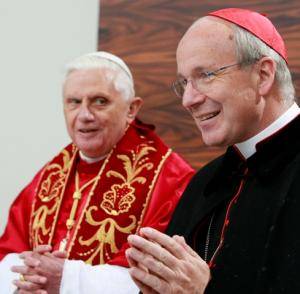
Showing posts with label Cardinal Christoph Schonborn. Show all posts
Tuesday, October 02, 2018
Cardinal Christoph Schonborn: Women deacons are an open question
The apostasy grows.
"Cardinal Christoph Schönborn has said that in his view, whether the Church could ordain women as deacons remains an 'open question.'
The Archbishop of Vienna was speaking Sept. 29 to 1700 delegates from parish councils and other bodies in St. Stephen's Cathedral. Reflecting that he recently had ordained 14 men to the permanent diaconate, he added, according to local news agency Kathpress, 'perhaps one day also female deacons.'"
In this he aligns himself with the destructive program of Modernists, warned of by St. Pius X in Pascendi: "There is no part of Catholic truth which they leave untouched, none they do not strive to corrupt.”
Modernists who want to ordain women to the diaconate are not only engaging in heresy but will foment schism in the Church. There is absolutely no basis whatsoever for considering this.
Gerhard Ludwig Muller, Professor of Dogmatic Theology in Munich, explains in his scholarly work entitled "Priesthood and Diaconate" (Ignatius Press) that the consecration of deaconesses in the early Church was not an ordination of women to the diaconate. He writes:
"The institutionalization of charitable services performed by widows in the Christian community, of the assistance rendered by women during baptismal ceremonies, and of liturgical functions in a convent of consecrated virgins is apparent from the beginning of the third century in the ecclesiastical neologism: diaconissa/diacona. For Koine Greek, unlike Latin, could not construct the female form of 'servant' by a change of ending, but could only indicate it with the feminine article (cf. Rom 16:1). Aside from that, we also encounter the title diaconissa (and, similarly, presbyterissa and episcopissa) as a designation for the wives of deacons - for example, in papal instructions or conciliar canons that admonish higher clerics to practice celibacy, in the sense of continence.
Although there are records of the liturgical installation of deaconesses dating back to the fourth century, one must not overlook the fact that the selfsame authors who testify to this practice also make clear that the consecration of deaconesses was not the ordination of women to the diaconal ministry; on the contrary, it was a question of a different ecclesiastical office.
To the early Church it was clear that, without prejudice to the various degrees of bishop, presbyter, and deacon, which assumed a definitive form in the transition to the postapostolic age, these ministries owe their existence to the historical initiative of the apostles and to the special presence of the Holy Spirit in the foundational phase of the Church; whereas the latter, so-called nonsacramental consecrations were introduced by ecclesiastical authorities and thus are not matters of divine law but only of Church law." (pp. 48-49).
The Catechism of the Catholic Church teaches clearly that: "Deacons share in Christ's mission and grace in a special way. The sacrament of Holy Orders marks them with an imprint ('character') which cannot be removed and which configures them to Christ, who made himself the 'deacon' or servant of all. Among other tasks, it is the task of deacons to assist the bishop and priests in the celebration of the divine mysteries, above all the Eucharist, in the distribution of Holy Communion, in assisting at and blessing marriages, in the proclamation of the Gospel and preaching, in presiding over funerals, and in dedicating themselves to the various ministries of charity." (CCC, 1570).
And again: "Since the Second Vatican Council the Latin Church has restored the diaconate 'as a proper and permanent rank of the hierarchy,' while the Churches of the East had always maintained it. This permanent diaconate, which can be conferred on married men, constitutes an important enrichment for the Church's mission. Indeed it is appropriate and useful that men who carry out a truly diaconal ministry in the Church, whether in its liturgical and pastoral life or whether in its social and charitable works, should 'be strengthened by the imposition of hands which has come down from the apostles. They would be more closely bound to the altar and their ministry would be made more fruitful through the sacramental grace of the diaconate.'" (CCC, 1571).
Women cannot receive Holy Orders. Period. End of story. The Sacrament of Holy Orders is conferred in the degrees of Bishop, Presbyter, and Deacon (See Lumen Gentium Nos. 18-29). Tradition in its entirety has always firmly held that all degrees of ordination are essentially rooted in one sacrament, as being a repraesentatio Christi capitis [a representation of Christ the Head].
The darkness spreads.
Wednesday, April 11, 2012
"..it can happen that this non-Catholic thought within Catholicism, will tomorrow become the stronger."
While Cardinal Christoph Schonborn has said that "We should give more consideration to the quality of homosexual relationships," The Austrian Independent is reporting that Father Gerard Swierzek's fidelity to Catholic doctrine isn't getting much consideration at his parish or in his community.
The Austrian Independent:
"Florian Stangl, a homosexual carer of disabled children, received a majority of votes in the recent Stützenhofen parish community council ballot. Viennese Archbishop Christoph Cardinal Schönborn, the highest representative of the Austrian Roman Catholic Church, gave the green light to Stangl’s engagement in the parish despite his sexual orientation. Schönborn said last week that he had been "impressed" by Stangl. Schönborn met with the 26-year-old social worker before making clear that he supported his nomination.
Now Gerhard Swierzek, the Catholic priest of the town of 110 residents, said he did not want to hold masses in Stützenhofen any longer. Swierzek explained he opposed the "sinful lifestyle" of some members of the local Catholic community. Swierzek added he planned to ask clerical leaders for a position in another parish due to recent occurrences.
Stangl refused to comment on Swierzek’s statements except stressing that a possible appeal for a job somewhere else was the priest’s "personal decision". Other members of the Stützenhofen parish community council are less cautious with keeping their opinion to themselves. Local newspapers quote them as saying that Swierzek gambled away the chances for a mutual agreement. They told reporters that the priest was well advised to leave the village to help its Catholic community to regroup and get over the latest turmoil." (See full article here).
It was Pope Paul VI who said, back in 1977, "There is a great uneasiness, at this time, in the world and in the Church, and that which is in question is the faith. It so happens now that I repeat to myself the obscure phrase of Jesus in the Gospel of St. Luke: 'When the Son of Man returns, will He still find faith on the earth?' It so happens that there are books coming out in which the faith is in retreat on some important points, that the episcopates are remaining silent and these books are not looked upon as strange. This, to me, is strange. I sometimes read the Gospel passage of the end times and I attest that, at this time, some signs of this end are emerging.."
And this was 35 years ago when, compared with today, things were far better. Pope Paul VI also said, "What strikes me, when I think of the Catholic world, is that within Catholicism, there seems sometimes to predominate a non-Catholic way of thinking, and it can happen that this non-Catholic thought within Catholicism, will tomorrow become the stronger. But it will never represent the thought of the Church. It is necessary that a small flock subsist, no matter how small it might be." (The Secret Paul VI, by Jean Guitton).
Every day the non-Catholic way of thinking Pope Paul VI spoke of grows stronger. Minds are succumbing to the darkness. Our Lady told Father Stefano Gobbi on November 15, 1990, "I have not been listened to. You have continued to walk along the way of rejection of God and of his Law of love. Sins of impurity have become ever more widespread, and immorality has spread like a sea which has submerged all things. Homosexuality, a sin of impurity which is against nature, has been justified; recourse to the means of preventing life have become commonplace, while abortions - these killings of innocent children, that cry for vengeance before the face of God - have spread and are performed in every part of your homeland...there will remain only a small faithful remnant, over which I will keep watch in the garden of my Immaculate Heart..The chastisement, predicted by me at Fatima and contained in that part of the secret which has not yet been revealed, is about to take place. The great moment of divine justice and of mercy has come upon the world."
Pray. Remain faithful to the Holy Father. Live a sacramental life. Confess your sins. The hour of Calvary approaches.
Tuesday, April 10, 2012
Has Cardinal Christoph Schönborn lost his faith and the ability to reason?
LifeSiteNews is reporting that the Cardinal Archbishop of Vienna, Christoph Schönborn , received a letter from the Vatican demanding action, after ten months of "discussion" between the Cardinal and the dissent group calling itself the "Austrian Priests' Initiative." The dissent group issued a manifesto last year demanding that the Church change her teachings on the ordination of women and married clergy and the reception of Communion by non-Catholics and divorced and remarried persons, and calling on their fellow clergy to disobey the Vatican.
LifeSiteNews is reporting that, "the Cardinal himself has also publicly called for the Church to acquiesce to the group's agenda" and has asserted that "the Church does need some reform."
Back in 2010, Cardinal Schönborn criticised the Church for what he characterised as its refusal to accept homosexual relations. Schönborn told the far-left UK Tablet magazine that the Church should also consider allowing divorced and remarried Catholics to receive Communion since "many people don’t even marry at all any longer" and insisted that, "We should give more consideration to the quality of homosexual relationships. A stable relationship is certainly better than if someone chooses to be promiscuous." (See here).
The doctrines which have been revealed by the Lord Jesus, either directly or through His Church, are often truths beyond the power of reason to discover or comprehend. In such cases, supernatural aid is required to accept these truths. This supernatural aid is called the gift of faith. Faith is a supernatural gift of God for the acquisition of truth in the supernatural order, just as reason is a natural gift of God for the acquisition of truth in the natural order.
Now, the natural law is perceptible and knowable by all men who have reached the age of reason. Pope John Paul II, in his Encyclical Letter Veritatis Splendor, No. 36, explains that, "Some people..disregarding the dependence of human reason on divine wisdom and the need, given the present state of fallen nature, for divine revelation as an effective means for knowing moral truths, even those of the natural order, have actually posited a complete sovereignty of reason in the domain of moral norms regarding the right ordering of life in this world. Such norms would constitute the boundaries for a merely 'human' morality; they would be the expression of a law which has its source exclusively in human reason. In no way could God be considered the Author of this law, except in the sense that human reason exercises its autonomy in setting down laws by virtue of a primordial and total mandate given to man by God. These trends of thought have led to a denial, in opposition to Sacred Scripture (cf. Mt 15: 3-6) and the Church's constant teaching, of the fact that the natural moral law has God as its Author, and that man, by the use of reason, participates in the eternal law, which it is not for him to establish."
Cardinal Schönborn wants us to give "more consideration" to what he refers to as " the quality of homosexual relationships." But the Holy Spirit, through St. Paul, explains why idolatrous peoples, such as the Romans, fall into unnatural vice. We are told that:
"The wrath of God is indeed being revealed from heaven against every impiety and wickedness of those who suppress the truth by their wickedness. For what can be known about God is evident to them. Ever since the creation of the world, His invisible attributes of eternal power and divinity have been able to be understood and perceived in what He has made. As a result, they have no excuse; for although they knew God they did not accord Him glory as God or give Him thanks." (Romans 1: 18-21).
The Holy Spirit tells us through the Apostle that the failure to recognize God leads to corruption of the will and a blinded intellect which, ultimately, leads to idolatry. And God's punishment for this vanity is to abandon such people to the vice against nature:
"Instead, they became vain in their reasoning, and their senseless minds were darkened. While claiming to be wise, they became fools and exchanged the glory of the immortal God for the likeness of an image of mortal man or of birds or of four-legged animals or of snakes. Therefore, God handed them over to impurity through the lusts of their hearts for the mutual degradation of their bodies." (Romans 1: 21-24).
The Apostle, writing under the inspiration of the Holy Spirit, is most clear and unambiguous. He describes this mutual degradation while stressing its unnatural character:
"Their females exchanged natural relations for unnatural, and the males likewise gave up natural relations with females and burned with lust for one another. Males did shameful things with males and thus received in their own persons the due penalty for their perversity." (Romans 1: 26-27).
As a result of these unnatural relations, such people face horible consequences:
"They are filled with every form of wickedness, evil, greed, and malice; full of envy, murder, rivalry, treachery, and spite. They are gossips and scandal-mongers and they hate God. They are insolent, haughty, boastful, ingenious in their wickedness, and rebellious toward their parents. They are senseless, faithless, heartless, ruthless." (Romans 1: 25; 28-31).
Finally, those who succumb to this unnatural vice not only become attached to it but attempt to justify it while applauding others who have fallen into the vice: "they not only do them but give approval to those who practice them." (Romans 1: 32).
Rather than challenging sinners to conform themselves to Christ and His Church and to work, with the help of God's grace, toward reforming themselves, Cardinal Schönborn wants the Church to "reform" [and here we are not speaking of legitimate reform - a growth in holiness and truth] by changing her teaching to accommodate those who dissent from the teaching of the Lord Jesus.
Has Cardinal Schönborn lost his faith and the ability to reason? If not, why does he then request the Church to abandon her teaching and acquiesce to the demands of a group which has embraced dissent? Why does he speak of unnatural relations as having "quality"?
Truly, as I have been warning for years, and as Pope Benedict XVI recently said, darkness is descending upon the world. And many can no longer distinguish between good and evil.
LifeSiteNews is reporting that, "the Cardinal himself has also publicly called for the Church to acquiesce to the group's agenda" and has asserted that "the Church does need some reform."
Back in 2010, Cardinal Schönborn criticised the Church for what he characterised as its refusal to accept homosexual relations. Schönborn told the far-left UK Tablet magazine that the Church should also consider allowing divorced and remarried Catholics to receive Communion since "many people don’t even marry at all any longer" and insisted that, "We should give more consideration to the quality of homosexual relationships. A stable relationship is certainly better than if someone chooses to be promiscuous." (See here).
The doctrines which have been revealed by the Lord Jesus, either directly or through His Church, are often truths beyond the power of reason to discover or comprehend. In such cases, supernatural aid is required to accept these truths. This supernatural aid is called the gift of faith. Faith is a supernatural gift of God for the acquisition of truth in the supernatural order, just as reason is a natural gift of God for the acquisition of truth in the natural order.
Now, the natural law is perceptible and knowable by all men who have reached the age of reason. Pope John Paul II, in his Encyclical Letter Veritatis Splendor, No. 36, explains that, "Some people..disregarding the dependence of human reason on divine wisdom and the need, given the present state of fallen nature, for divine revelation as an effective means for knowing moral truths, even those of the natural order, have actually posited a complete sovereignty of reason in the domain of moral norms regarding the right ordering of life in this world. Such norms would constitute the boundaries for a merely 'human' morality; they would be the expression of a law which has its source exclusively in human reason. In no way could God be considered the Author of this law, except in the sense that human reason exercises its autonomy in setting down laws by virtue of a primordial and total mandate given to man by God. These trends of thought have led to a denial, in opposition to Sacred Scripture (cf. Mt 15: 3-6) and the Church's constant teaching, of the fact that the natural moral law has God as its Author, and that man, by the use of reason, participates in the eternal law, which it is not for him to establish."
Cardinal Schönborn wants us to give "more consideration" to what he refers to as " the quality of homosexual relationships." But the Holy Spirit, through St. Paul, explains why idolatrous peoples, such as the Romans, fall into unnatural vice. We are told that:
"The wrath of God is indeed being revealed from heaven against every impiety and wickedness of those who suppress the truth by their wickedness. For what can be known about God is evident to them. Ever since the creation of the world, His invisible attributes of eternal power and divinity have been able to be understood and perceived in what He has made. As a result, they have no excuse; for although they knew God they did not accord Him glory as God or give Him thanks." (Romans 1: 18-21).
The Holy Spirit tells us through the Apostle that the failure to recognize God leads to corruption of the will and a blinded intellect which, ultimately, leads to idolatry. And God's punishment for this vanity is to abandon such people to the vice against nature:
"Instead, they became vain in their reasoning, and their senseless minds were darkened. While claiming to be wise, they became fools and exchanged the glory of the immortal God for the likeness of an image of mortal man or of birds or of four-legged animals or of snakes. Therefore, God handed them over to impurity through the lusts of their hearts for the mutual degradation of their bodies." (Romans 1: 21-24).
The Apostle, writing under the inspiration of the Holy Spirit, is most clear and unambiguous. He describes this mutual degradation while stressing its unnatural character:
"Their females exchanged natural relations for unnatural, and the males likewise gave up natural relations with females and burned with lust for one another. Males did shameful things with males and thus received in their own persons the due penalty for their perversity." (Romans 1: 26-27).
As a result of these unnatural relations, such people face horible consequences:
"They are filled with every form of wickedness, evil, greed, and malice; full of envy, murder, rivalry, treachery, and spite. They are gossips and scandal-mongers and they hate God. They are insolent, haughty, boastful, ingenious in their wickedness, and rebellious toward their parents. They are senseless, faithless, heartless, ruthless." (Romans 1: 25; 28-31).
Finally, those who succumb to this unnatural vice not only become attached to it but attempt to justify it while applauding others who have fallen into the vice: "they not only do them but give approval to those who practice them." (Romans 1: 32).
Rather than challenging sinners to conform themselves to Christ and His Church and to work, with the help of God's grace, toward reforming themselves, Cardinal Schönborn wants the Church to "reform" [and here we are not speaking of legitimate reform - a growth in holiness and truth] by changing her teaching to accommodate those who dissent from the teaching of the Lord Jesus.
Has Cardinal Schönborn lost his faith and the ability to reason? If not, why does he then request the Church to abandon her teaching and acquiesce to the demands of a group which has embraced dissent? Why does he speak of unnatural relations as having "quality"?
Truly, as I have been warning for years, and as Pope Benedict XVI recently said, darkness is descending upon the world. And many can no longer distinguish between good and evil.
Subscribe to:
Posts (Atom)