The French preacher Lacordaire once said that the vocation of a soldier is next in dignity to the priesthood, not only because it commissioned him to defend justice on the field of battle and order on the field of peace, but also because it called him to the spirit and intention of sacrifice.
It is the soldier's high calling to the defense of justice and freedom which makes him (or should) so loved. It was a soldier who first spoke the words recalled by the Church during every Mass at Holy Communion: "Lord, I am not worthy to have Thee come under my roof; but only say the word, and my servant will be healed." (Mt 8:8).
The Breviary, which priests pray daily, praises Judas Machabeus, who refused to surrender to superior enemy forces and died saying: "Far be it from us to do such a thing as to flee from them. If our time has come, let us die bravely for our brethren, and leave no cause to question our honor." (1 Macc 9: 10).
A soldier who does his or her duty honorably contributes to the common good and to authentic peace.
Many do not appreciate this. At Saint Mary's Church in Orange, Massachusetts, Veteran's Day apparently means next to nothing. Veterans were not included in the Mass intentions or the prayer intentions during Mass. And this is an old story.
In the Church, those of us who served in the military are often treated as second-class citizens. As Wintery Knight says, "All of the outward facing disciplines within Christianity, such as apologetics, theology, ethics, etc. are de-emphasized, censored or resisted in feminized churches. There is no place for rationality, moral judgments and boundaries, debates and disagreement, confrontations and persuasion, or other manly Christian practices."
I've personally encountered such resistance toward apologetics and spiritualities which are decidely masculine (such as the Ignatian model). I'm convinced that the effeminization which has take place within the Catholic Church in this country is one reason I am not welcome at my own parish and have been, like so many other healthy young men who are not homosexual or crippled by effeminacy, relegated to the trash bin.
What a shame!
Not all Catholic Churches treat veterans with contempt or ignore them altogether. This Catholic Church is but one of many which does not suffer from ingratitude.
Showing posts with label Dignity. Show all posts
Sunday, November 11, 2018
Tuesday, February 20, 2018
Father Shaun O'Connor, Pastor of Saint Mary's Church in Orange, Massachusetts and the Evangelical Counsels...
During his pontificate, Pope Benedict XVI emphasized that the laity are co-responsible for the Church. In other words, the laity are not "second-class" citizens within the Church.
"Since, like all the faithful, lay Christians are entrusted by God with the apostolate by virtue of their Baptism and Confirmation, they have the right and duty, individually or grouped in associations, to work so that the divine message of salvation may be known and accepted by all men throughout the earth. This duty is the more pressing when it is only through them that men can hear the Gospel and know Christ. Their activity in ecclesial communities is so necessary that, for the most part, the apostolate of the pastors cannot be fully effective without it." (Catechism of the Catholic Church, 900).
In his Post-Synodal Apostolic Exhortation Christifideles Laici (The Lay Members of Christ's Faithful People), Pope John Paul II reminded us that, "The voice of the Lord clearly resounds in the depths of each of Christ's followers who, through faith and the sacraments of Christian initiation is made like to Jesus Christ, is incorporated as a living member in the Church and has an active part in her mission of salvation." (No. 3).
Sadly, there are all too many clerics who haven't really embraced this authentic teaching of the Magisterium. For such clerics, the laity are second-class citizens who are tolerated but not really embraced fully as collaborators in the life and mission of the Church.
This is most unfortunate. It was Pope Pius XII who said that, "The Faithful, more precisely the lay faithful, find themselves on the front lines of the Church's life; for them the Church is the animating principle for human society. Therefore, they in particular, ought to have an ever-clearer consciousness not only of belonging the Church, but of being the Church, that is to say, the community of the faithful on earth under the leadership of the Pope, the head of all, and of the Bishops in communion with him. These are the Church..." (Pius XII, Discourse to the New Cardinals, February 20, 1946: AAS 38 (1946), 149).
The truth of lay participation in the priesthood of Christ follows logically from the doctrine of the Mystical Body. Everyone who is incorporated into the Mystical Body participates in the dignities, honors, and offices of the Mystical Head (Jesus). "Because Christ is our head," says St. Thomas Aquinas, "that which was conferred upon him, was also in him conferred upon us" (Summa Theologica, III, q. 58, a.4, ad 1).
Or, as Pope John Paul II put it: "Referring to the baptized as 'new born babes', the apostle Peter writes: 'Come to him, to that living stone, rejected by men but in God's sight chosen and precious; and like living stones be yourselves built into a spiritual house, to be a holy priesthood to offer spiritual sacrifices acceptable to God through Jesus Christ ... you are a chosen race, a royal priesthood, a holy nation, God's own people, that you may declare the wonderful deeds of him who called you out of darkness into his marvelous light' (1 Pt 2:4-5, 9).
A new aspect to the grace and dignity coming from Baptism is here introduced: the lay faithful participate, for their part, in the threefold mission of Christ as Priest, Prophet and King. This aspect has never been forgotten in the living tradition of the Church, as exemplified in the explanation which St. Augustine offers for Psalm 26: 'David was anointed king. In those days only a king and a priest were anointed. These two persons prefigured the one and only priest and king who was to come, Christ (the name "Christ" means "anointed"). Not only has our head been anointed but we, his body, have also been anointed ... therefore anointing comes to all Christians, even though in Old Testament times it belonged only to two persons. Clearly we are the Body of Christ because we are all "anointed" and in him are "christs", that is, "anointed ones", as well as Christ himself, "The Anointed One". In a certain way, then, it thus happens that with head and body the whole Christ is formed..'
In the wake of the Second Vatican Council, at the beginning of my pastoral ministry, my aim was to emphasize forcefully the priestly, prophetic and kingly dignity of the entire People of God..." (Christifideles Laici, No. 14).
Lay Catholics, called to be co-responsible for the Church, must embrace the Evangelical Counsels of Poverty, Chastity and Obedience. As Monsignor Owen Campion has reminded us:
"These virtues [Poverty, Chastity and Obedience], called the 'Evangelical Counsels,' apply not just to women Religious. They apply not just to men Religious. Actually, they apply to every baptized Catholic. They are the ideals we all should honor and seek to put into our lives and lifestyles.
The Catholic Church calls these ideals Evangelical Counsels because no less a source than the Gospels themselves recommends them to us, advising us to embrace them if we wish truly to follow Christ."
Father Shaun O'Connor, Pastor of Saint Mary's Church in Orange, Massachusetts, reminded parishioners of this fact in his homily this past weekend. It is always encouraging when pastors encourage the lay apostolate and that spiritual formation which is rooted in the Evangelical Counsels.
"Since, like all the faithful, lay Christians are entrusted by God with the apostolate by virtue of their Baptism and Confirmation, they have the right and duty, individually or grouped in associations, to work so that the divine message of salvation may be known and accepted by all men throughout the earth. This duty is the more pressing when it is only through them that men can hear the Gospel and know Christ. Their activity in ecclesial communities is so necessary that, for the most part, the apostolate of the pastors cannot be fully effective without it." (Catechism of the Catholic Church, 900).
In his Post-Synodal Apostolic Exhortation Christifideles Laici (The Lay Members of Christ's Faithful People), Pope John Paul II reminded us that, "The voice of the Lord clearly resounds in the depths of each of Christ's followers who, through faith and the sacraments of Christian initiation is made like to Jesus Christ, is incorporated as a living member in the Church and has an active part in her mission of salvation." (No. 3).
Sadly, there are all too many clerics who haven't really embraced this authentic teaching of the Magisterium. For such clerics, the laity are second-class citizens who are tolerated but not really embraced fully as collaborators in the life and mission of the Church.
This is most unfortunate. It was Pope Pius XII who said that, "The Faithful, more precisely the lay faithful, find themselves on the front lines of the Church's life; for them the Church is the animating principle for human society. Therefore, they in particular, ought to have an ever-clearer consciousness not only of belonging the Church, but of being the Church, that is to say, the community of the faithful on earth under the leadership of the Pope, the head of all, and of the Bishops in communion with him. These are the Church..." (Pius XII, Discourse to the New Cardinals, February 20, 1946: AAS 38 (1946), 149).
The truth of lay participation in the priesthood of Christ follows logically from the doctrine of the Mystical Body. Everyone who is incorporated into the Mystical Body participates in the dignities, honors, and offices of the Mystical Head (Jesus). "Because Christ is our head," says St. Thomas Aquinas, "that which was conferred upon him, was also in him conferred upon us" (Summa Theologica, III, q. 58, a.4, ad 1).
Or, as Pope John Paul II put it: "Referring to the baptized as 'new born babes', the apostle Peter writes: 'Come to him, to that living stone, rejected by men but in God's sight chosen and precious; and like living stones be yourselves built into a spiritual house, to be a holy priesthood to offer spiritual sacrifices acceptable to God through Jesus Christ ... you are a chosen race, a royal priesthood, a holy nation, God's own people, that you may declare the wonderful deeds of him who called you out of darkness into his marvelous light' (1 Pt 2:4-5, 9).
A new aspect to the grace and dignity coming from Baptism is here introduced: the lay faithful participate, for their part, in the threefold mission of Christ as Priest, Prophet and King. This aspect has never been forgotten in the living tradition of the Church, as exemplified in the explanation which St. Augustine offers for Psalm 26: 'David was anointed king. In those days only a king and a priest were anointed. These two persons prefigured the one and only priest and king who was to come, Christ (the name "Christ" means "anointed"). Not only has our head been anointed but we, his body, have also been anointed ... therefore anointing comes to all Christians, even though in Old Testament times it belonged only to two persons. Clearly we are the Body of Christ because we are all "anointed" and in him are "christs", that is, "anointed ones", as well as Christ himself, "The Anointed One". In a certain way, then, it thus happens that with head and body the whole Christ is formed..'
In the wake of the Second Vatican Council, at the beginning of my pastoral ministry, my aim was to emphasize forcefully the priestly, prophetic and kingly dignity of the entire People of God..." (Christifideles Laici, No. 14).
Lay Catholics, called to be co-responsible for the Church, must embrace the Evangelical Counsels of Poverty, Chastity and Obedience. As Monsignor Owen Campion has reminded us:
"These virtues [Poverty, Chastity and Obedience], called the 'Evangelical Counsels,' apply not just to women Religious. They apply not just to men Religious. Actually, they apply to every baptized Catholic. They are the ideals we all should honor and seek to put into our lives and lifestyles.
The Catholic Church calls these ideals Evangelical Counsels because no less a source than the Gospels themselves recommends them to us, advising us to embrace them if we wish truly to follow Christ."
Father Shaun O'Connor, Pastor of Saint Mary's Church in Orange, Massachusetts, reminded parishioners of this fact in his homily this past weekend. It is always encouraging when pastors encourage the lay apostolate and that spiritual formation which is rooted in the Evangelical Counsels.
Labels:
Called,
Church,
Co-Responsible,
Dignity,
Embrace,
Evangelical Counsels,
Father,
For,
Laity,
Lay,
Massachusetts,
Orange,
Pastor,
People,
Pope Saint John Paul II,
Saint Mary's,
Shaun O'Connor,
Vocation
Friday, April 28, 2017
Francis insults the dignity of the laity...
Mundabor writes:
"Francis has spoken in front of the usual, convenient audience of opportunists and assorted sycophants, and was applauded when he issued the following admonitions to his abused sheep: “do not clericalise the laity” and “don't be more Papist than the Pope”.
I must say I had to smile.
The laity is being “clericalised” (that is: seen as the authentic carriers of the Catholic message) because the clergy shamelessly, insistently, blatantly refuse to do their job. If the local priest talks rubbish all the time and the bloggers online talk sense, it is fairly obvious that everyone with even a faint interest in his salvation will look to the latter for his instruction, and will look at the former as an embarrassment at best and a disgrace at worst. Actually, woe to the one who swallows all the excrement the bad priest dishes to him and thinks he is being a good Catholic. He is dancing on the brink of hell as he smiles “peace beeeee with youuuuuuu” to his pew neighbour..."
Popes Benedict XVI and Saint John Paul II, like their predecessors, were not threatened by an informed laity as Francis is. But then, they weren't spewing nonsense either.
Pope Benedict XVI emphasized that the laity are co-responsible for the Church
In other words, the laity are not "second-class" citizens within the Church.
The Catechism stresses that, "Since, like all the faithful, lay Christians are entrusted by God with the apostolate by virtue of their Baptism and Confirmation, they have the right and duty, individually or grouped in associations, to work so that the divine message of salvation may be known and accepted by all men throughout the earth. This duty is the more pressing when it is only through them that men can hear the Gospel and know Christ. Their activity in ecclesial communities is so necessary that, for the most part, the apostolate of the pastors cannot be fully effective without it." (Catechism of the Catholic Church, 900).
In his Post-Synodal Apostolic Exhortation Christifideles Laici (The Lay Members of Christ's Faithful People), Pope John Paul II reminded us that, "The voice of the Lord clearly resounds in the depths of each of Christ's followers who, through faith and the sacraments of Christian initiation is made like to Jesus Christ, is incorporated as a living member in the Church and has an active part in her mission of salvation." (No. 3).
Sadly, there are all too many clerics Like Francis who haven't really embraced this authentic teaching of the Magisterium. For such clerics, the laity are second-class citizens who are tolerated but not really embraced fully as collaborators in the life and mission of the Church.
This is most unfortunate. It was Pope Pius XII who said that, "The Faithful, more precisely the lay faithful, find themselves on the front lines of the Church's life; for them the Church is the animating principle for human society. Therefore, they in particular, ought to have an ever-clearer consciousness not only of belonging the Church, but of being the Church, that is to say, the community of the faithful on earth under the leadership of the Pope, the head of all, and of the Bishops in communion with him. These are the Church..." (Pius XII, Discourse to the New Cardinals, February 20, 1946: AAS 38 (1946), 149).
The truth of lay participation in the priesthood of Christ follows logically from the doctrine of the Mystical Body. Everyone who is incorporated into the Mystical Body participates in the dignities, honors, and offices of the Mystical Head (Jesus). "Because Christ is our head," says St. Thomas Aquinas, "that which was conferred upon him, was also in him conferred upon us" (Summa Theologica, III, q. 58, a.4, ad 1). Or, as Pope John Paul II put it: "Referring to the baptized as 'new born babes', the apostle Peter writes: 'Come to him, to that living stone, rejected by men but in God's sight chosen and precious; and like living stones be yourselves built into a spiritual house, to be a holy priesthood to offer spiritual sacrifices acceptable to God through Jesus Christ ... you are a chosen race, a royal priesthood, a holy nation, God's own people, that you may declare the wonderful deeds of him who called you out of darkness into his marvelous light' (1 Pt 2:4-5, 9).
A new aspect to the grace and dignity coming from Baptism is here introduced: the lay faithful participate, for their part, in the threefold mission of Christ as Priest, Prophet and King. This aspect has never been forgotten in the living tradition of the Church, as exemplified in the explanation which St. Augustine offers for Psalm 26: 'David was anointed king. In those days only a king and a priest were anointed. These two persons prefigured the one and only priest and king who was to come, Christ (the name "Christ" means "anointed"). Not only has our head been anointed but we, his body, have also been anointed ... therefore anointing comes to all Christians, even though in Old Testament times it belonged only to two persons. Clearly we are the Body of Christ because we are all "anointed" and in him are "christs", that is, "anointed ones", as well as Christ himself, "The Anointed One". In a certain way, then, it thus happens that with head and body the whole Christ is formed..'
In the wake of the Second Vatican Council, at the beginning of my pastoral ministry, my aim was to emphasize forcefully the priestly, prophetic and kingly dignity of the entire People of God..." (Christifideles Laici, No. 14).
This emphasis has been abandoned by the Masonic Francis as he seeks to destroy the Church from within.
"Francis has spoken in front of the usual, convenient audience of opportunists and assorted sycophants, and was applauded when he issued the following admonitions to his abused sheep: “do not clericalise the laity” and “don't be more Papist than the Pope”.
I must say I had to smile.
The laity is being “clericalised” (that is: seen as the authentic carriers of the Catholic message) because the clergy shamelessly, insistently, blatantly refuse to do their job. If the local priest talks rubbish all the time and the bloggers online talk sense, it is fairly obvious that everyone with even a faint interest in his salvation will look to the latter for his instruction, and will look at the former as an embarrassment at best and a disgrace at worst. Actually, woe to the one who swallows all the excrement the bad priest dishes to him and thinks he is being a good Catholic. He is dancing on the brink of hell as he smiles “peace beeeee with youuuuuuu” to his pew neighbour..."
Popes Benedict XVI and Saint John Paul II, like their predecessors, were not threatened by an informed laity as Francis is. But then, they weren't spewing nonsense either.
Pope Benedict XVI emphasized that the laity are co-responsible for the Church
In other words, the laity are not "second-class" citizens within the Church.
The Catechism stresses that, "Since, like all the faithful, lay Christians are entrusted by God with the apostolate by virtue of their Baptism and Confirmation, they have the right and duty, individually or grouped in associations, to work so that the divine message of salvation may be known and accepted by all men throughout the earth. This duty is the more pressing when it is only through them that men can hear the Gospel and know Christ. Their activity in ecclesial communities is so necessary that, for the most part, the apostolate of the pastors cannot be fully effective without it." (Catechism of the Catholic Church, 900).
In his Post-Synodal Apostolic Exhortation Christifideles Laici (The Lay Members of Christ's Faithful People), Pope John Paul II reminded us that, "The voice of the Lord clearly resounds in the depths of each of Christ's followers who, through faith and the sacraments of Christian initiation is made like to Jesus Christ, is incorporated as a living member in the Church and has an active part in her mission of salvation." (No. 3).
Sadly, there are all too many clerics Like Francis who haven't really embraced this authentic teaching of the Magisterium. For such clerics, the laity are second-class citizens who are tolerated but not really embraced fully as collaborators in the life and mission of the Church.
This is most unfortunate. It was Pope Pius XII who said that, "The Faithful, more precisely the lay faithful, find themselves on the front lines of the Church's life; for them the Church is the animating principle for human society. Therefore, they in particular, ought to have an ever-clearer consciousness not only of belonging the Church, but of being the Church, that is to say, the community of the faithful on earth under the leadership of the Pope, the head of all, and of the Bishops in communion with him. These are the Church..." (Pius XII, Discourse to the New Cardinals, February 20, 1946: AAS 38 (1946), 149).
The truth of lay participation in the priesthood of Christ follows logically from the doctrine of the Mystical Body. Everyone who is incorporated into the Mystical Body participates in the dignities, honors, and offices of the Mystical Head (Jesus). "Because Christ is our head," says St. Thomas Aquinas, "that which was conferred upon him, was also in him conferred upon us" (Summa Theologica, III, q. 58, a.4, ad 1). Or, as Pope John Paul II put it: "Referring to the baptized as 'new born babes', the apostle Peter writes: 'Come to him, to that living stone, rejected by men but in God's sight chosen and precious; and like living stones be yourselves built into a spiritual house, to be a holy priesthood to offer spiritual sacrifices acceptable to God through Jesus Christ ... you are a chosen race, a royal priesthood, a holy nation, God's own people, that you may declare the wonderful deeds of him who called you out of darkness into his marvelous light' (1 Pt 2:4-5, 9).
A new aspect to the grace and dignity coming from Baptism is here introduced: the lay faithful participate, for their part, in the threefold mission of Christ as Priest, Prophet and King. This aspect has never been forgotten in the living tradition of the Church, as exemplified in the explanation which St. Augustine offers for Psalm 26: 'David was anointed king. In those days only a king and a priest were anointed. These two persons prefigured the one and only priest and king who was to come, Christ (the name "Christ" means "anointed"). Not only has our head been anointed but we, his body, have also been anointed ... therefore anointing comes to all Christians, even though in Old Testament times it belonged only to two persons. Clearly we are the Body of Christ because we are all "anointed" and in him are "christs", that is, "anointed ones", as well as Christ himself, "The Anointed One". In a certain way, then, it thus happens that with head and body the whole Christ is formed..'
In the wake of the Second Vatican Council, at the beginning of my pastoral ministry, my aim was to emphasize forcefully the priestly, prophetic and kingly dignity of the entire People of God..." (Christifideles Laici, No. 14).
This emphasis has been abandoned by the Masonic Francis as he seeks to destroy the Church from within.
Friday, October 07, 2016
Those who will not receive correction and those who will not give it are like the limbs of a body beginning to rot..
In her own day, St. Catherine of Sienna found much corruption within the Holy
Church. Homosexuality and many other deeply rooted problems were found among the
clergy and Our Lord spoke to this Doctor of the Church about these problems
(pride, loss of sacred identity, loss of faith, worldliness, and sensuality).
These conversations were laid out in St. Catherine's book entitled "Dialogue,"
and most especially in that portion of the book labelled "The Mystical Body of
Holy Church."
While St. Catherine cautions her readers not to engage in blanket condemnations aimed at the clergy in general (using scandals as an excuse to denigrate priests in general), and refers to such people as "irreverent persecutors" of the clergy, still, she was told by Our Lord that those who will not receive correction and those who will not give it are like the limbs of a body beginning to rot.
In our sacharrin society, medicinal rebuke is often mistaken for a "lack of charity" when in actuality such constructive criticism aids in healing. In his excellent work entitled "Liberalism is a sin," Fr. Felix Sarda Y Salvany writes:
"If the propagation of good and the necessity of combating evil require the employment of terms somewhat harsh against error and its supporters, this usage is certainly not against charity. This is a corollary or consequence of the principle we have just demonstrated. We must render evil odious and detestable. We cannot attain this result without pointing out the dangers of evil, without showing how and why it is odious, detestable and contemptible. Christian oratory of all ages has ever employed the most vigorous and emphatic rhetoric in the arsenal of human speech against impiety. In the writings of the great athletes of Christianity the usage of irony, imprecation, execration and of the most crushing epithets is continual. Hence the only law is the opportunity and the truth.
But there is another justification for such an usage. Popular propagation and apologetics cannot preserve elegant and constrained academic forms. In order to convince the people we must speak to their heart and their imagination which can only be touched by ardent, brilliant, and impassioned language. To be impassioned is not to be reprehensible----when our heat is the holy ardor of truth.
The supposed violence of modern Ultramontane journalism not only falls short of Liberal journalism, but is amply justified by every page of the works of our great Catholic polemicists of other epochs. This is easily verified. St. John the Baptist calls the Pharisees "race of vipers," Jesus Christ, our Divine Savior, hurls at them the epithets "hypocrites, whitened sepulchers, a perverse and adulterous generation" without thinking for this reason that He sullies the sanctity of His benevolent speech. St. Paul criticizes the schismatic Cretins as "always liars, evil beasts, slothful bellies." The same apostle calls Elymas the magician a "seducer, full of guile and deceit, child of the Devil, enemy of all justice."
If we open the Fathers we find the same vigorous castigation of heresy and heretics. St. Jerome arguing against Vigilantius casts in his face his former occupation of saloonkeeper: "From your infancy," he says to him, "you have learned other things than theology and betaken yourself to other pursuits. To verify at the same time the value of your money accounts and the value of Scriptural texts, to sample wines and grasp the meaning of the prophets and apostles are certainly not occupations which the same man can accomplish with credit." On another occasion attacking the same Vigilantius, who denied the excellence of virginity and of fasting, St. Jerome, with his usual sprightliness, asks him if he spoke thus "in order not to diminish the receipts of his saloon?" Heavens! What an outcry would be raised if one of our Ultramontane controversialists were to write against a Liberal critic or heretic of our own day in this fashion!
What shall we say of St. John Chrysostom? His famous invective against Eutropius is not comparable, in its personal and aggressive character, to the cruel invectives of Cicero against Catiline and against Verres! The gentle St. Bernard did not honey his words when he attacked the enemies of the faith. Addressing Arnold of Brescia, the great Liberal agitator of his times, he calls him in all his letters "seducer, vase of injuries, scorpion, cruel wolf."
The pacific St. Thomas of Acquinas forgets the calm of his cold syllogisms when he hurls his violent apostrophe against William of St. Amour and his disciples: "Enemies of God," he cries out, "ministers of the Devil, members of antiChrist, ignorami, perverts, reprobates!" Never did the illustrious Louis Veuillot speak so boldly. The seraphic St. Bonaventure, so full of sweetness, overwhelms his adversary Gerard with such epithets as "impudent, calumniator, spirit of malice, impious, shameless, ignorant, impostor, malefactor, perfidious, ingrate!" Did St. Francis de Sales, so delicately exquisite and tender, ever purr softly over the heretics of his age and country? He pardoned their injuries, heaped benefits on them even to the point of saving the lives of those who sought to take his, but with the enemies of the faith he preserved neither moderation nor consideration. Asked by a Catholic, who desired to know if it were permissible to speak evil of a heretic who propagated false doctrines, he replied: "Yes, you can, on the condition that you adhere to the exact truth, to what you know of his bad conduct, presenting that which is doubtful as doubtful according to the degree of doubt which you may have in this regard." In his Introduction to a Devout Life, that precious and popular work, he expresses himself again: "If the declared enemies of God and of the Church ought to be blamed and censured with all possible vigor, charity obliges us to cry 'wolf' when the wolf slips into the midst of the flock, and in every way and place we may meet him."
This is real meat for real Catholics. It was Sir Edmund Burke who said that, "The only thing necessary for evil to triumph in the world is for good people to do nothing." When we witness another Catholic (and yes, even a priest) promoting homosexuality, abortion, contraception, New Age, witchcraft, or dissent in general, we have an obligation (in charity) to speak the truth and to show others how that individual's words, ideas or actions fail to hold up when placed in the Lumen Christi - when held up to the Magisterial teaching of the Church.
The truth of lay participation in the priesthood of Christ follows logically from the doctrine of the Mystical Body. Everyone who is incorporated into the Mystical Body participates in the dignities, honors, and offices of the Mystical Head (Jesus). "Because Christ is our head," says St. Thomas Aquinas, "that which was conferred upon him, was also in him conferred upon us" (Summa Theologica, III, q. 58, a.4, ad 1). Or, as Pope John Paul II put it: "Referring to the baptized as 'new born babes', the apostle Peter writes: 'Come to him, to that living stone, rejected by men but in God's sight chosen and precious; and like living stones be yourselves built into a spiritual house, to be a holy priesthood to offer spiritual sacrifices acceptable to God through Jesus Christ ... you are a chosen race, a royal priesthood, a holy nation, God's own people, that you may declare the wonderful deeds of him who called you out of darkness into his marvelous light' (1 Pt 2:4-5, 9).
A new aspect to the grace and dignity coming from Baptism is here introduced: the lay faithful participate, for their part, in the threefold mission of Christ as Priest, Prophet and King. This aspect has never been forgotten in the living tradition of the Church, as exemplified in the explanation which St. Augustine offers for Psalm 26: 'David was anointed king. In those days only a king and a priest were anointed. These two persons prefigured the one and only priest and king who was to come, Christ (the name "Christ" means "anointed"). Not only has our head been anointed but we, his body, have also been anointed ... therefore anointing comes to all Christians, even though in Old Testament times it belonged only to two persons. Clearly we are the Body of Christ because we are all "anointed" and in him are "christs", that is, "anointed ones", as well as Christ himself, "The Anointed One". In a certain way, then, it thus happens that with head and body the whole Christ is formed..'
In the wake of the Second Vatican Council, at the beginning of my pastoral ministry, my aim was to emphasize forcefully the priestly, prophetic and kingly dignity of the entire People of God..." (Christifideles Laici, No. 14).
How quickly some have forgotten this threefold dignity of the laity!
While St. Catherine cautions her readers not to engage in blanket condemnations aimed at the clergy in general (using scandals as an excuse to denigrate priests in general), and refers to such people as "irreverent persecutors" of the clergy, still, she was told by Our Lord that those who will not receive correction and those who will not give it are like the limbs of a body beginning to rot.
In our sacharrin society, medicinal rebuke is often mistaken for a "lack of charity" when in actuality such constructive criticism aids in healing. In his excellent work entitled "Liberalism is a sin," Fr. Felix Sarda Y Salvany writes:
"If the propagation of good and the necessity of combating evil require the employment of terms somewhat harsh against error and its supporters, this usage is certainly not against charity. This is a corollary or consequence of the principle we have just demonstrated. We must render evil odious and detestable. We cannot attain this result without pointing out the dangers of evil, without showing how and why it is odious, detestable and contemptible. Christian oratory of all ages has ever employed the most vigorous and emphatic rhetoric in the arsenal of human speech against impiety. In the writings of the great athletes of Christianity the usage of irony, imprecation, execration and of the most crushing epithets is continual. Hence the only law is the opportunity and the truth.
But there is another justification for such an usage. Popular propagation and apologetics cannot preserve elegant and constrained academic forms. In order to convince the people we must speak to their heart and their imagination which can only be touched by ardent, brilliant, and impassioned language. To be impassioned is not to be reprehensible----when our heat is the holy ardor of truth.
The supposed violence of modern Ultramontane journalism not only falls short of Liberal journalism, but is amply justified by every page of the works of our great Catholic polemicists of other epochs. This is easily verified. St. John the Baptist calls the Pharisees "race of vipers," Jesus Christ, our Divine Savior, hurls at them the epithets "hypocrites, whitened sepulchers, a perverse and adulterous generation" without thinking for this reason that He sullies the sanctity of His benevolent speech. St. Paul criticizes the schismatic Cretins as "always liars, evil beasts, slothful bellies." The same apostle calls Elymas the magician a "seducer, full of guile and deceit, child of the Devil, enemy of all justice."
If we open the Fathers we find the same vigorous castigation of heresy and heretics. St. Jerome arguing against Vigilantius casts in his face his former occupation of saloonkeeper: "From your infancy," he says to him, "you have learned other things than theology and betaken yourself to other pursuits. To verify at the same time the value of your money accounts and the value of Scriptural texts, to sample wines and grasp the meaning of the prophets and apostles are certainly not occupations which the same man can accomplish with credit." On another occasion attacking the same Vigilantius, who denied the excellence of virginity and of fasting, St. Jerome, with his usual sprightliness, asks him if he spoke thus "in order not to diminish the receipts of his saloon?" Heavens! What an outcry would be raised if one of our Ultramontane controversialists were to write against a Liberal critic or heretic of our own day in this fashion!
What shall we say of St. John Chrysostom? His famous invective against Eutropius is not comparable, in its personal and aggressive character, to the cruel invectives of Cicero against Catiline and against Verres! The gentle St. Bernard did not honey his words when he attacked the enemies of the faith. Addressing Arnold of Brescia, the great Liberal agitator of his times, he calls him in all his letters "seducer, vase of injuries, scorpion, cruel wolf."
The pacific St. Thomas of Acquinas forgets the calm of his cold syllogisms when he hurls his violent apostrophe against William of St. Amour and his disciples: "Enemies of God," he cries out, "ministers of the Devil, members of antiChrist, ignorami, perverts, reprobates!" Never did the illustrious Louis Veuillot speak so boldly. The seraphic St. Bonaventure, so full of sweetness, overwhelms his adversary Gerard with such epithets as "impudent, calumniator, spirit of malice, impious, shameless, ignorant, impostor, malefactor, perfidious, ingrate!" Did St. Francis de Sales, so delicately exquisite and tender, ever purr softly over the heretics of his age and country? He pardoned their injuries, heaped benefits on them even to the point of saving the lives of those who sought to take his, but with the enemies of the faith he preserved neither moderation nor consideration. Asked by a Catholic, who desired to know if it were permissible to speak evil of a heretic who propagated false doctrines, he replied: "Yes, you can, on the condition that you adhere to the exact truth, to what you know of his bad conduct, presenting that which is doubtful as doubtful according to the degree of doubt which you may have in this regard." In his Introduction to a Devout Life, that precious and popular work, he expresses himself again: "If the declared enemies of God and of the Church ought to be blamed and censured with all possible vigor, charity obliges us to cry 'wolf' when the wolf slips into the midst of the flock, and in every way and place we may meet him."
This is real meat for real Catholics. It was Sir Edmund Burke who said that, "The only thing necessary for evil to triumph in the world is for good people to do nothing." When we witness another Catholic (and yes, even a priest) promoting homosexuality, abortion, contraception, New Age, witchcraft, or dissent in general, we have an obligation (in charity) to speak the truth and to show others how that individual's words, ideas or actions fail to hold up when placed in the Lumen Christi - when held up to the Magisterial teaching of the Church.
Just a few years ago, Pope Benedict XVI insisted
that the role of the laity in the Church is essential. In other words, he reminded us that the laity
are not "second-class" citizens within the Church.
The Catechism of the Catholic Church reminds us
that: "Since, like all the faithful, lay Christians are entrusted by God with
the apostolate by virtue of their Baptism and Confirmation, they have the right
and duty, individually or grouped in associations, to work so that the divine
message of salvation may be known and accepted by all men throughout the earth.
This duty is the more pressing when it is only through them that men can hear
the Gospel and know Christ. Their activity in ecclesial communities is so
necessary that, for the most part, the apostolate of the pastors cannot be fully
effective without it." (CCC , 900).
In
his Post-Synodal Apostolic Exhortation Christifideles Laici (The Lay Members of
Christ's Faithful People), Pope John Paul II reminded us that, "The voice of the
Lord clearly resounds in the depths of each of Christ's followers who, through
faith and the sacraments of Christian initiation is made like to Jesus Christ,
is incorporated as a living member in the Church and has an active part in her
mission of salvation." (No. 3).
Sadly, there are all too many clerics who haven't
really embraced this authentic teaching of the Magisterium. For such clerics,
the laity are second-class citizens who are tolerated but not really embraced
fully as collaborators in the life and mission of the Church. This is most
unfortunate, for, as Pope Pius XII said, "The Faithful, more precisely
the lay faithful, find themselves on the front lines of the Church's life; for
them the Church is the animating principle for human society. Therefore, they in
particular, ought to have an ever-clearer consciousness not only of belonging
the Church, but of being the Church, that is to say, the community of the
faithful on earth under the leadership of the Pope, the head of all, and of the
Bishops in communion with him. These are the Church..." (Pius XII, Discourse to
the New Cardinals, February 20, 1946: AAS 38 (1946),
149).The truth of lay participation in the priesthood of Christ follows logically from the doctrine of the Mystical Body. Everyone who is incorporated into the Mystical Body participates in the dignities, honors, and offices of the Mystical Head (Jesus). "Because Christ is our head," says St. Thomas Aquinas, "that which was conferred upon him, was also in him conferred upon us" (Summa Theologica, III, q. 58, a.4, ad 1). Or, as Pope John Paul II put it: "Referring to the baptized as 'new born babes', the apostle Peter writes: 'Come to him, to that living stone, rejected by men but in God's sight chosen and precious; and like living stones be yourselves built into a spiritual house, to be a holy priesthood to offer spiritual sacrifices acceptable to God through Jesus Christ ... you are a chosen race, a royal priesthood, a holy nation, God's own people, that you may declare the wonderful deeds of him who called you out of darkness into his marvelous light' (1 Pt 2:4-5, 9).
A new aspect to the grace and dignity coming from Baptism is here introduced: the lay faithful participate, for their part, in the threefold mission of Christ as Priest, Prophet and King. This aspect has never been forgotten in the living tradition of the Church, as exemplified in the explanation which St. Augustine offers for Psalm 26: 'David was anointed king. In those days only a king and a priest were anointed. These two persons prefigured the one and only priest and king who was to come, Christ (the name "Christ" means "anointed"). Not only has our head been anointed but we, his body, have also been anointed ... therefore anointing comes to all Christians, even though in Old Testament times it belonged only to two persons. Clearly we are the Body of Christ because we are all "anointed" and in him are "christs", that is, "anointed ones", as well as Christ himself, "The Anointed One". In a certain way, then, it thus happens that with head and body the whole Christ is formed..'
In the wake of the Second Vatican Council, at the beginning of my pastoral ministry, my aim was to emphasize forcefully the priestly, prophetic and kingly dignity of the entire People of God..." (Christifideles Laici, No. 14).
How quickly some have forgotten this threefold dignity of the laity!
Labels:
Beginning,
Body,
Correction,
Dignity,
Duty,
Give,
Laity,
Like,
Limbs,
Not,
Receive,
Role,
Rot,
Saint Catherine of Sienna,
Those,
To,
Will
Saturday, July 16, 2016
The American Medical Association wants to kill terminally ill patients
Life News reports that the American Medical Association wants to empower doctors to refuse medical care to terminally ill patients.
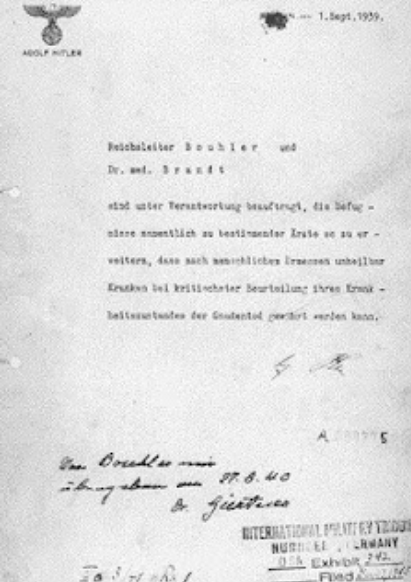
The National Socialist's "Euthanasia" program would set the stage for the Holocaust: the mass murder of Jews and others who were deemed either racially inferior or ideologically unsuitable. In the words of Dr. Leo Alexander, Chief U.S. Medical Consultant at the Nuremberg War Crimes Trials: 'Whatever proportions these crimes finally assumed, it became evident to all who investigated them that they had started from small beginnings."
Dr. Alexander referred to "a subtle shift in emphasis in the basic attitude of physicians." These physicians came to accept the notion that there is such a thing as a life not worthy to be lived. We are witnessing what appears to be a similar "subtle shift in emphasis" with regard to human life in the United States and other Western nations.
In its Declaration on Euthanasia issued on May 5, 1980, the Sacred Congregation for the Doctrine of the Faith had this to say:
"Human life is the basis of all goods, and is the necessary source and condition of every human activity and of all society. Most people regard life as something sacred and hold that no one may dispose of it at will, but believers see in life something greater, namely, a gift of God's love, which they are called upon to preserve and make fruitful. And it is this latter consideration that gives rise to the following consequences:
1. No one can make an attempt on the life of an innocent person without opposing God's love for that person, without violating a fundamental right, and therefore without committing a crime of the utmost gravity.
2. Everyone has the duty to lead his or her life in accordance with God's plan. That life is entrusted to the individual as a good that must bear fruit already here on earth, but that finds its full perfection only in eternal life.
3. Intentionally causing one's own death, or suicide, is therefore equally as wrong as murder; such an action on the part of a person is to be considered as a rejection of God's sovereignty and loving plan. Furthermore, suicide is also often a refusal of love for self, the denial of a natural instinct to live, a flight from the duties of justice and charity owed to one's neighbor, to various communities or to the whole of society - although, as is generally recognized, at times there are psychological factors present that can diminish responsibility or even completely remove it. However, one must clearly distinguish suicide from that sacrifice of one's life whereby for a higher cause, such as God's glory, the salvation of souls or the service of one's brethren, a person offers his or her own life or puts it in danger (cf. Jn. 15:14).
II.
EUTHANASIA
In order that the question of euthanasia can be properly dealt with, it is first necessary to define the words used. Etymologically speaking, in ancient times Euthanasia meant an easy death without severe suffering. Today one no longer thinks of this original meaning of the word, but rather of some intervention of medicine whereby the suffering of sickness or of the final agony are reduced, sometimes also with the danger of suppressing life prematurely. Ultimately, the word Euthanasia is used in a more particular sense to mean 'mercy killing,' for the purpose of putting an end to extreme suffering, or having abnormal babies, the mentally ill or the incurably sick from the prolongation, perhaps for many years of a miserable life, which could impose too heavy a burden on their families or on society.
It is, therefore, necessary to state clearly in what sense the word is used in the present document. By euthanasia is understood an action or an omission which of itself or by intention causes death, in order that all suffering may in this way be eliminated. Euthanasia's terms of reference, therefore, are to be found in the intention of the will and in the methods used. It is necessary to state firmly once more that nothing and no one can in any way permit the killing of an innocent human being, whether a fetus or an embryo, an infant or an adult, an old person, or one suffering from an incurable disease, or a person who is dying. Furthermore, no one is permitted to ask for this act of killing, either for himself or herself or for another person entrusted to his or her care, nor can he or she consent to it, either explicitly or implicitly. nor can any authority legitimately recommend or permit such an action. For it is a question of the violation of the divine law, an offense against the dignity of the human person, a crime against life, and an attack on humanity.
It may happen that, by reason of prolonged and barely tolerable pain, for deeply personal or other reasons, people may be led to believe that they can legitimately ask for death or obtain it for others. Although in these cases the guilt of the individual may be reduced or completely absent, nevertheless the error of judgment into which the conscience falls, perhaps in good faith, does not change the nature of this act of killing, which will always be in itself something to be rejected. The pleas of gravely ill people who sometimes ask for death are not to be understood as implying a true desire for euthanasia; in fact, it is almost always a case of an anguished plea for help and love. What a sick person needs, besides medical care, is love, the human and supernatural warmth with which the sick person can and ought to be surrounded by all those close to him or her, parents and children, doctors and nurses."
A sick person needs love, human and supernatural warmth. They do not need to be treated as a burden and discarded as useless. At a time when the value of human life is being thrown into question by the medical community itself, it is all the more necessary for Christians to stand up for and witness to the dignity of human life from the moment of conception to the final stages of a natural death.
Let us pray:
"O Mary, bright dawn of the new world,
Mother of the living, to you do we entrust the cause of life
Look down, O Mother, upon the vast numbers of babies not allowed to be born, of the poor whose lives are made difficult, of men and women who are victims of brutal violence, of the elderly and the sick killed by indifference or out of misguided mercy.
Grant that all who believe in your Son may proclaim the Gospel of life with honesty and love to the people of our time.
Obtain for them the grace to accept that Gospel as a gift ever new, the joy of celebrating it with gratitude throughout their lives and the courage to bear witness to it resolutely, in order to build, together with all people of good will, the civilization of truth and love, to the praise and glory of God, the Creator and lover of life." (Pope John Paul II, Evangelium Vitae).
The National Socialist's "Euthanasia" program would set the stage for the Holocaust: the mass murder of Jews and others who were deemed either racially inferior or ideologically unsuitable. In the words of Dr. Leo Alexander, Chief U.S. Medical Consultant at the Nuremberg War Crimes Trials: 'Whatever proportions these crimes finally assumed, it became evident to all who investigated them that they had started from small beginnings."
Dr. Alexander referred to "a subtle shift in emphasis in the basic attitude of physicians." These physicians came to accept the notion that there is such a thing as a life not worthy to be lived. We are witnessing what appears to be a similar "subtle shift in emphasis" with regard to human life in the United States and other Western nations.
In its Declaration on Euthanasia issued on May 5, 1980, the Sacred Congregation for the Doctrine of the Faith had this to say:
"Human life is the basis of all goods, and is the necessary source and condition of every human activity and of all society. Most people regard life as something sacred and hold that no one may dispose of it at will, but believers see in life something greater, namely, a gift of God's love, which they are called upon to preserve and make fruitful. And it is this latter consideration that gives rise to the following consequences:
1. No one can make an attempt on the life of an innocent person without opposing God's love for that person, without violating a fundamental right, and therefore without committing a crime of the utmost gravity.
2. Everyone has the duty to lead his or her life in accordance with God's plan. That life is entrusted to the individual as a good that must bear fruit already here on earth, but that finds its full perfection only in eternal life.
3. Intentionally causing one's own death, or suicide, is therefore equally as wrong as murder; such an action on the part of a person is to be considered as a rejection of God's sovereignty and loving plan. Furthermore, suicide is also often a refusal of love for self, the denial of a natural instinct to live, a flight from the duties of justice and charity owed to one's neighbor, to various communities or to the whole of society - although, as is generally recognized, at times there are psychological factors present that can diminish responsibility or even completely remove it. However, one must clearly distinguish suicide from that sacrifice of one's life whereby for a higher cause, such as God's glory, the salvation of souls or the service of one's brethren, a person offers his or her own life or puts it in danger (cf. Jn. 15:14).
II.
EUTHANASIA
In order that the question of euthanasia can be properly dealt with, it is first necessary to define the words used. Etymologically speaking, in ancient times Euthanasia meant an easy death without severe suffering. Today one no longer thinks of this original meaning of the word, but rather of some intervention of medicine whereby the suffering of sickness or of the final agony are reduced, sometimes also with the danger of suppressing life prematurely. Ultimately, the word Euthanasia is used in a more particular sense to mean 'mercy killing,' for the purpose of putting an end to extreme suffering, or having abnormal babies, the mentally ill or the incurably sick from the prolongation, perhaps for many years of a miserable life, which could impose too heavy a burden on their families or on society.
It is, therefore, necessary to state clearly in what sense the word is used in the present document. By euthanasia is understood an action or an omission which of itself or by intention causes death, in order that all suffering may in this way be eliminated. Euthanasia's terms of reference, therefore, are to be found in the intention of the will and in the methods used. It is necessary to state firmly once more that nothing and no one can in any way permit the killing of an innocent human being, whether a fetus or an embryo, an infant or an adult, an old person, or one suffering from an incurable disease, or a person who is dying. Furthermore, no one is permitted to ask for this act of killing, either for himself or herself or for another person entrusted to his or her care, nor can he or she consent to it, either explicitly or implicitly. nor can any authority legitimately recommend or permit such an action. For it is a question of the violation of the divine law, an offense against the dignity of the human person, a crime against life, and an attack on humanity.
It may happen that, by reason of prolonged and barely tolerable pain, for deeply personal or other reasons, people may be led to believe that they can legitimately ask for death or obtain it for others. Although in these cases the guilt of the individual may be reduced or completely absent, nevertheless the error of judgment into which the conscience falls, perhaps in good faith, does not change the nature of this act of killing, which will always be in itself something to be rejected. The pleas of gravely ill people who sometimes ask for death are not to be understood as implying a true desire for euthanasia; in fact, it is almost always a case of an anguished plea for help and love. What a sick person needs, besides medical care, is love, the human and supernatural warmth with which the sick person can and ought to be surrounded by all those close to him or her, parents and children, doctors and nurses."
A sick person needs love, human and supernatural warmth. They do not need to be treated as a burden and discarded as useless. At a time when the value of human life is being thrown into question by the medical community itself, it is all the more necessary for Christians to stand up for and witness to the dignity of human life from the moment of conception to the final stages of a natural death.
Let us pray:
"O Mary, bright dawn of the new world,
Mother of the living, to you do we entrust the cause of life
Look down, O Mother, upon the vast numbers of babies not allowed to be born, of the poor whose lives are made difficult, of men and women who are victims of brutal violence, of the elderly and the sick killed by indifference or out of misguided mercy.
Grant that all who believe in your Son may proclaim the Gospel of life with honesty and love to the people of our time.
Obtain for them the grace to accept that Gospel as a gift ever new, the joy of celebrating it with gratitude throughout their lives and the courage to bear witness to it resolutely, in order to build, together with all people of good will, the civilization of truth and love, to the praise and glory of God, the Creator and lover of life." (Pope John Paul II, Evangelium Vitae).
Friday, April 08, 2016
Pope Francis has forgotten that conscience has a right to respect and obedience in the measure in which the person himself respects it and gives it the care which its dignity deserves
Even now the Man of Sin readies to reveal himself. Various signs are emerging. There is a growing diabolical disorientation. Life Site reports:
"The most controversial moment of Pope Francis’ new apostolic exhortation – Amoris Laetitia (The Joy of Love) – might be confined to a humble footnote, but the implication is clear: the pope has opened the door to Cardinal Walter Kasper’s proposal that in some circumstances divorced and remarried Catholics could be readmitted to the sacraments, including the Eucharist.
In so doing the pope appears to have taken up a position contrary to that of his predecessors, most notably Pope Saint John Paul II, who had flatly rejected the idea of admitting the divorced and remarried to Communion in his apostolic exhortation Familiaris Consortio. Pope Benedict XVI, during his time as prefect of the Congregation for the Doctrine of the Faith, had also addressed the controversy, coming down definitively against liberalizing the Church’s practice.
It isn’t until Chapter 8 of Pope Francis’ historically lengthy apostolic exhortation that he deals directly with the question that has embroiled the Church in debate for the past two years - ever since Cardinal Kasper, at Pope Francis’ personal invitation, outlined his controversial proposal in a keynote address to a consistory of Cardinals at the Vatican.
The text of the final document (or relatio) of last year’s Synod on the Family had caused concern among some synod fathers by referencing the idea of the “internal forum” in relation to the debate over the divorced and remarried. This idea has been used by some theologians to argue that a penitent who persists in an objectively sinful state could discern, in private discussion with his confessor, that his subjective culpability is limited, and he could therefore return to the sacraments.
In the exhortation released today, Pope Francis has adopted and expanded that reasoning.
Though the entire thrust of Chapter 8 is making the case for a deeper “integration” of those in “irregular unions” into the life of the Church, in the main body of the text the pope leaves the meaning of the phrase more or less ambiguous. However, he provides a clear answer at the end of a footnote to paragraph 305, where he states that this “integration” can, “in certain cases,” involve admittance to the sacraments, including the Eucharist. He does not explicitly elucidate what those "certain cases" might be, though broad principles for discernment are given elsewhere in the text.
In paragraph 305, the pope warns that “a pastor cannot feel that it is enough simply to apply moral laws to those living in ‘irregular’ situations, as if they were stones to throw at people’s lives.” Quoting a well-known section of his own speech at the conclusion of the Synod on the Family last October, Francis says that such a pastor would be “sitting on the chair of Moses and judging at times with superiority and superficiality difficult cases and wounded families.”
He adds:
Because of forms of conditioning and mitigating factors, it is possible that in an objective situation of sin – which may not be subjectively culpable, or fully such – a person can be living in God’s grace, can love and can also grow in the life of grace and charity, while receiving the Church’s help to this end.
At the end of that sentence, he includes a footnote (351), which clarifies: “In certain cases, this can include the help of the sacraments,” and then refers to both Confession and the Eucharist. He writes: “I would also point out that the Eucharist ‘is not a prize for the perfect, but a powerful medicine and nourishment for the weak.’”
Speaking of the problem of integrating people in irregular unions, the pope says it would be impossible to establish “general rules,” such as through canon law. Rather, he encourages individuals to discern their individual circumstances in the “internal forum” - i.e. in private consultation with their priest - and following guidelines established by the bishop.
He writes: “What is possible is simply a renewed encouragement to undertake a responsible personal and pastoral discernment of particular cases, one which would recognize that, since ‘the degree of responsibility is not equal in all cases’, the consequences or effects of a rule need not necessarily always be the same.”
This applies even to “sacramental discipline,” he writes in a footnote to that text, because “discernment can recognize that in a particular situation no grave fault exists.”
Quoting the Synod on the Family’s final text, he says the discernment “can never prescind from the Gospel demands of truth and charity, as proposed by the Church.” Still quoting the Synod text, he says the discernment must involve several conditions: “humility, discretion and love for the Church and her teaching, in a sincere search for God’s will and a desire to make a more perfect response to it.”
He then writes: “These attitudes are essential for avoiding the grave danger of misunderstandings, such as the notion that any priest can quickly grant ‘exceptions’, or that some people can obtain sacramental privileges in exchange for favours.”
The pope bases his argument on a radical interpretation of the role of conscience - which he suggests could, in some cases, actually reveal to a person that God may in fact be “asking” them to continue in a situation that does not achieve the “objective ideal” of the Gospel.
The pope writes that “individual conscience needs to be incorporated into the Church’s praxis in certain situations which do not objectively embody our understanding of marriage.” He continues:
Naturally, every effort should be made to encourage the development of an enlightened conscience, formed and guided by the responsible and serious discernment of one’s pastor, and to encourage an ever greater trust in God’s grace. Yet conscience can do more than recognize that a given situation does not correspond objectively to the overall demands of the Gospel. It can also recognize with sincerity and honesty what for now is the most generous response which can be given to God, and come to see with a certain moral security that it is what God himself is asking amid the concrete complexity of one’s limits, while yet not fully the objective ideal.*
Perhaps the most surprising aspect of the exhortation’s treatment of irregular unions is the pope’s apparent dismissal of the idea that couples in such unions who find themselves unable to separate for legitimate reason should be required or even encouraged to live together as “brother and sister” - i.e. to forego engaging in sexual relations.
Pope John Paul II had, in Familiaris Consortio, proposed sexual continence as the only moral solution for couples who, repenting of their irregular union, find that “for serious reasons” - such as the need to raise their children - they “cannot satisfy the obligation to separate.” In such cases, wrote John Paul II, the couple must "take on themselves the duty to live in complete continence, that is, by abstinence from the acts proper to married couples."
Pope Francis, however, while citing this sentence of Familiaris Consortio to show that the Church does acknowledge cases where separation may be impossible, leaves out the latter half of the sentence, which references the obligation to continence. In a footnote, Pope Francis then casts into doubt the wisdom of living in continence for such couples, suggesting that doing so could harm the couple’s relationship and children.
“In such situations, many people, knowing and accepting the possibility of living ‘as brothers and sisters’ which the Church offers them, point out that if certain expressions of intimacy are lacking, ‘it often happens that faithfulness is endangered and the good of the children suffers.’” This footnote in turn cites the Second Vatican Council’s document, Gaudium et Spes - in particular a section that acknowledges the strain married couples face during periods of abstinence in the practice of natural family planning. However, Pope Francis’ usage of the quote applies it to those in irregular unions.
Pope Francis acknowledges that the pastoral approach he has outlined may be viewed by some as causing confusion, but suggests that this is a risk he is willing to take. "I understand those who prefer a more rigorous pastoral care which leaves no room for confusion," he writes. "But I sincerely believe that Jesus wants a Church attentive to the goodness which the Holy Spirit sows in the midst of human weakness, a Mother who, while clearly expressing her objective teaching, 'always does what good she can, even if in the process, her shoes get soiled by the mud of the street'.”
The pope’s decision today follows decades of pressure on the issue from progressives in the aftermath of Vatican II. In particular, it was a major point of discussion at the Synod on the Family that Pope John Paul II convened in 1980. It was in his exhortation following that Synod, Familiaris Consortio, that he firmly shut the door on the question, citing Scripture and the Church’s doctrine. His short paragraph on the issue still offers the most cogent and concise explanation for why the proposal is impossible. He wrote:
However, the Church reaffirms her practice, which is based upon Sacred Scripture, of not admitting to Eucharistic Communion divorced persons who have remarried. They are unable to be admitted thereto from the fact that their state and condition of life objectively contradict that union of love between Christ and the Church which is signified and effected by the Eucharist. Besides this, there is another special pastoral reason: if these people were admitted to the Eucharist, the faithful would be led into error and confusion regarding the Church's teaching about the indissolubility of marriage."
See here.
* There is a famous hymn written by Martin Luther which begins, "A mighty fortress is our God, a bulwark never failing.." For all too many people today (including sadly, many Catholics and Francis himself) the conscience has become a "mighty fortress" built so as to shelter one from the exacting demands of truth. In the words of Joseph Cardinal Ratzinger, "In the Psalms we meet from time to time the prayer that God should free man from his hidden sins. The Psalmist sees as his greatest danger the fact that he no longer recognizes them as sins and thus falls into them in apparently good conscience. Not being able to have a guilty conscience is a sickness...And thus one cannot aprove the maxim that everyone may always do what his conscience allows him to do: In that case the person without a conscience would be permitted to do anything. In truth it is his fault that his conscience is so broken that he no longer sees what he as a man should see. In other words, included in the concept of conscience is an obligation, namely, the obligation to care for it, to form it and educate it. Conscience has a right to respect and obedience in the measure in which the person himself respects it and gives it the care which its dignity deserves. The right of conscience is the obligation of the formation of conscience. Just as we try to develop our use of language and we try to rule our use of rules, so must we also seek the true measure of conscience so that finally the inner word of conscience can arrive at its validity.
For us this means that the Church's magisterium bears the responsibility for correct formation. It makes an appeal, one can say, to the inner vibrations its word causes in the process of the maturing of conscience. It is thus an oversimplification to put a statement of the magisterium in opposition to conscience. In such a case I must ask myself much more. What is it in me that contradicts this word of the magisterium? Is it perhaps only my comfort? My obstinacy? Or is it an estrangement through some way of life that allows me something which the magisterium forbids and that appears to me to be better motivated or more suitable simply because society considers it reasonable? It is only in the context of this kind of struggle that the conscience can be trained, and the magisterium has the right to expect that the conscience will be open to it in a manner befitting the seriousness of the matter. If I believe that the Church has its origins in the Lord, then the teaching office in the Church has a right to expect that it, as it authentically develops, will be accepted as a priority factor in the formation of conscience." (Joseph Cardinal Ratzinger, Keynote Address of the Fourth Bishops' Workshop of the National Catholic Bioethics Center, on "Moral Theology Today: Certitudes and Doubts," February 1984).
In the same address, Cardinal Ratzinger explains that, "Conscience is understood by many as a sort of deification of subjectivity, a rock of bronze on which even the magisterium is shattered....Conscience appears finally as subjectivity raised to the ultimate standard."
A broken conscience, an ill-formed conscience, becomes a mighty fortress which shuts the truth out. Have we built an interior castle, as did St. Teresa of Avila, which remains open to the demands of truth and the promptings of the Holy Spirit? Or has our conscience become a mighty fortress built to prevent our encounter with truth?
Francis is preparing the way for the Beast. Where the Holy Spirit brings clarity and peace, the False Prophet brings confusion, disorientation and discord.
Make no mistake about it, Francis is proposing (and imposing) a radical interpretation of the role of conscience which directly contradicts the perennial Magisterial teaching of Holy Mother Church.
Soon, the Man of Sin will reveal himself openly. As we approach the 100th anniversary of Our Lady of Fatima's apparitions (where the Queen of Heaven gave us the weapons for fighting against the Devil and his followers), the False Prophet - in a cruel and sick parody of the Baptist - prepares the way for the Man-god.
Pray. Prepare the catacombs. The New Church foretold by Venerable Emmerich, behold, is upon us. Sin and evil will increasingly be justified and openly celebrated.
Suggested reading: Catechism of the Catholic Church Nos. 1783-1785.
Photo courtesy of TradCatKnight
Related reading here.
Labels:
Antichrist,
Care,
Conscience,
Dark Church,
Dignity,
False Prophet,
Forgotten,
Francis,
Gives,
Himself,
It,
Measure,
Obedience,
Person,
Pope,
Pope Benedict XVI,
Respect,
Right
Sunday, February 08, 2015
You have a vocation from God: No more excuses
"It is Jesus who stirs in you the desire to do something great with your lives, the will to follow an ideal, the refusal to allow yourselves to be ground down by mediocrity, the courage to commit yourselves humbly and patiently to improving yourselves and society, making the world more human and more fraternal.” - Pope John Paul II.
In an essay entitled One Solitary Life which was adapted from a sermon by Dr. James Allan Francis, we are reminded about certain aspects of Jesus' life:
Here is a man who was born in an obscure village, the child of a peasant woman. He grew up in another village. He worked in a carpenter shop until He was thirty. Then for three years He was an itinerant preacher.
He never owned a home. He never wrote a book. He never held an office. He never had a family. He never went to college. He never put His foot inside a big city. He never traveled two hundred miles from the place He was born. He never did one of the things that usually accompany greatness. He had no credentials but Himself...
While still a young man, the tide of popular opinion turned against him. His friends ran away. One of them denied Him. He was turned over to His enemies. He went through the mockery of a trial. He was nailed upon a cross between two thieves. While He was dying His executioners gambled for the only piece of property He had on earth – His coat. When He was dead, He was laid in a borrowed grave through the pity of a friend.
Nineteen long centuries have come and gone, and today He is a centerpiece of the human race and leader of the column of progress.
I am far within the mark when I say that all the armies that ever marched, all the navies that were ever built; all the parliaments that ever sat and all the kings that ever reigned, put together, have not affected the life of man upon this earth as powerfully as has that one solitary life.
Omnia possum in eo qui me confortat. I can do all things in Him who strengthens me. (Phil 4:13). These words are engraved on a bracelet which I wear. Do we really believe this? Or do we let others define who we are?
Issue the battle cry! Let's take back our cities!
Those who walk in the Spirit know no fear. What are we waiting for? The Lord Jesus waits. He grows tired of our excuses:
I’m not holy enough:
Is 6:1-9; Lk 5:1-11
I’m afraid I will fail:
Ex 14:10-31; Lk 15
I’ve made mistakes and I’m a sinner:
Jn 21:15-23; Mt 9:9-13; Lk 7:36-50
I’m too young:
1 Sam 3:1-18; Jer 1:4-10; Lk 1:26-38
I’m not talented enough:
1 Sam 17:32-51; Lk 1:26-38
I want to have a family:
Gn 12:1-3; Mt 12:46-50; Mk 10:28-30
I’m afraid of making a permanent commitment:
Ruth 1:15-17; Mt 28:16-20
I’m afraid of public speaking:
Ex 4:10-17; Jer 1:4-10
I’m not smart enough:
2 Cor 4:7-18; Ex 4:10-17
I’m afraid of being alone:
Ex 3:4-22; Lk 1:28-38
I want to be happy:
Ps 37:4; Mt 5:1-12; Jn 10:10; Mk 10:28-31
I can do all things in Him who strengthens me. There are no obstacles we can't overcome in His holy name. Even while others attempt to label us and dismiss us as useless, as having no worth. I knew a young man with developmental disabilities whose father told him he was "worthless." He was told by his father that the best thing for him would be a bullet in the head. When he asked me one day if he was worthless, I reminded him of his many gifts: his sense of humor, his ability to love others, his ability to pray to God and a litany of other gifts. And I assured him that he is not "worthless."
We live in a sad, broken world. There are many people who are heavily burdened with sin who are hurting. And because they are hurting, they want to hurt others. If you could read some of the comments which have been left at this Blog you would cringe. Sad time. Hurting time. And we pray for such people.
But we cannot let others define who we are. We are children of God who have access to the Holy Spirit's Gifts just by asking for them.
The Son of God loves us. What does that suggest about those who hate us?
In an essay entitled One Solitary Life which was adapted from a sermon by Dr. James Allan Francis, we are reminded about certain aspects of Jesus' life:
Here is a man who was born in an obscure village, the child of a peasant woman. He grew up in another village. He worked in a carpenter shop until He was thirty. Then for three years He was an itinerant preacher.
He never owned a home. He never wrote a book. He never held an office. He never had a family. He never went to college. He never put His foot inside a big city. He never traveled two hundred miles from the place He was born. He never did one of the things that usually accompany greatness. He had no credentials but Himself...
While still a young man, the tide of popular opinion turned against him. His friends ran away. One of them denied Him. He was turned over to His enemies. He went through the mockery of a trial. He was nailed upon a cross between two thieves. While He was dying His executioners gambled for the only piece of property He had on earth – His coat. When He was dead, He was laid in a borrowed grave through the pity of a friend.
Nineteen long centuries have come and gone, and today He is a centerpiece of the human race and leader of the column of progress.
I am far within the mark when I say that all the armies that ever marched, all the navies that were ever built; all the parliaments that ever sat and all the kings that ever reigned, put together, have not affected the life of man upon this earth as powerfully as has that one solitary life.
Omnia possum in eo qui me confortat. I can do all things in Him who strengthens me. (Phil 4:13). These words are engraved on a bracelet which I wear. Do we really believe this? Or do we let others define who we are?
Issue the battle cry! Let's take back our cities!
Those who walk in the Spirit know no fear. What are we waiting for? The Lord Jesus waits. He grows tired of our excuses:
I’m not holy enough:
Is 6:1-9; Lk 5:1-11
I’m afraid I will fail:
Ex 14:10-31; Lk 15
I’ve made mistakes and I’m a sinner:
Jn 21:15-23; Mt 9:9-13; Lk 7:36-50
I’m too young:
1 Sam 3:1-18; Jer 1:4-10; Lk 1:26-38
I’m not talented enough:
1 Sam 17:32-51; Lk 1:26-38
I want to have a family:
Gn 12:1-3; Mt 12:46-50; Mk 10:28-30
I’m afraid of making a permanent commitment:
Ruth 1:15-17; Mt 28:16-20
I’m afraid of public speaking:
Ex 4:10-17; Jer 1:4-10
I’m not smart enough:
2 Cor 4:7-18; Ex 4:10-17
I’m afraid of being alone:
Ex 3:4-22; Lk 1:28-38
I want to be happy:
Ps 37:4; Mt 5:1-12; Jn 10:10; Mk 10:28-31
I can do all things in Him who strengthens me. There are no obstacles we can't overcome in His holy name. Even while others attempt to label us and dismiss us as useless, as having no worth. I knew a young man with developmental disabilities whose father told him he was "worthless." He was told by his father that the best thing for him would be a bullet in the head. When he asked me one day if he was worthless, I reminded him of his many gifts: his sense of humor, his ability to love others, his ability to pray to God and a litany of other gifts. And I assured him that he is not "worthless."
We live in a sad, broken world. There are many people who are heavily burdened with sin who are hurting. And because they are hurting, they want to hurt others. If you could read some of the comments which have been left at this Blog you would cringe. Sad time. Hurting time. And we pray for such people.
But we cannot let others define who we are. We are children of God who have access to the Holy Spirit's Gifts just by asking for them.
The Son of God loves us. What does that suggest about those who hate us?
Labels:
Dignity,
Excuses,
Fear,
Has,
Jesus,
Mission,
Philippians 4,
Pope John Paul II,
Trust,
Verse 13,
Vocation,
Worth,
You
Monday, January 28, 2013
A new form of atheism....have we succumbed to it?
"I had a little tea party this afternoon at three.
Twas very small - three guests in all - just I, myself and me.
Myself ate all the sandwiches, while I drank all the tea.
Twas also I who ate the pie, and passed the cake to me."
- Author unknown.
In his January 19th audience with workers and leaders of Catholic charities and members of the Pontifical Council Cor Unum, Pope Benedict XVI warned that while there is "a growing consensus today about the inalienable dignity of the human being" and people's interdependence and responsibilities toward others, there are also many "dark spots" that are obscuring God's plan.
The Holy Father warned of a new form of atheism which views people as independent and autonomous with happiness lying solely in realizing one's own self. Here the Pope is referring to those who are crippled by the sin of selfishness, a sin as old as humanity which has taken deep root in the heart of "modern man." As Archbishop Fulton John Sheen reminded us, "Selfishness does not mean that there is not to be a proper love of self. Our Blessed Lord told us: 'Love thy neighbor as thyself' (Mt 19: 19). God made 'self' the standard by which the neighbor is to be loved. This could not be, if love of self did not have a legitimate basis. Selfishness, is the love of the wrong self; that is, the self that is indifferent to the feeling and the interest and the safety of others. People are not selfish because they wish to earn enough to raise a family, but they are selfish if they consult only their own gains regardless of the losses that they may bring on others." (Essay entitled Selfishness).
The Lord Jesus has put us here on earth to serve Him and not ourselves. Many today, and sadly even within the Church, have succumbed to a philosophy of self-indulgence which is often indicative of pride and may even represent a failure to trust in the Lord, a practical atheism which renders others invisible and irrelevant.
Damien Fisher, writing for The Gardner News, relates the story of Vietnam veteran Jesse Stallings, a soldier who became invisible and irrelevant to those around him who should have welcomed him. Mr. Fisher writes, "Jesse Stallings served in Vietnam, and then came home to a difficult life. His trouble coming back and becoming part of society again was partly because of the negative attitudes many had about the Vietnam War, and by extension, the men who fought it. Mr. Stallings' troubles also stemmed from post-traumatic stress disorder, a condition not widely understood at the time, and not well-treated either...Mr. Stallings was proud to put on his uniform to march in the parade in Fitchburg, one of the first in the region to welcome Vietnam vets....But his long hair and beard did not mesh with how the other, older veterans wanted him to look. He was sent away. Dejected after leaving the parade ground, Mr. Stallings went home and killed himself." (MVOC opens new Winchendon campus, January 26-27 edition of The Gardner News).
Have we become so self-indulgent that others have practically become invisible to us? We can answer this question only through honest self-examination. Hence the need for frequent sacramental confession. Self-deception is so very easy. As Saint Francis de Sales noted, "Self-love is cunning; it pushes and insinuates itself into everything, while making us believe it is not there at all."
If we wish to deepen our relationship with the Lord Jesus and to be of genuine service to Him, then we must struggle against self-deception and be completely honest with ourselves, petitioning the Lord to reveal to us our hidden motives and attachments. And then we must, with the help of His grace (without which nothing is possible), reorder our priorities.
Related meditation here.
Labels:
Archbishop Fulton John Sheen,
Atheism,
Dignity,
Form,
Human Being,
Inalienable,
Invisible,
Irrelevant,
Jesse Stallings,
New,
Others,
Pope Benedict XVI,
Realizing,
Self,
Selfishness,
The Gardner News
Tuesday, January 22, 2013
Bishop McManus calls for prayer and fasting to instill spiritual stamina and fortitude
In an editorial published in this week's Catholic Free Press and entitled 'Proclaim the Gospel of Life," Bishop Robert J. McManus, Bishop of the Worcester [Massachusetts] Diocese, reflecting on the 40th anniversary of the infamous Roe v. Wade decision, writes, "As we reflect on this unspeakable tragedy, we recall that Jesus told us that certain evils are only overcome by prayer and fasting. Currently we are assailed by many increasing threats in our culture, most especially in the ongoing assaults on life, marriage and religious liberty. In light of these unprecedented attacks on these most fundamental pillars of society, the U.S. Bishops recently launched a special initiative that will continue throughout the Year of Faith. This Call to Prayer for Life, Marriage, and Religious Liberty is something that all of us can participate in both personally and communally....I wish to personally invite everyone to take this opportunity to increase our spiritual stamina and fortitude by joining with our fellow Catholics across the country through participation in the monthly holy hours that will be offered in our parishes, saying the rosary regularly, fasting and abstaining from meat on Fridays, and other devotions and events that will take place in the diocese..."
It's real nice that Bishop McManus is finally beginning to wake up to the realities of our times by recognizing that only through prayer and fasting will certain evils be driven out since there is an element of the demonic behind them. But before Catholics can convert the culture, they must first convert themselves. About a month back I wrote Bishop McManus about his promotion of Servite Sister Joyce Rupp, a confused religious who promotes New Age spirituality and dissent from the authoritative teachings of the Magisterium. Specifically, I asked His Excellency if he felt that it was truly appropriate for the Chancery to be offering her books for sale given her peculiar beliefs [such as the "godess" Sophia] and her angry, hate-filled attacks on the Church's hierarchy [see my previous posts on Joyce Rupp]. His response? There was none. So much for increasing spiritual stamina and fortitude. Or perhaps His Excellency believes that it is only the laity who are in need of metanoia?
If the Bishop has no time for a Christian believer who accepts, promotes and defends the Magisterial teaching of the Church and cares little for the right of the faithful to receive Catholic teaching in its purity and integrity [Veritatis Splendor, No. 113], then it is a safe bet that his own prayer life is suffering. It was Pope John Paul II who wrote that, "A bishop should try to ensure that as many as possible of those who, together with him, make up the local Church can come to know him personally. He for his part will seek to be close to them, to know about their lives - what gives joy to their hearts and what saddens them. Such mutual acquaintance cannot be built through occasional meetings: it comes from a genuine interest in what is happening in their lives regardless of age, social status, or nationality, whether they are close at hand or far away....It is very important for a bishop to have a rapport with his people and to know how to relate to them well...Interest in others begins with the bishop's prayer life: his conversations with Christ, who entrusts 'His own' to him. Prayer prepares him for encounter with others." (Rise, Let Us Be On Our Way).
If a bishop cannot even maintain a rapport with faithful Catholics in his own diocese, then it is difficult to take him seriously when he writes, "Let us unite our hearts and minds through special acts of prayer, fasting, and sacrifice....to uphold the inherent dignity of all human life from conception to natural death."
Where was the bishop's recognition of my "inherent dignity" when I wrote him a letter detailing how one of his priests was encouraging a couple in their senior years to live together while assuring them that any sexual acts outside of marriage were not sinful at their age and mentioned my interest in pursuing a priestly vocation within the diocese? Readers of this Blog know that this letter of mine also received no response. And I had requested the Bishop's blessing each time I wrote him! Dignity?
Long before Bishop McManus' call for prayer and fasting, I issued a similar call. In fact, over the years, I have issued this call. See here and here for example. But along with prayer and fasting, we Catholics - all of us - must first take the plank out of our own eyes if we are to see clearly enough to take the speck out of the eyes of our fellow citizens throughout the broader culture. And this goes for our priests and deacons and religious as well. More so, for they should be shining examples of the faith life. Needless to say, this sort of behavior will never convert our broken, sin-sick culture.
As Father Vincent Miceli, S.J., reminded us some years back, "Rampant immorality is [an] obstacle opposing the work of evangelization. Since conduct follows from convictions, once Catholics cancel their creed from their lives, their conduct inevitably becomes depraved....The decay on all sides of Christian morals makes it not only difficult to bring in those outside the Church, but even to stay in themselves and hold their fellow Catholics within the Church." (Essay entitled The Evangelization of the United States).
It is a spiritual maxim that we cannot give to others what we ourselves do not possess. The Bishop of Worcester, and the priests who serve with him, should reflect very carefully on this truth.
Sunday, November 13, 2011
"Value comes not from what a person 'has'...as much as from what a person 'is'"
In his Post-Synodal Apostolic Exhortation Christifideles Laici, No. 37, Pope John Paul II reminded us that, "To rediscover and make others rediscover the inviolable dignity of every human person makes up an essential task, in a certain sense, the central and unifying task of the service which the Church, and the lay faithful in her, are called to render to the human family. Among all other earthly beings, only a man or a woman is a 'person', a conscious and free being and, precisely for this reason, the 'center and summit' of all that exists on the earth.
The dignity of the person is the most precious possession of an individual. As a result, the value of one person transcends all the material world. The words of Jesus, 'For what does it profit a man, to gain the whole world and to forfeit his life?' (Mk 8:36) contain an enlightening and stirring statement about the individual: value comes not from what a person 'has' even if the person possessed the whole world!-as much as from what a person 'is': the goods of the world do not count as much as the good of the person, the good which is the person individually.
The dignity of the person is manifested in all its radiance when the person's origin and destiny are considered: created by God in his image and likeness as well as redeemed by the most precious blood of Christ, the person is called to be a 'child in the Son' and a living temple of the Spirit, destined for the eternal life of blessed communion with God. For this reason every violation of the personal dignity of the human being cries out in vengeance to God and is an offence against the Creator of the individual.
In virtue of a personal dignity the human being is always a value as an individual, and as such demands being considered and treated as a person and never, on the contrary, considered and treated as an object to be used, or as a means, or as a thing.
The dignity of the person constitutes the foundation of the equality of all people among themselves. As a result all forms of discrimination are totally unacceptable, especially those forms which unfortunately continue to divide and degrade the human family, from those based on race or economics to those social and cultural, from political to geographic, etc. Each discrimination constitutes an absolutely intolerable injustice, not so much for the tensions and the conflicts that can be generated in the social sphere, as much as for the dishonour inflicted on the dignity of the person: not only to the dignity of the individual who is the victim of the injustice, but still more to the one who commits the injustice."
Vatican II, in its Decree on the Apostolate of the Laity (Apostolicam Actuositatem), has this to say: "The laity derive the right and duty to the apostolate from their union with Christ the head; incorporated into Christ's Mystical Body through Baptism and strengthened by the power of the Holy Spirit through Confirmation, they are assigned to the apostolate by the Lord himself." (No. 3). And in No. 4, this same document explains that, "This plan for the spiritual life of the laity should take its particular character from their married or family state or their single or widowed state.."
What is the point I'm trying to make? That single people, like those whose vocation is to marriage, are also called to the apostolate. But one wouldn't know this when one examines the way in which single people are often treated in the Church. Father Pat Umberger has noted that, "Being single. For some of us it is the way we live our Vocation. For others it is a temporary state. For some it brings much joy. For others sadness and a feeling of incompleteness. Not all single folks are called to a Vocation of priesthood or consecrated life. Single people come in all age ranges, from the 20's through old age. Single people have needs and goals. We don't always fit into the society we live in. Sometimes there is a perception that we cannot be happy or fulfilled while we are single. We can buy into that perception. The Church can be quite helpful to us. Sometimes it can hinder us as well. It is true that much is said about married life, children, teenagers and other groups within the Church, but not much about single people. The Church can unconsciously discriminate against single people by sponsoring mostly "couples only" events, inviting "families" to bring up the gifts, or seeing singles as the pool from which to draw helpers to complete tasks nobody else wants to do."
I have personally experienced this through the years. Only recently I joined another parish, immediately registered, and noted both on the registration form and to the parish secretary, that I would like to volunteer at the parish. I never did hear from anyone. This is not the first time I have experienced such animus. Single people are often viewed as being somehow "inadequate," even within the Church. We are often seen as being somehow peculiar because we live celibate lives and concern ourselves primarily with building up the Kingdom of God here on earth. We are often excluded and written off at the parish level as if the Lord Jesus couldn't possibly find any use for us. This attitude is far from Catholic. Pope Benedict XVI said recently that, "The Lord has a plan for each of us; he calls each one of us by name. Our task is to learn how to listen, to perceive his call, to be courageous and faithful in following him and, when all is said and done, to be found trustworthy servants who have used well the gifts given us."
And if we are discouraged from participating in the life of the Church by those entrusted with leadership positions in the Church; if we are discriminated against because we do not measure up to their idea of "value," those who excluded us will have to render an account to the Lord Jesus and to explain why they scattered when they should have been gathering.
Will they be accounted as profitable servants?
The dignity of the person is the most precious possession of an individual. As a result, the value of one person transcends all the material world. The words of Jesus, 'For what does it profit a man, to gain the whole world and to forfeit his life?' (Mk 8:36) contain an enlightening and stirring statement about the individual: value comes not from what a person 'has' even if the person possessed the whole world!-as much as from what a person 'is': the goods of the world do not count as much as the good of the person, the good which is the person individually.
The dignity of the person is manifested in all its radiance when the person's origin and destiny are considered: created by God in his image and likeness as well as redeemed by the most precious blood of Christ, the person is called to be a 'child in the Son' and a living temple of the Spirit, destined for the eternal life of blessed communion with God. For this reason every violation of the personal dignity of the human being cries out in vengeance to God and is an offence against the Creator of the individual.
In virtue of a personal dignity the human being is always a value as an individual, and as such demands being considered and treated as a person and never, on the contrary, considered and treated as an object to be used, or as a means, or as a thing.
The dignity of the person constitutes the foundation of the equality of all people among themselves. As a result all forms of discrimination are totally unacceptable, especially those forms which unfortunately continue to divide and degrade the human family, from those based on race or economics to those social and cultural, from political to geographic, etc. Each discrimination constitutes an absolutely intolerable injustice, not so much for the tensions and the conflicts that can be generated in the social sphere, as much as for the dishonour inflicted on the dignity of the person: not only to the dignity of the individual who is the victim of the injustice, but still more to the one who commits the injustice."
Vatican II, in its Decree on the Apostolate of the Laity (Apostolicam Actuositatem), has this to say: "The laity derive the right and duty to the apostolate from their union with Christ the head; incorporated into Christ's Mystical Body through Baptism and strengthened by the power of the Holy Spirit through Confirmation, they are assigned to the apostolate by the Lord himself." (No. 3). And in No. 4, this same document explains that, "This plan for the spiritual life of the laity should take its particular character from their married or family state or their single or widowed state.."
What is the point I'm trying to make? That single people, like those whose vocation is to marriage, are also called to the apostolate. But one wouldn't know this when one examines the way in which single people are often treated in the Church. Father Pat Umberger has noted that, "Being single. For some of us it is the way we live our Vocation. For others it is a temporary state. For some it brings much joy. For others sadness and a feeling of incompleteness. Not all single folks are called to a Vocation of priesthood or consecrated life. Single people come in all age ranges, from the 20's through old age. Single people have needs and goals. We don't always fit into the society we live in. Sometimes there is a perception that we cannot be happy or fulfilled while we are single. We can buy into that perception. The Church can be quite helpful to us. Sometimes it can hinder us as well. It is true that much is said about married life, children, teenagers and other groups within the Church, but not much about single people. The Church can unconsciously discriminate against single people by sponsoring mostly "couples only" events, inviting "families" to bring up the gifts, or seeing singles as the pool from which to draw helpers to complete tasks nobody else wants to do."
I have personally experienced this through the years. Only recently I joined another parish, immediately registered, and noted both on the registration form and to the parish secretary, that I would like to volunteer at the parish. I never did hear from anyone. This is not the first time I have experienced such animus. Single people are often viewed as being somehow "inadequate," even within the Church. We are often seen as being somehow peculiar because we live celibate lives and concern ourselves primarily with building up the Kingdom of God here on earth. We are often excluded and written off at the parish level as if the Lord Jesus couldn't possibly find any use for us. This attitude is far from Catholic. Pope Benedict XVI said recently that, "The Lord has a plan for each of us; he calls each one of us by name. Our task is to learn how to listen, to perceive his call, to be courageous and faithful in following him and, when all is said and done, to be found trustworthy servants who have used well the gifts given us."
And if we are discouraged from participating in the life of the Church by those entrusted with leadership positions in the Church; if we are discriminated against because we do not measure up to their idea of "value," those who excluded us will have to render an account to the Lord Jesus and to explain why they scattered when they should have been gathering.
Will they be accounted as profitable servants?
Monday, June 21, 2010
"Every sin of a priest is a sin of malice..."
A Boston priest has just been accused of adult sexual misconduct and a Connecticut priest of stealing one million dollars. Saint Alphonsus de Liguori, in his book entitled Dignity and Duties of the Priest, says that, "Every sin of a priest is a sin of malice; it is like the sin of the angels that sinned in view of the light, says St. Bernard, speaking of a priest; hence he adds, 'He has become an angel of the Lord, and sinning as a priest he sins in heaven.' He sins in the midst of light, and therefore his sin, as has been said, is a sin of malice: he cannot allege ignorance, for he knows the great evil of mortal sin: he cannot plead weakness, because he knows the means by which, if he wishes, he can acquire strength; if he is unwilling to adopt the means, the fault is entirely his own...Our Saviour prayed on the cross for his persecutors, saying, Father, forgive them, for they know not what they do. But for bad priests this prayer was a source rather of condemnation than of salvation: for they know what they do.." (Dignity and Duties of the Priest, pp. 71-72).
Isn't it refreshing to hear the truth from this Doctor of the Church? There have been many scandals throughout the Church and just as many cheap attempts to offer poor excuses for misconduct, sexual and otherwise. But Our Lord Himself has said that, "Much more will be required of the person entrusted with much, and still more will be demanded of the person entrusted with more." (Luke 12: 48).
A holy Bishop prophesied long ago that a time would come when scandals would be rife in the Church. Woe to those from whom they come.
Isn't it refreshing to hear the truth from this Doctor of the Church? There have been many scandals throughout the Church and just as many cheap attempts to offer poor excuses for misconduct, sexual and otherwise. But Our Lord Himself has said that, "Much more will be required of the person entrusted with much, and still more will be demanded of the person entrusted with more." (Luke 12: 48).
A holy Bishop prophesied long ago that a time would come when scandals would be rife in the Church. Woe to those from whom they come.
Wednesday, April 21, 2010
How serious is the sin of scandal when committed by a priest?

In recent posts I have examined Father James Scahill's blasphemous assertion that the Holy Catholic Church is "insidiously evil." Just how serious is the sin of scandal when committed by a priest? St. Alphonsus De Liguori, a Doctor of the Church and a moral theologian, explains that, "The Lord ordained in Leviticus that for the sin of a single priest a calf should be offered, as well as for the sins of the entire people. From this Innocent III concludes that the sin of a priest is as grievous as the sins of the whole people. The reason is, says the Pontiff, that by his sin the priest leads the entire people into sin ('Unde conjicitur quod peccatum Sacerdotis totius multitudinis peccato coaequatur, quia Sacerdos in suo peccato totam fecit delinquere multitudinem' - In Consecr. Pont. s. I.) And, long before, the Lord himself said the same: 'If the priest that is anointed shall sin, he maketh the people to offend.' Hence, St. Augustine, addressing priests, says, 'Do not close heaven: but this you do if you give to others a bad example to lead a wicked life.' Our Lord said one day to St. Bridget, that when sinners see the bad example of the priest, they are encouraged to commit sin, and even begin to glory in the vices of which they were before ashamed. Hence our Lord added that worse maledictions shall fall on the priest than on others, because by his sinful life he brings himself and others to perdition.'...says St. John Chrysostom, the life of the priest is the root from which the people, who are the branches, receive nutriment. St. Ambrose also says that priests are the head from which virtue flows to the members, that is, to seculars. The whole head is sick, says the Prophet Isaias;...from the sole of the foot unto the top of the head there is no soundness therein. St. Isidore explains this passage in the following words: 'This languishing head is the priest that commits sin, and that communicates his sin to the whole body.' St. Leo weeps over this evil, saying, 'How can health be found in the body if the head be not sound?' Who, says St. Bernard, shall seek in a sink the limpid water of the spring? Shall I, adds the saint, seek counsel from the man that knows not how to give counsel to himself? Speaking of the bad example of princes, Plutarch says, that it poisons not a single cup, but the public fountain; and thus, because all draw from the fountain, all are poisoned. This may be said with greater truth of the bad example of priests; hence Eugene III has said that bad Superiors are the principal causes of the sins of inferiors...St. Bernardine of Sienna writes that many, seeing the bad example of the scandalous ecclesiastic, begin even to waver in faith, and thus abandon themselves to vice, despising the sacraments, hell, and heaven." (St. Alphonsus De Liguori, Dignity and Duties of the Priest, pp. 142-144, 149).
Canon 1364 of the Code of Canon Law: "...an apostate from the faith, a heretic or a schismatic incurs automatic (latae sententiae) excommunication and if a cleric, he can also be punished by the penalties mentioned in can. 1336.."
Subscribe to:
Posts (Atom)